Disclosure: As an Amazon Associate, I earn from qualifying purchases. If you buy through links in this article, I may earn a commission at no extra cost to you.
Our top pick: Dr.Meter LX1330B. Runner-up: UNI-T UT383.
A lux meter turns guesswork about brightness into a number you can act on. That matters more in a workshop than most people expect. Bench lighting that feels fine at noon can leave you squinting over fine assembly work by evening, a paint corner can hide colour mismatches under weak light, and a desk setup built for long screen sessions can strain your eyes if the task light and the room light are badly mismatched. A handheld meter lets you walk the room, hold the sensor where the work actually happens, and record the illuminance in lux or foot-candles before you move a lamp, swap a bulb or add a fixture.
The five meters below cover the main designs on the market: a classic split-sensor bench unit, a compact pocket meter, two rotating-sensor models with very different ranges, and a meter built specifically around white LED sources. Each one is a distinct model with its own sensor layout and feature set, so the right choice depends on where you measure, how bright your brightest source is, and whether you need to log readings or just take quick spot checks.
Top 3 picks at a glance

How to Choose a Lux Meter
Start with the measuring range. Indoor task areas usually sit between a few hundred and a few thousand lux, while a bench near a window or a high-bay workshop fixture can run far higher. A meter that tops out near 200,000 lux covers almost every indoor job and most shaded outdoor checks. If you plan to measure in direct sunlight or under high-output grow and industrial fixtures, a 400,000 lux ceiling gives you headroom instead of an over-range display.
Next, look at the listed accuracy figure and how it changes across the range. Most handheld meters quote one figure for lower readings and a looser one for the top ranges, and some quote a tighter figure for a reference lamp than for other sources. For layout work, matching lamps across a room and checking whether a bench meets a target level, a listed accuracy of +/-4% or +/-5% is normally plenty. If you are comparing fixtures side by side, consistency between readings matters more than the last digit.
Sensor design shapes how you work. A separate sensor on a cable lets you place the sensing dome inside a cabinet, under a shelf or at desk height while the display stays in your hand at a readable angle. A built-in sensor is simpler and faster for walk-around checks. A rotating sensor head sits between the two: it lets you aim the dome at the source while keeping the screen facing you, which helps when you measure ceiling fixtures or lights inside enclosures.
Finally, check the everyday features. Data hold freezes a reading taken at arm’s length. Maximum and minimum modes capture the brightest and dimmest points as you sweep a room. Memory slots save repeat visits to the same benches. A backlit display helps in the dim corners you are often measuring, and auto power off protects the batteries between jobs. Units matter too: every meter here reads in both lux and foot-candles, so you can follow whichever scale your lighting plan uses.
1. Dr.Meter LX1330B — Split Sensor for Bench Work

The LX1330B is the long-running split-sensor design in this group. The photo detector sits on a coiled cable away from the main body, so you can rest the dome flat on a bench, inside a display case or under a task lamp while the meter body stays upright in your other hand. That layout is the easiest way to take repeatable readings at a fixed work surface, because the sensor stays still and your hand never shadows it.
Its listed range runs from 0 to 200,000 lux across four ranges, with foot-candle readings available on the same dial logic. The maker lists data hold and a peak hold mode, which captures the highest momentary reading — handy when a fixture warms up or a dimmer sweeps. Auto zeroing and an over-range indication round out a feature set aimed at steady, methodical measurement rather than quick pocket checks. It runs on a single 9V battery with a listed life of about 200 hours.
Specs
- Model: Dr.Meter LX1330B
- Listed range: 0 to 200,000 lux; foot-candle readings supported
- Listed accuracy: +/-3% of reading at lower ranges, +/-4% at higher ranges
- Sensor: separate photo detector on a coiled cable
- Display: 3-1/2 digit LCD, 18 mm digits
- Features: data hold, peak hold, auto zeroing, over-range indication
- Power: 1 x 9V battery, listed life about 200 hours
- ASIN: B005A0ETXY
2. UNI-T UT383 — Compact Meter for Walk-Around Checks
The UT383 is the pocket option. The sensor is built into the top of a slim body, the screen is a 4-digit LCD with backlight, and the whole unit is sized for a jacket pocket or a tool pouch. It suits quick surveys: walk a workshop, pause at each bench, and note whether the light at the work surface matches the level you planned.
The listed range is 0 to 199,900 lux, or 0 to 18,500 foot-candles, with a fast 0.5-second sampling rate that keeps the display responsive as you move. Maximum and minimum modes let you sweep a bench and capture the extremes without watching the screen the whole time. Data hold, overload indication, a low battery warning and auto shutdown are all listed. It runs on three AAA batteries, which are easy to replace from any workshop drawer.
Specs
- Model: UNI-T UT383
- Listed range: 0 to 199,900 lux / 0 to 18,500 foot-candles
- Listed accuracy: +/-4% at lower ranges, +/-5% at higher ranges
- Sensor: built-in photoelectric sensor with optical filtering
- Display: 4-digit LCD with backlight
- Sampling: listed 0.5 seconds
- Features: data hold, maximum/minimum, overload indication, auto power off
- Power: 3 x AAA batteries
- ASIN: B098SXQB2T
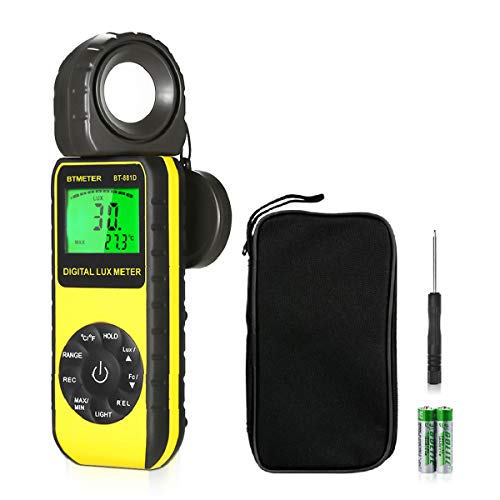
3. BTMETER BT-881D — Widest Range, Rotating Sensor
The BT-881D pushes the ceiling higher than the other meters here. Its listed range starts at 0.01 lux and runs to 400,000 lux, so it covers dim corners and very bright fixtures with one instrument. The sensor head rotates through 270 degrees, which lets you point the dome upward at a ceiling panel, sideways at a wall washer or down at a bench without twisting the display away from you.
It samples two to three times per second, so readings settle quickly when you sweep across a space. A memory function stores up to 33 sets of readings, and a relative mode shows the difference between the current reading and a stored reference — useful when you balance several lamps to the same level. The maker also lists a temperature readout alongside the light measurement. A carrying case is included in the listed package contents.
Specs
- Model: BTMETER BT-881D
- Listed range: 0.01 to 400,000 lux / 0.01 to 40,000 foot-candles
- Listed accuracy: +/-4% up to 10,000 lux, +/-5% at higher ranges
- Sensor: built-in head, rotates 270 degrees
- Response: listed 0.4 seconds, 2 to 3 samples per second
- Features: 33-reading memory, relative mode, data hold, maximum/minimum, temperature readout
- Power: 2 x AAA batteries
- ASIN: B07JZ3ZZQ6
4. TopTes TS-710 — Rotating Sensor With a Large Display

The TS-710 takes the rotating-sensor idea and pairs it with the largest screen in this group, a 2.25-inch backlit LCD with a bar graph that makes trends easy to follow as light changes. The head rotates through 180 degrees, enough to aim at ceiling fixtures or window light while the display stays facing you.
Its listed range is 0.1 to 200,000 lux, or 0.1 to 20,000 foot-candles. The maker lists a tighter accuracy figure against a reference incandescent source, at +/-3% of reading, with a looser figure for other visible light sources — worth knowing if you mostly measure LED panels, where the second figure applies. Alongside light, the meter lists ambient temperature and humidity readings, which makes it a practical single tool for checking a grow corner, a greenhouse bench or a workshop corner where both light and air conditions matter. Maximum and minimum recording and data hold are included, and it runs on three AAA batteries with auto shut-off after 10 minutes.
Specs
- Model: TopTes TS-710
- Listed range: 0.1 to 200,000 lux / 0.1 to 20,000 foot-candles
- Listed accuracy: +/-3% of reading against a reference incandescent source, +/-6% for other visible sources
- Sensor: built-in head, rotates 180 degrees, silicon photo-diode with spectral filter
- Display: 2.25-inch backlit LCD with bar graph
- Features: data hold, maximum/minimum, ambient temperature and humidity readings, auto shut-off
- Power: 3 x AAA batteries
- ASIN: B0C3LTSJBB
5. Extech LT40 — Built for White LED Lighting
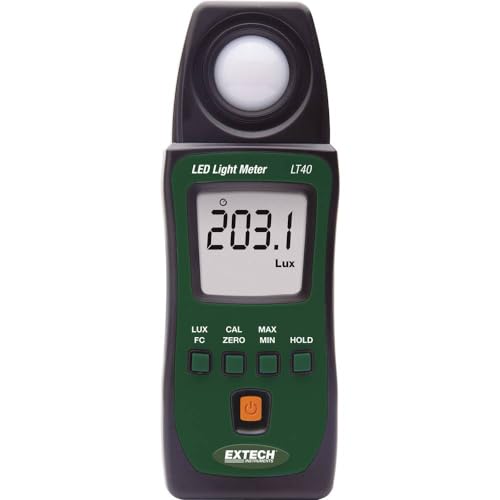
The LT40 is the specialist here. Extech designed it to measure white LED lighting, the source that now fills most workshops, offices and garages, and it also measures standard sources such as fluorescent, metal halide, high-pressure sodium and incandescent lamps. If your space is fully LED and you want a meter whose sensor response is specified around that source type, this is the design aimed at you.
The listed range reaches 400,000 lux, or 40,000 foot-candles, matching the widest ceiling in this group. The sensor is built into the body under a protective cover, and readings appear on a 4000-count LCD. The feature set is deliberately simple compared with the logging models above: this is a meter for facilities checks, lighting layouts and verifying that a renovated space delivers the light levels its plan called for, in lux or foot-candles at the press of a button.
Specs
- Model: Extech LT40
- Listed range: up to 400,000 lux / 40,000 foot-candles
- Light sources: listed for white LED, plus fluorescent, metal halide, high-pressure sodium and incandescent
- Sensor: built-in sensor with protective cover
- Display: 4000-count LCD
- Units: lux and foot-candles, switchable
- ASIN: B0792CCTCS
Comparison Table
| Model | Listed max range | Sensor design | Standout listed feature |
|---|---|---|---|
| Dr.Meter LX1330B | 200,000 lux | Separate sensor on cable | Peak hold, auto zeroing |
| UNI-T UT383 | 199,900 lux | Built-in, fixed | 0.5-second sampling, backlit pocket body |
| BTMETER BT-881D | 400,000 lux | Built-in, rotates 270 degrees | 33-reading memory, relative mode |
| TopTes TS-710 | 200,000 lux | Built-in, rotates 180 degrees | Temperature and humidity readings, 2.25-inch display |
| Extech LT40 | 400,000 lux | Built-in with cover | Specified for white LED sources |
FAQ
What lux level should a workshop bench have?
General workshop areas are commonly planned around a few hundred lux, with finer assembly, inspection and finishing work planned higher, often in the 750 to 1,500 lux band at the work surface. Measure at the surface where the work sits, not at ceiling height, because the reading falls quickly as you move away from the fixture.
What is the difference between lux and foot-candles?
Both measure illuminance — light arriving at a surface. Lux is the metric unit and foot-candles the imperial one; one foot-candle equals about 10.76 lux. Every meter in this guide switches between the two, so you can follow whichever scale your lighting plan or local code uses.
Where should I hold the sensor when measuring?
Place the sensor dome at the work surface, facing the light source, and keep your body from shadowing it. Split and rotating sensors help here: they let the dome sit flat and correctly aimed while the display stays in your hand.
Can a lux meter measure LED lights?
Yes, but check the listed specification. Some meters quote their accuracy figure against a reference incandescent lamp and a looser figure for other sources, while the Extech LT40 is specified around white LED lighting. For comparing LED fixtures against each other, any of these meters gives consistent relative readings.
Do I need a 400,000 lux range indoors?
For most indoor work, no — a 200,000 lux ceiling already covers bright benches and window-lit rooms. The wider range earns its place outdoors in direct sun, under high-bay industrial fixtures or under high-output grow lights, where a smaller meter would simply show an over-range indication.
Conclusion
For most workshops, the choice comes down to sensor layout. The Dr.Meter LX1330B, with its cabled sensor, is the natural pick for fixed bench work and repeatable readings at one surface. The UNI-T UT383 covers fast walk-around surveys in the smallest body. The BTMETER BT-881D adds the widest range, a 270-degree rotating head and reading memory for balancing several lights. The TopTes TS-710 pairs a rotating head with the biggest display and extra temperature and humidity readings. And the Extech LT40 is the one to shortlist when your space is lit by white LEDs and you want a meter specified for exactly that job. Pick the design that matches how you move around your space, and the numbers will do the rest.
Related guides
More from Amazon
Programs that pair well with the guide above. Offers and eligibility are set by Amazon and may change.
Free shipping on eligible items, Prime Video and more. Eligible new members can start with a free trial.
Start a Prime free trialAd-free music streaming. Eligible new subscribers can start with a free trial.
Try Music Unlimited freeA Prime membership for ages 18-24 with a trial period. Eligibility is set by Amazon.
See Prime for Young AdultsAudiobooks and podcasts to listen to on the go. Eligible new members can start with a free trial.
Try Audible freeAs an Amazon Associate we earn from qualifying purchases.