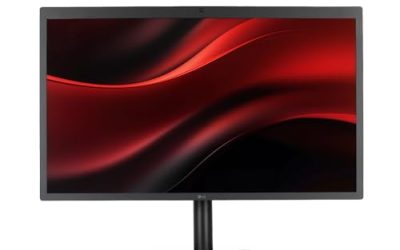
A 38 inch ultrawide monitor is a serious step up from the common 34 inch size. At 38 inches diagonally with a 21:9 aspect ratio and a 3840 x 1600 resolution, these screens give you a wider field of view and more vertical space than a 34 inch panel, which makes a real difference when you are editing video, running a flight simulator, or keeping three windows open at once. The best 38 inch ultrawide monitors pair that extra size with fast refresh rates and strong colour, so the screen feels like an upgrade in every direction, not just a bigger version of what you already have.
The 38 inch class sits in a useful gap. It is noticeably larger than a 34 inch ultrawide without demanding the desk space and graphics power of a 49 inch super ultrawide, and its 3840 x 1600 resolution is sharper than the 3440 x 1440 panels used at 34 inches. That combination makes it a natural fit for people who want one big screen to replace a multi-monitor setup entirely, whether the priority is gaming immersion, creative work, or a mix of both.
There are fewer 38 inch ultrawides on the market than 34 inch models, and the ones that exist tend to sit at the premium end, with Nano IPS panels, 144 Hz refresh rates, and HDR600 certification. This guide covers three of them, all curved, all 3840 x 1600, and all capable of handling both serious gaming and serious work. The differences between them come down to adaptive sync, connectivity, and how each one balances gaming speed against office-friendly features.
How to Choose
Resolution and sharpness
Every 38 inch ultrawide in this guide uses a 3840 x 1600 resolution, often called WQHD+, which gives around 111 pixels per inch. That is a small but real step up in sharpness from a 34 inch 3440 x 1440 panel, and the extra vertical pixels matter when you are working with timelines, code, or documents. Text stays crisp at normal viewing distances, and the wider canvas means less scrolling in every direction. There is no lower-resolution 38 inch ultrawide worth buying, so resolution is one thing you do not need to compromise on here.
Panel type and colour
The 38 inch ultrawides on the market overwhelmingly use Nano IPS panels, which combine the wide viewing angles and colour accuracy of IPS with a wider colour gamut. Look for 98 percent or more of DCI-P3 coverage if you edit video or photos, since that range of reds and greens makes a visible difference in creative work. HDR600 certification is common at this size, and it is a meaningful step above entry-level HDR, with enough brightness and local dimming to make HDR content look genuinely different from standard content.
Refresh rate and response time
A 144 Hz refresh rate is the standard at 38 inches, and it is fast enough for competitive gaming while staying smooth for everyday use. Response times around 1 ms keep fast motion clean, though the quoted figure is measured under laboratory conditions and real-world motion depends on the overdrive setting. Adaptive sync matters as much as the headline refresh rate: G-Sync compatibility or FreeSync Premium Pro keeps the frame rate and refresh rate in step, which removes tearing without adding input lag.
Curve and viewing distance
Most 38 inch ultrawides use a 2300R curve, which is gentle enough to feel natural at a normal desk distance while still pulling the far edges slightly toward you. A 38 inch screen is wide enough that a flat panel would leave the corners noticeably further from your eyes, so the curve is doing real work here. Sit roughly an arm’s length away and the whole screen should fall comfortably within your field of view. If you sit much closer than that, the screen can feel overwhelming, so a deeper desk helps.
Connectivity: Thunderbolt, USB-C, and KVM
At this size and price, connectivity separates the merely good from the genuinely useful. Thunderbolt 3 or USB-C with power delivery lets a laptop connect with a single cable, and a built-in KVM switch lets you share one keyboard and mouse between two computers connected to the same screen. HDMI 2.0 and DisplayPort 1.4 are the standard video inputs, and DisplayPort is the one to use for the full 144 Hz refresh rate at native resolution. Check the USB-C wattage against your laptop: 90 W covers most machines.
Ergonomics and desk space
A 38 inch ultrawide is around 90 centimetres wide and weighs considerably more than a 27 inch screen, so check both your desk width and your monitor arm’s weight limit before ordering. Height, tilt, and swivel adjustment should be standard at this price, and VESA mounting is worth having for a cleaner setup. The stand that ships with these monitors is usually substantial, so a deep desk of at least 60 centimetres gives the base room to sit without crowding your keyboard.
Graphics card requirements
Driving 3840 x 1600 at 144 Hz asks a lot of a graphics card, roughly a third more pixels than a 1440p screen and more than twice a 1080p screen. A mid-range or better modern graphics card will handle it in most games at high settings, while older or entry-level cards will need lower settings to hold a smooth frame rate. For office work and video, any modern laptop or desktop with a DisplayPort or Thunderbolt output will drive these screens without trouble.
Top Picks
LG UltraGear 38GN950-B 38-Inch Curved Gaming Monitor
The LG UltraGear 38GN950-B is the gaming-first pick in this roundup, with a 38 inch Nano IPS panel, a 3840 x 1600 resolution, and a 144 Hz refresh rate that can be pushed higher with overclocking. Its 1 ms-class response time and G-Sync compatibility keep fast motion clean, and HDR600 certification with local dimming gives HDR games real punch. The 2300R curve wraps the screen gently around your field of view without distorting the image.
Specs
- 38 inch Nano IPS panel, 3840 x 1600 resolution, 144 Hz refresh rate, 2300R curve, 1 ms-class response time, HDR600, G-Sync compatibility and FreeSync Premium Pro, DisplayPort and HDMI inputs.
Who it is for: PC gamers who want the largest ultrawide that still feels like a gaming monitor, with fast motion, strong HDR, and a wide field of view for racing and simulation games.
Caveats: it has no Thunderbolt input and no built-in KVM, so laptop users will need a separate dock for a single-cable setup. Confirm the exact model code 38GN950-B on the listing before ordering, since LG sells several similar 38 inch screens.
Alienware AW3821DW 38-Inch Curved Gaming Monitor
The Alienware AW3821DW is a 38 inch curved gaming ultrawide with a Nano IPS panel, a 3840 x 1600 resolution, and a 144 Hz refresh rate, built around a native G-Sync Ultimate module rather than mere compatibility. That hardware module gives the smoothest variable refresh rate experience in this roundup, with no tearing and very low input lag across the whole refresh range. The white chassis and AlienFX lighting ring give it a distinctive look that stands out from the usual black slabs.
Specs
- 38 inch Nano IPS panel, 3840 x 1600 resolution, 144 Hz refresh rate, 2300R curve, 1 ms-class response time, HDR600, G-Sync Ultimate, DisplayPort and HDMI inputs, height-adjustable stand.
Who it is for: NVIDIA graphics card owners who want the best variable refresh rate experience available at 38 inches, and anyone who likes the Alienware design language.
Caveats: the G-Sync Ultimate module adds cost, and the white finish shows dust more readily than black. Two different ASINs have been seen attached to this model, so confirm the listing shows model AW3821DW before ordering.
LG 38WN95C-W 38-Inch Curved UltraWide Monitor

The LG 38WN95C-W is the work-and-play hybrid of this roundup, with a 38 inch Nano IPS panel, a 3840 x 1600 resolution, and a 144 Hz refresh rate, plus Thunderbolt 3 connectivity that the gaming-first picks lack. Its Thunderbolt 3 port carries picture, data, and charging over one cable, and its accurate Nano IPS colour makes it equally at home editing video or playing games. The white and silver finish suits bright office spaces.
Specs
- 38 inch Nano IPS panel, 3840 x 1600 resolution, 144 Hz refresh rate, 2300R curve, 1 ms-class response time, HDR600, Thunderbolt 3 with power delivery, G-Sync compatibility and FreeSync, DisplayPort and HDMI inputs.
Who it is for: laptop users and creators who want one 38 inch screen for everything, with single-cable docking, accurate colour, and a 144 Hz refresh rate for gaming after work.
Caveats: Thunderbolt 3 is an older standard than Thunderbolt 4, so very new laptops may not get the full benefit, and the 144 Hz refresh rate needs a DisplayPort connection for the best results. Confirm the listing shows model 38WN95C-W, since LG sells several similar 38 inch panels.
Comparison Table
| Monitor | Panel | Refresh Rate | Curve | Thunderbolt / USB-C | Adaptive Sync |
|---|---|---|---|---|---|
| LG UltraGear 38GN950-B | Nano IPS | 144 Hz | 2300R | No | G-Sync Compatible, FreeSync Premium Pro |
| Alienware AW3821DW | Nano IPS | 144 Hz | 2300R | No | G-Sync Ultimate |
| LG 38WN95C-W | Nano IPS | 144 Hz | 2300R | Thunderbolt 3 | G-Sync Compatible, FreeSync |
Which One Is Right for You?
If gaming is your main priority and you run an NVIDIA graphics card, the Alienware AW3821DW is the strongest pick, because its hardware G-Sync Ultimate module delivers the smoothest variable refresh rate of the three. The LG UltraGear 38GN950-B is the alternative for gamers who want the same 144 Hz Nano IPS performance without the Alienware styling or the hardware module, and it is the more straightforward choice if you use an AMD graphics card.
If your screen has to do double duty as a work display for a laptop, the LG 38WN95C-W is the clear pick. Its Thunderbolt 3 port turns one cable into a full docking station, and its colour accuracy and 144 Hz refresh rate mean you give up nothing when the workday ends and the games begin. The trade-off is the older Thunderbolt standard, which matters only if you need the newest docking features.
Whichever you choose, plan for the graphics card. All three of these screens need a capable card to hold high frame rates at 3840 x 1600, and all three reward a DisplayPort connection over HDMI for the full refresh rate. Measure your desk too: a 38 inch ultrawide needs roughly 90 centimetres of width, and a deep desk makes the curve feel natural rather than overwhelming.
Frequently Asked Questions
Is a 38 inch ultrawide too big for a normal desk?
It fits most desks that are at least 120 centimetres wide and 60 centimetres deep, though it will dominate a smaller setup. Sit about an arm’s length away and the screen fills your field of view without forcing you to turn your head constantly. If your desk is narrower than 120 centimetres, a 34 inch ultrawide is a safer fit.
Can a 38 inch ultrawide replace two monitors?
Yes, and this is one of its strongest use cases. A 3840 x 1600 panel gives you the width of two 1920-pixel windows side by side plus extra vertical space, with no bezel in the middle. Window management software or your operating system’s snap features make it easy to arrange two or three applications across the screen.
Do I need Thunderbolt for a 38 inch ultrawide?
No, Thunderbolt is a convenience, not a requirement. DisplayPort and HDMI carry the picture perfectly well from a desktop. Thunderbolt matters mainly for laptop users who want one cable to handle the picture, charging, and peripherals, and the LG 38WN95C-W is the pick in this roundup that provides it.
Is 144 Hz worth it on a 38 inch ultrawide?
Yes, if you play games. The difference between 60 Hz and 144 Hz is immediately visible in fast motion, and it makes the whole desktop feel more responsive. For pure office work the benefit is smaller, though scrolling and mouse movement still feel smoother, so a 144 Hz panel is a reasonable choice even for non-gamers who can afford it.
Disclosure: As an Amazon Associate, we may earn from qualifying purchases.
Related guides
More from Amazon
Programs that pair well with the guide above. Offers and eligibility are set by Amazon and may change.
Free shipping on eligible items, Prime Video and more. Eligible new members can start with a free trial.
Start a Prime free trialAd-free music streaming. Eligible new subscribers can start with a free trial.
Try Music Unlimited freeA Prime membership for ages 18-24 with a trial period. Eligibility is set by Amazon.
See Prime for Young AdultsAudiobooks and podcasts to listen to on the go. Eligible new members can start with a free trial.
Try Audible freeAs an Amazon Associate we earn from qualifying purchases.