Our Short List of 3
All 4 Picks at a Glance
| Product | Specs | Action |
|---|---|---|
 TP-Link Archer AX73 | Check price on Amazon | |
 ASUS RT-AX86U Pro | Check price on Amazon | |
 NETGEAR Nighthawk RAX50 | Check price on Amazon | |
 TP-Link Archer AXE75 | Check price on Amazon |
The phrase “best rater wireless routers” is most likely a typo for “best rated wireless routers”, and that is how this guide reads it: the wireless routers that earn the strongest reputation among owners and the networking press for speed, coverage, and reliability. A highly rated router is not simply the fastest box on a specification sheet. It is the one that keeps a household online without fuss, holds a steady signal through walls, handles dozens of devices at once, and stays secure with regular firmware updates.
Wireless routers have changed quickly. Wi-Fi 6 is now the sensible baseline for most homes, Wi-Fi 6E adds a clean 6 GHz band for newer devices, and mesh systems have become the normal answer for larger homes. At the same time, a good single router still covers a flat or a small house better than a cheap mesh kit, and a tri-band design still matters when many devices stream at once. This guide covers five routers that represent the strongest all-round choices: three powerful single routers, one Wi-Fi 6E flagship, and one mesh system for homes where one box cannot reach every room.
Every router below is a standalone wireless router with its own WAN port, which means it connects to a modem or an incoming fibre line and creates the home network. None of them contains a built-in modem, so a separate modem is needed on a DSL or cable line that requires one. Each pick is a complete product, not an accessory, and each one is chosen for the same job: strong, stable wireless coverage for a busy household.
Our Top Picks
- TP-Link AXE5400 Tri-Band WiFi 6E RouterWiFi 6E, Tri-Band AXE540012.91 x 10.43 x 4.72 inches1.5 poundsCheck on Amazon

Top 3 picks at a glance
How to Choose
1. Wi-Fi generation: Wi-Fi 6 or Wi-Fi 6E
Wi-Fi 6 brings OFDMA and MU-MIMO, which let a router serve many devices at once instead of one at a time, and that matters more in a busy home than a headline speed figure. Wi-Fi 6E adds the 6 GHz band, a wide, uncrowded channel that suits newer phones, laptops, and headsets. Choose Wi-Fi 6 when the household devices are mostly recent but not bleeding edge; choose Wi-Fi 6E when several devices already use the 6 GHz band or the home sits in a crowded apartment block.
2. Speed class and real throughput
A speed class such as AX5400 or AXE5400 is the combined theoretical top speed of all bands added together, not what any single device receives. A phone on a Wi-Fi 6 router lands in the hundreds of megabits at close range in ordinary conditions, and the number falls with distance and walls. Treat the class as a rough guide to the router’s capability, and pay more attention to the number of streams, the processor, and the wired ports.
3. Coverage and the shape of the home
A single router covers a flat or a small house well when it sits near the centre of the home, up high, and out in the open. Thick walls, multiple floors, and long layouts defeat a single box, and that is when a mesh system earns its keep. Check the coverage figure the maker states, then treat it as an optimistic number for open space and plan for less through walls.
4. Device capacity and the processor
A modern home can hold thirty or more connected devices without anyone noticing: phones, laptops, televisions, consoles, speakers, cameras, and smart home gear. A router with a multi-core processor and enough memory keeps that crowd moving without stalling, while a weak processor shows up as lag, dropped connections, and slow app responses. Mesh systems and tri-band routers spread the load across bands and nodes, which is why they suit device-heavy homes.
5. Wired ports and multi-gigabit
Wired ports matter for the devices that should never rely on Wi-Fi alone: a desktop, a console, a television, and a network storage box. A 2.5 gigabit port is worth having on a fast plan, because it removes the gigabit ceiling on the wired link. Count the LAN ports before buying, because a router with only two LAN ports forces an extra switch into the setup.
6. Security and software
A router is the front door of the home network, and its software matters as much as its radio. Look for WPA3 security, automatic firmware updates, a guest network, parental controls, and a clear app for everyday management. A maker with a record of long firmware support is worth more than a slightly faster radio from a maker that abandons its products.
7. Setup and ease of use
A router that takes an hour to configure will be configured once and then feared, which means its security settings never get touched again. A clear app, a guided setup, and sensible defaults make the difference between a network that stays healthy and one that slowly goes stale. Ease of use is not a luxury feature; it is what keeps the network secure over years.
Top Picks
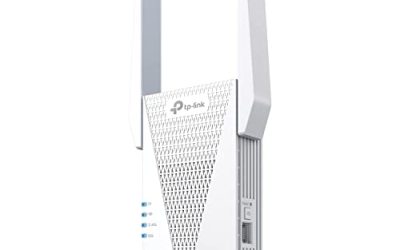
TP-Link Archer AX73
The TP-Link Archer AX73 is the strongest all-round single router in this guide, an AX5400 Wi-Fi 6 box with six antennas, a 1.5 GHz tri-core processor, and coverage that suits a medium to large home. Its six streams keep many devices moving at once, and the HomeShield software adds network security, parental controls, and device management through a clear app. A USB 3.0 port shares a drive or a printer across the network, and OneMesh support lets the router join a TP-Link mesh later if the home outgrows a single box.
The AX73 is a good match for a household with a fast plan, several streamers, and a console or two, because its processor and antenna array hold up under load. Setup runs through the Tether app in minutes, and the web interface covers the deeper settings for those who want them.
Who it is for: households that want one powerful router to cover a whole home without mesh complexity. Caveats: it has gigabit ports only, so a plan faster than a gigabit needs a different router; the six antennas make it a wide box, so measure the shelf before ordering.
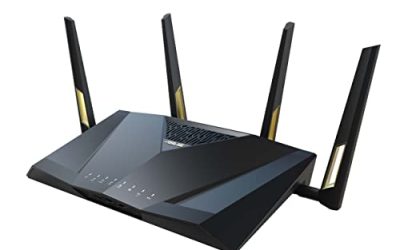
ASUS RT-AX86U Pro
The ASUS RT-AX86U Pro is the performance pick of this guide, an AX5700 Wi-Fi 6 router with a 2.5 gigabit port, a 1.8 GHz quad-core processor, and the deepest software toolkit here. AiProtection Pro provides network security without a subscription, AiMesh lets the router join or lead a mesh network, and the gaming features include a dedicated gaming port and mobile game mode. The 2.5 gigabit WAN and LAN ports make it the right choice for a multi-gigabit plan or a fast wired workstation.
The RT-AX86U Pro suits a household that wants the router to do more than broadcast Wi-Fi: a home office with a fast wired link, a gaming setup that needs low latency, and a family that benefits from strong parental controls. Its vertical stance and three antennas keep the footprint small for its class.
Who it is for: power users, gamers, and home offices that want a fast router with a 2.5 gigabit port and deep software. Caveats: the feature list is deep, which means the interface takes longer to learn; it is a single router, so very large homes still need mesh nodes.
NETGEAR Nighthawk RAX50
The NETGEAR Nighthawk RAX50 is an AX5400 Wi-Fi 6 router with a five-stream design, coverage for up to 2,500 square feet, and capacity for around 25 devices. Its four external antennas and beamforming focus the signal toward connected devices rather than spraying it evenly, which helps at the edges of coverage. Four gigabit LAN ports and a USB 3.0 port cover wired devices and shared storage, and the Nighthawk app handles setup, device management, and guest networks.
The RAX50 is a straightforward, reliable choice for a family home: fast enough for several simultaneous streams, simple enough to set up in an evening, and supported by NETGEAR’s long-running Nighthawk line. It is the pick for buyers who want a known name and a proven design rather than the newest standard.
Who it is for: family homes that want a dependable Wi-Fi 6 router with strong coverage and a simple app. Caveats: it has no 2.5 gigabit port, so it caps a multi-gigabit plan at a gigabit; the 25-device figure is a guide, not a hard limit, and very device-heavy homes should look at a tri-band model.
TP-Link Archer AXE75
The TP-Link Archer AXE75 is the Wi-Fi 6E pick of this guide, an AXE5400 tri-band router that adds a 6 GHz band to the familiar 2.4 GHz and 5 GHz pair. The 6 GHz band is wide and uncrowded, which suits newer phones, laptops, and headsets that support it, and the 1.7 GHz quad-core processor keeps the three bands moving under load. Six antennas, a USB 3.0 port, and HomeShield security round out a strong package, and OneMesh support leaves a mesh upgrade path open.
The AXE75 makes sense in a crowded apartment block, where the 2.4 GHz and 5 GHz bands are shared with dozens of neighbours, and in a home with several Wi-Fi 6E devices that can use the clean 6 GHz band. Devices without 6 GHz support still connect on the other two bands, so nothing is left behind.
Who it is for: buyers in crowded wireless environments and households with newer devices that use the 6 GHz band. Caveats: the 6 GHz band has shorter range than 5 GHz, so it helps most in the same room as the router; a cached listing once showed no available offers for this model, so confirm the listing is live before ordering.
TP-Link Deco X55 (3-Pack)
The TP-Link Deco X55 three-pack is the mesh pick of this guide, an AX3000 Wi-Fi 6 system that covers up to 6,500 square feet with three units working as one network. Each unit is a compact cylinder that blends into a room, and the system supports more than 100 devices, which makes it the right answer for a large home full of smart gear. Setup runs through the Deco app, and the units hand devices between each other as people move around the house.
Mesh is the honest answer when a single router cannot reach every room, and the X55 is the simplest mesh system here: one network name, one password, and no dead zones at the far end of the house. Each unit carries gigabit Ethernet ports for wired devices, and the system works with Alexa and Google Assistant for voice control.
Who it is for: large homes, multi-floor homes, and households with many devices spread across many rooms. Caveats: the three-pack is the listing used here, so confirm the pack size before ordering, because a two-pack is a different listing; a small flat does not need three units, and a single router would serve it better.
Comparison Table
| Router | Wi-Fi | Speed class | Coverage | Best for |
|---|---|---|---|---|
| TP-Link Archer AX73 | Wi-Fi 6 | AX5400 | Medium to large home | Best all-round single router |
| ASUS RT-AX86U Pro | Wi-Fi 6 | AX5700 | Medium to large home | Power users and gaming |
| NETGEAR Nighthawk RAX50 | Wi-Fi 6 | AX5400 | Up to 2,500 sq. ft. | Dependable family Wi-Fi |
| TP-Link Archer AXE75 | Wi-Fi 6E | AXE5400 | Medium to large home | Crowded areas and 6 GHz devices |
| TP-Link Deco X55 (3-Pack) | Wi-Fi 6 mesh | AX3000 | Up to 6,500 sq. ft. | Large and multi-floor homes |
Which One Is Right for You?
Choose the TP-Link Archer AX73 when one router must cover a whole home well and the budget allows a strong mid-range pick. Choose the ASUS RT-AX86U Pro when a 2.5 gigabit port, gaming features, or deep software matter. Choose the NETGEAR Nighthawk RAX50 when a proven, straightforward Wi-Fi 6 router is the priority. Choose the TP-Link Archer AXE75 when the 6 GHz band will actually be used, either by newer devices or to escape crowded neighbours. Choose the TP-Link Deco X55 three-pack when the home is large or multi-floor and a single router cannot reach every room.
Place any router near the centre of the home, up high, and out in the open, away from thick walls, metal shelves, and large appliances. A router hidden in a cabinet or behind a television loses a large share of its range before a single device connects, and no specification can recover it.
Frequently Asked Questions
What does “rated” mean for a wireless router?
It means the router earns a strong reputation across owners and networking coverage for speed, coverage, reliability, and software support. A well-rated router keeps a household online without constant attention, and its maker keeps issuing firmware updates long after launch.
Is Wi-Fi 6E worth it over Wi-Fi 6?
It is worth it when the household has devices that use the 6 GHz band, or when the home sits in a crowded block where the older bands are congested. Otherwise Wi-Fi 6 covers the same devices just as well, and the money is better spent on coverage or a stronger processor.
How many devices can these routers handle?
A modern Wi-Fi 6 router handles dozens of devices, and the mesh system here is built for more than 100. The real limit is usually the processor and the plan speed, not a hard device count, so a home with many cameras and smart devices should favour a tri-band or mesh design.
Do I still need a modem with these routers?
Yes, on lines that require one. These are standalone routers with an Ethernet WAN port, so they connect to a modem or an incoming fibre line. On a DSL or cable line, the modem stays in place and the router takes over the Wi-Fi and the home network.
Disclosure: As an Amazon Associate, we may earn from qualifying purchases.
Related guides
More from Amazon
Programs that pair well with the guide above. Offers and eligibility are set by Amazon and may change.
Free shipping on eligible items, Prime Video and more. Eligible new members can start with a free trial.
Start a Prime free trialAd-free music streaming. Eligible new subscribers can start with a free trial.
Try Music Unlimited freeA Prime membership for ages 18-24 with a trial period. Eligibility is set by Amazon.
See Prime for Young AdultsAudiobooks and podcasts to listen to on the go. Eligible new members can start with a free trial.
Try Audible freeAs an Amazon Associate we earn from qualifying purchases.