Our Short List of 3
All 5 Picks at a Glance
| Product | Specs | Action |
|---|---|---|
 Roland KC-200 | Check price on Amazon | |
 Roland KC-80 | Check price on Amazon | |
 Behringer Ultratone K900FX | Check price on Amazon | |
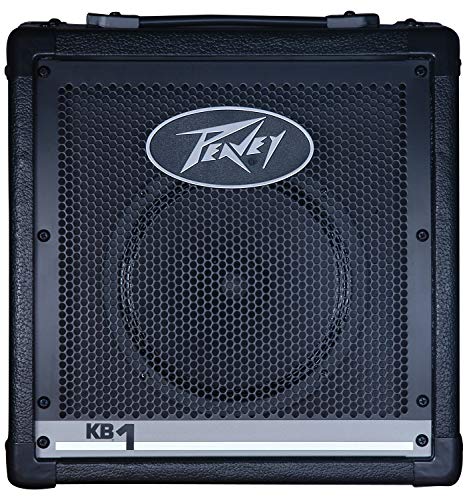 Peavey KB 1 | Check price on Amazon | |
 Coolmusic DM20 | Check price on Amazon |
As an Amazon Associate, we earn from qualifying purchases made through links on this page.
A keyboard player who goes shopping for a “powered monitor” is usually not looking for a studio monitor at all. Studio monitors are built for mixing and production: they sit on a desk, take a line-level feed from an audio interface, and aim for a flat, honest sound at close range. This site already covers that class in its studio monitor guides. What a pianist, synth player, or organist needs at rehearsal, in a lesson room, or on a small stage is a different product: a keyboard amplifier. A keyboard amp is a powered, full-range speaker cabinet with its own built-in mixer, voiced to reproduce the whole span of a piano or synth, from deep left-hand notes to bright upper harmonics, and able to take a second keyboard, a microphone, and a backing track at the same time.
That distinction sets the frame for this guide. Every pick below is sold by its maker as a keyboard amplifier or keyboard speaker, carries its amplifier inside the cabinet, and gives you more than one input channel or a proper mixer section. The five models run from a 100-watt rehearsal and small-stage amp down to a compact personal monitor that sits beside a practice keyboard at home. If your real goal is recording and mixing at a desk, the studio monitor route is the right one; if your goal is hearing yourself play, read on.
Our Top Picks
Top 3 picks at a glance
What to look for in a powered monitor for keyboards
Full-range reproduction. A piano covers a wider span of notes than a guitar or a voice, and synth patches push lower and higher still. Two-way cabinets, with a woofer for the lows and a tweeter for the top end, handle that span more evenly than a single small driver. Cabinet and woofer size still set a floor on bass weight: an 8-inch practice amp will not move air the way a 12-inch cabinet does, no matter what the spec sheet promises elsewhere.
A built-in mixer, not just an input. The practical difference between a keyboard amp and a plain powered speaker is the mixer section. Look for several line channels with their own level controls, so a main keyboard, a second board, and a playback device can be balanced from the amp itself. A channel that doubles as a monitor input is handy for click and guide tracks in a band setting.
Microphone input. Many keyboard players also sing, announce, or teach. A channel with an XLR mic input lets one cabinet cover keys and voice together, which is exactly how these amps earn their keep in worship bands, schools, and small venues.
Playback inputs. An auxiliary input, on RCA or 3.5 mm plugs, or a Bluetooth link, lets you run backing tracks, lesson audio, or a metronome app through the same speaker you hear yourself on. That matters more in daily practice than almost any other feature.
Outputs for bigger rooms. A line output sends your mixed signal to a house PA or a recorder while the amp keeps working as your personal monitor. A sub output lets you add a subwoofer later for organ pedals or synth bass. A headphone output covers quiet practice at home.
Power matched to the room. Wattage figures are not measured the same way across brands, so treat them as a rough guide to headroom rather than a loudness score. As a working rule from the makers’ own positioning: around 20 watts suits solo practice, 50 watts covers lessons and small rehearsals, and 90 to 100 watts with a 12-inch woofer holds up in a band rehearsal or a small hall.
Weight and shape. A rehearsal amp gets carried. The models below range from a little over 4 kg to nearly 19 kg, and that spread decides whether an amp lives in one room or travels with you. Angled, wedge-style cabinets aim the sound up at a seated player, which suits personal monitoring beside a stand.
Roland KC-200
The KC-200 is the centre of Roland’s long-running KC keyboard amp line, and it shows what the class is for. Roland rates it at 100 watts and builds it around a custom two-way speaker system with a 12-inch woofer and a tweeter, so piano lows and synth leads both get a driver suited to them. The mixer is the headline: four 1/4-inch line input channels, with channel 1 also accepting an XLR microphone, a dedicated monitor function on channel 4 for click or guide tracks, and an auxiliary input on 1/8-inch and RCA jacks for playback. Master low and high EQ, a line output, a sub output, and a headphone output round out the panel.
This is the pick for a player who runs two keyboards, sings, or plays in a rehearsal band and wants one cabinet to handle all of it. The monitor channel is a genuinely thoughtful touch for anyone who plays to a click.
The limits follow from the specs. At 15 kg it is a carry-with-two-hands amp, not a grab-and-go one. It is a single mono cabinet, so a stereo piano patch collapses to mono unless you add a second amp. And there are no built-in effects, so reverb or chorus has to come from your keyboard or a pedal.
Roland KC-80
The KC-80 takes the same formula down a size. Roland rates it at 50 watts, with a 10-inch woofer and a tweeter in a cabinet that weighs 12.5 kg. You get three 1/4-inch line input channels instead of four, and channel 1 again doubles as an XLR mic input, so a singing teacher or a worship player keeps the one-cabinet setup. The auxiliary input takes 1/8-inch and RCA sources, master EQ covers low and high bands, and the output set, line out, sub out, and headphones, matches its bigger sibling.
For home practice with headroom to spare, lessons, and small rehearsals, the KC-80 covers the job with less bulk to store and move. Players who mostly play alone but sometimes plug in a second source will not miss the fourth channel.
The trade-offs are headroom and bass. Fifty watts through a 10-inch woofer will not keep up with a loud drummer the way the KC-200 can, and deep synth bass or low piano registers carry less weight than they do through a 12-inch cabinet. If your playing moves from the practice room to band rehearsals, this is the model you outgrow first.
Behringer Ultratone K900FX
Behringer names this one a “PA System / Keyboard Amplifier,” and the panel explains why. The K900FX is a 90-watt, three-channel amp built around a 12-inch Bugera woofer and a 1-inch high-frequency driver. Channel 1 takes an XLR microphone, each channel has its own level and effects send, and the amp adds two things the Roland models leave out: a 24-bit digital effects processor with 100 presets, including reverb, chorus, flanger, and delay, and an FBQ feedback detection system that flags the frequencies feeding back when a mic is live. A five-band graphic EQ gives finer shaping than a simple low/high pair.
This suits the keyboard player who is also the de facto sound person: a school hall, a church, a community venue, a solo performer who sings and plays and needs reverb on the voice without hauling a mixer and an effects unit.
The cost is size and weight. At roughly 18.8 kg it is the heaviest pick here, and the effects and EQ sections add panel complexity a pure practice amp does not need. Like the KC-200, it is one mono cabinet, so stereo width needs a second unit.
Peavey KB 1
Peavey’s KB series is the other long-standing keyboard amp line, and the KB 1 is its smallest member: 20 watts into an 8-inch extended-range speaker, in a cabinet that weighs about 7.9 kg. The layout is simple in a good way. Two channels, each with its own level control and two-band EQ, let you balance a keyboard against a second source, say a drum machine or a student’s instrument, without any menu or preset in sight. A headphone output covers silent practice.
For a beginner’s first amp, a classroom, or a home corner where the keyboard lives, the KB 1 does the core job with the least fuss and the least floor space of any full keyboard amp here.
Its limits are plain from the spec sheet. Twenty watts is practice and small-room volume; it will not anchor an ensemble. Both inputs are 1/4-inch, so a microphone needs an adapter or a preamp, and there is no auxiliary input for backing tracks and no line output for a house PA. This is a personal amp, and it stays one.
Coolmusic DM20
The DM20 sits at the personal-monitor end of the market. Coolmusic sells it as a 20-watt personal monitor amplifier for electronic drums and keyboards, built around a 6.5-inch woofer and a dedicated tweeter in an angled cabinet of about 4.2 kg that runs from an 18-volt adapter. The single instrument input has low and high EQ, and the playback side is modern: Bluetooth streaming plus a USB slot for tracks on a flash drive, with onboard buttons for track control.
For desk-side or stand-side practice, this is the easiest pick to live with. It takes up little room, points up at a seated player, and plays lesson videos or backing tracks from a phone without a cable. Shared practice corners, where one small amp serves a keyboard one hour and an electronic drum kit the next, are its home ground.
The compromises are equally clear. Twenty watts through a 6.5-inch woofer is personal volume only; it will not fill a rehearsal room. There is one instrument input rather than a mixer, no microphone input, and no line output for a PA, so it cannot grow with you the way the KC-80 or KC-200 can.
Comparison table
| Model | Rated power | Speaker system | Input channels | Mic input | Weight |
|---|---|---|---|---|---|
| Roland KC-200 | 100 W | 12-inch woofer + tweeter | 4 line + aux | Yes, XLR on channel 1 | 15 kg |
| Roland KC-80 | 50 W | 10-inch woofer + tweeter | 3 line + aux | Yes, XLR on channel 1 | 12.5 kg |
| Behringer Ultratone K900FX | 90 W | 12-inch woofer + 1-inch driver | 3 + aux | Yes, XLR on channel 1 | About 18.8 kg |
| Peavey KB 1 | 20 W | 8-inch extended-range speaker | 2 | No, 1/4-inch inputs only | About 7.9 kg |
| Coolmusic DM20 | 20 W | 6.5-inch woofer + tweeter | 1 + Bluetooth/USB playback | No | About 4.2 kg |
FAQ
Is a keyboard amp the same thing as a studio monitor?
No. A studio monitor is a nearfield speaker for mixing and production, fed from an audio interface and judged on flat response at a desk. A keyboard amp is a live-sound tool: it has its own mixer for instrument-level sources, often a mic channel, and enough output for rehearsals and small rooms. The two classes overlap in being powered and full-range, and diverge almost everywhere else.
Can I plug a digital piano straight into one of these amps?
Yes. Every model here takes a keyboard’s line-level outputs on standard 1/4-inch plugs, which is what they are built for. Use both left and right outputs into two channels if you want to keep a stereo patch’s balance in the mixer; a single cable into one channel sums the signal to mono.
Do I need two cabinets for stereo?
For true stereo, yes, or a dedicated stereo model higher up the makers’ ranges. Each amp in this guide is a single mono cabinet. In practice, mono foldback is normal on stage and in rehearsal, and many players only add a second cabinet for larger rooms.
Keyboard amp or powered PA speaker: which should a keyboard player choose?
A powered PA speaker expects a line-level feed from a mixer and usually gives you one or two inputs with no instrument-focused mixer section. A keyboard amp folds the mixer into the cabinet: several channels, a mic input on the larger models, and EQ voiced for keyboards. If you already own a mixer and play in a full band rig, a PA speaker can make sense; if the cabinet has to be your whole sound system, the keyboard amp is the simpler tool.
Conclusion
For most keyboard players who rehearse or play out, the Roland KC-200 is the complete answer: a real mixer, a mic channel, a monitor input, and enough power and speaker area for band work. The KC-80 keeps the same idea in a smaller, lighter box for home and teaching. The Behringer K900FX is the pick when the amp also has to be a small PA, effects included. At the practice end, the Peavey KB 1 is the straightforward two-channel amp, and the Coolmusic DM20 is the compact personal monitor for playing along with tracks at home. Match the cabinet to the room you actually play in, and any of the five will let your keyboard sound like itself.
Related guides
More from Amazon
Programs that pair well with the guide above. Offers and eligibility are set by Amazon and may change.
Free shipping on eligible items, Prime Video and more. Eligible new members can start with a free trial.
Start a Prime free trialAd-free music streaming. Eligible new subscribers can start with a free trial.
Try Music Unlimited freeA Prime membership for ages 18-24 with a trial period. Eligibility is set by Amazon.
See Prime for Young AdultsAudiobooks and podcasts to listen to on the go. Eligible new members can start with a free trial.
Try Audible freeAs an Amazon Associate we earn from qualifying purchases.