Our Short List of 3

- Best for: Competitive players who want their PC traffic prioritised above all else.
- AX5700 dual-band WiFi 6
- 2.5G port plus a dedicated gaming port
- Mobile Game Mode for phones
- AiMesh compatible for mesh expansion

- Best for: Larger homes where several people game and stream at once.
- AX5400 dual-band WiFi 6, up to 5.4 Gbps
- Coverage for up to 2,500 sq ft
- Supports up to 25 devices
- 4 x 1G Ethernet ports and 1 x USB 3.0 port

- Best for: Homes where the gaming room sits far from the router.
- AX5400 dual-band WiFi 6
- Six high-performance antennas with beamforming
- 1.5 GHz triple-core CPU
- Supports more than 200 devices
All 4 Picks at a Glance
| Product | Specs | Action |
|---|---|---|
| ASUS RT-AX86U Pro |
| Check price on Amazon |
| NETGEAR Nighthawk RAX50 |
| Check price on Amazon |
| TP-Link Archer AX73 |
| Check price on Amazon |
 TP-Link Archer AX6000 |
| Check price on Amazon |
A gaming router has one job that a standard router does not: it has to keep your game traffic first in line while the rest of the house streams, downloads and scrolls. WiFi 6 gives it the tools to do that, with OFDMA and MU-MIMO letting one router serve many devices at once instead of making each one wait its turn. The four routers in this guide were picked for gamers who play on PC and console, and each one brings a different strength, from a dedicated gaming port to eight-stream throughput.
This guide is for players who lose matches to lag spikes, households where several people game and stream at the same time, and anyone upgrading from an older WiFi 5 box. Every router below was chosen from the names and specifications on its Amazon page, with the band speeds, wired ports and gaming features that decide whether a router actually helps your connection or just looks the part.
Our Top Picks
Top 3 picks at a glance
Quick Picks
As an Amazon Associate we earn from qualifying purchases
| Product | Best for | Key spec from title |
|---|---|---|
| ASUS RT-AX86U Pro | A dedicated gaming port | AX5700 dual-band WiFi 6 |
| NETGEAR Nighthawk RAX50 | Large homes | AX5400 with 2,500 sq ft coverage |
| TP-Link Archer AX73 | Long-range streaming | AX5400 with six antennas |
| TP-Link Archer AX6000 | Eight-stream households | AX6000 with eight antennas |
How to Choose
Wired Ports Decide the Real Speed
Wireless numbers get the headlines, but a wired connection still wins every match that matters. Look for at least one multi-gig port, because a 2.5G WAN port lets a fast fibre line reach your PC without a bottleneck at the router. A dedicated gaming port is worth more than it sounds: traffic plugged into it jumps the queue ahead of downloads and streams, so a patch downloading in the background does not spike your ping mid-match. Count the LAN ports too. Four gigabit ports cover a PC, a console and a streaming box with room to spare, while eight ports suit a house where every room has something wired in.
Bands and Throughput
AX numbers describe the combined speed of the 2.4 GHz and 5 GHz bands, and they are the quickest way to compare routers. An AX5400 router moves plenty of data for most gaming homes, while an AX5700 or AX6000 model adds headroom for households with many devices. Dual-band WiFi 6 is the standard here, and it is distinct from WiFi 6E, which adds a 6 GHz band, and from WiFi 7, which is a newer generation entirely. OFDMA and MU-MIMO matter more than the headline number: they let the router talk to several devices in one transmission instead of serving them one by one, which keeps latency steady when the whole household is online.
Coverage and Antennas
A router that cannot reach your gaming room is no use, however fast its headline speed. External antennas shape the signal, and more antennas usually mean a steadier connection at distance, though placement matters just as much. Put the router high, central and out in the open rather than buried behind a television. Check the coverage figure on the listing, but treat it as a best-case number for open rooms, since walls and floors cut it down. Mesh support is the fallback worth having: a router that can join a mesh system lets you add a node later instead of replacing the whole setup when one room stays out of reach.
Security and Setup
Gaming routers handle everything your household does online, so their security tools deserve a close look. WPA3 is the current wireless standard and should be on any router you buy now. Built-in network security that blocks malicious sites and scans for threats adds a layer of protection without a subscription on some models, while others fold the same tools into a paid service, so read the listing carefully. Parental controls and device scheduling help in shared homes. Setup should take minutes through a phone app, with a clear dashboard for traffic priority, connected devices and firmware updates.
The 4 Best Options
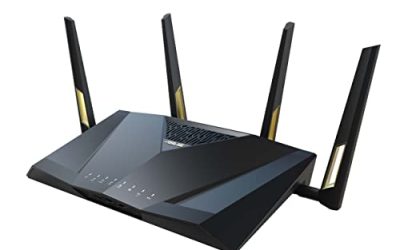
ASUS RT-AX86U Pro
- Best for: Competitive players who want their PC traffic prioritised above all else.
- AX5700 dual-band WiFi 6
- 2.5G port plus a dedicated gaming port
- Mobile Game Mode for phones
- AiMesh compatible for mesh expansion
Competitive players who want their PC traffic prioritised above all else.
No 6 GHz band, so it cannot use the extra spectrum of WiFi 6E.
The RT-AX86U Pro is the most gaming-focused router in this guide, and its dedicated gaming port is the feature that sets it apart. Traffic from the device plugged into that port gets priority over everything else on the network, which is exactly what you want when a housemate starts a large download mid-match. The 2.5G port handles fast fibre lines, Mobile Game Mode trims latency for phones, and AiMesh lets it join a mesh network later. It is a dual-band AX5700 router, so it covers the speed and the features without stepping up to the newer, costlier WiFi 7 generation.
Watch out for: No 6 GHz band, so it cannot use the extra spectrum of WiFi 6E.
NETGEAR Nighthawk RAX50
- Best for: Larger homes where several people game and stream at once.
- AX5400 dual-band WiFi 6, up to 5.4 Gbps
- Coverage for up to 2,500 sq ft
- Supports up to 25 devices
- 4 x 1G Ethernet ports and 1 x USB 3.0 port
Larger homes where several people game and stream at once.
No multi-gig port, so a plan faster than a gigabit will be capped at the WAN port.
The RAX50 suits a gaming household spread across a larger home, with coverage rated for 2,500 square feet and support for up to 25 devices. Its AX5400 dual-band WiFi 6 radio delivers up to 5.4 Gbps of combined throughput, and four gigabit Ethernet ports give wired connections to a PC, a console and a streaming box. A USB 3.0 port adds shared storage or a printer to the network. The Nighthawk app handles setup and device management, and the router includes a year of Armor cyber threat protection for the household network.
Watch out for: No multi-gig port, so a plan faster than a gigabit will be capped at the WAN port.
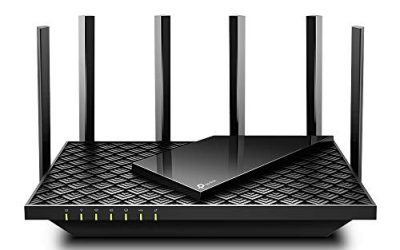
TP-Link Archer AX73
- Best for: Homes where the gaming room sits far from the router.
- AX5400 dual-band WiFi 6
- Six high-performance antennas with beamforming
- 1.5 GHz triple-core CPU
- Supports more than 200 devices
Homes where the gaming room sits far from the router.
No 2.5G port, so wired speeds top out at gigabit.
The Archer AX73 is the long-range pick of this group, with six high-performance antennas and beamforming that focus the signal toward your devices instead of scattering it. Its AX5400 dual-band WiFi 6 radio covers streaming and gaming in rooms far from the router, and it supports more than 200 devices, which suits a smart home full of cameras, speakers and consoles. The 1.5 GHz triple-core CPU keeps the router responsive under load, and HomeShield adds security and parental controls. Setup runs through the Tether app, which also handles guest networks and device priority.
Watch out for: No 2.5G port, so wired speeds top out at gigabit.
TP-Link Archer AX6000
- Best for: Busy households with many wired and wireless devices.
- AX6000 dual-band WiFi 6, eight-stream
- Eight external antennas
- 2.5 Gbps WAN port and 8 gigabit LAN ports
- 1.8 GHz quad-core CPU
Busy households with many wired and wireless devices.
Its large footprint and eight antennas need real shelf space.
The Archer AX6000 is built for households where everything is online at once. Eight antennas and eight-stream WiFi 6 push its combined throughput to AX6000, and a 1.8 GHz quad-core CPU keeps it steady when dozens of devices demand attention. The 2.5 Gbps WAN port lets a fast fibre line through, eight gigabit LAN ports cover every wired device in the house, and USB-C and USB-A 3.0 ports add shared storage. WPA3 security and HomeCare threat protection round out a router that is really a small network hub rather than a single box.
Watch out for: Its large footprint and eight antennas need real shelf space.
Which One Fits Your Situation
A Competitive PC Gamer
Pick the ASUS RT-AX86U Pro. Its dedicated gaming port gives your PC priority over every other device on the network, and Mobile Game Mode does the same for your phone. The 2.5G port makes sure a fast fibre line is not wasted at the router. If you play ranked matches and your housemates stream and download at the same time, this is the router that keeps your connection first in line.
A Household Full of Consoles
Pick the NETGEAR Nighthawk RAX50. Its coverage reaches across a larger home, and four gigabit ports wire up a PC and two consoles with a port to spare. Support for up to 25 devices means phones, tablets and smart speakers will not crowd the consoles off the network. The Nighthawk app makes it simple to see what is connected and to pause a device when a match matters.
A Large Home with Dead Spots
Pick the TP-Link Archer AX73. Six antennas with beamforming push the signal further than a standard four-antenna design, and support for more than 200 devices suits a home full of smart gadgets. If one room still drops out, its mesh-ready design means you can add a node later instead of starting over with a new system.
A First Gaming Router
Pick the TP-Link Archer AX6000 if you want one router to cover everything, or the Archer AX73 if your home is smaller. Both set up through a phone app in minutes, and both give you WiFi 6 speeds, modern security and enough ports for a growing setup. Start with the model that matches your home size, and add mesh nodes only if a dead spot appears.
Common Mistakes
- Buying on the AX number alone without checking the wired ports, since a gigabit WAN port caps a faster fibre line.
- Hiding the router behind a television or inside a cabinet, which blocks the signal before it reaches your gaming room.
- Assuming WiFi 6 and WiFi 6E are the same thing, when only 6E adds the 6 GHz band.
- Skipping firmware updates, which fix security holes and improve stability over time.
- Placing the router at one end of the house and expecting the far rooms to get a strong signal.
Frequently Asked Questions
Is WiFi 6 enough for gaming in 2026?
Yes, for most players. WiFi 6 handles low-latency gaming well with a dedicated gaming port or traffic priority, and a wired connection to your PC or console removes the wireless question. WiFi 7 adds speed and lower latency, but it needs WiFi 7 devices to shine, and a good WiFi 6 router with strong QoS tools keeps matches smooth for years.
Do I need a 2.5G port on a gaming router?
You need one only if your plan is faster than a gigabit, or if you move large files between devices on your own network. For a plan at a gigabit or below, gigabit ports are enough. A 2.5G port is still worth having as headroom, because it stops the router from becoming the bottleneck when you upgrade your plan later.
What is a dedicated gaming port?
It is a LAN port that gives the device plugged into it priority over all other traffic on the network. When someone starts a big download or a 4K stream, the gaming port keeps your game packets first in the queue. It is a simple feature, but one of the most useful on a gaming router, and it needs no settings to configure.
Can a gaming router fix high ping?
It can help, but it cannot fix everything. A gaming router with traffic priority and a wired connection removes the delays your own network adds, often the biggest part of high ping at home. It cannot fix a slow internet plan, a distant game server, or congestion on your provider’s network, so check those first if ping stays high after the upgrade.
Related guides
More from Amazon
Programs that pair well with the guide above. Offers and eligibility are set by Amazon and may change.
Free shipping on eligible items, Prime Video and more. Eligible new members can start with a free trial.
Start a Prime free trialAd-free music streaming. Eligible new subscribers can start with a free trial.
Try Music Unlimited freeA Prime membership for ages 18-24 with a trial period. Eligibility is set by Amazon.
See Prime for Young AdultsAudiobooks and podcasts to listen to on the go. Eligible new members can start with a free trial.
Try Audible freeAs an Amazon Associate we earn from qualifying purchases.