
Our Top Picks
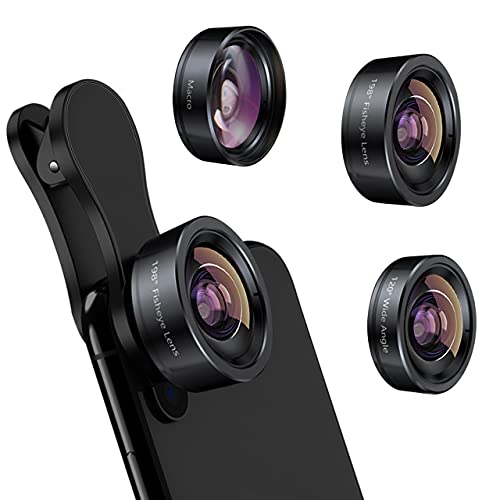
Top 3 picks at a glance

Quick Comparison
The six lenses below span every realistic way people arrive at the phrase “best wide angle camera lenses” — a phone clip-on kit, two DSLR screw-on attachments, a compact-camera conversion lens, a tiny FPV/security board lens, and a Raspberry Pi HQ camera lens. Matching the mount to your camera body is the first filter; everything else is negotiable.
| Product | Best for | Key specs | Price tier |
|---|---|---|---|
| KEYWING 3-in-1 Phone Camera Lens Kit | Phone shooters who want wide, fisheye and macro in one pocket case | 3 clip-on elements (fisheye + wide angle + macro), universal spring clip, works with most phone bodies over a naked or thin case | Budget |
| Lightdow 58mm 0.43x Wide Angle + Macro Attachment | Canon EOS owners wanting a cheap 0.43x field-of-view expansion on an existing 58mm-thread lens | 58mm rear thread, 0.43x converter factor, two-piece design that unscrews into a macro front element, includes front cap and pouch | Mid-range |
| Altura Photo 52mm Wide Angle Lens with Macro for Nikon DSLR | Nikon DSLR shooters on a 52mm filter thread who want wide plus close-up from one barrel | 52mm rear thread, wide-angle converter with detachable macro section, aluminium and optical-glass construction, carry pouch included | Mid-range |
| NEEWER Wide Angle Lens for Sony ZV-1 | Sony ZV-1 vloggers who need a wider selfie/desk framing without a new body | 2-in-1 wide + macro design, bayonet-style mount matched to the ZV-1 lens barrel, black frame, no adapter rings required | Premium |
| Xenocam FPV CCD Camera Lens 2.5mm 170° | FPV pilots, security builds and DIY camera rigs that need an extreme angle in a tiny barrel | 2.5mm focal length, 170° claimed diagonal field of view, low-distortion design, no IR-cut filter (passes infrared), M12-style board-lens class | Budget |
| Arducam 120° Ultra Wide CS Lens for Raspberry Pi HQ Camera | Raspberry Pi HQ camera builders shooting wide scenes, timelapse or machine vision | 3.2mm focal length, CS mount, 120° field of view class, manual focus ring, no autofocus, no electronics | Mid-range |
How We Chose
This roundup was assembled from manufacturer and retailer specifications, published focal-length and angle-of-view figures, and well-documented behaviour of each product class — screw-on converters, clip-on phone optics, board lenses and CS-mount lenses. Nobody here put these units on a test bench; the numbers cited are the ones the makers publish or that the category reliably delivers.
The first cut was mount compatibility, because a wide-angle lens that does not physically fit your camera is not a candidate regardless of how good its glass is. That immediately splits the list into four families: universal phone clips, threaded DSLR converters (52mm and 58mm), a model-specific compact-camera converter, and bare board/CS lenses for FPV and Raspberry Pi builds.
Second, we judged each item against the job it is actually sold for. A $30 phone clip-on earns its place if it widens a phone’s main camera without softening the centre; a 0.43x DSLR converter earns its place if it keeps the original lens’s filter thread usable and unscrews into a usable macro. We weighted edge behaviour, distortion character (barrel vs. acceptable wide look), whether the design accepts filters, and whether any autofocus is involved at all.
Third, upgrade path. A converter should not force you to buy a second set of filters, and a board lens should not require a mount adapter you cannot source. Products that locked the buyer into a dead end were down-weighted; products that reused existing threads, hoods or mounts were up-weighted.
Finally, price tiers reflect general market bands, not daily listings. Budget clip-ons and board lenses sit in the low tens; threaded converters and the Pi CS lens sit in the mid band; model-specific converters built for one camera sit at the top of this particular list.
1. KEYWING 3-in-1 Phone Camera Lens Kit – Best for Phone Shooters
As an Amazon Associate we earn from qualifying purchases at no extra cost to you.
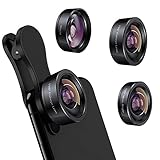
The KEYWING kit is the answer for someone whose only camera is the phone in their pocket and who wants three looks — ultra-wide, fisheye and macro — without buying a second device. It is a clip-on system: a spring-loaded clamp grips the phone body and centres a screw-in element over the main rear camera. Three elements ship in the box, usually in a small zip case with lens caps.
Key specs
- Type: 3-element clip-on conversion kit for phones
- Elements: fisheye, wide angle, macro (typically 10x-class close focus)
- Mount: universal spring clip, adjustable across common phone widths
- Case compatibility: works best on a bare phone or a very thin case; thick or heavily raised camera bumps can block centring
- Focus: none — the phone’s own autofocus does all the work
- Filter support: none
Strengths. The appeal is portability and price. A kit like this lives in a jacket pocket and turns a phone’s already-wide main camera into something closer to an action-camera field of view, or produces the heavy circular fisheye look that phone software cannot fake convincingly. The macro element is genuinely useful for photographing documents, plants, coins and small electronics, because it forces the phone to focus far closer than its native minimum distance. Because the elements are manually swapped, you choose the look before you shoot rather than cropping afterwards, which preserves full sensor resolution for that frame.
The clip design also means the kit is not tied to one phone. Upgrade the handset and the kit still works, which is unusual in this price band. For travel, hiking or a casual interior shot where you cannot step back any further, that is most of what you need.
Pros
- Three distinct focal looks in one small case
- No mount adapter, no electronics, nothing to charge
- Carries over between phone models
- Macro mode genuinely extends close-focus beyond the phone’s native limit
- Lowest cost of entry on this list
Cons
- Image quality depends entirely on the phone’s own lens and sensor behind it
- Centring the element over the correct camera is fussy on multi-camera phones
- Thick cases and large camera bumps cause misalignment and corner vignetting
- Adds a small amount of flare and edge softness, especially into backlight
- No filter thread, so no ND or polariser for video
Compared with the nearest alternative. Against the NEEWER ZV-1 converter, the KEYWING trades optical quality and a rigid mount for universality and a fraction of the cost. The NEEWER is bolted to one specific camera’s lens barrel and will not vignette or drift; the KEYWING is a clip that can shift if you bump it, but it works on whatever phone you own this year and the next. If your camera is an actual ZV-1, buy the NEEWER. If your camera is a phone, the KEYWING is the rational pick.
2. Lightdow 58mm 0.43x Wide Angle + Macro Attachment – Best for Canon EOS Owners
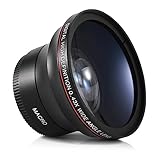
The Lightdow 58mm attachment is a screw-on converter: you thread it onto the front of an existing lens that takes 58mm filters, and it multiplies the field of view by roughly 0.43x. It is sold as a two-piece unit — the wide-angle section unscrews and leaves a macro element behind, so one purchase covers two jobs.
Key specs
- Type: threaded front-mount wide-angle converter with detachable macro element
- Rear thread: 58mm (fits any lens with a 58mm filter thread)
- Conversion factor: 0.43x claimed
- Construction: multi-element optical glass in a metal barrel, front cap and carry pouch included
- Focus: none — the host lens retains autofocus and manual focus
- Filter support: front element generally does not accept a standard filter thread; plan to remove it before fitting filters
Worked example of what 0.43x actually buys you. Take a very common pairing: an APS-C Canon body with the 18-55mm kit lens set to 18mm. Its diagonal field of view on APS-C is roughly 74°. Multiply the focal length by the converter factor and you are effectively at about 7.7mm, which on the same sensor lands near 110° diagonal — almost a third more of the scene edge to edge. In a small room, that is the difference between capturing two people at a table and capturing the whole table plus the window. On a full-frame body at 24mm, 0.43x behaves like roughly 10mm, which is genuinely ultra-wide territory and starts to show pronounced barrel curvature at the frame edges.
That example is also the honest limitation. A converter does not add information the host lens never resolved; it spreads the same image circle wider, so centre sharpness holds reasonably well while corners soften and curvature increases. On a 24MP sensor you will see it. On a 12MP sensor you mostly will not.
Strengths. This is the cheapest credible way to widen a Canon kit lens you already own, and it keeps the host lens’s autofocus, image stabilisation and EXIF working normally. The detachable macro section is the sleeper feature: unscrew the wide element and the remaining piece gets you much closer than the host lens’s native minimum focus distance, which is ideal for texture, product and detail shots. The metal barrel and included caps suggest it will survive a camera bag.
Pros
- One purchase covers wide angle and macro
- Retains host-lens autofocus and stabilisation
- Screws straight onto any 58mm-threaded lens
- Substantial field-of-view increase for interiors and group shots
- Robust metal build with caps and pouch supplied
Cons
- Corner softness and barrel distortion increase noticeably
- Only fits 58mm threads — other diameters need a step-up or step-down ring
- Adds weight and length to the front of the lens
- Flare resistance is worse than the host lens on its own
- No electronic communication, so no correction profile is applied
Compared with the nearest alternative. The Altura Photo 52mm converter is the direct sibling — same concept, different thread diameter. If your Canon lenses take 58mm filters, take the Lightdow; if you are on Nikon glass with 52mm threads, take the Altura. Buying the wrong thread diameter and stacking adapters is where people go wrong, so measure your lens cap first — it is printed on the front of the lens or inside the cap.
3. Altura Photo 52mm Wide Angle Lens with Macro for Nikon DSLR – Best for Nikon DSLR Shooters
Altura Photo’s 52mm converter does for 52mm-threaded Nikon lenses exactly what the Lightdow does for 58mm threads: it screws onto the front of an existing lens and widens the view, and the front section detaches to leave a macro attachment. It is a Nikon-oriented listing, but the physics are mount-agnostic — it fits any lens with a 52mm filter thread, which includes a large number of Nikon kit and prime lenses.
Key specs
- Type: threaded wide-angle converter with detachable macro element
- Rear thread: 52mm
- Construction: optical glass elements in an aluminium barrel, pouch included
- Focus: fully passive — host lens autofocus and VR continue to operate
- Filter support: not designed to stack filters on the front
Strengths. The value case is strongest for anyone holding a 52mm-threaded kit zoom. Many Nikon 18-55mm-class lenses use 52mm threads, which makes this a near drop-in wide-angle solution for a body you already own. Because there are no electronics, there is nothing to fail, nothing to update, and nothing to configure — you screw it on, and the camera continues to autofocus through it as if it were a filter.
The detachable macro half behaves the same way as the Lightdow’s: it shortens the practical minimum focus distance of the host lens, which is useful for flowers, food, jewellery and product photography where a true macro lens is overkill. For a hobbyist building a small kit, that is two focal capabilities from one accessory.
Practical notes that a spec sheet will not tell you: fit the converter with the lens focused at its longest focal length first, screw it down gently, and only then zoom out. Threading a converter onto a zoom at the wide end can make it bind. Also expect the front element to be relatively exposed — the included pouch matters because these converters scratch more easily than a coated prime.
Pros
- Direct fit for the many Nikon lenses with 52mm filter threads
- Wide angle and macro from a single accessory
- No electronics means no firmware or compatibility issues
- Aluminium barrel is more durable than plastic clip-on alternatives
- Very low cost relative to buying a dedicated wide-angle lens
Cons
- 52mm only; larger lenses need step rings
- Edge sharpness and distortion are visibly worse than a native wide lens
- Adds flare potential, especially with the sun near frame edge
- No filter thread on the front for ND or polariser use
- On a 24MP+ sensor the drop in corner resolution is easy to spot
Compared with the nearest alternative. Against the Lightdow 58mm, the choice is purely mechanical: match the thread to the lens you own. Optically they are the same class of product. If you shoot two systems, buying one of each is often cheaper than buying step rings for every lens you own — and step rings on a wide converter can cause vignetting you would not otherwise get.
4. NEEWER Wide Angle Lens for Sony ZV-1 – Best for Sony ZV-1 Vloggers
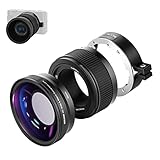
The NEEWER 2-in-1 wide-angle lens for the Sony ZV-1 is a model-specific converter: it mounts to the ZV-1’s lens barrel rather than to a filter thread, in a black frame, and widens the shot for vlogging, selfies and desk setups. The second half of the 2-in-1 is a macro element for close-up work.
Key specs
- Type: camera-specific conversion lens with wide-angle and macro functions
- Mount: attaches to the ZV-1 lens barrel — no step rings or filter adapters
- Finish: black frame to match the body
- Focus: passive; the camera’s own autofocus continues to operate
- Use case: handheld vlogging, talking-head framing, tabletop and product video
Why the ZV-1 specifically benefits. The ZV-1’s lens is a relatively narrow zoom at the wide end for arm’s-length shooting. The practical consequence for a vlogger is that at arm’s length you either crop your own head or your background is nothing but your face. A wide converter changes the arithmetic: instead of backing into a wall, you get more environment around you while keeping the camera where your arm can hold it. That is the entire reason this product exists, and it is the scenario it should be judged against — not against a full-frame 16-35mm.
Because the mount is made for this one camera, it cannot be mis-centred or knocked askew the way a universal clip can. That matters more for video than stills: a clip that shifts mid-take ruins the take, whereas a rigid bayonet-style fit does not move. The macro half is a bonus for shooting small objects on a desk, product details, or hands demonstrating something on camera.
Pros
- Rigid, purpose-built fit — no slipping or mis-centring
- Meaningfully wider vlogging framing at arm’s length
- Black frame blends in with the camera body on camera
- Second element provides a usable macro function
- Keeps the host camera’s autofocus, stabilisation and menus untouched
Cons
- Works only with the Sony ZV-1 — no other camera, no other body
- Highest price tier of the six products here for a single-camera accessory
- Adds front weight and bulk to a camera designed to be pocketable
- No filter thread, so ND for bright-day video is awkward
- Image quality still depends on the host lens behind it
Compared with the nearest alternative. The KEYWING kit is the obvious cross-shop: a third of the concept, a fraction of the money, and applicable to any phone. The trade is rigidity and centring accuracy. If you already own a ZV-1 and shoot to camera, the NEEWER solves a specific framing problem with no fiddling. If you might switch cameras next year, the KEYWING or a threaded converter is the more future-proof spend.
5. Xenocam FPV CCD Camera Lens 2.5mm 170° – Best for FPV and DIY Camera Builds
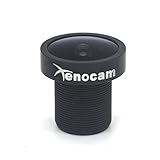
The Xenocam 2.5mm lens is a completely different animal from everything above. It is a small board-style lens intended for FPV cameras, security modules and DIY rigs, specified at 2.5mm focal length with a claimed 170° field of view and a low-distortion design. Critically, it ships without an infrared-cut filter, which means it passes infrared light rather than blocking it.
Key specs
- Focal length: 2.5mm
- Field of view: 170° claimed (diagonal)
- IR filter: none — infrared passes through to the sensor
- Distortion: described as low-distortion for its class
- Class: tiny board lens for FPV, security and embedded camera modules
- Focus: manual, set by threading the barrel in or out, then locked
What “no IR filter” actually means in practice. This is the single most misunderstood line on the listing. Without an IR-cut filter, near-infrared light reaches the sensor alongside visible light. Two consequences follow. First, colours shift — foliage and skin often render differently, and anything that reflects IR strongly looks brighter than it does to your eye. Second, in low light the extra IR does raise apparent brightness, which is why security and machine-vision builds sometimes deliberately want a lens like this. If you are buying for normal colour footage, you need an IR-cut filter elsewhere in the optical path, or you will spend an afternoon wondering why your white balance will not settle. If you are buying for night-time IR illumination or sensor experiments, the missing filter is the feature.
Strengths. The extreme 170° angle in a barrel this small is the point: you get an almost hemispherical view from a camera module no bigger than a coin, which is exactly what FPV pilots and embedded-camera builders need. Manual focus by rotating the barrel gives you hard-set focus you can lock and forget, which is more reliable than autofocus hunting in a vibrating airframe. Low-distortion claims matter at this angle, because software de-warping a strongly barrel-distorted 170° image costs resolution and processing time on a small embedded board.
Pros
- Extreme wide angle for FPV, security and machine-vision use
- Very small and light — negligible payload on a drone or gimbal
- Manual focus is lockable and repeatable
- No IR filter suits night-vision and IR-illumination builds
- Lowest-cost tier in this roundup
Cons
- No IR-cut filter causes colour casts for normal daytime footage
- No autofocus at all
- Requires a compatible board/CS-style camera module, not a mirrorless or DSLR body
- Thread and mount dimensions must be verified against your module before ordering
- Not a general-purpose photography lens by any measure
Compared with the nearest alternative. The Arducam CS lens is the other non-photographic lens on this list. The difference is the ecosystem: the Arducam is a CS-mount lens designed for the Raspberry Pi HQ camera’s larger sensor and manual-focus workflow, while the Xenocam is a tiny board lens for compact FPV/security modules. If you are building on a Pi HQ camera, the Arducam is the fit; if you are building a drone or an embedded camera module, the Xenocam is the fit. They are not interchangeable.
6. Arducam 120° Ultra Wide CS Lens for Raspberry Pi HQ Camera – Best for Raspberry Pi Builders

The Arducam 3.2mm CS lens is made for the Raspberry Pi HQ camera. It is an ultra-wide, manual-focus, fully mechanical lens: no electronics, no autofocus, no communication with the board. You focus it by hand using the focus ring and lock it where you want it.
Key specs
- Focal length: 3.2mm
- Field of view: roughly 120° class
- Mount: CS mount, matched to the Raspberry Pi HQ camera
- Focus: manual focus ring, no autofocus
- Electronics: none — no firmware, no board-side configuration
Why manual focus suits a Pi project. Autofocus is a liability when the camera is bolted to a fixed rig — a 3D-printer enclosure, a weather box, an overhead timelapse arm. Manual focus lets you set the plane once with a focus-peaking overlay in the software preview, then tighten the ring and leave it. Nothing drifts, nothing hunts, and the frame is identical on every capture, which is exactly what timelapse and machine-vision pipelines need.
A wide field of view also does work that a narrower lens cannot in this context: an overhead Pi camera watching a full desk, a print bed, or a doorway needs to see the whole area without being moved back. Roughly 120° from a 3.2mm lens covers that. Expect barrel curvature at the frame edges — it is inherent to wide lenses at this focal length, and on a Pi you generally correct it in software rather than optically, which costs a little resolution at the corners. Build that into your resolution budget: if you are capturing 12MP stills, plan for corner cropping after de-warp.
Strengths. The lens is simple, cheap for its class, and utterly predictable. There is no firmware to fight, no compatibility matrix, and no electronics to fail on a rig that runs unattended for weeks. CS mount also means you can swap between lenses as your project changes without touching the board, and the manual focus ring gives enough travel to set focus precisely rather than approximately.
Pros
- Purpose-built for the Raspberry Pi HQ camera’s CS mount
- Wide 120°-class coverage from a short 3.2mm focal length
- Manual focus ring is repeatable and stays put
- No electronics means nothing to configure or update
- Good value for a dedicated ultra-wide module lens
Cons
- No autofocus whatsoever — unsuitable for handheld casual shooting
- Barrel distortion requires software correction for straight-line subjects
- Restricted to CS-mount camera modules, mainly the Pi HQ camera
- Manual focus takes time to nail with a wide depth of field
- Not usable on a mirrorless, DSLR or phone
Compared with the nearest alternative. Against the Xenocam 2.5mm, the Arducam trades a wider claimed angle for a larger, better-supported sensor platform and a focus ring built for repeatable setting. If your project is a Raspberry Pi, the Arducam is the correct ecosystem. If your project is a tiny FPV or security module, the Xenocam’s board-lens form factor is what you need.
How to Choose
Wide-angle buying goes wrong in one of two ways: the lens does not fit, or it fits but is the wrong kind of wide for the job. Work through the criteria below in order and most of the decision makes itself.
Step 1: Identify the mount before anything else
Mount format eliminates more candidates than any other factor. There are four families in this roundup and they do not overlap:
- Universal phone clip — no thread, no bayonet. Works on almost any phone, alignment depends on your hand and your case.
- Threaded converter — screws onto a filter thread. The two here are 52mm and 58mm. Look at the front of your lens or inside the lens cap: the diameter is printed there.
- Camera-specific bayonet — made for one model, in this case the Sony ZV-1. Rigid, accurate, no alternatives.
- CS mount or board lens — for Raspberry Pi HQ cameras and small FPV/security modules. Never fits a consumer camera body.
If you cannot state the mount of your camera in one sentence, stop and find out. Buying a 52mm converter for a 58mm lens and then stacking a step-down ring introduces vignetting and mechanical strain for no benefit.
Step 2: Decide what “wide” means in degrees, not adjectives
Adjectives are useless here. Convert the options into approximate diagonal field of view:
- Standard phone main camera: roughly 70–80°
- Phone with clip-on wide element: adds meaningfully — often to around 100–110°
- 0.43x DSLR converter on an 18mm APS-C kit zoom: approximately 110° (see the worked example above)
- Dedicated ultra-wide on APS-C: roughly 100–115° depending on focal length
- Pi CS lens at 3.2mm: approximately 120° class
- FPV board lens at 2.5mm: up to 170° claimed
For landscapes, 100–115° is the sweet spot: enough sweep for a horizon and foreground, not so much that mountains in the corners stretch unnaturally. For interiors, more is better up to a point — you need to clear walls, and barrel curvature is usually masked by the room’s own vertical lines if you keep the camera level. For video and vlogging, 100–120° is the practical band, because the narrower end is unusable at arm’s length and the wider end makes faces at the edge look distorted. For FPV and machine vision, the wider the better, and distortion is corrected in software or simply accepted.
Step 3: Understand what a converter cannot do
All three threaded and clip-on products here are converters, not lenses. A converter takes the image the host lens already produces and spreads it over a wider angle. It does not increase resolution, does not reduce noise, and does not improve the host lens’s weakest characteristic. The practical consequences:
- Corners soften. The host lens’s corner performance was already its weakest area; the converter moves that weak area further out and stretches it. On a 24MP body this is visible. On a 12MP body it is largely hidden.
- Barrel distortion increases. Straight lines near the frame edge bow outward. For architecture, either keep the camera perfectly level so verticals stay vertical, or accept it and correct in post.
- Flare gets worse. More glass surfaces in front of the lens means more internal reflections. Shoot with the sun behind you or well outside the frame.
- Autofocus still works. This is the good news — because there are no electronics, a passive converter does not interfere with the camera’s AF, stabilisation or metering.
If you need corner-to-corner sharpness at a wide angle and you are shooting a 24MP+ body, no converter on this list will satisfy you. Budget for a native wide-angle lens instead, or accept a lower-resolution deliverable by shooting at a reduced size.
Step 4: Match aperture thinking to the job
None of these products change the aperture of the host lens, which matters because wide angle and light gathering are separate questions. For landscapes you will usually be at f/8 to f/11 for depth of field, and the converter’s corner softness partly disappears when stopped down. For interiors and video you want the widest available aperture, often f/2.8 to f/4, because you are indoors and want either a usable shutter speed or a clean ISO. For FPV and machine vision, light is whatever the scene gives you and you will be running wide open — the board lens’s fixed aperture is simply your reality.
One number worth keeping in mind: if you want a 1/50s shutter for smooth 24p video in normal indoor light, you need either a bright lens or a lot of light. A wide-angle converter on a slow kit zoom will push you to raise ISO, and at high ISO on a small sensor the corners will look worse than the optics alone would suggest.
Step 5: Plan filter support before you buy
Filter support is the most commonly overlooked specification. Converters screw onto the front of your lens and generally do not provide a filter thread of their own, which means:
- No polariser for cutting reflections or deepening skies unless you remove the converter.
- No ND for long exposures or for keeping shutter speed sensible in bright light during video.
- Any filter you own becomes unusable while the converter is mounted.
If your workflow depends on a polariser — landscape shooters working near water, anyone shooting through glass — decide whether you can live without it during wide shots. Some people carry a second host lens with its own filter thread and simply switch. The alternative is a matte box or a filter holder rig, which costs more than the converter.
Step 6: Autofocus performance — who has it and who does not
Be explicit about this, because it decides whether a product is usable for you:
| Product | Autofocus | How focus is achieved | Rigid mount? |
|---|---|---|---|
| KEYWING 3-in-1 phone kit | Yes (via phone) | Phone’s own AF, element is passive | No — spring clip |
| Lightdow 58mm converter | Yes (via host lens) | Host lens AF, converter is passive | Yes — threaded |
| Altura Photo 52mm converter | Yes (via host lens) | Host lens AF, converter is passive | Yes — threaded |
| NEEWER ZV-1 converter | Yes (via camera) | Camera AF, converter is passive | Yes — model-specific mount |
| Xenocam 2.5mm board lens | No | Manual barrel focus, lockable | Yes — threaded into module |
| Arducam 3.2mm CS lens | No | Manual focus ring | Yes — CS bayonet |
The pattern is simple: consumer-facing wide converters are passive and rely on the camera for focus, which is why they are cheap and why they do not break AF. Embedded and board lenses are manual, because the platforms they serve are fixed-position and set-and-forget.
Step 7: Edge sharpness and distortion — what you can and cannot fix
Distortion is correctable. Sharpness is not. If your wide angle shows barrel curvature, most editors have a lens profile or a manual distortion slider that straightens it, at the cost of a small crop. If your corners are soft, no slider will restore detail that was never captured. This is why landscapes — where corners contain important texture and the horizon is a straight line — are the hardest test for a converter, while interiors, video and people-focused shots are the easiest.
A practical, unscientific check you can run yourself on any converter: shoot a brick wall square-on, then compare the centre and the corners at 100% on a decent monitor. If the corners are acceptable to you at your normal viewing size, the converter is fine for your purposes. If they are not, you have learned the key fact in two minutes.
Step 8: Upgrade path
Ask what happens when your needs grow. A phone clip kit survives a phone upgrade, which is unusually good value. Threaded converters survive a body upgrade as long as you keep lenses with the same thread diameter — but a move to a different system often means different filter sizes, so a step ring may be needed. The model-specific ZV-1 converter dies with the camera. The two board/CS lenses are tied to their platforms. If you expect to change systems within two years, weight the universal and threaded options more heavily.
Frequently Asked Questions
Will a 0.43x wide-angle converter make my photos look distorted?
It will increase barrel distortion — straight lines near the frame edges bow outward. How much you notice depends on the subject: architecture shows it immediately, while landscapes, interiors shot level, and people-centred images often hide it completely. Most editing software can correct it with a manual distortion slider, at the cost of a small crop.
Can I stack a wide-angle converter on top of a UV filter I already own?
Technically yes if the threads match, but it is a bad idea. Each extra glass-to-air surface increases flare and reduces contrast, and stacking two elements in front of a lens multiplies the mechanical load and vignetting risk. Remove the UV filter, fit the converter directly to the lens, and re-fit the filter when you are done.
Why does the Xenocam lens say it has no infrared filter, and does that matter?
It means near-infrared light reaches the sensor along with visible light. For normal daytime colour photography that causes colour shifts and unpredictable white balance, so you would need an IR-cut filter elsewhere in the optical path. For FPV night flying with IR illumination, security cameras, and sensor experiments, passing infrared is exactly the desired behaviour.
Do clip-on phone lenses work on phones with multiple rear cameras?
They work, but alignment is the hard part. Multi-camera phones have the lenses clustered at different points, and the clip has to be positioned over the correct one. Thick cases and raised camera bumps make this harder and can cause corner vignetting. It is easiest on a bare phone or a very thin case, and you should check the framing on screen before every serious shot.
Is a wide-angle converter better than just stepping backwards?
They solve different problems. Stepping back preserves optical quality and costs nothing, so do it whenever the space allows. A converter is for when you physically cannot step back — small interiors, a cliff edge, a crowded street, a vlogging arm’s length — or when you want more background context around a subject without changing your shooting distance.
Can I use a CS-mount lens like the Arducam on a regular mirrorless camera?
No. CS-mount lenses are designed for board cameras and modules such as the Raspberry Pi HQ camera, and their flange distance and image circle will not work on a mirrorless or DSLR body. They are a separate ecosystem with separate mounts, and no adapter makes them interoperate sensibly.
What aperture should I use with a wide-angle converter for landscapes?
f/8 to f/11 is the usual range: it gives you deep depth of field and partially mitigates the converter’s corner softness, because most lenses are sharpest at their mid apertures. Going to f/16 or beyond tends to reintroduce softness through diffraction, which is worse than the converter’s own contribution.
Do I need a polarsing filter for wide-angle landscape work?
A polariser is one of the most useful filters for landscapes — it cuts haze, reduces reflections and deepens skies — but wide-angle converters generally do not accept one, and polarisers behave inconsistently across very wide fields of view anyway, producing uneven sky darkening. If a polariser is essential to your workflow, shoot wide with your native lens rather than a converter.
Which One Should You Buy?
If your camera is a phone: take the KEYWING 3-in-1 kit. Three focal looks, tiny footprint, and it survives your next phone upgrade. Nothing else on this list applies to you.
If you shoot Canon with 58mm threads: the Lightdow 0.43x is the straightforward pick, and its detachable macro half makes it two accessories in one. If you shoot Nikon with 52mm threads: the Altura Photo is the same product for your mount — measure your lens cap before ordering either.
If you own a Sony ZV-1 and vlog to camera: the NEEWER is the only converter here that is rigidly built for your exact camera, and the framing improvement at arm’s length is the whole point. Accept the single-camera limitation as the price of that fit.
If you are building a Raspberry Pi HQ camera rig: the Arducam 3.2mm CS lens gives you a wide, manual-focus, zero-electronics solution that will behave identically on every capture. If you are building an FPV or embedded module: the Xenocam 2.5mm is the extreme-angle, no-IR-filter lens that category calls for — just be certain you want infrared, or plan for an IR-cut filter.
Whoever you are, verify two numbers before you buy: the mount or thread diameter of your camera, and what fraction of your frame the corners need to be sharp. Those two answers decide more than any specification table.


