- Top Pick: PlayStation VR2 (PSVR2)
- Runner-up: Final verdict
- Also consider: Final verdict
VR headsets now split into two camps. Standalone models carry their own processor and game library, so they work anywhere with no PC in the room. PC VR headsets lean on a gaming rig for heavier graphics, wider SteamVR libraries and simulation titles that standalone hardware cannot run. A few headsets, including two below, can do both jobs.
This guide compares five current headsets across both camps: two Meta Quest models for standalone and PC play, Sony’s PlayStation VR2 for PS5 owners who also want a PC option, and two enthusiast headsets from Pimax and HTC built around high-resolution PC VR. Each entry lists the specifications shown on its Amazon listing so you can compare resolution, tracking and platform requirements side by side.
As an Amazon Associate, we earn from qualifying purchases.
Our Top Picks
Top 3 picks at a glance
Quick answer
For most players, the Meta Quest 3 is the safest single purchase because it runs a large standalone library and connects to a PC for SteamVR. The Quest 3S covers the same ground at a lower tier, the PS VR2 suits PS5 owners, and the Pimax Crystal Light and HTC Vive Focus Vision target high-resolution PC VR.
Meta Quest 3 512GB
The Quest 3 is Meta’s flagship all-in-one headset and the most flexible pick in this roundup. It runs games and apps on its own Snapdragon XR2 Gen 2 processor, so no PC or console is required, and the 512GB of storage holds a large installed library without constant deleting. When you do own a gaming PC, the same headset connects by cable or wirelessly through Air Link to play PC VR titles, which makes it a genuine two-platform device rather than a compromise.
Its pancake-lens display runs at 2064 x 2208 pixels per eye, and dual RGB color cameras provide full-color passthrough for mixed reality apps that blend virtual objects into your room. Touch Plus controllers are included in the box, along with a charging cable and power adapter, per the listing.
Specs
- Storage: 512 GB
- Processor: Snapdragon XR2 Gen 2
- Memory: 8 GB RAM
- Resolution: 2064 x 2208 pixels per eye
- Operating system: Meta Horizon OS
- Passthrough: dual RGB color cameras, full color
- Controllers: Touch Plus controllers included
- PC connection: Link cable or Air Link (VR-ready PC required)
- Battery life and weight: confirm on the listing
Meta Quest 3S 256GB
The Quest 3S is the entry point into the same Meta ecosystem. It uses the same Snapdragon XR2 Gen 2 processor and 8 GB of memory as the Quest 3, so standalone games run on identical silicon, and it connects to a PC through Air Link or a Link cable in the same way. The savings come from the optics and display: the 3S uses Fresnel lenses at 1832 x 1920 pixels per eye, a step down in sharpness from the Quest 3 that matters most for small text and distant detail.
This 256GB listing includes Batman: Arkham Shadow and a three-month trial of Meta Horizon+ according to the product title, which softens the first months of building a library. Meta rates the battery at up to 2.5 hours of average use, so longer sessions need a charging break or a battery accessory. For a first headset, or a second headset for a household, it covers the essentials well.
Specs
- Storage: 256 GB
- Processor: Snapdragon XR2 Gen 2
- Memory: 8 GB RAM
- Resolution: 1832 x 1920 pixels per eye
- Lenses: Fresnel
- Battery: up to 2.5 hours average use, per Meta
- Controllers: Touch Plus controllers included
- Included in listing title: Batman: Arkham Shadow and a 3-month Meta Horizon+ trial
- PC connection: Air Link or Link cable (VR-ready PC required)
PlayStation VR2 (PSVR2)
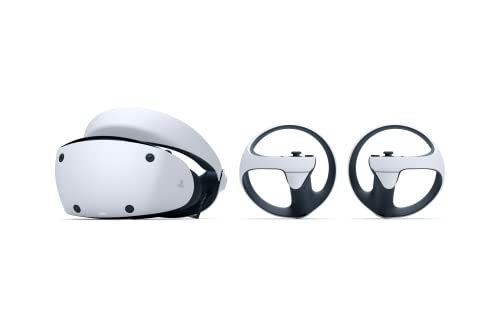
Sony’s PS VR2 is built for the PlayStation 5 first. It connects to the console with a single USB-C cable, needs no external camera, and renders at 2000 x 2040 pixels per eye with a 110-degree field of view. Its Sense technology adds eye tracking, headset feedback and 3D Audio, and the Sense controllers bring haptic feedback, adaptive triggers and finger touch detection that most PC headsets do not match.
PC players are not locked out: Sony supports PS VR2 on Windows through its separate PlayStation VR2 PC adapter, which opens the SteamVR library. That adapter is an extra purchase, and some features behave differently on PC, so check the listing and Sony’s adapter notes before planning around it. If your gaming already centers on a PS5, this is the natural headset; if you have no PS5, the Quest line is the simpler route.
Specs
- Resolution: 2000 x 2040 pixels per eye maximum display resolution
- Field of view: 110 degrees
- Features: eye tracking, headset feedback, 3D Audio
- Controllers: PS VR2 Sense controllers with haptic feedback, adaptive triggers and finger touch detection
- Platform: PlayStation 5
- Connection: single USB-C cable to PS5
- PC use: supported through the PlayStation VR2 PC adapter, sold separately
- Refresh rate: confirm on the listing
Pimax Crystal Light Prime PCVR Headset
The Crystal Light is a dedicated PC VR headset aimed at flight simulation and racing fans who read cockpit instruments and distant apexes for hours. Its QLED panels deliver 2880 x 2880 pixels per eye with local dimming, the highest resolution in this guide, fed by a wired DisplayPort connection from your PC so there is no wireless compression and no battery to manage mid-session.
Tracking is inside-out on this listing, so no base stations are required, and Pimax offers an optional Lighthouse faceplate for owners who already run SteamVR base stations. The trade-offs are a real setup process, a powerful GPU requirement to drive that resolution, and Pimax’s Prime program on this particular listing variant. Read the listing terms carefully so you know exactly which version and payment structure you are ordering.
Specs
- Resolution: 2880 x 2880 pixels per eye
- Display: QLED with local dimming
- Connection: wired DisplayPort to PC
- Tracking: inside-out; optional Lighthouse faceplate for SteamVR base stations
- Platform: PC, SteamVR compatible
- Weight: around 650 g, per the listing details
- Refresh rate: up to 120 Hz modes listed; confirm the exact modes on the listing
- Field of view and controller bundle contents: confirm on the listing
HTC Vive Focus Vision
The Vive Focus Vision is HTC’s premium hybrid: a standalone headset that also serves PC VR. Its displays run at 2448 x 2448 pixels per eye with up to a 120-degree field of view, it carries built-in eye tracking, and the battery is hot-swappable, which suits long sessions and shared or work-adjacent use better than a fixed internal cell.
For PC play it streams through VIVE Streaming over USB-C or Wi-Fi. A fully wired DisplayPort mode exists, but it requires HTC’s optional VIVE Wired Streaming Kit, so budget for that accessory if lossless wired PC VR is the main reason you are buying. Standalone performance rests on the older Snapdragon XR2 generation rather than the Gen 2 chip in the Quest 3, so treat this primarily as a PC VR and mixed reality headset with standalone as a bonus.
Specs
- Resolution: 2448 x 2448 pixels per eye
- Field of view: up to 120 degrees
- Refresh rate: 90 Hz; higher PC VR rate via DisplayPort mode, per the listing notes
- Storage: 128 GB
- Tracking: inside-out with eye tracking
- Battery: hot-swappable battery cradle
- Controllers: two 6DoF controllers included
- PC connection: VIVE Streaming by cable or Wi-Fi; DisplayPort mode needs the optional VIVE Wired Streaming Kit
How to choose
Start with the platform you already own. A gaming PC unlocks every headset here; a PS5 points to the PS VR2; no gaming hardware at all points to a Quest. Next, weigh resolution against convenience. Standalone headsets top out below dedicated PC VR panels, so sim racers and flight sim players who read fine detail should look at the Crystal Light or Focus Vision, while room-scale action games feel fine on a Quest.
Then check the practicalities. Wired DisplayPort headsets never run out of battery but tether you to the PC. Standalone headsets are portable but run roughly two to three hours per charge. Confirm your PC meets the headset maker’s requirements, especially the graphics card and the DisplayPort output, before ordering a PC VR model. Finally, follow the manufacturer age guidance printed on the listing and in the box: VR makers publish minimum ages and supervision advice, and younger players should use the parental controls each platform provides.
Who should skip
Skip VR entirely if you are prone to motion sickness and have never tolerated a headset demo, or if your play space cannot give you a clear, safe boundary area. Skip the PC VR models if your PC sits below the listed requirements, since upgrading a graphics card costs more than the headset decision itself. Skip the PS VR2 if you do not own a PS5, and skip premium hybrids like the Focus Vision if standalone gaming is your only goal, because the Quest 3S does that job for far less commitment.
FAQ
Do I need a gaming PC to use these headsets?
Only some of them. The Quest 3, Quest 3S and Vive Focus Vision run standalone with no PC. The Pimax Crystal Light is PC-only, and the PS VR2 needs a PS5, or a PC with Sony’s separate adapter.
Can the Meta Quest headsets play SteamVR games?
Yes. Both Quest models connect to a VR-ready PC with a Link cable or wirelessly through Air Link, and then behave as PC VR headsets for SteamVR and other PC libraries while standalone games stay on the headset itself.
What age are VR headsets suitable for?
Each maker publishes its own age guidance on the listing and packaging, and platforms such as Meta’s offer parent-managed accounts and supervision tools. Check the guidance for the specific headset before buying for a younger player, and plan on supervised, shorter sessions.
How much play space do I need?
Room-scale games work best with a clear area you can set as a guardian or boundary, while many titles also offer seated or standing modes that need little more than arm’s reach. Check each game’s store page for its stated play-area requirements before buying.
Final verdict
Buy the Quest 3 if you want one headset that covers standalone and PC VR with the least friction. Choose the Quest 3S for a first or second headset, the PS VR2 if a PS5 is your main platform, the Crystal Light for maximum PC VR clarity in simulators, and the Focus Vision if you want eye tracking and swappable batteries in a hybrid. Match the headset to the hardware you already own and the choice mostly makes itself.


Related guides
More from Amazon
Programs that pair well with the guide above. Offers and eligibility are set by Amazon and may change.
Free shipping on eligible items, Prime Video and more. Eligible new members can start with a free trial.
Start a Prime free trialAd-free music streaming. Eligible new subscribers can start with a free trial.
Try Music Unlimited freeA Prime membership for ages 18-24 with a trial period. Eligibility is set by Amazon.
See Prime for Young AdultsAudiobooks and podcasts to listen to on the go. Eligible new members can start with a free trial.
Try Audible freeAs an Amazon Associate we earn from qualifying purchases.