Disclosure: As an Amazon Associate, I earn from qualifying purchases. If you buy through links in this article, I may earn a commission at no extra cost to you.
Our top pick: Rigol DS1054Z. Runner-up: Rigol DHO804.
An oscilloscope is the one bench instrument that shows you what a circuit is actually doing instead of what you hope it is doing. A multimeter tells you a rail sits at 3.3 volts; a scope shows you the ripple riding on that rail, the ringing on a switching node, and the exact moment a serial line changes state. Whether you are debugging a microcontroller project, repairing audio gear, or tracing a fault on a game console board, the right scope turns guesswork into evidence.
This guide compares five genuinely different instruments: two four-channel Rigol bench scopes from different generations, a fast two-channel Siglent, a value-focused Hantek, and a battery-powered FNIRSI tablet scope for work away from the bench. Each suits a different mix of budget, bench space, and signal speed.
Top 3 picks at a glance

How to Choose an Oscilloscope
Bandwidth is the headline number, and the most misunderstood. It describes the highest sine-wave frequency the scope can display without serious attenuation; a 100 MHz scope shows a 100 MHz sine wave at roughly 70 percent of its true amplitude. For square waves and digital edges, built from higher harmonics, a common rule of thumb is three to five times the bandwidth of the fastest signal you plan to measure. For Arduino-class projects, I2C and SPI buses, audio work, and power-supply troubleshooting, 50 to 100 MHz is plenty. Faster logic and switch-mode converter edges push you toward 200 MHz.
Sample rate determines how finely the scope slices time. Look for at least 1 GSa/s on a bench scope, and check whether that figure is per channel or shared, because many scopes halve the rate when you enable a second channel. Memory depth matters just as much: a deep record, measured in Mpts, lets you capture a long event at full sample rate and zoom into the interesting part afterward.
Channels are simpler: two channels handle most hobby and repair work, but four channels make life much easier when you need to watch a clock, data line, chip-select, and output at the same time, which is exactly the situation serial-bus debugging creates.
Bench vs handheld is a question of where the work happens. Bench scopes offer bigger screens, better front ends, deeper memory, and mains power for long sessions. Handheld and tablet scopes run on batteries and fit in a tool bag for automotive or field diagnostics. The trade-off is that budget handhelds often advertise headline bandwidth and sample-rate figures that independent teardowns have measured as optimistic, so treat their top-end claims with skepticism.
Finally, consider the extras that affect daily use: serial decoding for I2C, SPI, and UART; FFT for a quick look at noise and harmonics; and waveform update rate for catching glitches.
The Five Picks
1. Rigol DS1054Z — The Proven Four-Channel Starter Bench Scope

The DS1054Z has been the default first serious oscilloscope for a decade, and it still earns that spot. Four channels at 50 MHz with a shared 1 GSa/s sample rate covers the overwhelming majority of hobby, educational, and repair work, and its 12 Mpts of memory (expandable to 24 Mpts) is generous for its class. The 7-inch display is not a touchscreen, but the front panel is logically laid out, and the enormous community around this model means every question you will ever have has already been answered somewhere.
Serial triggering and decoding is built in for common buses, and intensity grading gives the display an almost analog feel for spotting intermittent glitches. Its limitations are honest ones: the bandwidth ceiling matters if you move into faster digital design, and the sample rate drops as you enable more channels. As a first bench scope you will not outgrow for years, it remains the benchmark.
Specs
- Brand: Rigol
- Bandwidth: 50 MHz
- Sample rate: 1 GSa/s
- Channels: 4
- Display: 7-inch WVGA (800 x 480)
- ASIN: B012938E76
2. Rigol DHO804 — Modern 12-Bit Resolution in a Compact Body
The DHO804 is Rigol’s newer answer to the same brief, redesigned around a 12-bit analog-to-digital converter. That vertical resolution delivers sixteen times the level detail of a traditional 8-bit scope, which shows up immediately when you are hunting small ripple on a power rail. Bandwidth rises to 70 MHz, the sample rate to 1.25 GSa/s, and memory depth to 25 Mpts, while the 7-inch 1024 x 600 touchscreen runs a modern, phone-like interface that is far quicker to navigate than button-and-menu systems.
It is also unusually portable for a bench instrument: the body is compact, it can run from a USB-C power source, and it adds HDMI output and web control. Four channels remain, so the bus-debugging advantage of the DS1054Z carries over. If you value screen quality, low noise, and a current platform, the DHO804 is the strongest all-round pick in this roundup.
Specs
- Brand: Rigol
- Bandwidth: 70 MHz
- Sample rate: 1.25 GSa/s
- Channels: 4
- Display: 7-inch HD touchscreen (1024 x 600)
- ASIN: B0CGHQHQN7
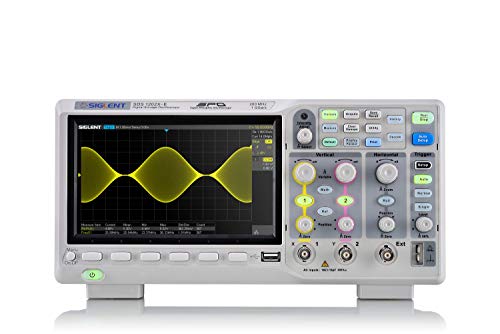
3. Siglent SDS1202X-E — 200 MHz Speed for Two-Channel Work
Where the Rigols trade bandwidth for channels, the SDS1202X-E makes the opposite trade, and for many electronics tasks it is the right one. Its 200 MHz bandwidth and 1 GSa/s sample rate across two channels handle faster edges, quicker serial buses, and switch-mode power-supply waveforms that would roll off on a 50 or 70 MHz instrument. Siglent’s Super Phosphor architecture delivers a high waveform capture rate, making intermittent faults far easier to catch.
The 7-inch 800 x 480 display is clear, the front panel is quick to learn, and serial decoding for I2C, SPI, UART, CAN, and LIN is included rather than sold as an add-on bundle. History mode and segmented acquisition help you review events after they happen. Choose this model when signal speed matters more than watching four points at once, particularly for power electronics and faster microcontroller designs.
Specs
- Brand: Siglent
- Bandwidth: 200 MHz
- Sample rate: 1 GSa/s
- Channels: 2
- Display: 7-inch TFT LCD (800 x 480)
- ASIN: B06XZML6RD
4. Hantek DSO2C10 — Serious Bench Specs on a Tight Budget

Hantek built its name on affordable test gear, and the DSO2C10 is its straightforward bench offering: 100 MHz of bandwidth, a 1 GSa/s sample rate, two channels, and 8 Mpts of memory depth behind a 7-inch display. On paper, that sits a full tier above what its price bracket usually offers, which is why it appears in so many starter labs.
The honest caveats are about polish rather than capability. The user interface is functional rather than refined, the build feels lighter than the Rigol and Siglent instruments, and long-term firmware support is less certain than with the bigger brands. None of that stops it from triggering stably and measuring accurately for its class. If you want a real bench scope with real bandwidth and your budget will not stretch to the established names, the DSO2C10 is the sensible compromise.
Specs
- Brand: Hantek
- Bandwidth: 100 MHz
- Sample rate: 1 GSa/s
- Channels: 2
- Display: 7-inch TFT LCD (800 x 480)
- ASIN: B08Y6SKTX6
5. FNIRSI 1013D Plus — A Battery Tablet Scope for the Field

The 1013D Plus is a different species: a flat, tablet-style oscilloscope with a 7-inch 800 x 480 capacitive touchscreen, a built-in 6000 mAh battery rated for around four hours of use, and 1 GB of internal storage for screenshots and waveform data. It needs no mains connection and no separate screen, so it goes wherever the faulty equipment is, from a car dashboard to an HVAC controller. Two channels, automatic measurements, FFT viewing, and a built-in high-voltage protection module round out a genuinely useful field kit.
Now the honesty this category requires. FNIRSI advertises 100 MHz bandwidth and a 1 GSa/s sample rate, but independent teardowns of this scope family have measured real sampling performance well below the headline figure, and usable bandwidth falls short of the box claim. Treat it as a capable scope for audio, automotive sensors, power supplies, and slower digital signals rather than a true 100 MHz instrument, and it will not disappoint you.
Specs
- Brand: FNIRSI
- Bandwidth: 100 MHz (as stated by the manufacturer; independently measured performance is lower)
- Sample rate: 1 GSa/s (as stated by the manufacturer; independently measured performance is lower)
- Channels: 2
- Display: 7-inch TFT touchscreen (800 x 480)
- ASIN: B0BHHYMVKV
Quick Comparison
| Model | Bandwidth | Sample Rate | Channels | Display | Type |
|---|---|---|---|---|---|
| Rigol DS1054Z | 50 MHz | 1 GSa/s | 4 | 7-inch 800 x 480 | Bench |
| Rigol DHO804 | 70 MHz | 1.25 GSa/s | 4 | 7-inch 1024 x 600 touch | Bench |
| Siglent SDS1202X-E | 200 MHz | 1 GSa/s | 2 | 7-inch 800 x 480 | Bench |
| Hantek DSO2C10 | 100 MHz | 1 GSa/s | 2 | 7-inch 800 x 480 | Bench |
| FNIRSI 1013D Plus | 100 MHz (as stated) | 1 GSa/s (as stated) | 2 | 7-inch 800 x 480 touch | Handheld tablet |
FAQ
How much bandwidth do I need for microcontroller projects?
For Arduino, ESP32, and similar boards, the signals you probe most are I2C, SPI, UART, and PWM lines. A 50 to 100 MHz scope with at least 1 GSa/s sampling handles all of them comfortably. Move to 200 MHz for fast switching converters or high-speed edges.
Is a four-channel scope worth it over a two-channel model?
If you debug serial buses or multi-rail power systems, yes. Watching clock, data, chip-select, and output simultaneously turns a timing puzzle into a single captured screen. For simple repair and audio work, two channels are usually enough.
Can a handheld scope replace a bench scope?
For field diagnostics and slower signals, a good tablet scope is remarkably capable. For fast edges, deep captures, and long sessions, a bench scope’s front end, memory, and display still win. Many technicians own both and grab the handheld first.
Why do sample rate and memory depth matter together?
A scope can only sustain its headline sample rate for as long as its memory holds out. Deep memory means long captures at full speed, so you can record an entire event and zoom in afterward.
Do these scopes decode I2C and SPI?
The Rigol and Siglent bench models here include serial triggering and decoding for common buses. Check the individual listing for the exact bus list, since included options can vary by region and firmware.
Conclusion
Match the scope to the signals, not the spec sheet. The DS1054Z remains the safest first bench scope, the DHO804 is the modern 12-bit upgrade with the best screen here, the Siglent SDS1202X-E is the speed pick for two-channel work, the Hantek DSO2C10 delivers genuine bench capability on a tight budget, and the FNIRSI 1013D Plus trades headline accuracy for portability.
Related guides
More from Amazon
Programs that pair well with the guide above. Offers and eligibility are set by Amazon and may change.
Free shipping on eligible items, Prime Video and more. Eligible new members can start with a free trial.
Start a Prime free trialAd-free music streaming. Eligible new subscribers can start with a free trial.
Try Music Unlimited freeA Prime membership for ages 18-24 with a trial period. Eligibility is set by Amazon.
See Prime for Young AdultsAudiobooks and podcasts to listen to on the go. Eligible new members can start with a free trial.
Try Audible freeAs an Amazon Associate we earn from qualifying purchases.