Disclosure: As an Amazon Associate, I earn from qualifying purchases. If you buy through links in this article, I may earn a commission at no extra cost to you.
Our top pick: Lenox High-Tension Hacksaw (12132HT50). Runner-up: DEWALT 5-in-1 Hacksaw (DWHT20547L).
A hacksaw is the hand tool that handles the cuts a workshop throws at it every week: trimming bolts to length, cutting threaded rod, slicing steel and PVC pipe, and shortening brackets and conduit. The design has barely changed in a century — a frame, a fine-toothed blade held under tension, and a handle — but the details separate a saw that tracks straight from one that wanders, binds and snaps blades. High-tension frames keep the blade taut for straighter cuts, convertible frames reconfigure for flush and tight-space work, and plain solid frames trade features for simplicity and a low cost of entry.
The five picks below cover that spread. The Lenox HT50 is the high-tension specialist, tensioning its blade to a manufacturer-listed 50,000 psi. The DEWALT 5-in-1 reconfigures into five saw layouts in one frame. The Klein Tools 702-12 is a high-tension frame with onboard blade storage and a listed 30,000 psi tension ceiling. The Stanley STHT20138 and the Craftsman CMHT20138 are solid-frame saws with a listed 225 lb tension figure and a 4.375-inch cutting depth; they come from the same parent company and are close in design, so they are treated here as the straightforward budget pattern rather than as two different ideas. Every tension and tooth figure in this guide is stated as the manufacturer lists it.
Top 3 picks at a glance


How to Choose a Hacksaw
Blade tension. Tension is the single biggest factor in cut quality. A taut blade flexes less, tracks straighter and lasts longer; a slack blade bows in the cut and breaks sooner. High-tension frames list figures such as 30,000 or 50,000 psi of blade tension, while basic solid frames list a pull figure in pounds. If most of your cutting is steel bar, rod or pipe, a high-tension frame is worth choosing; for occasional PVC and soft metal, a solid frame is adequate.
Blade and TPI. Standard hacksaw blades are 12 inches long, and the saws here all take that size. Teeth per inch (TPI) decides what the blade cuts well: as a general rule, 18 TPI suits thicker stock, 24 TPI is the all-purpose middle ground most frames ship with, and 32 TPI gives a smoother cut in thin sheet and tubing. Bi-metal blades — a high-speed steel edge on a flexible backing — resist shattering and are the sensible default replacement.
Frame style and cutting depth. A standard frame’s throat depth, listed here at 4.375 inches on the solid-frame picks, limits how wide a piece you can cut before the frame fouls the workpiece. Pistol-grip and D-handle frames differ mainly in comfort. Convertible frames add a second blade position — typically a 45-degree mount for flush cuts, or a low-profile nose for cutting close to a surface — and some accept a reciprocating blade at the front for jab-saw style cuts in confined spots.
Blade storage and changes. Several modern frames store spare blades inside the I-beam or handle, which keeps a fresh blade with the tool instead of loose in a drawer. Check how the tension is released before a blade change: a lever or knob at the handle is faster than a wing nut at the front pin.
1. Lenox High-Tension Hacksaw (12132HT50)
The Lenox HT50 is built around its I-beam frame, which the manufacturer lists as tensioning a blade up to 50,000 psi — the highest figure in this guide — for fast, straight cuts in metal. The frame stores up to five spare 12-inch blades inside the I-beam, so replacements travel with the saw. It also accepts a Lenox reciprocating saw blade at the front mount for jab-saw style cuts in tight spots, which extends the frame beyond straight hacksaw work. A 12-inch, 24 TPI bi-metal blade is included, the handle is rubberized for grip, and the listed weight is 1.5 lb. The trade-off for the rigid beam is that blade changes are less convenient than on knob-release frames, but for repeated cutting in steel stock this is the saw here designed most directly around blade tension.
Specs
- Blade length: 12 in
- Blade included: 12 in, 24 TPI bi-metal
- Blade tension: Up to 50,000 psi as listed
- Frame: I-beam with storage for up to 5 spare blades
- Extra function: Accepts a Lenox reciprocating blade for jab-saw use
- Handle: Rubber grip
- Weight: 1.5 lb as listed
- ASIN: B000LGBZDE
2. DEWALT 5-in-1 Hacksaw (DWHT20547L)
The DEWALT DWHT20547L is the convertible pick: one frame that the manufacturer sets out in five configurations — a standard high-tension hacksaw, a low-profile hacksaw for close work, a jab saw using a reciprocating blade at the nose, a long-reach configuration, and a 45-degree blade mount for flush cuts. That range covers most of the odd cutting positions a workshop produces, from trimming a bolt flush with a nut to cutting inside a cabinet or along a wall. The blade mounts at 45 or 90 degrees, spare blades store in the frame, and the tensioning is handled at the handle. It is the heaviest-featured frame here, and the one to pick if a single saw has to cover both open bench cutting and awkward confined cuts.
Specs
- Model: DWHT20547L
- Configurations: 5 (standard, low-profile, jab saw, long reach, 45-degree flush)
- Blade length: 12 in
- Blade positions: 90 degrees and 45 degrees as listed
- Blade storage: In-frame, as listed
- Handle: Pistol grip
- UPC: 076174205473
- ASIN: B0051QIIDO
3. Klein Tools High-Tension Hacksaw (702-12)
The Klein Tools 702-12 is a high-tension frame with adjustable tension listed up to 30,000 psi, sitting between the Lenox’s 50,000 psi ceiling and the solid frames’ pull figures. The I-beam style frame stores spare 12-inch blades, and the front mount accepts a reciprocating blade so the saw can be used for short jab-style cuts as well as standard through cuts; the listing includes both a hand saw blade and reciprocating blades. Blade angle adjusts for flush cutting. It is a traditional trades-oriented design — metal frame, storage beam, tension adjustment at the handle — and suits buyers who want a high-tension saw without the DEWALT’s multi-configuration hardware.
Specs
- Model: 702-12
- Blade length: 12 in
- Blade tension: Adjustable, up to 30,000 psi as listed
- Frame: High-tension with in-beam blade storage
- Extra function: Accepts reciprocating blades at the front mount
- Included: Hacksaw blade and reciprocating blades as listed
- UPC: 092644702129
- ASIN: B0037NBSEY
4. Stanley High-Tension Hacksaw (STHT20138)

The Stanley STHT20138 is the straightforward solid-frame option: a steel frame, a 12-inch blade, a listed cutting depth of 4.375 inches, and blade tension listed up to 225 lb, adjusted with a knob at the handle. The blade can be mounted at 90 or 180 degrees for straight and flush-approach cuts. There is no blade storage beam and no jab-saw mount — the design keeps to the basics, which keeps the frame light and simple. For a first hacksaw, a spare for the truck box, or occasional cutting in pipe, rod and angle stock, this pattern covers the job without paying for tension figures or configurations that light work never uses.
Specs
- Model: STHT20138
- Blade length: 12 in
- Cutting depth: 4.375 in as listed
- Blade tension: Up to 225 lb as listed
- Blade positions: 90 degrees and 180 degrees as listed
- Frame: Solid steel frame
- UPC: 787461659403
- ASIN: B009CMV9D4
5. Craftsman Solid Frame Hacksaw (CMHT20138)
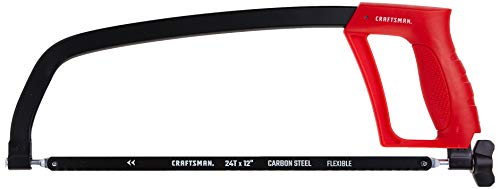
The Craftsman CMHT20138 follows the same solid-frame pattern as the Stanley above — the two brands share a parent company, and the listed figures match: a 12-inch blade, a 4.375-inch cutting depth, and tension up to 225 lb on a solid steel frame with a red handle. The blade angle adjusts for flush cuts. It is included as the Craftsman-badged version of this widely sold design rather than as a different tool; buyers choosing between the two are effectively choosing the badge and the handle finish. As with the Stanley, the appeal is simplicity: a rigid frame, an easy tension knob, and no storage compartments or conversion hardware to manage.
Specs
- Model: CMHT20138
- Blade length: 12 in
- Cutting depth: 4.375 in as listed
- Blade tension: Up to 225 lb as listed
- Blade positions: Adjustable for flush cuts as listed
- Frame: Solid steel frame
- ASIN: B07R92S9YZ
Quick Comparison
| Model | Blade | Tension (as listed) | Frame style | Standout feature |
|---|---|---|---|---|
| Lenox 12132HT50 | 12 in, 24 TPI bi-metal included | Up to 50,000 psi | I-beam high-tension | Stores 5 spare blades; jab-saw mount |
| DEWALT DWHT20547L | 12 in | High-tension | Convertible 5-in-1 | Five configurations incl. 45-degree flush |
| Klein Tools 702-12 | 12 in | Up to 30,000 psi | I-beam high-tension | Blade storage; reciprocating blade mount |
| Stanley STHT20138 | 12 in | Up to 225 lb | Solid frame | 4.375 in cutting depth; simple design |
| Craftsman CMHT20138 | 12 in | Up to 225 lb | Solid frame | 4.375 in cutting depth; adjustable angle |
FAQ
What TPI blade should I use for cutting steel pipe?
A 24 TPI blade is the general-purpose choice most of these frames ship with and handles pipe, rod and angle stock well. For thin-wall tubing or sheet, a finer 32 TPI blade keeps more teeth in contact with the material; for thick bar, an 18 TPI blade clears chips faster. All five frames take standard 12-inch blades, so swapping tooth counts is a blade change, not a new saw.
Does higher blade tension really matter?
Yes, within the limits the manufacturer lists. A blade under higher tension flexes less sideways, so the cut stays straighter and the blade is less likely to bow and snap. The difference shows most on longer cuts in steel. For short cuts in PVC or soft metal, a solid frame at its listed tension is sufficient.
Can these saws cut flush against a surface?
The DEWALT 5-in-1 has a dedicated 45-degree configuration for flush cuts, and the Klein and Craftsman list adjustable blade angles for the same purpose. The Lenox instead addresses tight spaces by mounting a reciprocating blade at the nose for jab-style cuts. A standard solid frame with a fixed 90-degree blade is the least suited to flush work.
Are the Stanley and Craftsman picks the same tool?
They are closely related designs from brands under the same parent company, with matching listed figures — 12-inch blade, 4.375-inch cutting depth and 225 lb listed tension. They are separate listings with different handles and branding, and this guide treats them as two versions of one pattern rather than two distinct designs.
How long does a hacksaw blade last?
Blade life depends on the material and how much tension and pressure are used. Letting the teeth do the work on the push stroke, keeping the blade taut, and switching to a bi-metal blade all extend life. Frames with onboard storage — the Lenox, DEWALT and Klein here — make carrying a spare simple, which matters more than squeezing extra cuts from a dull blade.
Conclusion
For the straightest cuts in metal, the Lenox HT50’s listed 50,000 psi tension and I-beam storage make it the specialist pick. The DEWALT 5-in-1 is the most versatile frame here, covering flush, low-profile and jab-saw positions in one tool, while the Klein 702-12 offers high tension and blade storage in a conventional layout. The Stanley STHT20138 and Craftsman CMHT20138 cover the basics honestly: solid frames, a 4.375-inch depth and listed 225 lb tension for everyday cutting. Match the frame to how much steel you cut and how often you work in tight spaces, keep a spare 24 TPI bi-metal blade in the frame, and any of the five will handle a workshop’s cutting list.
Related guides
More from Amazon
Programs that pair well with the guide above. Offers and eligibility are set by Amazon and may change.
Free shipping on eligible items, Prime Video and more. Eligible new members can start with a free trial.
Start a Prime free trialAd-free music streaming. Eligible new subscribers can start with a free trial.
Try Music Unlimited freeA Prime membership for ages 18-24 with a trial period. Eligibility is set by Amazon.
See Prime for Young AdultsAudiobooks and podcasts to listen to on the go. Eligible new members can start with a free trial.
Try Audible freeAs an Amazon Associate we earn from qualifying purchases.