Disclosure: As an Amazon Associate, I earn from qualifying purchases. If you buy through links in this article, I may earn a commission at no extra cost to you.
Our top pick: Siglent SDG2042X. Runner-up: Rigol DG1022Z.
An oscilloscope shows you what a circuit is doing, but a signal generator is what lets you ask the circuit questions. Feed a known sine wave into an amplifier and watch for clipping, sweep a filter to plot its response, inject a clock into a microcontroller project, or replay a captured sensor waveform to test firmware without the original hardware. For anyone who already owns a scope and a soldering station, a function generator is usually the next instrument to earn bench space.
The five models below span the realistic range for a home or small-lab bench: affordable DDS units for audio, sensor and microcontroller work, a compact generator with surprising bandwidth, and two benchtop arbitrary waveform generators from established instrument brands.
Top 3 picks at a glance


How to Choose a Signal Generator
Start with maximum sine frequency. The headline number is the sine wave ceiling, and other waveforms always run slower: square waves typically reach a fifth to a half of the sine figure, and ramps less still. Audio work, ultrasonic sensors and most microcontroller clock experiments live comfortably under 1 MHz. Testing power supplies, characterizing op-amp circuits and working with faster digital edges pushes you toward 25 MHz and above.
Understand DDS versus true arbitrary playback. Most affordable generators use direct digital synthesis, which is excellent for standard waveforms but can add jitter to pulses and steps. Higher-end models add point-by-point playback, which reproduces custom waveforms and pulse edges more faithfully. If you plan to replay captured waveforms or need clean pulse edges, that matters more than raw bandwidth.
Check sample rate and vertical resolution. A sample rate of 200 MSa/s or more keeps arbitrary waveforms smooth into the megahertz range, and 14-bit resolution is the current norm. One pick below reaches 16-bit resolution with a much faster sample rate, which visibly cleans up low-level signals.
Decide whether you need two channels. Dual outputs let you generate a signal and its clock, drive a differential pair, or sum a waveform with an offset tone. Most models here have two channels; the single-channel pick trades that flexibility for lower cost and simplicity.
Look at modulation, sweep and the counter. AM, FM, PM, FSK and PWM modulation plus linear and logarithmic sweeps turn a basic generator into a filter-plotting and communications-test tool. A built-in frequency counter is a useful bonus for checking oscillators and crystals.
1. Siglent SDG2042X — Best for Clean Arbitrary Waveforms
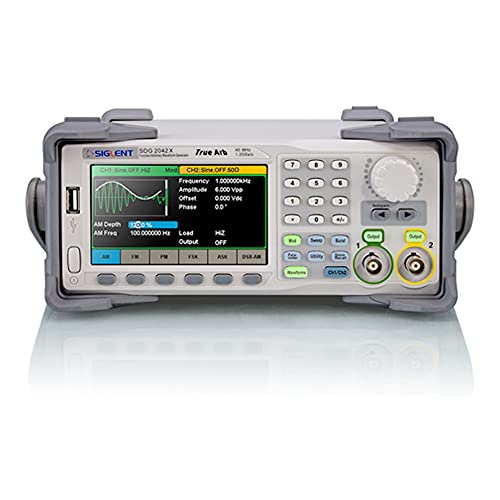
The SDG2042X is the most capable instrument in this roundup. Its headline feature is a 1.2 GSa/s sample rate with 16-bit vertical resolution, paired with Siglent’s TrueArb point-by-point playback, which avoids the edge jitter DDS-only generators can add to pulses and custom waveforms. The EasyPulse design keeps pulse edges fast and adjustable, so square waves stay square as frequency climbs.
You get two channels, a 40 MHz sine ceiling, a deep library of built-in arbitrary waveforms, modulation (AM, FM, PM, FSK, ASK, PSK and PWM), sweep and burst modes, and a built-in high-precision frequency counter. The 4.3-inch touchscreen makes a genuine difference in daily use, and USB and LAN support remote control and waveform transfer from a PC.
The trade-offs are size and cost. It is a full benchtop instrument that wants permanent desk space, and its capabilities exceed what basic digital work requires. If your bench time involves filter characterization, amplifier testing or replaying captured waveforms, this is the pick that will not need replacing.
Specs
- Brand: Siglent
- Max frequency: 40 MHz (sine)
- Waveforms: Sine, square, ramp, pulse, noise, DC, dual-tone and 196 built-in arbitrary waveforms
- Channels: 2
- Display: 4.3-inch TFT touchscreen
- ASIN: B01410O55U
2. Rigol DG1022Z — The Established Benchtop All-Rounder
Rigol’s DG1022Z has been a fixture on engineering benches for years, and its SiFi II sampling technology is the reason it still competes. SiFi II reconstructs waveforms point by point rather than with classic DDS truncation, lowering distortion on arbitrary shapes and keeping signals stable at very low frequencies. The 25 MHz sine ceiling covers most analog, power and embedded work.
Both channels deliver 200 MSa/s sampling with 14-bit resolution, and the generator ships with 160 built-in arbitrary waveforms alongside the standard sine, square, ramp, pulse and noise set. Modulation covers AM, FM, PM, ASK, FSK, PSK and PWM, and there is a built-in 7-digit frequency counter for checking external signals. The 3.5-inch color display is clear and the front panel is conventional and easy to learn.
It lacks a touchscreen, and its arbitrary memory is shallower than the Siglent’s, so very long captured waveforms are not its strength. As a dependable, well-documented all-rounder, it is an easy recommendation for a first serious bench generator.
Specs
- Brand: Rigol
- Max frequency: 25 MHz (sine)
- Waveforms: Sine, square, ramp, pulse, noise and 160 built-in arbitrary waveforms
- Channels: 2
- Display: 3.5-inch TFT color LCD
- ASIN: B09RK3ZH5T
3. UNI-T UTG962E — Compact Body, 60 MHz Bandwidth
The UTG962E packs the highest sine frequency in this roundup into a small, sloped-front enclosure barely larger than a multimeter. Despite the compact body it is a full dual-channel instrument: 60 MHz sine output, 200 MSa/s sampling, 14-bit resolution and a non-volatile library of arbitrary waveforms you can load over USB.
The waveform set covers sine, square, ramp, pulse, noise and harmonic generation, and modulation includes AM, FM, PM, ASK, FSK and PSK. A built-in frequency meter measures external signals, handy when checking a crystal oscillator or clock divider in the same session. The 4.3-inch color display is large relative to the case, and the controls are logically grouped.
The compromises are expected at this size: output amplitude tops out lower than the big benchtop units into demanding loads, and the case feels lighter than the Rigol or Siglent. For a crowded desk or repair bench where space is the constraint, it delivers bandwidth that used to require a much larger box.
Specs
- Brand: UNI-T
- Max frequency: 60 MHz (sine)
- Waveforms: Sine, square, ramp, pulse, noise, harmonic and stored arbitrary waveforms
- Channels: 2
- Display: 4.3-inch TFT color LCD
- ASIN: B0BZVDFDD5
4. OWON DGE1060 — Single Channel With PC Control
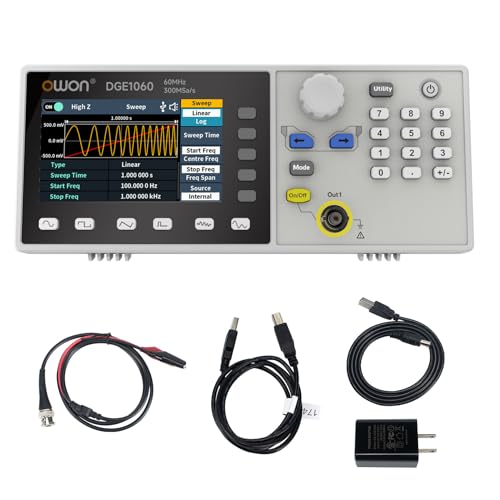
The DGE1060 takes a different route: one channel, a fast 300 MSa/s sample rate, and proper SCPI and LabVIEW support so the generator can be scripted from a PC for automated test setups. For builders who run repetitive measurements — stepping a filter through a frequency list, for example — remote control matters more than a second output.
You still get a 60 MHz sine ceiling, 14-bit resolution, 8k points of arbitrary memory and 160 built-in arbitrary waveforms on top of the five basic shapes. The 3.6-inch LCD and compact chassis suit smaller benches.
The single output is the obvious limitation: no independent clock channel, no differential pairs, no summing two tones without external hardware. Buy it for single-signal stimulus with PC automation; choose a dual-channel model if you regularly need a signal and its sync together.
Specs
- Brand: OWON
- Max frequency: 60 MHz (sine)
- Waveforms: Sine, square, ramp, pulse, noise and 160 built-in arbitrary waveforms
- Channels: 1
- Display: 3.6-inch LCD
- ASIN: B0D12GXBY8
5. Koolertron 60 MHz DDS Generator — The Budget Dual-Channel Pick

Koolertron’s DDS generator is the entry point for anyone who wants real dual-channel output without benchtop-instrument money. It offers a 60 MHz sine ceiling, 275 MSa/s sampling, two independent channels and a built-in frequency counter input.
The waveform library covers the standards (sine, square, triangle, pulse and sawtooth) along with arbitrary shapes defined through the PC software, plus sweep and modulation functions for filter and audio testing. The 2.8-inch TFT screen is small but legible.
Set expectations accordingly: output purity and accuracy do not match the Rigol, Siglent or UNI-T instruments, and documentation is thinner. For learning how filters, amplifiers and sensor front-ends behave, or for injecting test signals into hobby projects, it covers the fundamentals honestly and cheaply.
Specs
- Brand: Koolertron
- Max frequency: 60 MHz (sine)
- Waveforms: Sine, square, triangle, pulse, sawtooth and user-defined arbitrary waveforms
- Channels: 2
- Display: 2.8-inch TFT LCD
- ASIN: B0BBM2WP1P
Quick Comparison
| Model | Max Frequency | Channels | Sample Rate | Display | ASIN |
|---|---|---|---|---|---|
| Siglent SDG2042X | 40 MHz | 2 | 1.2 GSa/s | 4.3-inch touchscreen | B01410O55U |
| Rigol DG1022Z | 25 MHz | 2 | 200 MSa/s | 3.5-inch LCD | B09RK3ZH5T |
| UNI-T UTG962E | 60 MHz | 2 | 200 MSa/s | 4.3-inch LCD | B0BZVDFDD5 |
| OWON DGE1060 | 60 MHz | 1 | 300 MSa/s | 3.6-inch LCD | B0D12GXBY8 |
| Koolertron 60 MHz DDS | 60 MHz | 2 | 275 MSa/s | 2.8-inch LCD | B0BBM2WP1P |
FAQ
What is the difference between a function generator and an arbitrary waveform generator?
A function generator produces standard shapes such as sine, square and ramp waves. An arbitrary waveform generator adds the ability to output user-defined shapes, drawn on a PC or captured from an oscilloscope. Every model here does both, although memory depth and playback fidelity vary widely.
How much bandwidth do I need for microcontroller and audio projects?
Far less than the headline numbers suggest. Audio testing rarely exceeds 100 kHz, and clock injection, PWM experiments and sensor simulation for microcontroller projects usually stay below 1 MHz. Even the 25 MHz Rigol has ample headroom; higher bandwidth mainly helps with faster digital edges.
Can a signal generator damage my circuit?
It can if you ignore amplitude and offset. Most bench generators can output up to around 10 to 20 volts peak-to-peak, which will destroy a 3.3 V or 5 V logic input. Start low, confirm the level on your oscilloscope first, and only then connect the circuit under test.
Do I need two channels?
Two channels help when a circuit needs a signal plus a related clock, a trigger, or a second tone for summing tests. If you only ever inject one stimulus at a time — checking an amplifier, sweeping a filter, simulating a sensor — a single-channel model like the OWON is enough.
Why does sample rate matter if my signals are slow?
Sample rate determines how faithfully the generator reproduces arbitrary and pulse waveforms, especially their edges. A slow sine wave looks fine at almost any sample rate, but a custom waveform with sharp transitions needs many points per cycle to avoid rounding and jitter.
Conclusion
For most electronics benches, the decision comes down to fidelity versus budget. The Siglent SDG2042X is the pick when arbitrary waveform quality and pulse behavior matter most, while the Rigol DG1022Z remains the safe, well-supported all-rounder. The UNI-T UTG962E squeezes 60 MHz dual-channel output into the smallest footprint, the OWON DGE1060 suits single-channel work with PC automation, and the Koolertron covers the hobby fundamentals for the least outlay. Match the generator to the signals you actually produce: bandwidth you never use is worth less than clean waveforms at the frequencies you test every week.
Related guides
More from Amazon
Programs that pair well with the guide above. Offers and eligibility are set by Amazon and may change.
Free shipping on eligible items, Prime Video and more. Eligible new members can start with a free trial.
Start a Prime free trialAd-free music streaming. Eligible new subscribers can start with a free trial.
Try Music Unlimited freeA Prime membership for ages 18-24 with a trial period. Eligibility is set by Amazon.
See Prime for Young AdultsAudiobooks and podcasts to listen to on the go. Eligible new members can start with a free trial.
Try Audible freeAs an Amazon Associate we earn from qualifying purchases.