Disclosure: As an Amazon Associate, I earn from qualifying purchases. If you buy through links in this article, I may earn a commission at no extra cost to you.
Our top pick: Klein Tools CL800. Runner-up: Fluke 323.
A clamp meter reads current without breaking a circuit: open the jaw, close it around a single conductor, and the display shows the draw. That makes it the fastest way to check what a circuit is actually pulling, whether a DC lead is behaving, or how much a motor spikes at startup. The five meters below fall into three classes. The Fluke 323 is an AC-only workhorse for household and panel wiring. The Klein CL800, UNI-T UT210E and KAIWEETS HT206D measure AC and DC current through the clamp, which matters for battery leads, solar runs and bench electronics. The Fluke 376 FC adds inrush capture and a flexible probe for motor work. Every figure below is the manufacturer’s listed specification, not a lab result.
Top 3 picks at a glance


How to Choose a Clamp Meter
Decide AC-only versus AC/DC first. An AC-only meter is cheaper and perfectly fine for mains wiring, breakers and appliance draw. DC current through a clamp needs a Hall-effect sensor, so if you want to measure a car battery lead, a DC supply output or a solar string without disconnecting anything, the meter must list DC amps explicitly. Three of the five picks here do.
Match the current range to the job. Panel and appliance work sits comfortably under 400 A. Bench electronics live at the other end: a mini clamp with 1 mA resolution, like the UT210E, reads small DC loads that a 600 A meter rounds to almost nothing. Oversizing the range costs resolution at the low end.
Check the safety category for where you will measure. Categories are printed plainly on the meter and in its listing. CAT III 600 V covers distribution wiring and fixed installations in a home; CAT IV covers the service entrance and outdoor runs. For work inside a PC case or on a bench supply, the category matters less than DC capability and resolution, but on mains wiring, buy the category the location calls for.
Look at what else the meter replaces. Most clamp meters double as a multimeter through test leads: voltage, resistance, continuity, and often capacitance, frequency, diode test and temperature. A Low Impedance (LoZ) mode drains ghost voltages on floating wires, and non-contact voltage (NCV) detection warns you a conductor is live before you touch it. Inrush mode, found on the Fluke 376 FC, captures the startup surge a normal reading misses.
1. Klein Tools CL800 — Full-Size AC/DC Meter With LoZ
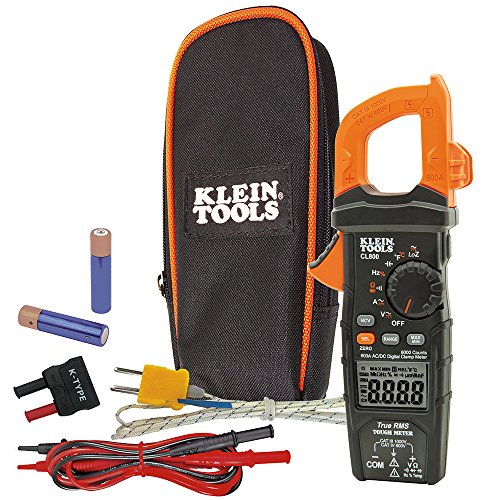
The CL800 is the most complete all-rounder in this group. Its clamp measures AC and DC current to 600 A, the leads handle AC/DC voltage to 1000 V, and the auto-ranging True RMS display counts to 6000. The Low Impedance mode is genuinely useful on residential wiring, where induced ghost voltages can make a dead circuit look live on a high-impedance meter, and the built-in non-contact voltage tester adds a quick safety check. A thermocouple input covers temperature, and capacitance, frequency and diode test round out the lead-based functions. Klein lists the meter at CAT IV 600 V and CAT III 1000 V, the strongest safety listing here alongside the Fluke 376 FC. The box includes test leads, a thermocouple with adapter, batteries and a carrying case. If you only buy one clamp meter for both mains work and DC checks, this is the one built for that brief.
Specs
- Clamp current: 600 A AC/DC
- Voltage: 1000 V AC/DC via test leads
- Display: 6000-count LCD, auto-ranging True RMS
- Extras: LoZ mode, non-contact voltage detection, temperature via included thermocouple
- Resistance / capacitance: up to 60 MΩ / up to 6000 µF, plus frequency and diode test
- Safety category: CAT IV 600 V, CAT III 1000 V
- Includes: test leads, thermocouple with adapter, carrying case, 2 AAA batteries
- ASIN: B019CY4FB4
2. Fluke 323 — AC-Only Meter for Panel and Appliance Work
The 323 is the clamp meter electricians reach for when the job is strictly AC. It measures AC current to 400 A and AC/DC voltage to 600 V through the leads, with True RMS sensing for accurate readings on non-linear loads like dimmers and variable-speed drives. Resistance goes to 4 kΩ with continuity detection, which covers the checks most residential troubleshooting needs. There is no DC current mode and no capacitance or temperature, and that focus is the point: fewer functions, a slim jaw that fits crowded panels, and Fluke’s build quality with a two-year warranty. It is listed at CAT IV 300 V and CAT III 600 V, and the soft carrying case and TL75 test leads are included. For a gaming-room circuit audit — which breaker feeds the rig, what the space heater really draws — this class of meter is all you need, and the 323 is its benchmark.
Specs
- Clamp current: 400 A AC (no DC current)
- Voltage: 600 V AC/DC via test leads
- Display: 4000-count, True RMS AC sensing
- Resistance: up to 4 kΩ with continuity detection
- Safety category: CAT IV 300 V, CAT III 600 V
- Includes: TL75 test leads, soft carrying case, 2 AAA batteries
- ASIN: B00AQKIEXY
3. Fluke 376 FC — Inrush Capture and a Flexible Probe
The 376 FC is the industrial pick, built for motors, HVAC and three-phase work. The rigid jaw reads AC and DC current to 1000 A, and the included 18-inch iFlex flexible probe wraps around busbars and bundles the jaw cannot reach, extending AC measurement to 2500 A. Its inrush mode captures startup surges with a 100 ms capture window — the measurement that explains why a compressor trips a breaker its running draw should not. Voltage reaches 1000 V AC/DC, resistance 60 kΩ, and capacitance and frequency are included. Fluke Connect wireless logging sends readings to a phone app, so a technician can record a motor’s behavior from outside the panel and save min, max and average values. Fluke lists it at CAT IV 600 V and CAT III 1000 V. It is the priciest class of meter here, and for home use it is overkill — but for inrush and logging, nothing else in this list substitutes.
Specs
- Clamp current: 1000 A AC/DC via jaw; up to 2500 A AC via included iFlex probe
- Voltage: 1000 V AC/DC via test leads
- Inrush: dedicated inrush capture mode, 100 ms capture
- Display: True RMS with min/max/average recording
- Wireless: Fluke Connect logging to a phone app
- Resistance / capacitance: up to 60 kΩ / up to 1000 µF, plus frequency
- Safety category: CAT IV 600 V, CAT III 1000 V
- ASIN: B017OVC2QM
4. UNI-T UT210E — Mini Clamp for DC Bench Work
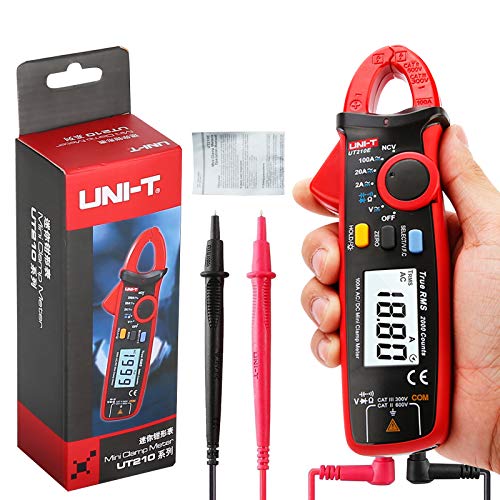
The UT210E solves the opposite problem from the Fluke 376 FC: small currents in tight spaces. This mini clamp measures AC and DC current to 100 A with 1 mA resolution, so it can show the actual draw of a fan, an LED strip or a 12 V accessory — readings a 600 A meter displays as a flickering zero. A zero-rel function cancels the Earth’s field offset before DC readings, which is essential at milliamp levels. The VFC mode filters variable-frequency drive noise, and non-contact voltage detection is built in. Through the leads it covers voltage, resistance, capacitance, diode and continuity. UNI-T lists it at CAT II 600 V and CAT III 300 V, which fits bench and appliance work rather than service-entrance jobs. For electronics hobbyists and anyone measuring DC loads around a PC build, this is the most useful meter in the list.
Specs
- Clamp current: 100 A AC/DC, 1 mA resolution
- Display: 2000-count, auto-ranging True RMS
- Extras: DC zero-rel function, VFC mode, non-contact voltage detection
- Lead functions: AC/DC voltage to 600 V, resistance, capacitance, diode, continuity
- Safety category: CAT II 600 V, CAT III 300 V
- Jaw opening: 17 mm
- ASIN: B0188WD1NE
5. KAIWEETS HT206D — Budget AC/DC With 6000 Counts

The HT206D is the value pick that still covers the DC bases. Its clamp reads AC and DC current to 600 A, the display counts to 6000 with True RMS sensing, and the lead functions include AC/DC voltage, resistance, capacitance, diode, continuity, duty cycle and temperature through the included thermocouple. A LowZ mode handles ghost-voltage checks the way the Klein does, non-contact voltage detection is built in, and the display is backlit for dark panels and under-desk work. KAIWEETS includes test leads, a thermocouple, batteries and an EVA storage bag. The trade-offs against the CL800 are the expected ones at this level: a lower voltage ceiling through the leads, a lighter build, and a brand with a shorter track record in professional test gear. As a first clamp meter for a home workshop or a gaming setup’s power audit, the feature list is hard to argue with.
Specs
- Clamp current: 600 A AC/DC
- Voltage: 600 V AC/DC via test leads
- Display: 6000-count, auto-ranging True RMS, backlit
- Extras: LowZ mode, non-contact voltage detection, temperature via included thermocouple
- Lead functions: resistance, capacitance, diode, continuity, duty cycle
- Includes: test leads, thermocouple, 2 AAA batteries, EVA storage bag
- ASIN: B07Z398YWF
Quick Comparison
| Model | Clamp range | DC current | Inrush | Safety category | Best for |
|---|---|---|---|---|---|
| Klein Tools CL800 | 600 A AC/DC | Yes | No | CAT IV 600 V / CAT III 1000 V | All-round mains + DC work |
| Fluke 323 | 400 A AC | No | No | CAT IV 300 V / CAT III 600 V | AC panel and appliance checks |
| Fluke 376 FC | 1000 A AC/DC, 2500 A AC with iFlex | Yes | Yes | CAT IV 600 V / CAT III 1000 V | Motors, HVAC, logging |
| UNI-T UT210E | 100 A AC/DC | Yes | No | CAT II 600 V / CAT III 300 V | Small DC loads, bench work |
| KAIWEETS HT206D | 600 A AC/DC | Yes | No | 600 V class | Budget all-rounder |
FAQ
Can a clamp meter measure the power draw of a gaming PC?
Yes, with one condition: the jaw must close around a single conductor. Around both the hot and neutral of a power cord, the fields cancel to zero. Use a line splitter accessory or measure at the panel on the individual circuit wire. The reading is current only; multiply by mains voltage for an approximate wattage.
Why does DC current need a special clamp meter?
DC produces a steady magnetic field that a basic transformer jaw cannot sense. Meters that list DC amps use a Hall-effect sensor in the jaw. If a listing only mentions AC current, the meter reads zero on a DC lead no matter how much current is flowing.
What does inrush current tell me?
Motors and compressors draw several times their running current for a fraction of a second at startup, and a standard meter averages that spike away. An inrush mode, like the one on the Fluke 376 FC, captures the peak in a short window — the number that decides whether a breaker or fuse holds.
What is the difference between CAT III and CAT IV?
The category describes where in an electrical system the meter is built to be used, and the number is its voltage limit there. CAT III covers distribution panels and fixed wiring inside a building; CAT IV covers the service entrance and outdoor conductors, where fault energy is higher. Match the printed category to the location.
Do I still need a regular multimeter?
For most checks, no: every meter here measures voltage, resistance and continuity through test leads, and several add capacitance and temperature. A dedicated multimeter still wins for precision bench measurements and very low resistance, but for current work a clamp meter is faster and safer because the circuit stays closed.
Conclusion
Pick by current type first. If your work is mains wiring and appliances, the Fluke 323 covers it with room to spare. If you need DC as well — battery leads, 12 V accessories, solar — the Klein CL800 is the strongest all-rounder, and the KAIWEETS HT206D delivers most of the same checklist for less. Small DC loads belong to the UNI-T UT210E, whose milliamp resolution no full-size meter here matches. And if startup surges, flexible-probe access or logged readings are the job, the Fluke 376 FC is the specialist built for it.
Related guides
More from Amazon
Programs that pair well with the guide above. Offers and eligibility are set by Amazon and may change.
Free shipping on eligible items, Prime Video and more. Eligible new members can start with a free trial.
Start a Prime free trialAd-free music streaming. Eligible new subscribers can start with a free trial.
Try Music Unlimited freeA Prime membership for ages 18-24 with a trial period. Eligibility is set by Amazon.
See Prime for Young AdultsAudiobooks and podcasts to listen to on the go. Eligible new members can start with a free trial.
Try Audible freeAs an Amazon Associate we earn from qualifying purchases.