Disclosure: As an Amazon Associate, I earn from qualifying purchases. If you buy through links in this article, I may earn a commission at no extra cost to you.
Our top pick: Etekcity Lasergrip 1080. Runner-up: ThermoPro TP30.
An infrared thermometer gun reads surface temperature from a distance, which makes it one of the most useful diagnostic tools around a gaming setup and workshop. Point it at a GPU backplate, a case exhaust, a radiator hose, an HVAC vent or a pizza steel and you get a number in about half a second, with nothing to touch. The five guns below are all handheld spot thermometers — not medical forehead thermometers and not thermal imaging cameras — and they split into two camps: affordable home guns with wide ranges and adjustable emissivity, and trade tools from Klein and Fluke built for daily site work. Every figure quoted is the manufacturer’s listed specification.
Top 3 picks at a glance

How to Choose an Infrared Thermometer
Distance-to-spot ratio decides how far away you can work. The ratio, written as 12:1 or 10:1, describes the size of the circle the gun averages over. At 12 inches from the target, a 12:1 gun reads a spot about 1 inch across; a 10:1 gun reads about 1.2 inches. Stand farther back and the spot grows, which is fine for a wall or a vent but useless for a single VRM heatsink or one exhaust fan. For close-up PC and bench work, either ratio here is workable; for ceiling vents and ductwork, the higher ratio keeps readings honest.
Emissivity is the setting that makes or breaks accuracy. Every surface emits infrared energy at a different rate. Matte surfaces like painted metal, plastic and wood sit near 0.95, while polished aluminum and bare copper emit far less and read falsely low on a fixed setting. Guns with adjustable emissivity (0.1 to 1.0) can be dialed to the material; a fixed 0.95 gun is simpler and works on most household surfaces, but on shiny metal the standard workaround is a small patch of matte tape, read instead of the bare surface.
Match the listed range to your hottest target. Home guns here start at -58 degrees F for freezer checks. At the top end, a griddle, pizza steel or engine manifold can pass 800 degrees F, so a gun that tops out at 752 degrees F leaves no headroom for cooking work, while the widest-range pick reaches a listed 1130 degrees F.
Readout modes matter more than raw speed. All five guns respond in half a second or less. What separates them is what happens during a scan: MAX hold shows the hottest point found, MIN/MAX/AVG modes help map a whole surface, and high/low alarms flag anything outside a band you set — handy when sweeping a breaker panel or a bank of power supplies for one hot outlier.
Remember what these tools cannot do. An infrared gun measures surface temperature only. It cannot read air temperature or see through glass or a PC side panel, and none of these models is a medical device.
1. Etekcity Lasergrip 1080

The Lasergrip 1080 is the all-round pick for a mixed workload. Its listed range runs from -58 to 1130 degrees F, the widest span here, so the same gun checks a freezer, a case exhaust and a pizza oven without swapping tools. The 12:1 distance-to-spot ratio keeps the measurement circle tight at bench distances, and emissivity adjusts across the full 0.1 to 1.0 span, which is what you want when moving between a matte GPU backplate and a steel oven deck. Etekcity lists a 0.5-second response time, a backlit LCD and a max-reading display that holds the hottest point of a scan. It runs on two AAA batteries, included in the box. For PC troubleshooting, cooking and general workshop checks in one tool, this is the default recommendation.
Specs
- Temperature range: -58°F to 1130°F (-50°C to 610°C), manufacturer listed
- Distance-to-spot ratio: 12:1
- Emissivity: Adjustable, 0.1 to 1.0
- Laser: Single point
- Response time: 0.5 seconds, listed
- Display: Backlit LCD with max reading display
- Battery: 2 x AAA (included)
- Model: Lasergrip 1080
- ASIN: B00DMI632G
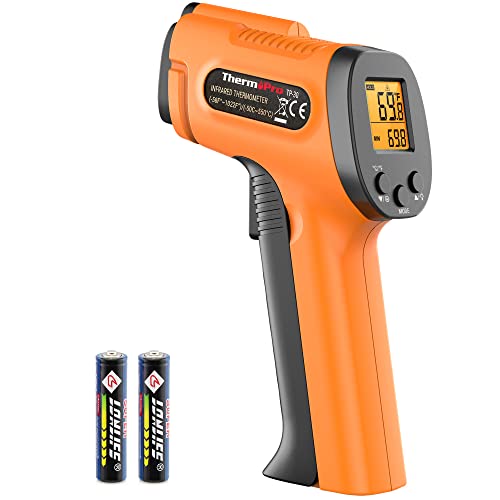
2. ThermoPro TP30
The TP30 covers nearly the same ground as the Lasergrip 1080 and adds scan statistics. Its listed range is -58 to 1022 degrees F with a 12:1 distance-to-spot ratio and adjustable emissivity from 0.1 to 1.0, and ThermoPro lists accuracy at plus or minus 1.5 percent. Where it earns its place is the readout: MAX, MIN and AVG modes let you sweep a radiator, a motherboard tray or a griddle and see the spread of temperatures rather than a single point. Response is listed at under 500 milliseconds, and the gun shuts itself off after 90 seconds of inactivity. It runs on two included AAA batteries. If you diagnose by comparing one area against another — one fan exhaust against its neighbor, one brake rotor against the rest — the TP30’s averaging modes are the reason to pick it.
Specs
- Temperature range: -58°F to 1022°F (-50°C to 550°C), manufacturer listed
- Distance-to-spot ratio: 12:1
- Emissivity: Adjustable, 0.1 to 1.0
- Readout modes: MAX, MIN, AVG
- Response time: Under 500 ms, listed
- Display: Backlit LCD
- Battery: 2 x AAA (included)
- Model: TP30
- ASIN: B07VTPJXH9
3. Etekcity Lasergrip 774
The Lasergrip 774 is the compact classic of the line: a smaller, simpler gun for kitchens and quick household checks. The listed range is -58 to 842 degrees F, which still covers freezers, ovens, griddles, HVAC vents and engine bays, and the 12:1 distance-to-spot ratio matches its bigger sibling. Emissivity is adjustable and the display shows the maximum temperature found during a scan, with a listed 0.5-second response time. It runs on two included AAA batteries. What you give up against the 1080 is top-end headroom — a pizza steel at full preheat can push past this gun’s ceiling — and what you gain is a lighter tool that lives in a kitchen drawer.
Specs
- Temperature range: -58°F to 842°F (-50°C to 450°C), manufacturer listed
- Distance-to-spot ratio: 12:1
- Emissivity: Adjustable
- Laser: Single point
- Response time: 0.5 seconds, listed
- Display: Backlit LCD with max reading display
- Battery: 2 x AAA (included)
- Model: Lasergrip 774
- ASIN: B0C9M5NB31
4. Klein Tools IR1
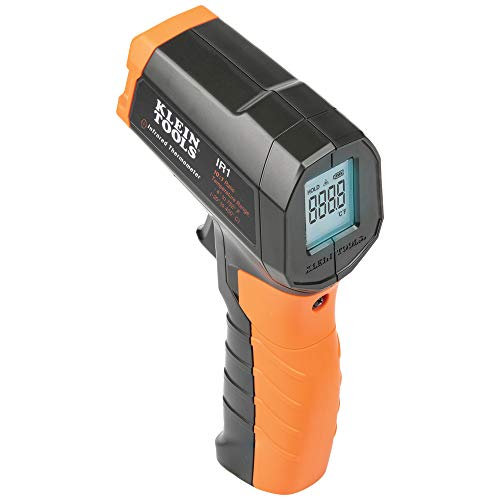
The IR1 is the electrician’s answer: a trade-brand gun that deliberately keeps things simple. Emissivity is fixed at 0.95, so there is nothing to set — pull the trigger, read the backlit display, and the reading holds when you release. The listed range is -4 to 752 degrees F with a 10:1 distance-to-spot ratio, and Klein lists a response time under 0.25 seconds, the fastest here. Durability is the selling point: the IR1 carries a listed 6.6-foot (2-meter) drop protection, runs on a single 9V battery and ships with a custom pouch. The trade-offs are real — the fixed emissivity reads low on bare shiny metal, and the 752-degree ceiling rules out pizza ovens — but for breaker panels, vents, pipes and motor housings, the IR1 is built to live in a tool bag and be grabbed without thinking.
Specs
- Temperature range: -4°F to 752°F (-20°C to 400°C), manufacturer listed
- Distance-to-spot ratio: 10:1
- Emissivity: Fixed at 0.95
- Laser: Single targeting laser
- Response time: Under 0.25 seconds, listed
- Display: Backlit LCD with data hold
- Drop protection: Listed 6.6 ft (2 m)
- Battery: 1 x 9V (included, with pouch)
- Model: IR1
- ASIN: B0873T6SGR
5. Fluke 62 MAX

The 62 MAX is the professional durability pick. Fluke lists a range of -22 to 932 degrees F, a 10:1 distance-to-spot ratio and adjustable emissivity, with stated accuracy of plus or minus 1.5 degrees C or 1.5 percent of the reading across the working span. It displays minimum, maximum, average and difference readings and adds high and low alarms, so a sweep across a panel flags the outlier without watching the screen. The body is sealed to IP54 for dust and splash resistance and carries a listed 3-meter (9.8-foot) drop protection — the toughest housing here — and it runs on a single AA battery. Fluke backs it with a listed 3-year warranty. It costs more than the home guns and its ratio is the joint-narrowest, so it rewards close work; for technicians who take the same readings month after month and need them to agree, this is the one built for that job.
Specs
- Temperature range: -22°F to 932°F (-30°C to 500°C), manufacturer listed
- Distance-to-spot ratio: 10:1
- Emissivity: Adjustable
- Laser: Single
- Readout modes: MIN, MAX, AVG, DIF; high and low alarms
- Stated accuracy: ±1.5°C or ±1.5% of reading (0 to 500°C)
- Sealing: IP54 dust and splash resistance
- Drop protection: Listed 3 m (9.8 ft)
- Battery: 1 x AA (included)
- Model: 62 MAX
- ASIN: B008EW837S
Quick Comparison
| Product | Listed range | Distance-to-spot | Emissivity | Readout extras | Battery |
|---|---|---|---|---|---|
| Etekcity Lasergrip 1080 | -58°F to 1130°F | 12:1 | Adjustable 0.1–1.0 | Max reading display | 2 x AAA |
| ThermoPro TP30 | -58°F to 1022°F | 12:1 | Adjustable 0.1–1.0 | MAX, MIN, AVG modes | 2 x AAA |
| Etekcity Lasergrip 774 | -58°F to 842°F | 12:1 | Adjustable | Max reading display | 2 x AAA |
| Klein Tools IR1 | -4°F to 752°F | 10:1 | Fixed 0.95 | Data hold | 1 x 9V |
| Fluke 62 MAX | -22°F to 932°F | 10:1 | Adjustable | MIN, MAX, AVG, DIF; alarms | 1 x AA |
FAQ
Can an infrared thermometer measure the temperature inside my PC?
Only surfaces it can see. With the side panel off, it reads the surface of a GPU backplate, heatsink fin or exhaust grille, which tracks component heat closely enough to spot a failing fan or a blocked vent. Through a glass or acrylic panel it reads the panel itself, not the parts behind it.
Which distance-to-spot ratio do I need for PC and bench work?
At the short distances involved — a few inches to a couple of feet — both 10:1 and 12:1 keep the measurement spot small enough for fans, heatsinks and vents. The ratio matters when you measure from across a room, where a 12:1 gun averages a noticeably smaller circle.
Why does bare metal read colder than it should?
Polished metal emits infrared energy weakly, so the gun under-reports it. On an adjustable-emissivity model, lower the setting for the material; on any gun, the reliable workaround is to read a small patch of matte electrical or masking tape stuck to the surface instead.
Can I use one of these guns to check a fever?
No. These are industrial and household surface thermometers. The manufacturers state plainly that they are not medical devices and are not intended for use on people or animals; body temperature needs a thermometer designed and cleared for that purpose.
Infrared gun or thermal camera for finding hot spots?
Different jobs. A gun gives one accurate number for one spot and is the better tool for checking a specific component against its expected range. A camera paints a whole scene at once and is better for discovering a hot spot you did not know existed, at a much higher cost and with lower per-point accuracy.
Conclusion
For most readers, the Etekcity Lasergrip 1080 is the right first infrared thermometer: the widest listed range here, adjustable emissivity and a 12:1 ratio cover PC diagnostics, cooking and workshop checks in one tool. The ThermoPro TP30 is the alternative if MAX/MIN/AVG scan modes matter to how you troubleshoot, and the Lasergrip 774 trims the range for a smaller kitchen-drawer gun. Choose the Klein IR1 for a fixed-setting trade tool that survives a tool bag, and the Fluke 62 MAX when sealed construction, alarms and repeatable readings justify the step up.
Related guides
More from Amazon
Programs that pair well with the guide above. Offers and eligibility are set by Amazon and may change.
Free shipping on eligible items, Prime Video and more. Eligible new members can start with a free trial.
Start a Prime free trialAd-free music streaming. Eligible new subscribers can start with a free trial.
Try Music Unlimited freeA Prime membership for ages 18-24 with a trial period. Eligibility is set by Amazon.
See Prime for Young AdultsAudiobooks and podcasts to listen to on the go. Eligible new members can start with a free trial.
Try Audible freeAs an Amazon Associate we earn from qualifying purchases.