Disclosure: As an Amazon Associate, I earn from qualifying purchases. If you buy through links in this article, I may earn a commission at no extra cost to you.
Our top pick: VIOFO A329S 2CH. Runner-up: VIOFO A229 Pro 2CH.
A dash cam earns its place on the windshield on the worst day of driving, not the best one. The footage has one job: show what happened clearly enough that a license plate, a lane position or a cabin incident can be read without guesswork. The five cameras here cover the main setups — a flagship front-and-rear pair, a proven 4K dual-channel value pick, a cloud-connected Full HD set, a four-channel system that watches the cabin as well as the road, and a compact front-only camera that disappears behind the mirror.
Every pick records with GPS data and supports a parking mode. The differences that matter are channel count, sensor generation, how parking mode is powered, and how footage gets off the camera.
Top 3 picks at a glance
How to Choose a Dash Cam
Start with channels. A front-only camera documents what happens ahead, which settles most disputes but says nothing about a rear-end collision or what happened inside the car. A front-and-rear set adds the view behind. Three- and four-channel systems add cabin cameras, the standard recommendation for rideshare and delivery drivers. Each added channel means more cable to route, so pick coverage that matches the driving actually done.
Resolution is really about the sensor. A 4K badge means little on an old sensor. Current Sony STARVIS 2 sensors (the IMX678 and IMX675 appear in several picks here) are listed with better low-light sensitivity and less motion blur than the previous generation, and night plate legibility is where that shows. Frame rate matters too: 60fps keeps plates readable at speed better than 30fps.
Parking mode needs a power plan. Cameras that record while parked draw power from a hardwire kit connected to the fuse box, an OBD power cable, or a dedicated battery pack. Buffered modes save the seconds before an impact as well as after it. Most cameras here require a hardwire kit sold separately, and a low-voltage cut-off in that kit is what protects the car battery.
GPS, storage and access round it out. Built-in GPS stamps speed and location into the file, which insurers and police reports can use. Loop recording overwrites the oldest footage, so card size decides how far back the record goes; high-endurance microSD cards are the manufacturer-recommended choice. Wi-Fi apps and cloud access decide how quickly a clip can be pulled up after an incident.
1. VIOFO A329S 2CH — Flagship 4K Front and Rear

The A329S is VIOFO’s current flagship two-channel camera and the most complete front-and-rear package in this guide. The front camera records 4K at 60fps on a Sony STARVIS 2 IMX678 sensor, and the rear camera records 2K on an IMX675, so both directions get the newer sensor generation rather than a token rear unit. HDR is applied on both channels, the combination listed for reading plates against headlights at night.
Wi-Fi 6 is listed for fast transfers to the VIOFO app, GPS is built in, and a circular polarizing filter is included for the front lens. Storage is unusually flexible — microSD cards up to 512GB, or an external SSD up to 4TB over USB-C. Power comes from a supercapacitor rather than a lithium battery, the safer design for a hot parked car. Parking mode uses low-power impact detection and requires the HK4 or HK6 hardwire kit, sold separately.
Specs
- Channels: Front + rear (2CH)
- Front resolution: 4K at 60fps
- Rear resolution: 2K at 30fps
- Sensors: Sony STARVIS 2 IMX678 (front), IMX675 (rear)
- GPS: Built in (GPS, BeiDou, Galileo, GLONASS)
- Wi-Fi: Wi-Fi 6, VIOFO app
- Storage: microSD up to 512GB; external SSD up to 4TB
- Power: Supercapacitor
- Extras: CPL filter included, voice control, HDR on both channels
- Parking mode: Impact detection, hardwire kit sold separately
- ASIN: B0FFT3YBH7
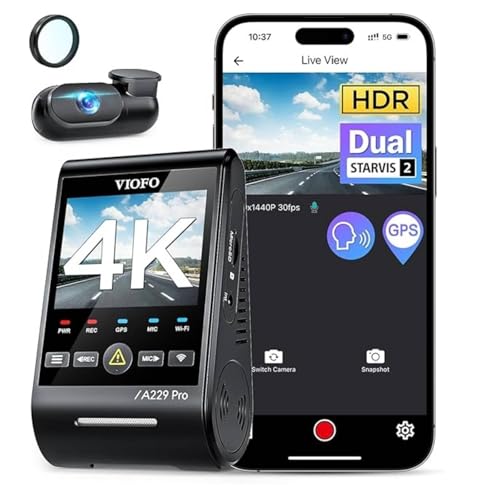
2. VIOFO A229 Pro 2CH — Proven 4K Dual-Channel Value
The A229 Pro uses the same STARVIS 2 sensor pairing as the flagship — an IMX678 in front and an IMX675 at the rear — at 4K and 2K respectively, with the front channel at 30fps instead of 60. For most drivers that is the meaningful spec sheet: the evidence quality is close to the flagship where it counts, at night and on plates.
A 2.4-inch screen makes aiming and quick playback simple without a phone, 5GHz Wi-Fi handles app transfers, GPS is built in, and voice control covers commands such as locking a clip. The supercapacitor design and buffered 24-hour parking mode carry over, again with a hardwire kit required for parked recording. It is the pick for buyers who want the sensor pairing and parking mode without paying for Wi-Fi 6, SSD support or the higher frame rate.
Specs
- Channels: Front + rear (2CH)
- Front resolution: 4K at 30fps
- Rear resolution: 2K at 30fps
- Sensors: Sony STARVIS 2 IMX678 (front), IMX675 (rear)
- Display: 2.4-inch screen
- GPS: Built in
- Wi-Fi: 5GHz Wi-Fi, VIOFO app
- Storage: microSD up to 512GB
- Power: Supercapacitor
- Extras: Voice control, HDR, Night Vision 2.0
- Parking mode: Buffered 24-hour mode, hardwire kit sold separately
- ASIN: B0CKYFSKNN
3. BlackVue DR770X-2CH II — Cloud-Connected Front and Rear
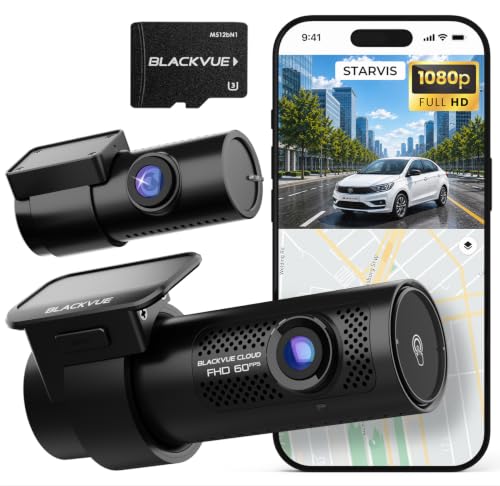
BlackVue takes a different approach: instead of chasing resolution, the DR770X-2CH II pairs dual Full HD Sony STARVIS cameras — the front at 60fps, the rear at 30fps — with the most developed cloud service in this guide. Connected through a Wi-Fi hotspot or BlackVue’s optional LTE module, it supports live view of the parked car, push notifications on detected events, remote playback and automatic backup of event files to BlackVue Cloud.
The slim cylindrical body is the most discreet dual-channel design here, and the details suit parked-car surveillance: event files include a 10-second pre-event buffer, up to 50 event files are protected from overwriting, and parking mode covers motion, impact and time-lapse recording. GPS is built in, and the listing includes a 64GB card, with support up to 1TB. The trade-off is plain: Full HD carries less plate detail at distance than the 4K picks above, so this is the choice when remote access matters more than resolution.
Specs
- Channels: Front + rear (2CH)
- Front resolution: 1080p Full HD at 60fps
- Rear resolution: 1080p Full HD at 30fps
- Sensors: Sony STARVIS (front and rear)
- GPS: Built in
- Wi-Fi: Built in, BlackVue app and Cloud
- Cloud: Live view, push alerts, remote playback (hotspot or optional LTE module)
- Storage: microSD up to 1TB; 64GB card included
- Power: Supercapacitor
- Parking mode: Motion, impact and time-lapse, hardwiring required
- ASIN: B0FFM4V8JS
4. Vantrue N5S — Four Channels With Cabin Coverage

The N5S is the coverage maximalist of this group: four cameras record the road ahead, the front cabin, the rear cabin and the road behind — the setup rideshare and taxi drivers are usually shopping for. The front camera records 2.7K, the rear 1440p, and both cabin cameras 1080p with infrared lights for night recording inside the car. All four channels use STARVIS 2 sensors (IMX675 and IMX662), and the system can run in one-, two-, three- or four-channel modes.
A 3.19-inch display, 5GHz Wi-Fi and dual-system GPS are built in, along with voice control and a supercapacitor. Buffered parking mode records motion and collisions with 10 seconds of pre-recording, and an optional LTE module adds remote monitoring; both parked features need the hardwire kit, sold separately. Storage runs to 1TB microSD cards, useful headroom since four channels fill a card far faster than one. The install is the most involved here, but nothing else in this guide watches the inside of the car.
Specs
- Channels: Front + front cabin + rear cabin + rear (4CH)
- Front resolution: 2.7K (1944p)
- Cabin resolution: 1080p front cabin, 1080p rear cabin, infrared night recording
- Rear resolution: 1440p
- Sensors: Sony STARVIS 2 IMX675 and IMX662
- Display: 3.19-inch screen
- GPS: Built in, dual-system
- Wi-Fi: 5GHz Wi-Fi, Vantrue app
- Storage: microSD up to 1TB
- Power: Supercapacitor
- Parking mode: Buffered with 10-second pre-recording, hardwire kit sold separately
- ASIN: B0F8BWJHW4
5. Garmin Dash Cam 67W — Compact Front-Only Simplicity

The 67W is the opposite philosophy: a single front camera, 1440p resolution and an extra-wide 180-degree field of view in a body about 2.2 by 1.6 inches that weighs roughly two ounces. It mounts with a low-profile magnetic mount and is meant to be forgotten about until needed. A small built-in display handles aiming and settings, and voice control saves a video or takes a picture without hands leaving the wheel.
Garmin adds driver-awareness alerts — forward collision, lane departure and “go” alerts when traffic ahead moves — plus red light and speed camera alerts in supported regions. Built-in GPS stamps location and speed, and the Garmin Drive app handles clips over Wi-Fi and Bluetooth. Parking Guard and Live View monitoring work when the camera has constant power and a Wi-Fi connection, which means the optional constant power cable for most installs. A 16GB card is included; support runs to 512GB. For a car that just needs the road ahead covered well, this is the lowest-effort install in the guide.
Specs
- Channels: Front only (1CH)
- Resolution: 1440p
- Field of view: 180 degrees
- GPS: Built in
- Connectivity: Wi-Fi and Bluetooth, Garmin Drive app
- Control: Voice control, small built-in display
- Storage: microSD up to 512GB; 16GB card included
- Dimensions: 2.21 x 0.86 x 1.59 inches; about 2 ounces
- Extras: Forward collision, lane departure and go alerts; Travelapse
- Parking mode: Parking Guard and Live View, constant power cable sold separately
- Model: 010-02505-05
- ASIN: B093244D1J
Quick Comparison
| Pick | Channels | Front / rear resolution | GPS | Parking mode | Max storage |
|---|---|---|---|---|---|
| VIOFO A329S 2CH | Front + rear | 4K 60fps / 2K | Built in | Impact detection (hardwire kit) | 512GB card, 4TB SSD |
| VIOFO A229 Pro 2CH | Front + rear | 4K 30fps / 2K | Built in | Buffered (hardwire kit) | 512GB card |
| BlackVue DR770X-2CH II | Front + rear | 1080p 60fps / 1080p | Built in | Motion, impact, time-lapse | 1TB card |
| Vantrue N5S | Front + 2 cabin + rear | 2.7K / 1440p | Built in | Buffered (hardwire kit) | 1TB card |
| Garmin Dash Cam 67W | Front only | 1440p / — | Built in | Parking Guard (power cable) | 512GB card |
FAQ
Do dash cams record while the car is parked?
Only with a continuous power source. Parking mode on every camera here needs a hardwire kit, an OBD power cable or a battery pack, because the 12V socket in most cars switches off with the ignition. Buffered modes are the most useful version: they save the seconds before an impact along with the aftermath.
Is 4K worth it over 1440p or 1080p?
For plate capture at distance and at night, yes — provided the sensor is current. A 4K camera on a STARVIS 2 sensor resolves plates that a 1080p camera smears, especially across lanes. A 1440p compact like the Garmin still documents fault clearly; it gives up fine detail, not the overall picture.
What size memory card does a dash cam need?
Loop recording means the card is rewritten constantly, so endurance matters more than raw size. A 128GB or 256GB high-endurance card suits most front-and-rear setups; four-channel systems and 4K cameras fill cards faster and justify 512GB or the camera’s maximum. Formatting the card in the camera monthly is the standard manufacturer maintenance advice.
Will parking mode drain the car battery?
A hardwire kit with a low-voltage cut-off stops drawing power before the battery drops too far, and low-power impact-only modes sip power compared with continuous recording. Cars that sit unused for many days are the edge case where a dedicated dash cam battery pack makes more sense.
Are cabin cameras and audio recording legal?
Rules vary by location. Windshield mounting restrictions, passenger consent for audio, and notice requirements for recording riders all depend on local law; rideshare drivers in particular should check local requirements before switching a cabin camera on.
Conclusion
For most drivers, the decision is about coverage. The VIOFO A329S is the strongest all-round front-and-rear set, and the A229 Pro delivers most of its evidence quality for less. The BlackVue DR770X-2CH II trades resolution for a cloud service that watches the car remotely. The Vantrue N5S is the pick when the cabin matters as much as the road, and the Garmin 67W covers the basics in the smallest, simplest package. Match the channel count to the driving, budget for a hardwire kit if parking coverage matters, and any of the five will be recording when it counts.
Related guides
More from Amazon
Programs that pair well with the guide above. Offers and eligibility are set by Amazon and may change.
Free shipping on eligible items, Prime Video and more. Eligible new members can start with a free trial.
Start a Prime free trialAd-free music streaming. Eligible new subscribers can start with a free trial.
Try Music Unlimited freeA Prime membership for ages 18-24 with a trial period. Eligibility is set by Amazon.
See Prime for Young AdultsAudiobooks and podcasts to listen to on the go. Eligible new members can start with a free trial.
Try Audible freeAs an Amazon Associate we earn from qualifying purchases.