Disclosure: As an Amazon Associate, I earn from qualifying purchases. If you buy through links in this article, I may earn a commission at no extra cost to you.
Our top pick: Fluke 117. Runner-up: Klein Tools MM700.
A digital multimeter is the one tool that turns guesswork into evidence. Is that fan header actually delivering 12 volts? Is a wall outlet wired correctly? Is a cable run continuous, or is there a break inside the insulation? A gaming PC builder uses the same meter an electrician does, just on different problems: checking PSU rails, testing case wiring, confirming a battery is dead, and proving an outlet is safe.
The five meters below range from a budget True RMS starter to an industrial flagship. Specs quoted are the ones the manufacturer or listing states.
Top 3 picks at a glance


How to choose a digital multimeter
Start with the CAT safety category, not the feature list. The CAT system describes how much transient energy a meter can survive at a given point in a wiring system, and it is about location, not just voltage. CAT I covers protected electronics away from mains wiring. CAT II covers receptacle-level work: outlets, plugs, and connected loads. CAT III covers distribution level: breaker panels, fixed wiring, and three-phase distribution. CAT IV covers the service entrance and utility side, where fault energy is highest. A CAT I meter has no business touching mains wiring at any voltage.
Two honest warnings belong here. First, category and voltage number work together: CAT III 1000 V does not make a meter “better” than CAT III 600 V for a 230 V panel, because the category describes the energy environment. Second, a printed category is a claim. On established brands it is backed by independent testing to IEC 61010 by a lab such as UL, ETL, or TÜV. On no-name meters, treat an aggressive CAT claim with skepticism, especially the budget pattern of claiming CAT III 1000 V or CAT IV 600 V on a very cheap tool.
True RMS matters for AC, not DC. On pure DC, such as PSU rails and batteries, any competent meter reads correctly. True RMS earns its keep on AC waveforms that are not clean sine waves: UPS outputs, variable-frequency drives, dimmers, and cheap inverters, where an averaging meter can read noticeably wrong.
Auto-ranging is convenience; counts are resolution. Auto-ranging meters pick the range for you, speeding up casual work. Counts describe display resolution: a 6000-count meter resolves millivolts on low ranges where a 2000-count meter cannot. Higher counts help with electronics work; they matter less for checking whether an outlet is live.
Match the extras to your actual jobs. Non-contact voltage detection is a fast safety check before touching a wire. A low-impedance (LoZ) mode drains “ghost voltage” picked up from adjacent live conductors, which otherwise makes dead circuits look live. Capacitance testing helps with HVAC and motor capacitors. Buy the functions you will use, and check whether the meter measures current through its leads; one pick below deliberately skips it.
1. Fluke 117: best overall pick

The Fluke 117 is the meter most electricians reach for in residential and commercial work, and it earns that spot with judgment calls rather than raw specs. AutoVolt automatically distinguishes AC from DC voltage, so there is no wrong-dial mistake on a first check. The built-in VoltAlert sensor detects AC voltage without contact, and the low-impedance mode settles ghost-voltage arguments instantly: a circuit still showing voltage in LoZ mode is genuinely live.
It is worth stating plainly what the 117 does not do: it does not measure current through test leads. For the outlet, lighting, and appliance work it is designed for, that rarely matters, and the omission keeps the dial simple. Resistance, continuity, capacitance, frequency, and diode testing are all present, along with min, max, and average recording. For most homeowners and PC builders who occasionally step up to mains work, this is the safest pair of hands on the list.
Specs
- Brand: Fluke
- Type: Auto-ranging, True RMS
- Counts/display: Large backlit LCD with analog bar graph; count figure not stated in the listing
- CAT category: CAT III 600 V
- Notable functions: VoltAlert non-contact voltage detection, AutoVolt automatic AC/DC selection, low-impedance mode, min/max/average recording, capacitance, frequency, diode test; no lead-based current measurement
- ASIN: B000O3LUEI
2. Klein Tools MM700: pro pick for panel work
The MM700 is Klein’s answer for people who like the Fluke formula but need current measurement and a higher category ceiling. It is an auto-ranging True RMS meter stated for 1000 V work, with a CAT IV 600 V and CAT III 1000 V category as published by Klein. It measures AC and DC current through its leads, which the Fluke 117 skips, and adds a low-pass filter for reading variable-frequency drive output more honestly.
Temperature measurement with the included probe, capacitance, frequency, and a low-impedance mode round out a function set aimed at HVAC and electrical troubleshooting. Lead-alert indicators warn when the leads sit in the wrong jack for the selected function, preventing a classic blown-fuse mistake. If your work regularly reaches breaker panels, the MM700 covers it without flagship territory.
Specs
- Brand: Klein Tools
- Type: Auto-ranging, True RMS
- Counts/display: Backlit display with analog bar graph; count figure not stated in the listing record
- CAT category: CAT IV 600 V / CAT III 1000 V as stated by the manufacturer
- Notable functions: AC/DC current measurement, low-impedance mode, low-pass filter, temperature, capacitance, frequency, lead-alert indicators
- ASIN: B018CMKWSC
3. Fluke 87V: the industrial flagship
The 87V is the meter industrial technicians standardize on, and it is overkill for most homes. Its category, CAT III 1000 V and CAT IV 600 V, makes it the pick for motor drives, industrial panels, and plant troubleshooting. The low-pass filter gives accurate readings on variable-frequency drives, where lesser meters wander, and peak min/max capture records fast transients: how you catch the glitch that resets a machine once a shift.
This listing includes the TL75 test leads, alligator clips, and the 80BK temperature probe, and the meter has a built-in thermometer to pair with it. It offers auto and manual ranging, capacitance, frequency, and duty cycle. Buy it if troubleshooting is your job; for occasional outlet checks, the 117 above does the same work in a simpler package.
Specs
- Brand: Fluke
- Type: Auto- and manual-ranging, True RMS
- Counts/display: Backlit display with analog bar graph; count figure not stated in the listing record
- CAT category: CAT III 1000 V / CAT IV 600 V
- Notable functions: Low-pass filter for variable-frequency drives, peak min/max capture, built-in thermometer with included 80BK probe, capacitance, frequency, duty cycle
- ASIN: B0002YFD1K
4. KAIWEETS HT118A: budget True RMS
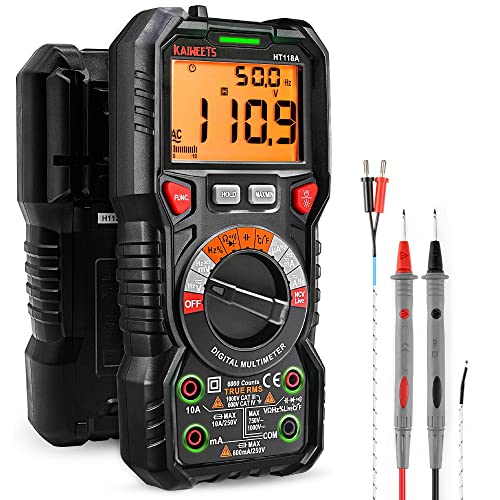
The HT118A is the value disruptor here: a 6000-count True RMS auto-ranging meter whose manual states an IEC category of CAT III 1000 V and CAT IV 600 V, figures normally associated with far more expensive tools. Apply the buying-guide caution: the claim is what the manufacturer states, and anyone who needs certified protection for daily panel work should weigh how much they trust a budget brand’s paperwork. For home, automotive, and electronics use, the package is genuinely strong.
The standout feature is the set of LED-lit input jacks, which light up to show where the leads belong for the selected function, reducing the most common beginner error. It measures AC and DC voltage and current, resistance to 60 megohms, capacitance, frequency, duty cycle, and temperature with the included thermocouple, plus non-contact voltage detection and a live-wire check. As a first serious meter, or a second one for the car and the PC bench, it delivers a lot for the class.
Specs
- Brand: KAIWEETS
- Type: Auto-ranging, True RMS
- Counts/display: 6000 counts, 2.9-inch backlit display
- CAT category: CAT III 1000 V / CAT IV 600 V as stated in the manual (IEC)
- Notable functions: LED-lit input jacks, non-contact voltage detection, live-wire detection, temperature with included thermocouple, capacitance, frequency, duty cycle, MAX/MIN
- ASIN: B07SHLS639
5. AstroAI TRMS 6000 Counts (M6KOR): the budget starter
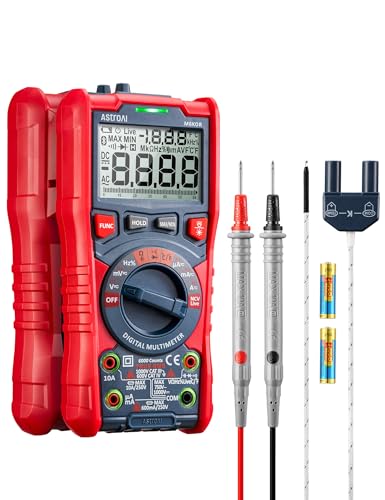
AstroAI’s 6000-count meter is the sensible first purchase for a PC builder who mainly needs DC truth: PSU rail voltages, fan and pump headers, battery health, continuity on cables and switches, and the occasional outlet sanity check. It is auto-ranging and True RMS, so household AC is handled properly too, and the listing states a CAT III 600 V category, suiting receptacle-level work.
Beyond the basics it covers capacitance, frequency, and temperature, with non-contact voltage detection for a quick live check, plus a flashlight and a large screen for dim case interiors. It will not replace a Fluke for daily mains work, but as a bench meter for electronics and automotive troubleshooting it covers the jobs most people actually have.
Specs
- Brand: AstroAI
- Type: Auto-ranging, True RMS
- Counts/display: 6000 counts, large backlit screen
- CAT category: CAT III 600 V as stated in the listing
- Notable functions: Non-contact voltage detection, capacitance, frequency, temperature, continuity, diode test, built-in flashlight
- ASIN: B08FDVQDM5
Quick comparison
| Product | Type | True RMS | CAT category (as stated) | Standout function | ASIN |
|---|---|---|---|---|---|
| Fluke 117 | Auto-ranging | Yes | CAT III 600 V | VoltAlert NCV and LoZ ghost-voltage mode | B000O3LUEI |
| Klein Tools MM700 | Auto-ranging | Yes | CAT IV 600 V / CAT III 1000 V | Low-pass filter plus lead current measurement | B018CMKWSC |
| Fluke 87V | Auto/manual-ranging | Yes | CAT III 1000 V / CAT IV 600 V | Peak min/max capture for transients | B0002YFD1K |
| KAIWEETS HT118A | Auto-ranging | Yes | CAT III 1000 V / CAT IV 600 V | LED-lit input jacks | B07SHLS639 |
| AstroAI TRMS 6000 (M6KOR) | Auto-ranging | Yes | CAT III 600 V | NCV and flashlight at a starter level | B08FDVQDM5 |
FAQ
Do I need True RMS to work on a gaming PC?
For DC measurements, no. PSU rails, batteries, and fan headers are DC, and any decent meter reads them accurately. True RMS matters when you measure AC from a UPS, inverter, or dimmer, where the waveform is not a clean sine wave and an averaging meter drifts.
What CAT category do I need for wall outlets?
Receptacle-level work falls under CAT II, and any CAT III meter above exceeds that requirement. Work inside a breaker panel is CAT III territory. Never use a CAT I electronics meter on mains wiring.
Can a multimeter tell me if my power supply is failing?
Partly. A meter verifies that the 12 V, 5 V, and 3.3 V rails sit within tolerance at the connector, catching dead or sagging supplies. It cannot show ripple or behavior under load, so a supply passing a static check can still cause crashes under load.
Why does my meter show voltage on a circuit that is switched off?
That is usually ghost voltage: a high-impedance meter picks up capacitive coupling from nearby live wires on a dead run. A low-impedance mode, found on the Fluke 117 and Klein MM700, drains that energy. If the reading survives LoZ mode, treat the circuit as live.
Is a higher CAT category always the better buy?
Not automatically. The category describes where the meter may be used, and the voltage figure is its ceiling; match both to your work. Prefer an independently certified meter over an uncertified higher claim.
Conclusion
For most people, the Fluke 117 is the right answer: safe, simple, and honest about what it leaves out. The Klein MM700 adds lead current measurement, a low-pass filter, and a higher stated category for panel and HVAC work. The Fluke 87V remains the professional benchmark. On a budget, the KAIWEETS HT118A offers a remarkable stated spec sheet, and the AstroAI 6000-count meter is the low-risk starter for PC and automotive work. Whichever you choose, respect the CAT category and test the meter on a known live source before trusting a dead reading.
Related guides
More from Amazon
Programs that pair well with the guide above. Offers and eligibility are set by Amazon and may change.
Free shipping on eligible items, Prime Video and more. Eligible new members can start with a free trial.
Start a Prime free trialAd-free music streaming. Eligible new subscribers can start with a free trial.
Try Music Unlimited freeA Prime membership for ages 18-24 with a trial period. Eligibility is set by Amazon.
See Prime for Young AdultsAudiobooks and podcasts to listen to on the go. Eligible new members can start with a free trial.
Try Audible freeAs an Amazon Associate we earn from qualifying purchases.