Disclosure: As an Amazon Associate, I earn from qualifying purchases. If you buy through links in this article, I may earn a commission at no extra cost to you.
Our top pick: Wagner Meters Orion 950. Runner-up: Lignomat Ligno-Scanner D.
A moisture meter is one of the cheapest insurance policies in a workshop. Lumber that goes into a project too wet will shrink, warp and open joints as it dries indoors, while stock already at equilibrium moisture content behaves predictably through milling, glue-up and finishing. A meter turns that guesswork into a number in seconds.
The five meters below cover the three designs on the market: pinless scanners that read through the surface without leaving marks, pin meters that drive two probes into the wood, and one dual-mode model that does both. Each pick lists the measurement range, sensing depth and material settings its manufacturer publishes, so you can match the meter to your work — rough lumber at the yard, finished tabletops, or leak checks around the shop.
Top 3 picks at a glance


How to Choose a Moisture Meter
Pin vs. pinless vs. dual-mode. Pin meters measure electrical resistance between two probes and read at the depth the pins reach. They cost less and work on rough stock, but leave two holes. Pinless meters scan with an electromagnetic sensor plate, leaving no marks — ideal for finished pieces and quick checks across many boards — but their readings average over the sensing depth and depend on the density setting you select. Dual-mode meters combine both: scan a stack quickly, then confirm a suspect board with pins.
Measurement range and accuracy. For wood, look for a listed range covering roughly 5% to 30% or wider — most interior furniture work happens between about 6% and 12%. Ranges reaching into the 40s and 50s help with firewood, framing lumber and freshly sawn stock. Listed accuracy is usually expressed as a percentage of the reading.
Sensing depth. Pinless meters list a fixed scanning depth, commonly 3/4 inch, and premium models add a shallow 1/4-inch mode for veneered or thin stock. If you regularly mill 8/4 lumber, a deeper scan says more about the core than a surface-only reading. Pin meters read at pin depth, and longer replacement pins can be fitted on some models for thicker material.
Species and density settings. Pinless readings shift with wood density, so better meters let you dial in a specific gravity value or pick from stored species settings. Pin meters handle the same problem with species correction tables or built-in adjustments. If you work with exotics or reclaimed stock of unknown origin, a wide density range keeps readings honest.
Extras that matter. Ambient temperature and humidity sensing lets a top-end meter calculate equilibrium moisture content (EMC) for the room the wood will live in — the number you want to hit. Data hold, audible alerts at a threshold you set, and a backlit display are the other features that earn their keep in a dim workshop.
1. Wagner Meters Orion 950 — Premium Pinless With EMC

The Orion 950 is Wagner’s flagship pinless meter and the most capable scanner on this list. It reads at two depths — a deep mode at 3/4 inch and a shallow mode at 1/4 inch for thin or finished stock — over a listed wood moisture range of 4.0% to 32.0%. A built-in sensor measures ambient temperature and relative humidity, and the meter uses them to calculate equilibrium moisture content, dew point and grains per pound/kilogram automatically, so you compare a board against the room it will live in rather than a generic target.
Species settings are handled through a specific gravity range of 0.20 to 1.0, and Bluetooth pairing sends readings to Wagner’s companion apps for logging by job or stack. Every Orion is calibrated with the included on-demand calibrator; this listing is the Standard Calibrator version.
Specs
- Type: Pinless, dual depth
- Listed wood range: 4.0%–32.0% MC
- Sensing depth: 1/4 in and 3/4 in modes
- Specific gravity range: 0.20–1.0
- Extra sensors: Ambient temperature and relative humidity, with automatic EMC, dew point and GPP/GPK calculations
- Connectivity: Bluetooth for app-based data logging
- Calibration: On-demand calibrator included (Standard Calibrator)
- Power: 9V battery
- ASIN: B07JZHTL9X
2. Lignomat Ligno-Scanner D — Pinless With Wide Density Range
Lignomat’s Ligno-Scanner D is a single-depth pinless meter built in Portland, Oregon, aimed at woodworkers and flooring installers. It scans to a listed depth of 3/4 inch over a wide 5% to 60% measuring range, making it as useful on green or reclaimed stock as on kiln-dried boards. Readings resolve to 0.1%, and corrections are applied through selectable wood density settings, so switching between pine and a dense exotic is a settings change rather than a chart lookup.
The Scanner D also carries reference settings for sheetrock and other building materials, handy for checking a shop wall or subfloor after a leak. It is a deliberately focused tool — no Bluetooth, no ambient sensors — but its range and resolution lead the single-depth class.
Specs
- Type: Pinless
- Listed range: 5%–60% MC
- Sensing depth: 3/4 in
- Resolution: 0.1%
- Corrections: Selectable wood density (specific gravity) settings, plus reference settings for building materials such as sheetrock
- Power: 9V battery
- ASIN: B005Q4XCUA
3. Extech MO55 — Dual-Mode Pin and Pinless in One Body
The MO55 is the flexible option: a combination meter that takes pin readings when you want a point measurement and pinless readings when you want to scan without marking the surface. In pin mode it lists 5% to 50% for wood and 1.5% to 33% for building materials such as wallboard, plaster, concrete and mortar. Pinless mode reads on a 0 to 99 relative scale to a listed depth of up to 1 inch — deeper than most scanners here — which suits thick slabs and stacked boards.
An audible beeper and visual alert flag readings above a high-moisture threshold, and data hold lets you pull the meter out of a tight joist bay before reading the display. For a workshop that doubles as a home-maintenance kit, one MO55 covers lumber checks, drywall leak hunts and firewood duty without a second purchase.
Specs
- Type: Dual-mode pin and pinless
- Pin mode, listed range: Wood 5%–50% MC; building materials 1.5%–33%
- Pinless mode: 0–99 relative scale
- Pinless sensing depth: Up to 1 in
- Alerts: Audible and visual high-moisture alerts, data hold
- Pins: Replaceable threaded measurement pins
- Power: 9V battery
- ASIN: B01IABHOUE
4. Klein Tools ET140 — Affordable Pinless for Quick Scans

Klein’s ET140 brings pinless scanning down to a trades-friendly format. The sensor detects moisture to a listed depth of 3/4 inch with no pins and no surface damage, and dedicated modes for softwood, hardwood, drywall and masonry match the reading scale to the material under the pad. A reverse-contrast display pairs the numeric readout with a 9-bar LED graph, making wet areas obvious.
It is a relative-measurement tool rather than a laboratory instrument — the modes are tuned for finding damp spots and comparing boards against each other — which is exactly the job most shop and site checks involve. The housing carries Klein’s stated 2 m drop protection, and the meter runs on the included 9V battery.
Specs
- Type: Pinless
- Sensing depth: Up to 3/4 in (19 mm)
- Material modes: Softwood, hardwood, drywall, masonry
- Display: Reverse-contrast LCD with 9-bar LED graph
- Features: Data hold, auto power-off, low-battery indicator
- Drop protection: Listed to 2 m (6.6 ft)
- Power: 9V battery (included)
- ASIN: B07SZX8QXH
5. General Tools MMD4E — Budget Pin Meter
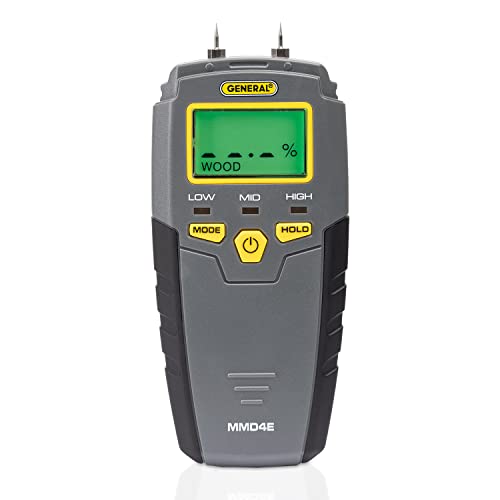
The MMD4E is the classic entry-level pin meter: two probes, a backlit LCD and a listed wood range of 5% to 50% moisture content, plus a building-materials range of 1.5% to 33% for drywall, masonry and leak checks. Audible and visual alerts sort readings into high, medium and low bands, speeding up firewood sorting and lumber-yard checks where a fast yes-or-no beats a decimal place.
General Tools lists accuracy at ±3% for wood, the pins are replaceable, and a protective cap keeps the probes covered in a toolbox. It leaves pin marks and asks you to apply species judgment yourself, but as a first meter — or a spare that lives in the truck for lumber-yard runs — it covers the essentials cheaply.
Specs
- Type: Pin-type
- Listed range: Wood 5%–50% MC; building materials 1.5%–33%
- Listed accuracy: ±3% (wood)
- Display: Backlit LCD
- Alerts: Audible and visual high/medium/low moisture alerts
- Pins: Replaceable test pins with protective cap
- Power: 9V battery
- ASIN: B00275F5O2
Quick Comparison
| Meter | Type | Listed Wood Range | Sensing Depth | Standout Feature |
|---|---|---|---|---|
| Wagner Orion 950 | Pinless | 4.0%–32.0% | 1/4 in and 3/4 in | Automatic EMC from built-in temp/RH sensor |
| Lignomat Ligno-Scanner D | Pinless | 5%–60% | 3/4 in | Widest range, 0.1% resolution |
| Extech MO55 | Pin + pinless | 5%–50% (pin) | Up to 1 in (pinless) | Both measurement methods in one meter |
| Klein Tools ET140 | Pinless | Relative scale by material mode | 3/4 in | LED bar graph, 2 m drop protection |
| General Tools MMD4E | Pin | 5%–50% | Pin depth | Backlit display with moisture alerts at a budget tier |
FAQ
What moisture content should lumber be before I build with it?
For furniture and cabinetry in a heated or air-conditioned interior, most guidance targets equilibrium with the room — commonly around 6% to 9% in conditioned spaces, higher in humid regions. A meter with an EMC function, like the Orion 950, calculates the target for your actual shop conditions instead of a generic figure.
Are pinless meters as accurate as pin meters?
They measure differently rather than better or worse. A pin meter reads moisture between its probes at pin depth; a pinless meter averages moisture over its sensing depth and sensor area. Pinless readings depend on selecting the right density setting for the species; pin readings depend on consistent pin depth plus species and temperature corrections.
Can one meter check both lumber and drywall?
Yes. Dual-mode meters such as the Extech MO55 publish separate ranges for wood and building materials, and several pinless models include drywall or masonry modes or reference scales. One meter can therefore handle both lumber checks and leak tracing in walls, floors and ceilings.
Why do my readings change between two boards of the same species?
Moisture is rarely uniform. Boards dry from the outside in, so a surface scan can read lower than the core, and boards at the center of a stack dry more slowly than those on the edges. Measuring several spots per board, and using a deeper sensing mode on thick stock, gives a truer picture.
Do I need to calibrate a moisture meter?
Pin meters are checked against a calibration reference, and some pinless meters, including the Orion line, ship with an on-demand calibrator that verifies the meter in the field. Checking calibration at the start of a project is cheap insurance against a meter that has drifted after a drop or battery change.
Conclusion
Pick the meter that matches your material and habits. The Wagner Orion 950 is the complete package for anyone drying or buying serious lumber, with dual-depth scanning and automatic EMC. The Lignomat Ligno-Scanner D offers the widest pinless range for mixed and reclaimed stock, while the Extech MO55 splits the difference with pin and pinless modes in one body. The Klein ET140 makes quick, mark-free scans affordable, and the General Tools MMD4E remains the budget pin meter to throw in the truck. Any of the five beats guessing — and guessing is how tabletops split.
Related guides
More from Amazon
Programs that pair well with the guide above. Offers and eligibility are set by Amazon and may change.
Free shipping on eligible items, Prime Video and more. Eligible new members can start with a free trial.
Start a Prime free trialAd-free music streaming. Eligible new subscribers can start with a free trial.
Try Music Unlimited freeA Prime membership for ages 18-24 with a trial period. Eligibility is set by Amazon.
See Prime for Young AdultsAudiobooks and podcasts to listen to on the go. Eligible new members can start with a free trial.
Try Audible freeAs an Amazon Associate we earn from qualifying purchases.