Disclosure: As an Amazon Associate, I earn from qualifying purchases. If you buy through links in this article, I may earn a commission at no extra cost to you.
Our top pick: Chemtronics Soder-Wick Rosin 80-5-5. Runner-up: MG Chemicals 425-NS No Clean Super Wick.
Solder wick, also called desoldering braid, is the simplest rework tool on the bench: a spool of fine copper braid coated in flux. Press it onto a joint with a hot iron and capillary action pulls the molten solder up into the weave, leaving the pad clean enough to lift the component or fit a new one. It is the tool that fixes solder bridges between fine-pitch pins, clears plated holes after a pump has taken the bulk of the solder away, and tidies pads on keyboard PCBs, game controllers and retro consoles before fresh parts go down.
This guide covers braid only. Desoldering pumps and powered vacuum tools are a different class of tool with a different job, and none of them appear here; every pick below is a spool of flux-coated copper wick. The five picks come from five different makers, and each one is a single, specific listing, so the width and spool length in the specs are the width and length you are actually ordering.
Top 3 picks at a glance


How to Choose Solder Wick
Match the width to the joint. Wick is sold in numbered sizes that run from about 0.03 inch (0.8 mm) for fine surface-mount pads up to 0.21 inch (5.3 mm) for large terminals and ground planes. The working rule is to pick a braid roughly the same width as the pad or joint: too narrow and it cannot hold all the solder in one pass, too wide and it spreads heat into neighboring pads and drinks solder from joints you meant to keep. A mid width around 0.075 to 0.10 inch (1.9 to 2.5 mm) covers most through-hole work, keyboard switches and general PCB repair, which is why most of the picks cluster there.
Pick a flux type and accept its trade-off. Rosin flux wicks the fastest and is the traditional choice for rework, but it leaves residue that should be cleaned off the board afterward. No-clean flux is slower to start but leaves minimal residue, which suits finished boards and quick fixes where a cleaning step is impractical. Lead-free work runs hotter, and some makers sell braid tuned for it; standard rosin or no-clean braid still works on lead-free joints, it just wants a hotter iron and a little more patience.
Decide how much length you need. Five-foot bobbins are the standard bench size and the cheapest way to try a brand. Ten and twenty-five foot spools cost less per foot and make sense if you recap boards, desolder mechanical keyboard switches by the plateful, or do regular repair work. Wick is a consumable with a shelf life: the flux coating dries out over time, so a huge spool you will take five years to finish is worse value than a fresh small one.
Mind the bobbin. Braid on an ESD-safe, static-dissipative bobbin is the safer choice around bare boards and sensitive components, and most professional lines use one. Whatever the spool, store it sealed and dry; oxidized, dull-looking braid wicks poorly no matter what the label says, and cutting back to bright copper is the first fix when a spool stops pulling solder.
Use enough iron. Wick works by conducting heat through the braid into the joint, so it wants a reasonably powerful iron and a tip at least as wide as the braid. Press, let the solder flow up into the weave, then lift the iron and braid together so the joint does not tear. Snip off the spent, solder-loaded section after every joint; reusing a saturated section is the main reason wick gets a bad reputation.
1. Chemtronics Soder-Wick Rosin 80-5-5
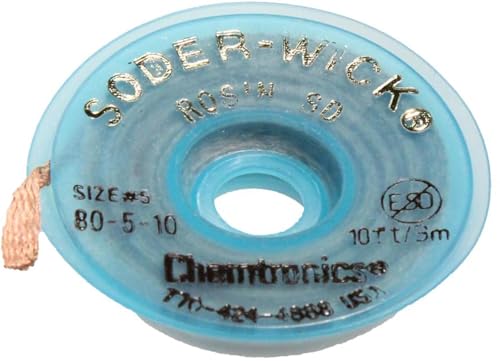
Soder-Wick is the braid most professional rework benches are stocked with, and the 80-5-5 is the wide end of its standard bobbin range: size #5, 0.145 inch (3.7 mm) wide, on a 5 foot ESD-safe spool. That width is for bigger work: power terminals, connector shells, relay pins, ground pours and any joint where a narrower braid would need three passes to clear the solder.
The flux is Chemtronics’ Type R rosin, the fastest-wicking coating in this roundup, in a pure copper braid built with a lighter mass so it heats quickly and responds at lower iron temperatures. The trade-off is the standard rosin one: plan to clean the residue off the board when the job is done. The bobbin is static dissipative, and the size #5 braid carries the range’s brown label.
Specs
- Brand: Chemtronics
- Model: 80-5-5 (Soder-Wick Rosin, size #5)
- Width: 0.145 inch (3.7 mm)
- Length: 5 ft (1.5 m)
- Flux: Type R rosin
- Bobbin: ESD-safe, static dissipative
- UPC: 747501575551
- ASIN: B004IOPUF4
2. MG Chemicals 425-NS No Clean Super Wick
The 425-NS is the no-clean counterpart to the professional rosin braids: a #3 fine braid, 0.075 inch (1.9 mm) wide and 5 feet long, coated with MG Chemicals’ no-clean flux. That mid-fine width is the general-purpose size for PCB rework, small through-hole parts and cleaning up after a pump, and the no-clean coating means the board does not need a solvent wash afterward for most jobs.
MG Chemicals weaves the Super Wick line from oxide-free copper and puts the 5 foot size on an ESD-safe bobbin. No-clean braid is a touch slower to start wicking than rosin, and the practical fix is a slightly hotter iron rather than more pressure. If you do a lot of quick repairs on boards that are going straight back into service, this is the spool that fits that workflow.
Specs
- Brand: MG Chemicals
- Model: 425-NS (No Clean Super Wick)
- Width: 0.075 inch (1.9 mm)
- Length: 5 ft (1.5 m)
- Flux: No-clean
- Bobbin: ESD-safe
- UPC: 779008425558
- ASIN: B00424S2C8
3. NTE Electronics SW02-10 No-Clean Solder Wick
NTE’s SW02-10 doubles the spool: 10 feet of #4 braid, 0.098 inch (2.5 mm) wide, with a no-clean flux formula. The 2.5 mm width is the classic all-rounder for through-hole desoldering, switch swaps and connector work, and the longer spool suits anyone who burns through 5 foot bobbins quickly, such as keyboard builders desoldering a full board of switches.
NTE weaves the wick from fine copper wire and adds the no-clean flux to increase absorption while keeping residue low. The #4 size carries the line’s blue label. Between the width and the length, this is the value pick of the group for general bench use: one spool covers a lot of joints before it runs out.
Specs
- Brand: NTE Electronics
- Model: SW02-10
- Width: 0.098 inch (2.5 mm), size #4
- Length: 10 ft
- Flux: No-clean
- Material: Fine copper wire braid
- ASIN: B0195UVWJ8
4. EasyBraid LF-E-25 Lead-Free Desoldering Braid

The LF-E-25 is the bulk spool of the group: 25 feet of 0.125 inch (3.2 mm) no-clean braid from EasyBraid’s lead-free line. The width sits between the general-purpose sizes and the wide Chemtronics, good for larger pads, terminal strips and production rework, and the length is aimed at benches that desolder every day and are tired of reordering 5 foot bobbins.
EasyBraid builds its wick from ultra-fine, oxide-free copper woven to maximize thermal conduction and solder retention, and the LF line is formulated for lead-free solder, which melts hotter and wets braid less willingly than leaded solder. If your work is mostly modern, lead-free boards, a braid tuned for those temperatures is the sensible default; it still works on leaded joints, just with heat to spare.
Specs
- Brand: EasyBraid
- Model: LF-E-25
- Width: 0.125 inch (3.2 mm)
- Length: 25 ft
- Flux: No-clean, lead-free formulation
- Material: Oxide-free copper braid
- ASIN: B00AZ7H4VQ
5. TOWOT Solder Wick Braid with Flux

TOWOT’s wick is the budget spool: 2.5 mm (0.10 inch) wide and 9.8 feet (3 m) long, a no-clean fluxed copper braid in the most useful general width. Nearly ten feet at the entry end of the market makes it a low-risk way to stock a first bench or a travel kit, and the width covers the same through-hole and switch work as the mid-size professional braids.
The braid uses a fine, geometrically precise weave designed to promote strong capillary action, and the maker positions it for PCB correction work, component removal and small-board repair. It does not come on a rated ESD bobbin like the professional lines, so treat it as a general-purpose consumable rather than a controlled-process material. For hobby boards, keyboards and retro console repairs, that distinction rarely matters in practice.
Specs
- Brand: TOWOT
- Width: 2.5 mm (0.10 inch)
- Length: 9.8 ft (3 m)
- Flux: No-clean
- Material: Copper braid
- ASIN: B0943MWPXN
Quick Comparison
| Wick | Width | Length | Flux | Best for |
|---|---|---|---|---|
| Chemtronics Soder-Wick 80-5-5 | 0.145 in (3.7 mm) | 5 ft | Type R rosin | Large terminals, fast wicking |
| MG Chemicals 425-NS | 0.075 in (1.9 mm) | 5 ft | No-clean | General rework, no cleanup step |
| NTE SW02-10 | 0.098 in (2.5 mm) | 10 ft | No-clean | All-round bench use, switch swaps |
| EasyBraid LF-E-25 | 0.125 in (3.2 mm) | 25 ft | No-clean, lead-free | Lead-free boards, heavy use |
| TOWOT | 2.5 mm (0.10 in) | 9.8 ft | No-clean | First bench, budget spool |
FAQ
What width of solder wick should I buy first?
Start with a mid width around 0.075 to 0.10 inch (1.9 to 2.5 mm). It clears most through-hole joints, keyboard switches and connector pins in one or two passes. Add a finer braid later for small surface-mount pads and a wide one if you regularly desolder power parts or connector shells.
Is rosin or no-clean wick better?
Rosin wicks faster and is the choice when speed matters and the board will be cleaned afterward anyway. No-clean is slightly slower to start but leaves minimal residue, which suits finished boards and quick repairs. Both remove solder the same way; the difference is the cleanup, not the result.
Why does my wick stop pulling solder?
Usually the section is already saturated, the braid has oxidized, or the iron is too cool or too small for the width. Cut back to fresh, bright braid, use a tip at least as wide as the wick, and lift the iron and braid off the joint together. Old spools with dried-out flux also wick poorly; braid is a consumable, not a lifetime tool.
Can solder wick clear a plated hole completely?
It can clear most of the solder and is the standard finishing step after a desoldering pump has removed the bulk. For a fully open hole, work the braid from both sides of the board and let capillary action do the work rather than pushing harder with the iron, which risks lifting the pad.
Does wick work on lead-free solder?
Yes, with more heat. Lead-free solder melts at a higher temperature and wets braid less readily, so raise the iron temperature and give the joint a moment longer. A braid formulated for lead-free work, like the EasyBraid above, is woven and fluxed with those temperatures in mind.
Conclusion
For most benches, the NTE SW02-10 is the easy default: the all-round 2.5 mm width, a 10 foot spool and no-clean flux cover everyday desoldering without a cleanup step. Choose the MG Chemicals 425-NS if you want a finer, ESD-bobbin spool from a professional line, the Chemtronics 80-5-5 when wide joints and the fastest rosin wicking matter, and the EasyBraid LF-E-25 if lead-free boards and heavy use justify a 25 foot spool. The TOWOT spool rounds out a first kit for very little commitment. Whichever braid you pick, keep it sealed, cut away spent sections, and let width and flux type, not habit, decide which spool you reach for.
Related guides
More from Amazon
Programs that pair well with the guide above. Offers and eligibility are set by Amazon and may change.
Free shipping on eligible items, Prime Video and more. Eligible new members can start with a free trial.
Start a Prime free trialAd-free music streaming. Eligible new subscribers can start with a free trial.
Try Music Unlimited freeA Prime membership for ages 18-24 with a trial period. Eligibility is set by Amazon.
See Prime for Young AdultsAudiobooks and podcasts to listen to on the go. Eligible new members can start with a free trial.
Try Audible freeAs an Amazon Associate we earn from qualifying purchases.