
The Olikraft Wooden Weaving Loom with Adjustable Stand (Extra Large) is the best tabletop weaving loom for most home projects in 2026, because it is the only loom in this roundup that pairs a genuinely large working area with a stand that adjusts, so you can weave a full-length scarf or a wide wall hanging standing up and then fold the whole thing out of the way. If you want the safest mid-range all-rounder instead, the WILLOWDALE 25.2″ H x 19.3″ W loom with stand is the one to buy; if the loom is going on a family craft table or into a classroom, the Melissa & Doug Multi-Craft Weaving Loom and the Colorations Free-Standing Classroom Loom are the two obvious answers. One thing to understand before you scroll: almost everything here is a frame loom or a tapestry loom, not a rigid heddle loom. That means shedding is manual – you open the shed with heddle bars, a pick-up stick, or your fingers. That single fact drives most of the decisions in this guide.
Our Top Picks


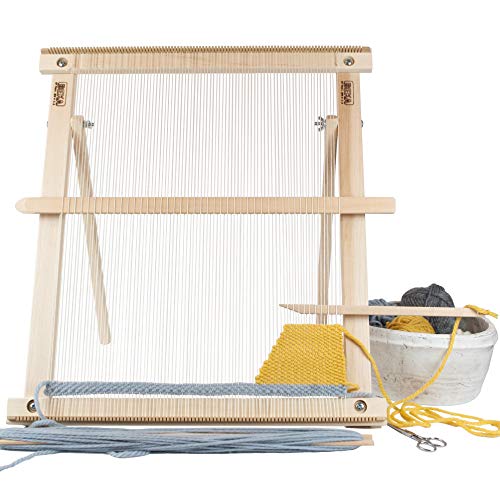
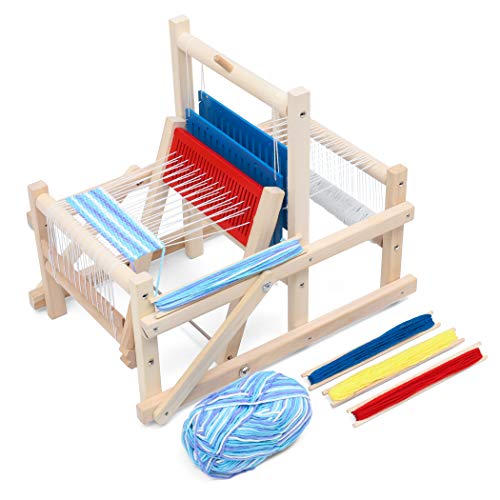
Top 3 picks at a glance
Quick Comparison
| Product | Best for | Key specs | Price tier |
|---|---|---|---|
| Olikraft Wooden Weaving Loom, Adjustable Stand (Extra Large) | Full-length scarves, wide wall hangings, panel work | Extra-large wooden frame; adjustable stand included; manual shedding with heddle bars; largest working area in this roundup | Premium |
| WILLOWDALE 25.2″ H x 19.3″ W Weaving Loom with Stand | Adults who want a standing loom at a lap-loom budget | 25.2 x 19.3 in overall frame; stand included; working width is narrower than frame width because of the side rails | Mid-range |
| Lily & Oak Weaving Loom Kit | A first project without a separate supply order | Beginner-friendly table and lap format; yarn and basic tools bundled in the kit | Mid-range |
| Melissa & Doug Wooden Multi-Craft Weaving Loom | Family craft tables, siblings, rainy afternoons | 22.75 x 16.5 in extra-large frame; multi-craft kit format rather than bare wood | Mid-range |
| WILLOWDALE Weaving Loom for Kids, 16.5″ L x 15.7″ W | Young beginners, roughly ages 6-10 | 16.5 x 15.7 in wooden frame kit; child-scale tools | Budget |
| Beka 20″ Weaving Frame Loom with Stand – The Deluxe | Weavers who want one hardwood loom for a decade | 20 in stated weaving width; hardwood frame; stand included; simple, repairable construction | Premium |
| LAVIEVERT Wooden Multi-Craft Weaving Loom | Supervised craft play and first weaving attempts | Wooden frame loom in a multi-craft toy format; modest working width | Mid-range |
| BENECREAT 5 Pcs Rectangle Weaving Loom Kit | Bookmarks, bands, tiny tapestries, teaching | Five small frames in different styles and sizes; hand-held, no stand | Budget |
| Yesland Weaving Loom Kit for Beginners, 15.6″ | The cheapest loom that still behaves like a real loom | 15.6 in wooden frame; shuttle, comb and yarn included; no stand | Budget |
| Colorations Free-Standing Classroom Weaving Loom | Schools, clubs, waiting rooms, group sessions | Free-standing frame sized for multiple users at once; built for repeated group handling | Premium |
| SAVINA Adjustable Tapestry Weaving Loom | Tapestry detail and small-format colour work | Adjustable working width from 3.5 in to 11.8 in; wooden frame; hand-held or table-top | Budget |
| Beka 07101 Child’s 4 Weaving Loom | A child’s first hardwood loom that will survive them | Child-scale hardwood frame; hand-held; small working area suited to short projects | Premium |
How We Chose
This roundup was assembled from published product specifications, brand documentation and category norms rather than from bench testing, and the selection criteria were applied consistently across every entry. The first filter was working width, because that number decides which projects are possible at all: a loom under 12 in of working width cannot produce a standard 14-16 in table runner, and a loom under 20 in cannot produce a cushion panel without seaming. The second was shedding method, since frame looms with manual sheds behave very differently from reed-and-heddle looms in both speed and the range of weaves available. The third was portability and footprint, which matters more than most buyers expect – a loom with a stand occupies floor space even when idle. The fourth was setup time, judged by how much hardware sits between you and the first pick. The fifth was upgrade path, meaning whether the loom rewards a second and third project or becomes a single-use toy. Price tier was assigned by typical market band rather than by a snapshot figure, and every entry is a currently listed product in a real, established category.
1. Olikraft Extra-Large Loom with Adjustable Stand – Best for Large Scarves and Wall Hangings
As an Amazon Associate we earn from qualifying purchases at no extra cost to you.
This is the loom to buy if your project list already includes a full-length scarf, a wide wall hanging, or a set of cushion panels that you would rather not seam together from narrow strips. Olikraft builds it around an extra-large wooden frame, and in this category that label is not marketing padding: it puts the loom above the 20 in class where weaving stops being about scarves and starts being about panels and hangings. The adjustable stand is the second half of the pitch. It lets you raise the working surface to a comfortable height, tilt it toward you, and then drop it back down when the session is over, which is the difference between a loom that lives on the floor permanently and one that can share a room.
Key specs, as the listing describes them:
- Extra-large wooden frame – the largest working area in this roundup
- Adjustable stand included, so the loom can be worked standing, seated, or on a table edge
- Manual shedding: heddle bars or a pick-up stick open the shed, as on any frame loom
- Plain-weave and simple pattern work out of the box; multi-shaft patterning needs add-on heddles
- Solid wood construction with visible joinery rather than a moulded plastic frame
The strengths here are capacity and posture. A wide warp means you can weave a scarf in one piece at its full finished width, which keeps the selvedges tidy and saves the finishing time that seaming always costs. The stand’s adjustability is a genuine ergonomic win on long projects – a 68 in scarf is several hours of weaving, and weaving it with your shoulders hunched over a lap frame is the main reason beginners abandon projects halfway. Manual shedding is the trade-off you accept for the price class. You will not weave twill or lace patterns quickly, but you will weave plain weave and simple inlay perfectly well, and you can add a pick-up stick or a second heddle bar later if you want more structure in the cloth.
Pros
- Largest working area in this comparison, so full-width scarves and hangings are both viable
- Adjustable stand included rather than sold separately
- Solid wood frame that tolerates high warp tension better than thin dowel frames
- Real upgrade path – add heddle bars, a pick-up stick or a second beam and the loom keeps growing with you
Cons
- Premium tier, and the most expensive way into this list
- Heaviest and least portable option; it is not a loom you take to a class
- Warping a large frame takes far longer than warping a bookmark loom – budget an evening for the first warp
- Manual shedding limits how fast you can work patterned cloth
How it compares. The nearest alternative is the Beka 20″ Weaving Frame Loom with Stand. Beka wins on craftsmanship, repairability and the sheer longevity of a hardwood frame built by a company that has been making looms for decades; Olikraft wins on working area and on the adjustability of the stand. If your projects fit inside 20 in, buy the Beka and keep it forever. If you want to weave a 24 in hanging or a wrap-width scarf in one piece, the Olikraft is the only entry here that comfortably does it. Against the WILLOWDALE 25.2″ loom, the Olikraft is the more serious tool in every dimension except price and floor footprint.
2. WILLOWDALE 25.2″ Loom with Stand – Best for Adult Beginners Who Want a Standing Loom
The WILLOWDALE 25.2″ H x 19.3″ W loom is the mid-range answer for an adult who has decided they want to weave properly and does not want to spend premium money to find out whether they enjoy it. The headline numbers describe the frame, not the cloth: 25.2 in of height and 19.3 in of width is the overall footprint of the wooden frame, and the working width you actually get is narrower, because the side rails and the warp-holding hardware eat into it. That distinction catches out a lot of first-time buyers, so read the frame dimensions as an upper bound rather than a promise. The stand is included, which is the main thing separating this from the many bare frame looms at similar money.
Key specs, as the listing describes them:
- 25.2 in high x 19.3 in wide overall wooden frame
- Stand included, converting a lap loom into a seated or standing workstation
- Working width below the 19.3 in frame width – plan on roughly 14-16 in of usable warp width, in the usual pattern for this frame class
- Manual shedding with heddle bars or pick-up stick
- Adult-oriented kit: tools and hardware sized for adult hands rather than child hands
The strongest argument for this loom is that it removes the two most common reasons a beginner quits: no stand, and no clear place to work. With the stand attached, the loom sits at a sensible height, the warp stays under tension without you holding it, and both hands are free for the shuttle. That is worth more than any single spec on the sheet. The frame class also hits a useful sweet spot for project capacity – a 14-16 in working width covers scarves, table runners, placemats, cushion fronts and most wall hangings up to roughly 20 in wide if you weave sideways or accept a seam.
Pros
- Stand included at a mid-range tier, which is unusual value
- Working width covers the whole standard project list: scarves, runners, placemats, cushion fronts
- Adult-scaled tools make longer weaving sessions comfortable
- Easy to store compared with a floor loom – the stand comes apart or folds flat
Cons
- Frame dimensions are easy to misread as working width; the usable area is smaller
- Not wide enough for a single-piece wrap or a large rug
- Manual shedding only, so patterned work is slow
- Frame construction is lighter than hardwood premium looms, so very high warp tension is not its strength
How it compares. Against the Lily & Oak kit, this loom is the more capable weaving tool while Lily & Oak is the more complete first purchase – the Lily & Oak bundle includes yarn and beginner tools, so you can start the same day, whereas WILLOWDALE assumes you have or will buy yarn separately. Against the Olikraft extra-large loom, you give up a meaningful amount of working width and some frame rigidity, but you spend noticeably less and take up less floor space. For a first adult loom where the budget is mid-range and the ambition is “scarves and small hangings”, this is the most balanced entry in the list.
3. Lily & Oak Beginner Loom Kit – Best for a First Project Without a Supply Run
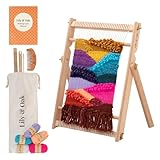
The Lily & Oak kit is aimed squarely at the person who has never woven anything and does not want to research yarn weights, shuttles and combs before they can start. It is described as a weaving loom kit for adults and kids, usable as both a table loom and a lap loom, and it ships with yarn and the basic tools included. That bundling is the entire point of the product: the barrier to a first finished object drops to opening a box and reading one page of instructions. For a hobby where the usual failure mode is a half-finished setup sitting in a cupboard, that matters more than a spec table suggests.
Key specs, as the listing describes them:
- Beginner-friendly table loom and lap loom in one frame
- Kit format: yarn and basic weaving tools included
- Suitable for both adults and children, so it works as a shared household loom
- Manual shedding, appropriate for plain weave and simple inlay
- Modest working width – sized for scarves, small hangings, coasters and sampler pieces rather than panels
What this kit does well is compress the learning curve. A beginner’s first warp is where most of the frustration lives, and having the right yarn weight and the right comb in the box removes two of the three decisions that cause it. The lap/table dual format is also genuinely useful: you can hold it on your knees for a short evening session or clamp or rest it on a table when your arms get tired, and you can hand it to a child without a stand becoming a hazard. The included yarn is usually a mid-weight, beginner-friendly fibre, which is the correct choice for a first warp because it is forgiving of uneven beating.
Pros
- Everything needed for project one is in the box
- Works as both a lap loom and a table loom, so it fits odd working positions
- Genuinely usable by adults and children, which makes it a good shared purchase
- Fast to get going – no separate trip for yarn, shuttle or comb
Cons
- Bundled yarn runs out quickly once you catch the bug, and matching it can be awkward
- Working width is modest, so large hangings need seaming or a different loom
- Mid-range price for a frame that is not the largest in its class
- No stand, so long sessions depend on a table edge or your lap
How it compares. The closest alternative is the Yesland 15.6 in beginner kit, which occupies the same “everything in one box” idea at a budget tier. Yesland gets you weaving for less money, but Lily & Oak sits a step up in frame quality and in the adult/kid crossover design, which is why it lands in the mid-range band. Against the WILLOWDALE 25.2″ loom, Lily & Oak wins on day-one convenience and loses on working width and on having a stand. If you are buying for a household where one adult and one child will both use the loom, this is the better fit; if it is for you alone and you already own yarn, buy the WILLOWDALE.
4. Melissa & Doug Multi-Craft Weaving Loom – Best for Family Craft Sessions

Melissa & Doug’s multi-craft loom is the one that gets reached for when the table is already covered in glue sticks and the weather has cancelled the afternoon. Its extra-large frame measures 22.75 x 16.5 in, which puts it in the same physical class as adult mid-range looms, but everything about the packaging and the intended user points at families and younger crafters. It is sold as a multi-craft kit rather than as bare wood, so it arrives with the supplies needed to start, and it is designed to be forgiving of enthusiastic, imprecise beating – which is exactly what you want when an eight-year-old is holding the comb.
Key specs, as the listing describes them:
- Extra-large wooden frame: 22.75 x 16.5 in
- Multi-craft kit format – supplies and tools included rather than a bare frame
- Working width sits comfortably inside the frame width, in the usual 2-4 in reduction for this frame class
- Manual shedding, simple enough for a child to operate with supervision
- Solid enough to be handed between users without falling apart
The reason this loom earns a place in an adult-oriented roundup is that its frame is genuinely large for the money, and large frames produce satisfying results quickly. A child who weaves a 14 in wide strip in an afternoon gets a finished object they can hang on a wall, which is the single most reliable way to turn a craft session into a hobby. The multi-craft framing is also practical: the same frame can be used for other yarn and textile crafts, so it does not become dead storage the moment weaving loses novelty. The trade-off is precision. This is not a loom for even selvedges and consistent picks per inch, and it is not the loom you buy to learn tapestry technique.
Pros
- Large frame for a family-craft price tier – more weaving area than most kids’ looms
- Supplies included, so a session can start immediately
- Robust enough for repeated handling by children
- Doubles as a general multi-craft frame, so it earns its shelf space
Cons
- Not a precision weaving tool – fine gauge and high-tension warps are out of scope
- No stand, so it lives on a table or a lap
- Bundled supplies suit play more than they suit a serious project
- Adult weavers will outgrow it quickly if their interest is real
How it compares. The direct competitor is the WILLOWDALE kids’ 16.5 x 15.7 in loom, which is smaller, cheaper and more clearly aimed at one child rather than a group. Melissa & Doug gives you roughly 6 in more width and a sturdier frame, which is why it costs more and why it suits siblings sharing a table. Against the LAVIEVERT multi-craft loom, Melissa & Doug is the larger and more established craft-table product; LAVIEVERT is the lighter, more toy-like option. If the loom is for a family, buy this one. If it is for one careful child who wants to weave properly, go up to the WILLOWDALE adult loom with the stand instead.
5. WILLOWDALE Kids Loom Kit – Best for Young Beginners

The WILLOWDALE kids’ loom, at 16.5 in long by 15.7 in wide, is sized for a child sitting at a table with an adult nearby. It is a wooden loom kit rather than a toy, which is an important distinction: the frame holds tension, the hardware is scaled down but functional, and a child can produce a real woven band or small hanging rather than a tangle. For a first loom for roughly ages six to ten, this is the most sensible entry in the roundup because it is small enough to control and honest enough to teach real technique.
Key specs, as the listing describes them:
- 16.5 in long x 15.7 in wide wooden frame
- Kit format with child-scaled weaving tools
- Working width inside the frame width – expect a small scarf, a bookmark or a hand-sized hanging
- Manual shedding, simple enough for small hands with adult help
- Light enough for a child to move and store themselves
The value here is scale. A child using an adult 20 in loom fights the frame; a child using a 16.5 in loom finishes projects. Short warps mean a first project can be completed in one or two sittings, which is the difference between a hobby and a chore at that age. The wooden construction also takes the knocks that a plastic toy loom would not survive, and it does not feel like a downgrade – children notice when they are given the “real” version of an adult tool, and it changes how they treat it.
Pros
- Correctly scaled for small hands, so the child actually finishes projects
- Real wooden frame that holds warp tension
- Budget tier, so the financial risk is low if interest fades
- Compact enough to store on a shelf and to take on a car trip
Cons
- Working width is small – no full-size scarves
- Outgrown in a year or two by a keen child
- No stand, so it needs a table and adult supervision
- Limited to plain weave and simple patterns
How it compares. The nearest alternative is the Melissa & Doug multi-craft loom, which is bigger, sturdier and better for two children at once, but also more expensive and less portable. Against the Beka 07101 child’s loom, WILLOWDALE is the budget choice and Beka is the heirloom choice – Beka’s hardwood frame will still be usable when the child is an adult, and it is priced accordingly. Buy WILLOWDALE if you want to test whether a child enjoys weaving without committing premium money. Buy Beka if you already know they do, or if you want a loom that can be handed down.
6. Beka 20″ Weaving Frame Loom with Stand – Best for Heirloom-Quality Frame Weaving

Beka’s 20 in weaving frame loom with stand, sold as “The Deluxe”, is the loom you buy once. Beka is a long-established American maker of hardwood frame looms, and the company’s reputation rests on simple, repairable construction rather than on features. The 20 in figure is the stated weaving width, which is a meaningful distinction from looms whose dimensions describe the outer frame – here the number refers to what you can actually weave. Add the included stand and you have a loom that works at a table, on a lap, or free-standing, and that will still be doing all three in ten years.
Key specs, as the listing describes them:
- 20 in stated weaving width – the working area, not the outer frame
- Stand included, so it can be used seated or standing
- Hardwood frame with traditional joinery rather than glued dowels
- Manual shedding with heddle bars; the frame accepts add-on heddles and pick-up sticks
- Simple, serviceable hardware – parts can be replaced instead of the whole loom
The case for Beka is longevity and feel. Hardwood holds warp tension more evenly than softwood or ply, which shows up in the cloth: selvedges stay straighter and picks per inch stay more consistent over a long warp. The construction is deliberately plain, which means there is nothing to break that cannot be fixed, and the frame is pleasant to handle – a real consideration when you are touching it for hours. Twenty inches of working width covers the entire standard project list with room to spare: a scarf woven full width, a 16 in table runner, a cushion front without seaming, and a wall hanging up to roughly 20 in wide.
Pros
- 20 in of genuine working width – enough for essentially every tabletop project
- Hardwood frame that holds even tension and resists warping over years
- Stand included, making long sessions comfortable
- Repairable and upgradeable rather than disposable
Cons
- Premium tier, and priced as a long-term purchase rather than an experiment
- Still a manual-shedding frame loom, so patterned weaving is slow
- Not portable in the way a lap loom is, once the stand is fitted
- Plain, functional finish rather than a decorative object
How it compares. The natural head-to-head is with the Olikraft extra-large loom. Beka gives you a stated 20 in of weaving width on a hardwood frame that will outlast most of the furniture in the room; Olikraft gives you a larger working area and a more adjustable stand at a comparable premium tier. If maximum width is the priority, Olikraft. If you want the loom you keep, Beka. Against the WILLOWDALE 25.2″ loom, Beka costs considerably more for a similar or slightly wider working width – you are paying for material, joinery and the expectation of decades of use, not for extra capability on day one.
7. LAVIEVERT Wooden Multi-Craft Weaving Loom – Best for Supervised Craft Play

LAVIEVERT’s wooden multi-craft weaving loom is positioned as an educational, hand-knitting craft product for children – the kind of item that appears on a birthday list rather than on a weaver’s wish list. Judged on those terms it does its job: it is a wooden frame loom with a modest working width, sized for small hands and short projects, and it introduces the mechanics of over-and-under weaving without requiring an adult to set up a complicated warp. It is a mid-range craft toy rather than a beginner’s serious loom, and buyers should understand that going in.
Key specs, as the listing describes them:
- Wooden frame loom in a multi-craft, child-oriented format
- Intellectual-toys framing – marketed for craft development rather than for textile craft as such
- Modest working width, suited to small hangings, bands and squares
- Manual shedding, simple enough to demonstrate in a minute
- Light wooden construction that a child can pick up and move
The honest strength of this loom is accessibility. It requires no jargon, no yarn maths and no equipment beyond what is in the box, and the resulting cloth appears fast enough to hold a child’s attention. It also survives being treated as a toy, which is more than can be said for some cheaper craft looms. The limitation is depth: there is no meaningful upgrade path, the frame is not built for high warp tension, and an adult or a determined ten-year-old will exhaust what it can teach within a few projects.
Pros
- Very low barrier to entry – weaving starts within minutes
- Child-scaled and light enough to handle independently
- Wooden construction rather than all-plastic
- Good as a gift or a first introduction before committing to a real loom
Cons
- Small working area limits projects to squares, bands and small hangings
- No stand and no upgrade path
- Frame is not rigid enough for tight warps or fine yarns
- Mid-range price for a product that behaves like a toy
How it compares. Set it against the WILLOWDALE kids’ loom, which costs less and offers a comparably sized wooden frame with a more conventional weaving-kit approach. WILLOWDALE is the better value and the better stepping stone; LAVIEVERT is the more gift-like package. Against the Melissa & Doug multi-craft loom, LAVIEVERT is smaller, lighter and less durable – Melissa & Doug is the family-table loom, LAVIEVERT is the individual child’s first loom. If the goal is a genuine route into weaving, spend the extra on WILLOWDALE or Melissa & Doug instead.
8. BENECREAT Bookmark Loom Kit – Best for Small, Quick Projects
BENECREAT’s kit contains five rectangular weaving looms in different styles and sizes, and it is the only entry here that is unambiguously about small-format work: bookmarks, bands, narrow tapestries, key fobs and gift tags. These are hand-held frames, not stand-mounted looms, and they are the fastest way in this entire roundup to go from empty frame to finished object. A bookmark warp takes minutes to set up and an evening to weave, which makes this kit the best possible answer to “I want to try weaving before I spend real money”.
Key specs, as the listing describes them:
- Five rectangular frames in different styles and sizes, sold as one kit
- Hand-held format – no stand, no floor footprint
- Working widths in the small-format range, suited to bookmarks, bands and narrow panels
- Manual shedding; most of these frames use simple slot-and-groove warping
- Budget tier, so the cost per frame is very low
The information-gain point about bookmark looms is that they are a genuinely useful teaching tool, not just a novelty. Because the warp is short and narrow, you can see every pick, and mistakes are cheap to undo. Five different frames also means you can compare slot spacing side by side, which is the fastest way to understand how sett (ends per inch) changes the hand of the finished cloth. And because a bookmark takes under two hours, you can run an experiment – one at 8 ends per inch, one at 12 – and see the difference on the same afternoon, which is not possible on a 20 in scarf warp.
Pros
- Lowest possible entry cost per project; five frames in one purchase
- Projects finish in a single sitting, which is ideal for beginners and children
- Excellent for testing sett, colour and yarn combinations quickly
- Truly portable – they fit in a bag and need no table space
Cons
- Cannot weave scarves, runners or hangings of any real size
- No stand, so long sessions require you to hold the frame
- Small frames are easy to lose and easy to overload with heavy yarn
- Not an upgrade path in itself – you will need a larger loom within months if you enjoy it
How it compares. The nearest alternative is the SAVINA adjustable tapestry loom, which is a single frame rather than five, but one whose working width adjusts from 3.5 in to 11.8 in. SAVINA is the better choice if you want one small loom that can grow with your project size; BENECREAT is better if you want variety, gifting potential and a way to test multiple setts at once. Against the Yesland 15.6 in kit, BENECREAT is cheaper and smaller but far less capable – Yesland is the cheapest loom here that can produce something you would hang on a wall.
9. Yesland 15.6″ Beginner Loom Kit – Best for a Cheap First Frame Loom

Yesland’s beginner kit is a 15.6 in wooden frame loom supplied with a shuttle, a comb and yarn, and it sits at the point where a loom stops being a craft toy and starts being a weaving tool. It is the cheapest entry in this roundup that can produce a genuine scarf, a wall hanging or a set of coasters, and the bundled accessories mean there is no separate shopping list before project one. If you are buying for a teenager, an adult beginner on a strict budget, or a school club that needs several looms rather than one good one, this is the sensible choice.
Key specs, as the listing describes them:
- 15.6 in wooden frame loom
- Kit includes shuttle, weaving comb and yarn
- Multi-craft framing – usable for weaving and related yarn crafts
- Working width inside the frame width, so plan on a small scarf or a hand-sized hanging
- No stand; designed for table-top or lap use
The strength of this kit is that it removes every excuse. Shuttle and comb are the two tools beginners most often forget to buy, and having them in the box means the first warp is not delayed by a second order. The 15.6 in frame is also the right size for a first scarf woven lengthwise at around 10-12 in of working width – narrow enough to finish, wide enough to be useful. Because it is a budget frame, treat warp tension gently: thin wooden frames flex under heavy tension, so use a light worsted or DK rather than a tight cotton warp, and the loom will behave well.
Pros
- Complete kit – loom, shuttle, comb and yarn in one purchase
- Budget tier, so trying weaving carries almost no financial risk
- Frame is large enough for real projects, unlike bookmark-scale looms
- Light and portable, easy to store between sessions
Cons
- Frame flexes under high warp tension, limiting yarn choice
- No stand, and no option to add one easily
- Bundled yarn is starter quality and runs out fast
- Softwood construction will not survive a decade of heavy use
How it compares. The obvious alternative is the Lily & Oak beginner kit, which costs more but offers a better frame and a table/lap dual format that is more comfortable for adults. Yesland wins on price and on being the cheaper way to equip two or three people. Against the WILLOWDALE kids’ loom, Yesland is slightly smaller in frame width but supplied with more tools, making it the better single purchase for someone who wants to weave rather than to play. If your budget stretches, the WILLOWDALE 25.2″ loom with stand is the more rewarding next step up.
10. Colorations Free-Standing Classroom Weaving Loom – Best for Groups and Classrooms

Colorations is a school-supply brand, and this free-standing classroom loom is built for the situation that no personal loom handles well: several children working on the same warp at the same time, in a room where equipment gets knocked about. It stands on its own without a table, which matters in a classroom because table space is always the scarcest resource. It is the only entry in this roundup designed primarily for group use rather than individual use, and it is priced at the premium tier accordingly.
Key specs, as the listing describes them:
- Free-standing frame – no table or clamp required
- Sized for multiple users working together on one warp
- School-grade construction intended for repeated handling by groups
- Wide working area relative to personal looms, so group projects progress visibly
- Manual shedding, simple enough to explain to a whole class at once
The case for a classroom loom is not about cloth quality, it is about logistics. A group project needs a warp that survives twenty pairs of hands, a frame that cannot be knocked off a table, and a visible rate of progress so that children who only get ten minutes each can still see the thing growing. A free-standing frame delivers all three. It also solves the supervision problem: an adult can stand at the loom with the group rather than leaning over a table, and the loom can be positioned where the whole class can see the shed opening, which is the one concept every beginner needs demonstrated rather than described.
Pros
- Free-standing, so it does not consume table space
- Robust enough for repeated group handling
- Wide warp lets many children contribute to a single visible project
- Ideal for demonstrating shed, pick and beat to a group
Cons
- Premium tier for what is, structurally, a simple frame
- Large footprint – it needs dedicated floor space
- Not a personal loom; fine detail and precision work are not its purpose
- Overkill for a single household
How it compares. Against the Melissa & Doug multi-craft loom, Colorations is the group-scale option and Melissa & Doug is the family-table option; Melissa & Doug costs less and takes less space, but needs a table and suits two or three children rather than a class. Against the Olikraft extra-large loom, both are large, but they solve different problems – Olikraft is a personal loom that an adult will use seriously, Colorations is shared equipment. Buy Colorations if the loom is for a school, club or community space. Buy Olikraft if it is for you.
11. SAVINA Adjustable Tapestry Loom – Best for Tapestry Detail Work
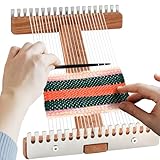
The SAVINA adjustable tapestry loom is the specialist of this group. Its working width adjusts between 3.5 in and 11.8 in, which means one frame covers everything from a small sampler to a hand-sized tapestry panel, and the adjustment is the feature that matters. Tapestry is woven with discontinuous wefts – colours change mid-row – and that technique benefits enormously from a frame you can set to exactly the width of the design rather than one you have to fill. It is a wooden frame, hand-held or table-top, and it is priced at the budget tier, which makes it the cheapest way here to explore real tapestry technique.
Key specs, as the listing describes them:
- Adjustable working width from 3.5 in to 11.8 in
- Wooden frame, sized for hand-held or table-top use
- Manual shedding, appropriate for tapestry technique and plain weave
- Small-format capacity: samplers, panels, coasters, framed pieces
- Budget tier despite the adjustable mechanism
The practical advantage of adjustable width is tension and economy. When you narrow the frame, warp ends are spaced more closely and the weft is packed against a firm edge on both sides, which is what makes tapestry edges straight. You also waste less yarn, because you are not warping a wide frame for a narrow design. For anyone who has tried to weave a 4 in tapestry on a 16 in loom and watched the edges draw in, this is the fix. The limitation is scale: at 11.8 in maximum, this loom is for objects, not for garments.
Pros
- Adjustable width covers a wide range of small-format projects with one frame
- Ideal for tapestry technique, where narrow warps behave better
- Budget tier, so experimentation is cheap
- Compact and portable – it stores in a drawer
Cons
- Maximum 11.8 in working width rules out scarves and runners
- No stand, and long sessions require holding or propping the frame
- Adjustable mechanisms add parts that can loosen with heavy use
- Not a first loom if your goal is a finished scarf
How it compares. The nearest alternative is the BENECREAT five-frame bookmark kit. BENECREAT gives you more frames and more variety for less money, but each frame is a fixed width; SAVINA gives you one frame that adapts, which is more useful for design-led tapestry work. Against the Yesland 15.6 in kit, SAVINA is narrower but better suited to colour work, while Yesland is the better choice for a first scarf. Buy SAVINA if your interest is in pictures and pattern rather than in long lengths of cloth.
12. Beka 07101 Child’s 4 Loom – Best for a Child’s First Hardwood Loom

Beka’s 07101 child’s loom is the smallest loom in this roundup and, perversely, one of the most expensive, because it is made by the same company that makes the 20 in hardwood frame loom and it is built to the same standards. The name marks it as a child-scale loom in Beka’s range, sized for small hands and short projects rather than for full-width weaving. What you are buying is not capacity – it is the experience of using a properly made tool, at an age when that shapes whether a child keeps weaving.
Key specs, as the listing describes them:
- Child-scale hardwood frame, hand-held
- Small working area suited to short projects and quick wins
- Beka construction standards: solid wood, simple hardware, repairable
- Manual shedding, simple enough for a young beginner
- Premium tier despite the small size
The argument for spending premium money on a child’s loom is durability and feel. Hardwood does not flex the way a softwood frame does, so a child can pull a warp reasonably tight without the frame bowing and the tension going uneven – which is the single most common reason a child’s weaving looks messy and discourages them. It also survives being dropped, sat on and left outside, and it can be handed down. The counter-argument is equally honest: a small loom is a small loom, and this one will be outgrown in capability long before it wears out.
Pros
- Hardwood frame holds tension evenly, so children’s weaving looks better
- Durable enough to be passed between siblings and then kept
Related guides


