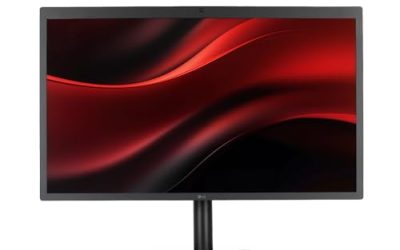
Our Short List of 3

- 32 inch IPS panel, 3840 x 2160 resolution, 144 Hz refresh rate, 1 ms-class response time, HDR400, HDMI 2.1 and DisplayPort 1.4, built-in KVM, height-adjustable stand.

- 32 inch curved VA panel with Mini LED, 3840 x 2160 resolution, 165 Hz refresh rate, 1 ms-class response time, 1000R curve, HDR600, HDMI 2.1 and DisplayPort 1.4, height-adjustable stand.

- 32 inch QD-OLED panel, 3840 x 2160 resolution, 240 Hz refresh rate, 0.03 ms-class response time, HDR True Black 400, Dolby Vision, HDMI 2.1 and DisplayPort 1.4, USB-C with 90 W power delivery, height-adjustable stand.
All 4 Picks at a Glance
| Product | Specs | Action |
|---|---|---|
| Gigabyte M32U 32-Inch 4K Gaming Monitor |
| Check price on Amazon |
| Samsung Odyssey Neo G7 32-Inch 4K Curved Gaming Monitor |
| Check price on Amazon |
| ASUS ROG Swift PG32UCDM 32-Inch 4K OLED Gaming Monitor |
| Check price on Amazon |
 LG UltraGear 32GQ950-B 32-Inch 4K Gaming Monitor |
| Check price on Amazon |
A 32 inch 4K gaming monitor is the point where sharpness, size, and speed come together. At 32 inches diagonally with a 3840 x 2160 resolution, these screens pack around 140 pixels per inch, which makes text crisp, game worlds detailed, and user interfaces clean at a normal viewing distance. The best 4K 32 gaming monitors pair that sharpness with refresh rates from 144 Hz to 240 Hz, so motion stays smooth as well as detailed, and HDMI 2.1 support means they work just as well with a modern console as with a PC.
The 32 inch 4K class has matured quickly. A few years ago, 4K gaming meant choosing between sharpness and speed, because high-refresh 4K panels were rare and costly. Today the market has fast IPS panels at 144 Hz and 160 Hz, curved VA panels with strong contrast, and QD-OLED panels at 240 Hz that combine perfect blacks with near-instant response times. The choice is no longer whether you can have both sharpness and speed, but which panel technology and which refresh rate match your games and your graphics card.
This guide covers five 32 inch 4K gaming monitors that span that range. There is a value IPS pick, a curved VA pick, a high-refresh IPS pick, and two OLED options at different ends of the premium scale. Every pick is a 32 inch, 3840 x 2160 display with a refresh rate of 144 Hz or higher, so you can compare them on panel type, HDR, connectivity, and the trade-offs that matter for your setup.
Our Top Picks
Top 3 picks at a glance
How to Choose
Resolution and pixel density
A 32 inch 4K panel has a pixel density of around 140 pixels per inch, which is a clear step up from a 27 inch 1440p screen and noticeably sharper than a 32 inch 1440p panel. Text looks clean without scaling tricks, and fine detail in games is easy to see. The cost is graphics power: 4K has more than twice the pixels of 1440p, so your graphics card works much harder. If your card struggles at 4K, you can run games at a lower resolution, but the image will look softer than on a native lower-resolution panel.
Refresh rate: 144 Hz, 165 Hz, or 240 Hz
Refresh rate is the most important gaming specification after resolution. A 144 Hz panel is the baseline for a good 4K gaming experience, and it is fast enough for most players. A 165 Hz or 240 Hz panel makes motion smoother still, with the biggest difference visible in fast-paced shooters and racing games. Higher refresh rates also demand more from your graphics card, since the card must produce more frames per second to use them, so match the refresh rate to what your card can actually deliver at 4K.
Panel type: IPS, VA, or QD-OLED
Panel type shapes contrast, response time, and colour. IPS panels give accurate colours and wide viewing angles, and they are the safe all-round choice for mixed gaming and work. VA panels deliver deeper blacks and stronger contrast, which suits dark games and movie watching, though fast motion can smear slightly. QD-OLED panels combine the perfect blacks of OLED with the colour volume of quantum dots, plus near-instant response times, making them the best gaming panels available today, at a higher figure and with sensible brightness habits needed over the long term.
HDR: 400, 600, or 1000
HDR certification tells you how bright a panel can get and how well it handles contrast. DisplayHDR 400 is an entry-level mark that mainly means the panel accepts an HDR signal, and the visible difference is modest. DisplayHDR 600 brings local dimming and enough brightness for HDR to look genuinely better. DisplayHDR 1000 and the OLED True Black standards go further, with the brightness and contrast to make HDR games and movies look striking. Treat HDR400 as a bonus and HDR600 or above as a real feature.
HDMI 2.1 and console support
HDMI 2.1 matters if you play on a modern console as well as a PC, because it carries 4K at 120 Hz, which older HDMI versions cannot. It also matters for PC players who want a single cable standard across devices. DisplayPort 1.4 is the standard PC connection for high-refresh 4K, and most 32 inch 4K gaming monitors include both. Check that the monitor supports variable refresh rate over both connections if you plan to use it with a console.
Adaptive sync and response time
Adaptive sync, sold as G-Sync compatibility or FreeSync Premium Pro, matches the refresh rate to your graphics card output and removes tearing without adding lag. It is close to essential for a good 4K gaming experience, since frame rates at 4K vary more than at lower resolutions. Response time is usually quoted around 1 ms for IPS and VA panels and 0.03 ms for OLED, and while the quoted figures are measured under laboratory conditions, OLED is genuinely faster in practice, with no visible smearing in fast motion.
Ergonomics and viewing distance
A 32 inch monitor is large enough that ergonomics matter. Sit roughly 70 to 90 centimetres away, and the whole screen should fall within your field of view without constant head turning. Height, tilt, and swivel adjustment should be standard, and VESA mounting lets you move the screen onto an arm for a cleaner setup. A curved panel can help at this size by pulling the edges slightly toward you, though flat panels suit shared viewing and design work better.
Top Picks
Gigabyte M32U 32-Inch 4K Gaming Monitor
- 32 inch IPS panel, 3840 x 2160 resolution, 144 Hz refresh rate, 1 ms-class response time, HDR400, HDMI 2.1 and DisplayPort 1.4, built-in KVM, height-adjustable stand.
The Gigabyte M32U is a 32 inch 4K IPS gaming monitor with a 144 Hz refresh rate, and it is the value pick in this roundup. Its IPS panel covers a wide colour gamut, its 1 ms-class response time keeps motion clean, and its HDMI 2.1 ports make it a natural fit for console gaming as well as PC play. A built-in KVM switch lets you share one keyboard and mouse between two computers, which is a useful bonus for a mixed work-and-play desk.
Who it is for: PC and console gamers who want a sharp 4K IPS screen with HDMI 2.1 at a sensible figure, and anyone who shares a desk between two computers.
Caveats: HDR400 is entry-level, so HDR content will look only modestly better than standard content. Confirm the listing shows the standard M32U model, since an Arm Edition variant uses a different ASIN.
MSI MPG 321URX QD-OLED 32-Inch Gaming Monitor
The MSI MPG 321URX QD-OLED is a 32 inch 4K QD-OLED gaming monitor with a 240 Hz refresh rate, and it is the fastest panel in this roundup. Its QD-OLED panel delivers perfect blacks, near-instant response times, and rich colour, which makes it the best-looking gaming screen here by a clear margin. The 240 Hz refresh rate keeps motion exceptionally smooth, and the 0.03 ms-class response time removes the smearing that LCD panels can show in fast scenes.
Specs
- 32 inch QD-OLED panel, 3840 x 2160 resolution, 240 Hz refresh rate, 0.03 ms-class response time, HDR True Black 400, HDMI 2.1 and DisplayPort 1.4, USB-C with power delivery, height-adjustable stand.
Who it is for: competitive and enthusiast gamers who want the best motion clarity and contrast available at 32 inches, and who have a graphics card strong enough to drive 4K at high frame rates.
Caveats: OLED panels need sensible brightness habits over the long term, and this pick rests on a single verification source, so confirm the listing and the exact model code MPG 321URX before ordering.
Samsung Odyssey Neo G7 32-Inch 4K Curved Gaming Monitor
- 32 inch curved VA panel with Mini LED, 3840 x 2160 resolution, 165 Hz refresh rate, 1 ms-class response time, 1000R curve, HDR600, HDMI 2.1 and DisplayPort 1.4, height-adjustable stand.
The Samsung Odyssey Neo G7 is a 32 inch curved 4K gaming monitor with a VA panel, a 165 Hz refresh rate, and Mini LED backlighting that gives it strong HDR performance for an LCD. Its 1000R curve wraps the screen noticeably around the viewer, which suits immersive single-player games and racing titles. Quantum Mini LED local dimming pushes contrast well beyond a standard VA panel, and HDR600 certification means HDR content looks genuinely better than standard content.
Who it is for: gamers who want strong HDR and deep contrast on an LCD, with a deep curve for immersion, without moving to OLED.
Caveats: the 1000R curve is a matter of taste and can distort straight lines for design work, and Samsung sells several Odyssey G7 variants, so confirm the listing shows the 32 inch 4K Neo G7 model before ordering.
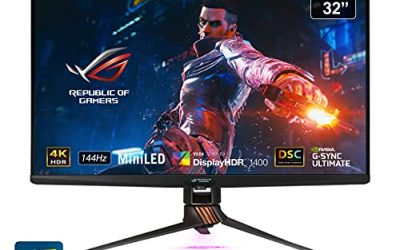
ASUS ROG Swift PG32UCDM 32-Inch 4K OLED Gaming Monitor
- 32 inch QD-OLED panel, 3840 x 2160 resolution, 240 Hz refresh rate, 0.03 ms-class response time, HDR True Black 400, Dolby Vision, HDMI 2.1 and DisplayPort 1.4, USB-C with 90 W power delivery, height-adjustable stand.
The ASUS ROG Swift PG32UCDM is a 32 inch 4K QD-OLED gaming monitor with a 240 Hz refresh rate, and it is the flagship pick in this roundup. Its third-generation QD-OLED panel delivers perfect blacks, 99 percent DCI-P3 colour, and a 0.03 ms-class response time, while a custom heatsink and graphene film help manage heat without a fan. Dolby Vision support and a 90 W USB-C port round out a screen that is built to be the centre of a high-end setup.
Who it is for: enthusiasts who want the best 4K gaming image available, with top-tier colour, contrast, and motion, and who have a strong graphics card to match.
Caveats: it is the most expensive screen in this roundup, and a revised PG32UCDMR model exists with a different ASIN, so confirm the listing shows model PG32UCDM before ordering.
LG UltraGear 32GQ950-B 32-Inch 4K Gaming Monitor
- 32 inch Nano IPS panel, 3840 x 2160 resolution, 144 Hz refresh rate, 1 ms-class response time, DisplayHDR 1000, HDMI 2.1 and DisplayPort 1.4, G-Sync compatibility and FreeSync Premium Pro, height-adjustable stand.
The LG UltraGear 32GQ950-B is a 32 inch 4K Nano IPS gaming monitor with a 144 Hz refresh rate and DisplayHDR 1000 certification, which makes it the brightest HDR pick among the LCD screens here. Its Nano IPS panel covers a wide colour gamut with accurate colour, and its 1 ms-class response time keeps motion clean. HDMI 2.1 support makes it a strong choice for console gaming as well as PC play, and the ATW polariser helps keep dark scenes free of the glow that can affect IPS panels.
Who it is for: gamers who want the brightest HDR available on an LCD at 32 inches, with accurate colour and strong console support.
Caveats: Nano IPS panels can show some glow in very dark scenes, and the 144 Hz refresh rate is the lowest among the gaming-first picks here, though it is fast enough for most players.
Comparison Table
| Monitor | Panel | Refresh Rate | HDR | HDMI 2.1 | Best For |
|---|---|---|---|---|---|
| Gigabyte M32U | IPS | 144 Hz | HDR400 | Yes | Value and console gaming |
| MSI MPG 321URX QD-OLED | QD-OLED | 240 Hz | True Black 400 | Yes | Fastest OLED motion |
| Samsung Odyssey Neo G7 | VA Mini LED | 165 Hz | HDR600 | Yes | Curved HDR gaming |
| ASUS ROG Swift PG32UCDM | QD-OLED | 240 Hz | True Black 400 | Yes | Flagship image quality |
| LG UltraGear 32GQ950-B | Nano IPS | 144 Hz | HDR1000 | Yes | Brightest LCD HDR |
Which One Is Right for You?
If you want the best value in 4K gaming at 32 inches, the Gigabyte M32U is the pick. Its 144 Hz IPS panel, HDMI 2.1 support, and built-in KVM cover the essentials for PC and console play at a sensible figure, and its colour accuracy makes it a good work screen too. The LG UltraGear 32GQ950-B is the step up for players who want brighter HDR and stronger colour on an LCD, with DisplayHDR 1000 giving HDR content real impact.
If you want the best image quality available, the choice is between the two QD-OLED panels. The MSI MPG 321URX QD-OLED and the ASUS ROG Swift PG32UCDM both run at 240 Hz with near-instant response times and perfect blacks, and the differences come down to extras: the ASUS model adds Dolby Vision, a 90 W USB-C port, and a fanless heatsink design, while the MSI model is the more straightforward route to the same core OLED performance. The Samsung Odyssey Neo G7 sits between the two worlds, with Mini LED HDR and a deep curve for players who want strong contrast without moving to OLED.
Whichever you choose, check your graphics card first. Driving 4K at 144 Hz or 240 Hz needs a strong modern card, and a weaker card will leave the refresh rate unused. A DisplayPort connection is the reliable choice for the full refresh rate on PC, while HDMI 2.1 is the connection to use for a console.
Frequently Asked Questions
Is 32 inches the right size for a 4K gaming monitor?
Yes, for most players. At 32 inches, 4K gives around 140 pixels per inch, which is sharp without making interface elements too small, and the screen is large enough to feel immersive without demanding constant head movement. A 27 inch 4K panel is sharper still but makes text and interface elements small, while a larger 4K screen needs a deeper desk.
Do I need HDMI 2.1 on a 4K gaming monitor?
HDMI 2.1 matters if you play on a modern console, because it carries 4K at 120 Hz. For PC gaming, DisplayPort 1.4 is the standard connection and handles 4K at high refresh rates. All five picks in this guide have both, so you can connect a PC and a console to the same screen without swapping cables.
Is QD-OLED better than IPS for gaming?
For pure gaming image quality, yes. QD-OLED delivers perfect blacks, near-instant response times, and rich colour that IPS cannot match, and the difference is most visible in dark games and fast motion. IPS still wins for bright office work and for buyers who want a screen with no brightness habits to manage, and it costs considerably less.
What graphics card do I need for 4K gaming at 144 Hz?
A 4K panel at 144 Hz needs a strong modern graphics card, and the exact requirement depends on the game and the settings you choose. Demanding titles at high settings need a high-end card to hold high frame rates, while less demanding games run well on mid-range hardware. Check benchmarks for the specific games you play before ordering, and remember that upscaling features can help a mid-range card reach higher frame rates at 4K.
Disclosure: As an Amazon Associate, we may earn from qualifying purchases.
Related guides
More from Amazon
Programs that pair well with the guide above. Offers and eligibility are set by Amazon and may change.
Free shipping on eligible items, Prime Video and more. Eligible new members can start with a free trial.
Start a Prime free trialAd-free music streaming. Eligible new subscribers can start with a free trial.
Try Music Unlimited freeA Prime membership for ages 18-24 with a trial period. Eligibility is set by Amazon.
See Prime for Young AdultsAudiobooks and podcasts to listen to on the go. Eligible new members can start with a free trial.
Try Audible freeAs an Amazon Associate we earn from qualifying purchases.