
The best convertible hand trucks are the ones that match your usual load, stair and doorway conditions: choose a compact two-wheel model for boxes and occasional deliveries, or a four-wheel convertible model when stability, bulky cargo and hands-free movement matter more than folded size.
As an Amazon Associate we earn from qualifying purchases at no extra cost to you.


Our Top Picks
 COSCO 4-in-1 Folding Series Hand Truck with Flat-Free4 in 145.75 x 20 x 36.25 inches29.25 poundsCheck on Amazon

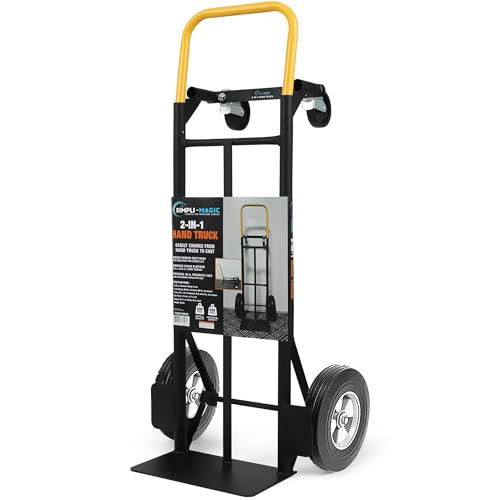

Top 3 picks at a glance
Quick comparison: two wheels versus four
| Configuration | Typical capacity | Best use | Main advantage | Main limitation |
|---|---|---|---|---|
| Two-wheel upright | 150–300 lb | Boxes, appliances, office equipment | Narrower and easier on stairs | Requires balancing the load |
| Four-wheel platform | 300–800 lb | Large cartons, totes, tools and deliveries | Stable rolling with less lifting effort | Longer, wider and less convenient on stairs |
| Convertible two-/four-wheel | 250–700 lb | Mixed home, warehouse and delivery work | One frame handles several tasks | Heavier and more expensive than a basic dolly |
Capacity figures are maximum manufacturer ratings, not a recommendation to routinely load the frame to its limit. Uneven floors, stairs, high centers of gravity and worn wheels can reduce the safe working load substantially.
Best convertible hand truck types for common jobs
For household boxes and occasional moving: compact aluminum models
A lightweight aluminum convertible hand truck is usually the most practical choice for apartments, garages and home offices. It can stand upright on two wheels for moving cartons through doorways, then open into a four-wheel platform for heavier boxes. Look for a nose plate at least 14 inches wide, a folded height below about 50 inches and a weight around 15–25 lb.
The Cosco Shifter is a familiar example of the compact home-oriented design. Models in this class commonly support roughly 250–300 lb in four-wheel mode but considerably less in two-wheel mode. Their smaller wheels and shorter platform make them convenient to store, although they are not ideal for repeated work on cracked pavement or stairs.
For frequent deliveries: steel or reinforced aluminum convertible trucks
Delivery work favors a stronger frame, a longer nose plate and larger wheels. A 7.5- to 10-inch wheel rolls more easily over thresholds than a small 4- to 6-inch caster, while pneumatic or semi-pneumatic tires absorb rough outdoor surfaces better than hard plastic wheels.
Magna Cart commercial-style convertible models and Magliner Gemini-series trucks represent the broader category to examine. Exact capacities differ by model, but the useful features are consistent: a taller frame, reinforced joints, replaceable wheels and a platform that supports deep cartons without forcing the operator to tilt the load excessively.
For warehouses and heavy equipment: industrial convertible frames
If the routine load includes kegs, large tool chests, printers, stacked totes or appliances, prioritize a 500–800 lb four-wheel rating and a wide platform over a very compact folded size. Industrial models are commonly made from welded steel or heavy-gauge aluminum and may weigh 35–60 lb before loading.
They are excellent for ramps, loading docks and smooth warehouse floors. They are less pleasant to carry upstairs or fit into a small vehicle. For this category, a stair-climber attachment or a separate appliance dolly may be safer than expecting one convertible truck to perform every job.
How to choose the right specifications
1. Calculate a realistic load margin
Do not select a truck simply because its advertised capacity equals your heaviest load. Add the items you will carry, then apply a margin for movement and poor surfaces.
For example, suppose a delivery consists of three 45 lb boxes, a 35 lb tool case and 20 lb of packing material:
3 × 45 + 35 + 20 = 190 lb
For smooth indoor floors, a 250 lb four-wheel rating provides a modest margin. For outdoor thresholds or a ramp, multiplying the working load by 1.5 gives a more cautious target:
190 × 1.5 = 285 lb
That job should move to a truck rated around 300 lb or higher, with the load kept low and centered. The two-wheel rating must also be checked separately; a truck rated at 300 lb as a platform may be rated closer to 200 lb upright.
2. Compare folded dimensions with your storage space
Folded dimensions matter more than advertised portability. Measure the narrowest point of your closet, vehicle cargo area or delivery van opening. A truck that folds to 8–10 inches deep may fit behind a door, while a stronger model can remain 12–18 inches deep because of its larger wheels and fixed platform.
Also measure height. A folded truck around 45–50 inches tall fits under many workbench shelves, but taller commercial designs may exceed 55 inches. If it will ride in a car, check the diagonal length as well as the vertical and horizontal measurements.
3. Match wheel construction to the route
- Hard rubber or molded plastic: low maintenance and suitable for smooth concrete, tile and warehouse floors.
- Thermoplastic rubber: quieter and less likely to mark indoor flooring.
- Pneumatic tires: better for gravel, cracked pavement and thresholds, but they require pressure checks and can puncture.
- Semi-pneumatic tires: a compromise that adds cushioning without regular inflation.
- Swivel casters: useful in four-wheel mode for maneuvering, but small casters can catch on door sills and floor gaps.
For a route that includes both a warehouse and a parking lot, 8-inch fixed wheels with 3- to 4-inch swivel casters are often more versatile than four tiny casters. For stair use, the main wheels need a solid axle position and enough diameter to clear each tread; caster size alone does not make a truck stair-friendly.
4. Check handle adjustment and load height
A telescoping or multi-position handle should place the hand grip roughly between the operator’s waist and lower chest when the truck is tilted. A handle that is too short encourages bending; one that is too high reduces control.
Multiple locking positions are preferable to a single telescoping tube because they reduce wobble under load. Look for a positive pin or latch, not only friction between nested tubes. Confirm that the release can be operated while wearing work gloves.
Decision matrix: which configuration fits your situation?
| Your situation | Recommended design | Target specifications | Why |
|---|---|---|---|
| Apartment moves and storage behind a door | Compact aluminum convertible | 150–250 lb, under 10 in folded depth, 5–8 in wheels | Low weight and easy storage outweigh maximum capacity |
| Weekly office or parcel deliveries | Reinforced two-/four-wheel model | 250–400 lb, 8–10 in wheels, adjustable handle | Handles thresholds and repeated rolling without becoming excessively heavy |
| Large cartons on smooth warehouse floors | Wide industrial convertible | 500 lb or more, 12–18 in platform depth, swivel casters | Platform stability is more useful than compact folded size |
| Gravel, outdoor paths and loading docks | Heavy-duty pneumatic-wheel model | 8–10 in pneumatic wheels, reinforced axle, 300 lb or more | Large tires reduce shock and rolling resistance |
| Frequent stairs | Two-wheel stair-capable hand truck | Large fixed wheels, narrow frame, lower center of gravity | Four-wheel platform mode is awkward or unsafe on stairs |
Two-wheel and four-wheel operation: what changes?
In two-wheel mode, keep the load’s center of gravity close to the axle. Place the heaviest box at the bottom, strap tall items to the frame and tilt the truck only as far as necessary. A load that extends far behind the axle can feel much heavier than its scale weight and may pull the handle toward the operator.
In four-wheel mode, distribute weight across the platform instead of concentrating it at the front edge. Keep at least two inches of platform visible around the load when possible, and use a strap for any stack higher than the handle. Four wheels improve stability, but they do not prevent a tall stack from tipping sideways during a turn.
Features worth paying for
- Replaceable wheels: important for work use because tires and bearings wear before the frame does.
- Non-marking tread: useful in homes, offices and finished floors.
- Integrated tie-down points: safer for tall or irregular loads.
- Rounded frame edges: reduce damage to walls, door trim and cartons.
- Lockable conversion mechanism: prevents the frame from shifting while changing configuration.
- Corrosion-resistant finish: valuable when the truck is stored in a garage or used outdoors.
A built-in bungee cord is convenient for small boxes, but it is not a substitute for a rated cargo strap. Verify that the wheels, platform and handle all support the same load rating; some products advertise the highest capacity only for a specific four-wheel arrangement.
Frequently asked questions
Can I use a convertible hand truck on stairs in four-wheel mode?
No; the article says four-wheel platform mode is awkward or unsafe on stairs. For frequent stair use, choose a two-wheel stair-capable hand truck with large fixed wheels, a narrow frame and a lower center of gravity. A stair-climber attachment or a separate appliance dolly may be safer for some heavy-equipment jobs.
How should I secure a tall or irregular load?
Use a strap, and place the heaviest items at the bottom in two-wheel mode. Keep the load’s center of gravity close to the axle, and secure tall or irregular items to the frame. In four-wheel mode, distribute weight across the platform; four wheels do not prevent a tall stack from tipping sideways during a turn.
Are pneumatic wheels the best choice for every route?
No; pneumatic tires suit gravel, cracked pavement and thresholds because they absorb rough surfaces, but they need pressure checks and can puncture. Hard rubber or molded plastic wheels are low-maintenance choices for smooth floors, while thermoplastic rubber is quieter and less likely to mark indoor flooring. Semi-pneumatic tires offer cushioning without regular inflation.
What should I check before buying a truck for my car?
Measure your vehicle’s cargo opening and available space, including the diagonal length as well as the height and width. Folded depth can vary: compact models may be 8–10 inches deep, while stronger ones can be 12–18 inches deep. Check folded height too, since some commercial designs may exceed 55 inches.
Is the listed weight capacity the same in both operating modes?
Not necessarily; check the two-wheel and four-wheel ratings separately. A truck rated at 300 lb as a platform may be rated closer to 200 lb upright. The article also cautions that stairs, uneven floors, high centers of gravity and worn wheels can substantially reduce safe working load, so the maximum rating is not a routine target.
Final buying recommendation
For most homes, choose a compact convertible aluminum truck with a 250–300 lb four-wheel rating, an adjustable handle, non-marking wheels and a folded depth under 10 inches. For regular delivery work, step up to a 300–500 lb reinforced model with 8-inch or larger wheels and replaceable components. Choose an industrial 500 lb-plus design only when the loads and floor conditions justify its extra weight.
The best convertible hand trucks do not merely have the largest capacity. They provide enough margin for your real load, wheels suited to the route, a handle that fits your height and folded dimensions that work where you actually store the equipment.


