Disclosure: As an Amazon Associate, I earn from qualifying purchases. If you buy through links in this article, I may earn a commission at no extra cost to you.
Our top pick: BusBoard Prototype Systems BB830. Runner-up: ELEGOO Upgraded Electronics Fun Kit.
Best Breadboards: 5 Solderless Boards and Kits Compared
Almost every PC-adjacent electronics project — a fan controller built around an Arduino, an ESP32 sensor node, a Raspberry Pi GPIO experiment — starts life on a solderless breadboard. Spring clips hidden under the plastic hold component leads and jumper wires in connected rows, so a circuit can be built, measured, rewired and rebuilt in minutes without touching a soldering iron. When the design works, it moves to a soldered board; while it is still changing, the breadboard is the workbench.
The five picks below cover the main ways to buy one: a single premium board with fully published contact specifications, a complete component kit built around a full-size board and a power supply module, a mixed pack of full-size and half-size boards, a plain three-pack of full-size boards, and a holder kit that mounts a board next to a Raspberry Pi or Arduino. They are five genuinely different listings, not size or color variants of one design.
Top 3 picks at a glance


How to Choose a Breadboard
Tie points and layout. A full-size board has 830 tie points: a 630-point terminal area split by a center channel that a DIP chip straddles, plus two 100-point distribution strips that form four power rails. A half-size 400-point board keeps the same idea in a smaller footprint and suits a single sensor or a compact microcontroller. Wide development boards can cover one row of holes on a standard board, so builds based on wide ESP32 boards often work better across two boards side by side.
Contact quality. The clips are the product. Boards differ in clip material, plating and how firmly they grip a lead, and loose clips are the classic cause of a circuit that works until the desk is bumped. Most budget listings say little about their contacts, so a maker that publishes a clip material and an insertion-life figure in its datasheet is giving you something concrete to compare.
Power rails. Check whether each rail runs the full length of the board or is split in the middle; a split rail needs a short jumper to carry power to the far half. Before a first build, a quick continuity check along each rail with a multimeter confirms which layout you have.
Voltage and current limits. Breadboards are for low-voltage DC prototyping only, never for mains wiring. Stay inside the limits the maker lists for the specific board, and keep high-current loads such as motors and long LED strips on proper wired connections rather than on breadboard clips and thin jumper leads.
Bare board, pack or kit. Bare boards and multi-packs are the cheapest way to keep several builds assembled at once. A component kit adds a power supply module — typically with selectable 3.3 V and 5 V outputs for the rails — plus jumper wires and a parts assortment, which suits a first bench. Controller boards and wall adapters are usually sold separately, so check what a kit actually includes.
1. BusBoard Prototype Systems BB830 — Best Single Board
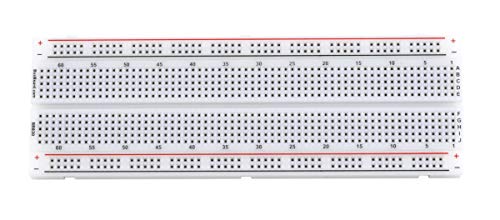
The BB830 is the pick for buyers who care most about the contacts themselves. BusBoard’s datasheet describes phosphor bronze spring clips with a plated nickel finish and a contact life of 50,000 insertions, figures most breadboard listings never publish. The layout is the standard full-size pattern: a 630 tie-point circuit area plus two 100 tie-point distribution strips providing four power rails, with a color printed legend on a white ABS body.
The same datasheet lists limits of 36 volts and 2 amps, an insertion wire size of 21 to 26 AWG, and a metal back plate behind the peelable adhesive backing. It is a bare board — no jumper wires or components are included — and it costs more per board than the multi-packs below. For a bench board that will be rewired for years, the published specifications are the reason to choose it.
Specs
- Brand: BusBoard Prototype Systems
- Model: BB830
- Tie points: 830 (630 circuit area + 2 x 100 distribution strips)
- Power rails: 4
- Contacts: Phosphor bronze with plated nickel finish
- Contact life: 50,000 insertions (maker datasheet)
- Maker-listed limits: 36 V, 2 A
- Wire size: 21 to 26 AWG
- Dimensions: 165.1 x 54.6 x 8.5 mm
- Body: White ABS, color printed legend, metal back plate
2. ELEGOO Upgraded Electronics Fun Kit — Best Complete Kit
This kit builds a whole starter bench around one 830 tie-point breadboard. The headline extra is the power supply module, which plugs across the rails and provides selectable 3.3 V and 5 V outputs; ELEGOO lists its input as DC 6.5 to 9 V through a barrel plug and warns not to use a voltage higher than 9 V. Around the board come more than 300 components: resistors across ten values, LEDs including an RGB LED, ceramic and electrolytic capacitors, 1N4007 diodes, PN2222 transistors, a 74HC595 shift register, a 4N35 optocoupler, buzzers, buttons, a precision potentiometer, a photoresistor and a thermistor.
Wiring is covered too, with a 65-piece jumper wire set, 140 solderless jumper wires and 20 female-to-male Dupont wires. A controller board and a wall adapter are not included, so the kit pairs with an Arduino, STM32 or similar board you already own. Choose it when the goal is learning and experimenting with parts, not just buying a board.
Specs
- Brand: ELEGOO
- Model: EL-CK-003
- Breadboard: 830 tie points, 4 power rails
- Power supply module input: DC 6.5 to 9 V (maker lists 9 V as the maximum)
- Power supply module output: Selectable 3.3 V and 5 V
- Components: 300+ pieces (resistors, LEDs, capacitors, diodes, transistors, buzzers, sensors)
- Jumper wires: 65-piece set, 140 solderless wires, 20 female-to-male Dupont wires
- Controller board: Not included
3. REXQualis 4PCS Breadboards Kit — Best Mixed Sizes
REXQualis bundles two board sizes in one box: two full-size 830-point boards for main circuits and two half-size 400-point boards for sensor sub-circuits, a display module or a small second build you do not want to tear down. Each board follows the usual layout with a printed legend, a color legend on the distribution strips and self-adhesive tape on the back for mounting a finished prototype inside a case or on a panel.
No jumper wires are included, so budget for a wire set if you do not already have one. As a single purchase that covers both a main board and satellite boards, this is the most flexible pack of the five.
Specs
- Brand: REXQualis
- Model: RG-BK-4
- Boards included: 4 (2 x 830 tie points, 2 x 400 tie points)
- Power rails: 4 per board
- Body: White ABS with printed legend, color legend on distribution strips
- Backing: Self-adhesive tape
- Jumper wires: Not included
4. HiLetgo 3pcs MB-102 Breadboard Kit — Best Plain Multi-Pack

HiLetgo’s kit is the straightforward option: three identical MB-102 full-size boards, each with 830 tie points and four power rails, and nothing else in the box. Three boards let you keep a finished circuit assembled, hand boards to a class or lab group, or join boards side by side when a wide development board covers too many holes on a single one.
Because every board in the pack is the same, a circuit can move between them without relearning a layout, and a spare is always on hand when clips on an older board start to feel loose. If you already own jumper wires and components, this is the no-extras way to stock up on full-size boards.
Specs
- Brand: HiLetgo
- Model: MB-102 (item model number 3-01-1286)
- Boards included: 3
- Tie points: 830 per board
- Power rails: 4 per board
- Connector type: Solderless
- Jumper wires: Not included
5. SunFounder RAB Holder Breadboard Kit — Best for Raspberry Pi and Arduino Benches

SunFounder’s kit pairs an 830-point solderless breadboard with the RAB Holder, a base plate that mounts the breadboard alongside a controller board so the whole build stays in one place on the desk. SunFounder lists compatibility with the Arduino Uno R3 and Mega 2560 and with Raspberry Pi 4B, 3B+, 3B, 2B, 1B+ and A+, and the holder is shaped with access in mind for the memory card, HDMI and USB cables.
For a Raspberry Pi or Arduino project that lives on the bench for weeks — a home sensor hub, a retro-computing build, a GPIO learning setup — the fixed plate keeps the board, the controller and the wiring from drifting apart every time something is unplugged. It is the most specialized pick here, and the right one when the controller and the breadboard always work as a pair.
Specs
- Brand: SunFounder
- Contents: RAB Holder base plate + 830-point solderless breadboard
- Breadboard: 830 tie points
- Controller compatibility (maker-listed): Arduino Uno R3, Mega 2560; Raspberry Pi 4B, 3B+, 3B, 2B, 1B+, A+
- Holder features: Fixed mounting for controller and breadboard, cutouts for TF card, HDMI and USB cables
- Controller board: Not included
Quick Comparison
| Product | Boards | Tie points | Power rails | What else is included |
|---|---|---|---|---|
| BusBoard BB830 | 1 | 830 | 4 | Metal back plate |
| ELEGOO Electronics Fun Kit | 1 | 830 | 4 | Power supply module, 300+ components, jumper wires |
| REXQualis 4PCS Kit | 4 | 2 x 830 + 2 x 400 | 4 per board | Self-adhesive backing |
| HiLetgo 3pcs MB-102 | 3 | 830 each | 4 per board | Nothing extra |
| SunFounder RAB Holder Kit | 1 | 830 | 4 | RAB Holder base plate |
FAQ
Should I buy an 830-point or a 400-point breadboard?
Start with 830 points for general Arduino, ESP32 and Raspberry Pi work; it fits most circuits with room to grow. A 400-point board suits one sensor, a small display or a compact microcontroller build, and works well as a second board next to a full-size one.
How much voltage can a breadboard handle?
Only low-voltage DC, and only within the limits the maker lists for that board — the BB830 datasheet, for example, lists 36 V and 2 A. Many boards list lower figures or none at all, so check the specific listing, and never connect mains voltage to a breadboard.
Why does only half of my power rail work?
On many boards each rail is split in the middle. The two halves are not connected until you bridge them with a short jumper wire. A continuity check with a multimeter shows where the break is.
Do these kits include an Arduino or Raspberry Pi?
No. All five picks are boards, parts or holders; controller boards, USB cables and wall adapters are sold separately unless a listing says otherwise.
My ESP32 board covers a whole row of holes. What can I do?
Wide development boards are a known fit issue on a single 830-point board. Using two boards side by side, or a pack with several boards, leaves a free row of tie points on each side of the controller.
Conclusion
For one board bought for the long term, the BusBoard BB830 is the standout because its maker publishes the contact material, insertion life and electrical limits that other listings leave out. The ELEGOO Fun Kit is the better first purchase when you also need parts and a rail power supply, the REXQualis pack covers two board sizes at once, the HiLetgo three-pack is the plain way to stock full-size boards, and the SunFounder kit earns its place on any desk where a Raspberry Pi or Arduino and a breadboard work as a fixed pair. Match the board to the build, stay within the maker’s listed limits, and check rail continuity before the first power-up.
Related guides
More from Amazon
Programs that pair well with the guide above. Offers and eligibility are set by Amazon and may change.
Free shipping on eligible items, Prime Video and more. Eligible new members can start with a free trial.
Start a Prime free trialAd-free music streaming. Eligible new subscribers can start with a free trial.
Try Music Unlimited freeA Prime membership for ages 18-24 with a trial period. Eligibility is set by Amazon.
See Prime for Young AdultsAudiobooks and podcasts to listen to on the go. Eligible new members can start with a free trial.
Try Audible freeAs an Amazon Associate we earn from qualifying purchases.