Disclosure: As an Amazon Associate, I earn from qualifying purchases. If you buy through links in this article, I may earn a commission at no extra cost to you.
Our top pick: PrimeWeld TIG225X. Runner-up: AHP AlphaTIG 203Xi.
A TIG welder is the precision tool of the home garage. It is what you reach for when the job is a thin-wall exhaust repair, a stainless bracket that will stay visible, an aluminum intercooler pipe, or a chromoly part where a sloppy bead is not acceptable. The five machines below were chosen for garage and small-shop use, and the first split to understand is electrical, not cosmetic. Four of them are AC/DC machines that can TIG weld aluminum as well as steel. One is a DC-only machine that costs less and covers steel and stainless work, but physically cannot TIG weld aluminum. Every output, amperage range, and duty cycle figure in this article is the maker’s listed figure, written as listed, because brands measure those numbers under their own test conditions.
Top 3 picks at a glance


How to Choose a TIG Welder
Decide AC versus DC first. Aluminum and magnesium need AC TIG output. The alternating current breaks up the oxide layer that forms on aluminum while the arc runs, which is why every aluminum-capable pick here is an AC/DC machine with adjustable AC balance and AC frequency. DC TIG is what steel, stainless steel, and titanium use, and a DC-only machine like the YESWELDER below is a legitimate choice if aluminum is genuinely not on your project list. What a DC-only machine cannot do is grow into aluminum work later.
Match listed output to your material thickness. A 200-amp class machine covers the range most home shops actually weld, from thin sheet to plate around 1/4 inch and somewhat beyond in multiple passes, as listed by each maker. More maximum amperage mostly buys headroom on thicker material and a better listed duty cycle at the amperage you actually use.
Read the listed duty cycle together with its amperage. A listed duty cycle states how many minutes out of ten a machine can weld at a given output before it needs to rest. The percentage alone means little: 60 percent at 200 amps describes a heavier workload than 60 percent at 120 amps. Compare the pair of numbers, and remember that all figures here are as listed by the maker.
Check the arc start and the pedal. High-frequency (HF) start strikes the arc without touching the tungsten to the work, which keeps the tungsten cleaner and is the standard on every pick here. A foot pedal lets you vary amperage mid-weld, which matters most on thin material and aluminum. Confirm whether the pedal is included or a separate purchase, as noted per pick.
Plan for the gas and the circuit. TIG needs an argon cylinder and a regulator, which are not always in the box. On power, dual-voltage machines run at reduced output on a household 120V circuit and reach full listed output on a 240V circuit, so check which input each figure assumes.
1. PrimeWeld TIG225X

The TIG225X is the all-around AC/DC pick for a garage that welds aluminum as well as steel. It is a 225-amp inverter machine with AC and DC TIG output plus a stick mode, running on 110/220V dual-voltage input. The listed package includes a CK Worldwide 17-series flex-head torch and a foot pedal, which removes two separate purchases that budget machines often leave out. AC balance and AC frequency controls let you tune the cleaning action and arc focus on aluminum, and the pulse function helps manage heat on thin stainless and sheet metal. A listed low-end start around 10 amps suits light-gauge work. For a home shop that wants one TIG machine to cover the widest material range, this is the most complete package of the five.
Specs
- Brand: PrimeWeld
- Model: TIG225X
- Processes: AC/DC TIG, stick
- Input power: 110/220V dual voltage, as listed
- Listed output range: 10–225 amps TIG
- Listed duty cycle: 60 percent at 225 amps, as listed
- Arc start: High frequency
- Included torch: CK17 flex-head TIG torch, as listed
2. AHP AlphaTIG 203Xi
The AlphaTIG 203Xi is AHP’s current 200-amp AC/DC machine, and its draw is control depth at a midrange position in this group. A digital front panel with a large LCD replaces the knob-only layout of older AlphaTIG models, and the machine offers fully adjustable AC frequency and AC balance, which shape the arc cone, the cleaning width, and penetration on aluminum. Pulse TIG is built in for thin material, and a stick mode covers rougher work where TIG is the wrong tool. It runs on 110/220V dual-voltage input, so it can start life on a household circuit at reduced output and move to a 240V circuit later. Buyers who expect to spend real time dialing in aluminum settings, rather than setting two knobs and welding, are the audience for this one.
Specs
- Brand: AHP
- Model: AlphaTIG 203Xi
- Processes: AC/DC TIG with pulse, stick
- Input power: 110/220V dual voltage, as listed
- Listed output: Up to 200 amps
- Listed duty cycle: Varies with output and input voltage, as listed
- Arc start: High frequency
- Controls: Digital panel, adjustable AC frequency and balance, as listed
3. Everlast PowerTIG 210EXT
The PowerTIG 210EXT is the feature-heavy digital option in this group. Everlast lists a full 210 amps in both AC and DC modes with a listed duty cycle of 60 percent at that output, which is a strong pair of numbers for a dual-voltage machine. The digital interface offers two pulse modes, a standard mode and an advanced pulse mode, along with the AC waveform and balance adjustments that aluminum work calls for. It runs on 120V/240V input and uses a NEMA 6-50 plug on 240V, the standard welder receptacle. The trade-off for the deep menu system is a steeper learning curve than the analog-style machines here: there are more parameters to set before the first arc, and the manual rewards a careful read.
Specs
- Brand: Everlast
- Model: PowerTIG 210EXT
- Processes: AC/DC TIG with pulse, stick
- Input power: 120/240V dual voltage, as listed
- Listed output: Up to 210 amps in AC and DC modes
- Listed duty cycle: 60 percent at 210 amps, as listed
- Arc start: High frequency
- Controls: Digital, standard and advanced pulse modes, as listed
4. Eastwood TIG 200 AC/DC

The Eastwood TIG 200 AC/DC is the straightforward square-wave machine in this group, aimed at the auto restoration and fabrication work Eastwood is known for. It delivers up to 200 amps of AC/DC TIG output plus stick mode, runs on either 120V or 240V input, and welds mild steel, stainless steel, and aluminum. AC balance control is included, which is the adjustment that matters most for cleaning action on aluminum. The control layout stays comparatively simple next to the digital machines above, which suits buyers who would rather set amperage and balance and get to work. A foot pedal is included in the listed package. For a garage whose TIG work is mostly body, chassis, and bracket fabrication with occasional aluminum, this is a sensible middle path.
Specs
- Brand: Eastwood
- Model: TIG 200 AC/DC (item 20565)
- Processes: AC/DC TIG, stick
- Input power: 120V or 240V dual voltage, as listed
- Listed output: Up to 200 amps
- Listed duty cycle: Varies with output and input voltage, as listed
- Arc start: High frequency
- Controls: Square-wave inverter, AC balance control, as listed
5. YESWELDER TIG-205P
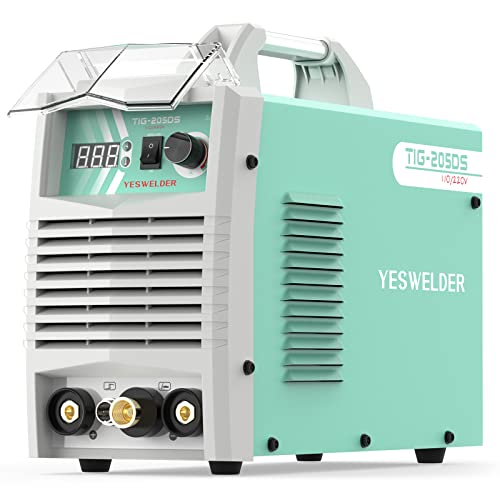
The TIG-205P is the budget DC-only pick, and its limit should be stated plainly: the listing itself notes this machine cannot be used for welding aluminum. What it does cover is DC TIG on steel and stainless, a pulse TIG mode for thinner material, and a stick mode, at up to 205 amps on 110/220V dual-voltage input. A large LED display shows the set amperage, and high-frequency start is included, which is not a given at this end of the market. For a first TIG machine bought to learn on steel, or a second machine dedicated to stainless exhaust and bracket work, the narrower scope is a reasonable trade. Buyers with any aluminum plans should step up to one of the AC/DC machines above instead.
Specs
- Brand: YESWELDER
- Model: TIG-205P
- Processes: DC TIG, pulse TIG, stick (no AC output)
- Input power: 110/220V dual voltage, as listed
- Listed output: Up to 205 amps
- Listed duty cycle: Varies with output and input voltage, as listed
- Arc start: High frequency
- Display: Large LED amperage display, as listed
Quick Comparison
| Pick | Output type | Listed max output | Input | Pulse | Best for |
|---|---|---|---|---|---|
| PrimeWeld TIG225X | AC/DC | 225 amps | 110/220V | Yes | One machine for aluminum and steel |
| AHP AlphaTIG 203Xi | AC/DC | 200 amps | 110/220V | Yes | Deep AC control adjustment |
| Everlast PowerTIG 210EXT | AC/DC | 210 amps | 120/240V | Yes, two modes | Digital features and duty cycle |
| Eastwood TIG 200 AC/DC | AC/DC | 200 amps | 120/240V | Not listed | Simple square-wave fabrication work |
| YESWELDER TIG-205P | DC only | 205 amps | 110/220V | Yes | Steel and stainless on a budget |
FAQ
Can a DC-only TIG welder weld aluminum? No. Aluminum TIG welding needs AC output to break up the surface oxide while welding. A DC-only machine such as the YESWELDER TIG-205P is limited to steel, stainless steel, and similar DC-friendly metals.
What does AC balance do on an AC/DC machine? AC balance adjusts how the AC cycle splits between cleaning action and penetration. More cleaning helps on dirty or cast aluminum; more penetration suits clean, thicker material. The exact range is listed by each maker.
Do I need a 240V circuit to run these machines? Not to start. Every pick here is dual voltage and runs at reduced output on a household circuit. Full listed output and the best listed duty cycle figures assume the higher input voltage, as listed.
Is a foot pedal necessary for TIG? Not strictly, since torch-switch control works, but a pedal makes amperage changes mid-weld far easier, especially on thin material and aluminum. Check the per-pick notes above for whether one is included.
What else do I need before the first weld? An argon cylinder with a regulator, tungsten electrodes, filler rod matched to your metal, and a helmet and gloves suited to TIG work. Gas and consumables are not always included with the machine, as listed per package.
Conclusion
Choose by metal first. If aluminum is anywhere in your plans, the choice is among the four AC/DC machines: the PrimeWeld TIG225X for the most complete listed package, the AHP AlphaTIG 203Xi for adjustable AC control, the Everlast PowerTIG 210EXT for digital depth and its listed duty cycle, and the Eastwood TIG 200 AC/DC for a simpler square-wave layout. If your work is steel and stainless only, the YESWELDER TIG-205P covers it for less, with the aluminum limit understood up front. In every case, compare listed duty cycle at the amperage you will actually run, and confirm the pedal, torch, and regulator contents of the exact listing before ordering.
Related guides
More from Amazon
Programs that pair well with the guide above. Offers and eligibility are set by Amazon and may change.
Free shipping on eligible items, Prime Video and more. Eligible new members can start with a free trial.
Start a Prime free trialAd-free music streaming. Eligible new subscribers can start with a free trial.
Try Music Unlimited freeA Prime membership for ages 18-24 with a trial period. Eligibility is set by Amazon.
See Prime for Young AdultsAudiobooks and podcasts to listen to on the go. Eligible new members can start with a free trial.
Try Audible freeAs an Amazon Associate we earn from qualifying purchases.