Disclosure: As an Amazon Associate, I earn from qualifying purchases. If you buy through links in this article, I may earn a commission at no extra cost to you.
Our top pick: Milescraft 1333 DowelJigKit. Runner-up: Kreg Dowel Jig Kit (KHJD345).
Dowel joinery is one of the cheapest ways to build strong furniture joints, but it only works when the holes in both parts line up exactly. A dowel jig removes the guesswork: it holds the drill bit square to the work, places the hole at a repeatable distance from a reference face, and in many designs finds the center of the board edge for you. The five jigs below cover the main approaches — self-centering vise-style jigs, complete starter kits with bits and dowels included, a self-clamping aluminum jig, and a fence-based system built around removable drill guides.
Two of the five picks come from Milescraft, because that brand sells two genuinely different designs in this class: the 1333 DowelJigKit, a complete self-centering starter kit, and the 1334 JointMaster, a self-clamping aluminum jig sold without bits or dowels. They solve different problems rather than being variations of one product. The remaining picks come from Kreg, Dowl-It and Task, each taking a different route to the same goal: straight holes that meet in the middle of the joint.
Top 3 picks at a glance

How to Choose a Dowel Jig
Centering method. Self-centering jigs close on the board edge from both sides, so the guide holes land on the centerline of whatever thickness you clamp, within the jig’s capacity. Fence-based jigs reference one face instead, which keeps holes aligned across parts of different thicknesses as long as you work from the same face. Self-clamping designs grip the work themselves and use spacers to position holes on common stock sizes.
Guide sizes. Most home furniture work uses 1/4 inch, 5/16 inch and 3/8 inch dowels. Jigs with fixed steel guide holes in the body usually cover more sizes, including 3/16, 7/16 and 1/2 inch, while kit-style jigs with interchangeable bushings or blocks typically cover the three common sizes. If you plan to dowel thick table legs or bed rails, check that a 1/2 inch guide is included.
Capacity. Every self-centering jig has a maximum stock thickness it can straddle, commonly around 2 inches to 2-3/8 inches. Fence and clamp-on jigs are less limited because they sit on a face rather than wrapping the edge, but their spacers and fences are calibrated for common thicknesses such as 1/2, 5/8, 3/4 and 1-1/2 inch stock.
What is in the box. Complete kits bundle the jig with brad point bits, depth stop collars, dowel centers and starter dowels, so you can drill your first joint the same day. Bare jigs assume you already own bits and dowels. Dowel centers matter more than they look: they transfer hole positions from one part to its mate, which is how most alignment errors are avoided.
Joint types. Edge joints for panels are the easiest and every jig here handles them. Corner and surface (face) joints need a fence, an alignment slot or a clamp-on body that can sit flat on a board face, so check the design if your projects go beyond panel glue-ups.
1. Milescraft 1333 DowelJigKit — Complete Self-Centering Starter Kit

The Milescraft 1333 DowelJigKit is built around the JointMate, a handheld self-centering jig with an adjustable, removable fence. Self-centering posts position the workpiece on the matching bushing, and the fence sets how far from the board end each hole lands, which makes repeated holes along an edge consistent. Because the bushings cover 1/4, 5/16 and 3/8 inch dowels and the jig works on stock from 1/2 to 1-1/2 inches thick, it covers the sizes used in most cabinet, shelf and frame work.
This is the most complete package in the group. The case holds the jig, three brad point drill bits, three steel depth stops, six dowel centers, dowel pins and a bottle of wood glue, so nothing else is needed to start. The trade-off is the resin jig body: the guides are hardened steel, but the body is a molded piece rather than a machined metal block, so it suits home workshop use rather than daily production work. For a first dowel jig, the completeness is the point.
Specs
- Brand: Milescraft
- Model: 1333 DowelJigKit (JointMate)
- Guide sizes: 1/4 in, 5/16 in, 3/8 in hardened steel bushings
- Stock thickness: 1/2 in to 1-1/2 in
- Design: Self-centering posts with adjustable, removable fence
- Includes: 3 brad point drill bits, 3 depth stops, 6 dowel centers, dowel pins, wood glue, storage case
2. Kreg Dowel Jig Kit (KHJD345) — Fence-Based, No-Measure Layout
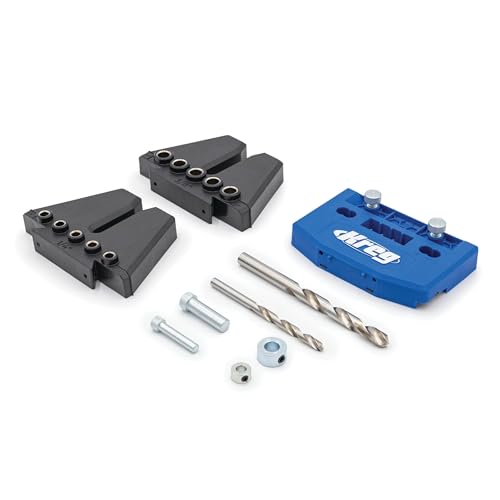
Kreg’s dowel jig takes the fence approach rather than self-centering. Two removable hardened steel drill guides, one for 1/4 inch and one for 3/8 inch dowels, lock into a fence that registers against the workpiece, and the kit’s index pins and alignment features let you position holes by referencing edges, faces or previously drilled holes instead of measuring and marking each one. The owner’s manual pairs the guides with stock from 1/2 inch to 1-1/2 inches thick, matching standard plywood and dimension lumber.
The box includes both drill guides, the fence, index pins, stop collars and drill bits for both sizes, connection pins, hex wrenches and sample dowels, so like the Milescraft 1333 it is ready to use without extra purchases. A 1/2 inch guide exists only in a separate upgrade kit: if your projects need 1/2 inch dowels, budget for that add-on or choose a jig that includes the size. For 1/4 and 3/8 inch cabinet and furniture work, the repeatable layout is the appeal.
Specs
- Brand: Kreg
- Model: KHJD345
- Guide sizes: 1/4 in and 3/8 in removable hardened steel drill guides (1/2 in guide in separate upgrade kit)
- Stock thickness: 1/2 in to 1-1/2 in, paired by guide size as listed in the manual
- Design: Fence-based with index pins and built-in alignment features
- Includes: 2 drill guides, fence, index pins, stop collars, drill bits, connection pins, hex wrenches, sample dowels
- Weight: 1.43 lb as listed
3. Dowl-It Model 2000 — Classic Self-Centering Steel Block Jig
The Dowl-It is the oldest design in this group, a self-centering doweling jig pattern that dates back to 1949 and is still made in the USA. Two aluminum alloy side rails close evenly on the workpiece as you tighten the large clamping screw, which keeps the hardened steel center block — and its guide holes — on the exact middle of the edge. There are no loose bushings to keep track of, because the six guide holes are machined directly into the steel block.
Those six sizes run from 3/16 inch up to 1/2 inch, the widest spread of any jig here, and the jig opens to clamp stock up to about 2 inches thick, including round stock. It is a bare tool built for edge joints rather than face work: no drill bits, stop collars or dowels are included. What you get instead is a simple, heavy, all-metal tool with nothing to wear out except the guide holes themselves, which is why the same design is still recommended for school and home workshops decades on.
Specs
- Brand: Dowl-It
- Model: 2000
- Guide sizes: 6 fixed guide holes, 3/16 in to 1/2 in
- Capacity: Up to 2 in thick stock, square or round
- Design: Self-centering vise-style, hardened steel center block, aluminum alloy side rails
- Includes: Jig only (bits, stops and dowels sold separately)
- Origin: Made in USA
4. Milescraft 1334 JointMaster — Self-Clamping Aluminum Jig

The JointMaster is Milescraft’s step up from the JointMate, and it works differently from every other pick here. Instead of asking you to hold the jig or add a separate clamp, the aluminum body clamps itself to the workpiece, and three interchangeable hardened steel drill blocks cover 1/4, 5/16 and 3/8 inch dowels. Retractable edge stops register against the end of a board for repeatable spacing, and a set of centering spacers positions the holes on common stock thicknesses.
Because the body can sit on an edge or a face and comes apart for drilling in awkward spots such as spindles, the JointMaster handles edge, corner and surface joints, the broadest joint range in this group. It is sold as a jig only, with no drill bits, stop collars or dowels, so the real starting cost includes those extras. In return you get an all-aluminum tool with no plastic body parts and a clamp that is always attached.
Specs
- Brand: Milescraft
- Model: 1334 JointMaster
- Guide sizes: 1/4 in, 5/16 in, 3/8 in hardened steel drill blocks
- Stock thickness: Centering spacers for 1/2 in, 5/8 in, 3/4 in and 1-1/2 in stock
- Design: Self-clamping aluminum body, retractable edge stops, built-in center finder
- Joint types: Edge, corner and surface
- Includes: 3 drill blocks, 3 spacers, 2 edge stops, pencil (bits and dowels sold separately)
5. Task 07300TK — Wide-Capacity Self-Centering Jig, Made in USA

The Task 07300TK follows the same self-centering vise pattern as the Dowl-It, executed in aircraft-grade aluminum with six hardened drill bushings. A single clamping screw draws both sides in together, so holes land on the centerline of the stock automatically, and a row of threaded positioning holes lets you preset dowel spacing in fixed increments for repeat work. At 2-3/8 inches, its clamping capacity is the widest of the self-centering jigs in this group, which makes it the natural pick for thicker tabletop and bench stock.
The six bushings cover 3/16 inch through 1/2 inch dowels, matching the Dowl-It’s size range, and at about 2.45 lb the jig has enough mass to stay put while drilling. Like the Dowl-It, it is a bare jig with no bits or dowels in the box, and long joints need the jig repositioned along the edge, using the preset spacing to stay consistent. For buyers who want the classic self-centering pattern with the most capacity and US manufacturing, this is the one.
Specs
- Brand: Task
- Model: 07300TK
- Guide sizes: 6 hardened drill bushings, 3/16 in to 1/2 in
- Capacity: Up to 2-3/8 in thick stock
- Design: Self-centering, aircraft-grade aluminum body, preset spacing holes
- Includes: Jig only (bits, stops and dowels sold separately)
- Weight: 2.45 lb as listed
- Origin: Made in USA
Quick Comparison
| Pick | Centering method | Guide sizes | Max stock | Bits and dowels included |
|---|---|---|---|---|
| Milescraft 1333 DowelJigKit | Self-centering posts, adjustable fence | 1/4, 5/16, 3/8 in | 1-1/2 in | Yes, full kit with case |
| Kreg KHJD345 | Fence with index pins | 1/4, 3/8 in | 1-1/2 in | Yes, bits and sample dowels |
| Dowl-It 2000 | Self-centering vise | 3/16 to 1/2 in (6 holes) | 2 in | No |
| Milescraft 1334 JointMaster | Self-clamping, spacers | 1/4, 5/16, 3/8 in | Spacer-based, face or edge | No |
| Task 07300TK | Self-centering vise | 3/16 to 1/2 in (6 bushings) | 2-3/8 in | No |
FAQ
Do I need a self-centering jig, or is a fence jig better?
Self-centering jigs are faster for edge joints in solid stock because they find the middle of any thickness automatically. A fence jig such as the Kreg references one face, which keeps holes aligned when mating parts have different thicknesses, as long as you always register from the same face.
Which dowel size should I use?
A common rule is a dowel about one third to one half the thickness of the stock. In practice, 1/4 inch suits thin drawer and frame parts, 3/8 inch covers most 3/4 inch furniture stock, and 1/2 inch is for thick legs, rails and tabletops. Only the Dowl-It and Task include 1/2 inch guides in the box.
What else do I need besides the jig?
Brad point drill bits in the guide sizes, stop collars to control depth, dowel centers to transfer hole positions to the mating part, dowels and wood glue. The Milescraft 1333 and Kreg kits include these; the Dowl-It, JointMaster and Task are bare jigs, so add the accessories if you do not already own them.
Can these jigs drill face and corner joints, or only edges?
The vise-style self-centering jigs (Dowl-It, Task) are edge-joint tools. The JointMaster is designed for edge, corner and surface joints, and the fence-based Kreg and the Milescraft 1333 with its fence can also position holes on board faces. Check the joint types listed in each product’s specs before choosing.
How do I keep holes aligned on long panels?
Drill one part, insert dowel centers, press the mating part against them to mark exact positions, then drill the second part. Work from the same reference face on both parts, and use the jig’s fence, edge stops or index pins for spacing instead of measuring each hole.
Conclusion
For most home workshops, the Milescraft 1333 DowelJigKit is the easiest starting point: it centers itself, covers the three common dowel sizes and arrives with every accessory in a case. The Kreg KHJD345 suits cabinet and plywood work where a fence and index pins give repeatable layouts without marking. If you prefer a bare, all-metal tool, the Dowl-It 2000 and Task 07300TK offer the widest guide size range, with the Task adding the most clamping capacity. The Milescraft 1334 JointMaster is the choice when one jig has to clamp itself to the work and handle edge, corner and surface joints. Match the jig to the joints you actually build, and dowels become one of the fastest ways to assemble furniture that stays square.
Related guides
More from Amazon
Programs that pair well with the guide above. Offers and eligibility are set by Amazon and may change.
Free shipping on eligible items, Prime Video and more. Eligible new members can start with a free trial.
Start a Prime free trialAd-free music streaming. Eligible new subscribers can start with a free trial.
Try Music Unlimited freeA Prime membership for ages 18-24 with a trial period. Eligibility is set by Amazon.
See Prime for Young AdultsAudiobooks and podcasts to listen to on the go. Eligible new members can start with a free trial.
Try Audible freeAs an Amazon Associate we earn from qualifying purchases.