Disclosure: As an Amazon Associate, I earn from qualifying purchases. If you buy through links in this article, I may earn a commission at no extra cost to you.
Our top pick: Mityvac 7201 Manual Fluid Evacuator Plus. Runner-up: Mityvac MV7300 PneumatiVac.
An oil extractor pulls used oil out through the dipstick tube with vacuum, so the oil change happens from above instead of from under the car. That one change removes the drain plug, the jack stands, and most of the spill risk from the job. It is a different tool from an oil drain pan, which only catches oil that gravity pulls out of the sump from below, and different again from an oil filter wrench, which only loosens the filter. An extractor is the pump; the pan and the wrench still have their own jobs. Extractors also suit jobs a drain plug cannot reach cleanly: boat engines, mowers, generators, and gearboxes where the drain sits over a surface you cannot slide a pan under.
This guide compares five extractors across the three power styles in the category. Two are from Mityvac, stated openly here: the 7201 is a manual hand-pump unit that can also dispense fluid back, while the MV7300 is a pneumatic-only venturi unit built purely for evacuation. The other three — from EWK, FOUR UNCLES, and OEMTOOLS — are dual-mode tanks that run by hand or on shop air. Tank sizes run from 6 liters up to 2.3 gallons as listed, so there is a fit for a small car sump, a truck, or a mixed fleet of yard equipment.
Top 3 picks at a glance


How to Choose an Oil Extractor
Confirm your engine can be extracted at all. The tube has to travel down the dipstick tube and reach the bottom of the sump. Some engines have baffles, bends, or closure flaps that block the tube, and some newer engines have no dipstick tube at all. Check before ordering: if a thin tube cannot reach your oil, no extractor on this page will work on that engine, and a drain pan stays the right tool.
Pick the power source for where you work. Manual pumps need nothing but arm effort and work anywhere — a driveway, a dock, a storage yard. Pneumatic venturi units are faster and nearly effortless but chain you to a compressor and an air hose. Dual-mode tanks cost a little complexity and give you both: hand pumping in the field, air power in the shop. If you already own a compressor, dual-mode or pneumatic is the natural pick; if you do not, manual is the honest one.
Size the tank to the sump, with headroom. The tank must hold the full drain plus the filter volume, and vacuum extractors lose suction as the tank fills, so a tank that is exactly sump-sized will feel undersized in practice. Most car sumps hold 4 to 6 quarts; the 6 to 6.5 liter picks below cover that with room to spare, while the 2.3 gallon Mityvac tanks take a truck drain or two small engines back to back without an emptying trip in between.
Look at the tubes, not just the tank. Extraction quality is mostly tube quality. You want at least one long main tube and thinner extension tubes that fit narrow dipstick tubes, plus a stiffener wire for tubes that need to bend through a curved path. A set with several diameters covers more engines. Note the listed tube length: the oil has to climb from the sump to a tank sitting beside the car, so short tubes limit where the tank can stand.
Value shut-off and overflow protection. A float shut-off or overflow valve stops oil being drawn into the pump or air mechanism when the tank fills — the failure that turns a clean job into a strip-down cleaning job. Also check how the tank empties: a molded pour spout drains into a recycling jug far more cleanly than tipping a tall cylinder by its rim.
Respect the fluid limits. These extractors are for engine oil, transmission fluid, coolant, and similar shop fluids, warmed so they flow. None of them is for gasoline or other highly volatile fluids, and the makers say so plainly. Warm oil extracts much faster than cold oil, so run the engine briefly first — warm, not hot, is the target.
The 5 Best Oil Extractors
1. Mityvac 7201 Manual Fluid Evacuator Plus — The Manual All-Rounder
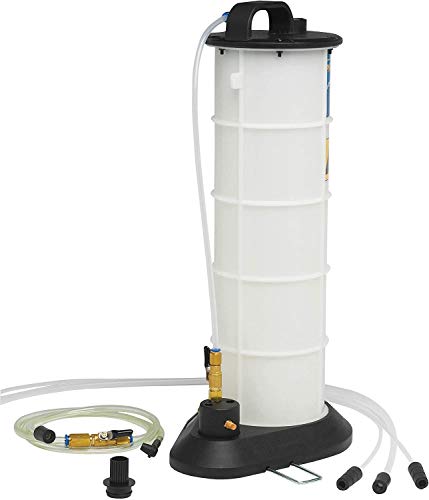
The 7201 is the reference design in this category: a tall 2.3 gallon polyethylene tank with a hand pump on top and a push-button valve that reverses the pump between evacuating and dispensing. That second direction is what separates it from the rest of this list. The same unit that pulls old oil out can push new fluid in, which makes it genuinely useful for refilling a transmission or a lower unit where pouring is awkward. The tank carries automatic overflow prevention and a quick-drain spout, and the wide base keeps a tall, filling tank stable on a garage floor. If you have no compressor and want one extractor that covers the most jobs, this is the default pick.
Specs
- Capacity: 2.3 gallons (8.8 L) as listed
- Operation: Manual hand pump
- Function: Evacuates and dispenses
- Tank material: Chemical-resistant polyethylene
- Features: Automatic overflow prevention, quick-drain spout, large base
2. Mityvac MV7300 PneumatiVac — The Shop-Air Specialist
The MV7300 keeps the same 2.3 gallon tank format as the 7201 but deletes the hand pump entirely. In its place, a venturi valve at the base turns shop air into a strong, continuous vacuum: connect the air line, open the valve, and the unit pulls until the sump is empty or the overflow prevention stops it. There is no pumping rhythm to maintain and no dispensing mode — this is an evacuation-only tool for people who always work within reach of a compressor. It ships with dipstick extraction tubes and a brake and clutch bleeding kit as listed, which makes it a fluid-service station as much as an oil tool. Choose it over the 7201 only if the compressor is a given in your workspace.
Specs
- Capacity: 2.3 gallons (8.8 L) as listed
- Operation: Pneumatic only (venturi, shop air)
- Function: Evacuation only, no dispensing
- Tank material: Chemical-resistant polyethylene
- Features: Air shut-off valve, overflow prevention, quick-drain spout
3. EWK 6.5L Pneumatic/Manual Oil Extractor (EB0103) — Dual-Mode Value
The EWK EB0103 is the dual-mode pattern done carefully. Pump the handle by hand away from the shop, or connect a compressor through the 1/4 inch NPT fitting and let air do the work at a listed extraction speed of up to 1.8 L/min. The sealed cap design is the detail owners notice: the tank is built to be carried and poured without weeping oil from the lid. The tube set is a main tube plus two extension tubes, each 51.2 inches as listed, with a guide wire for curved dipstick paths. EWK lists the unit for engine oil, transmission fluid, and coolant, and states plainly that it does not fit every engine — the listing names specific Mercedes models it cannot serve, which is the kind of honesty worth rewarding.
Specs
- Capacity: 6.5 L as listed
- Operation: Manual or pneumatic
- Listed working pressure: 40–170 PSI in pneumatic mode
- Extraction speed: Up to 1.8 L/min in pneumatic mode as listed
- Tubes: Main tube plus 2 extension tubes, 51.2 in as listed, guide wire included
4. FOUR UNCLES 6.5L Oil Extractor (FU-6502) — The Fullest Tube Kit

The FOUR UNCLES FU-6502 matches the EWK on the headline numbers — 6.5 liter tank, manual or pneumatic operation, 40 to 170 psi listed working pressure, 1.8 L/min listed extraction speed — and separates itself on what comes in the box. Alongside the main tube there are three extension tubes in different diameters, one with a wire stiffener, plus a dedicated brake bleeding hose, so the same tank handles an oil change and a brake fluid swap without accessory shopping. The translucent tank shows the fill level at a glance, and the sealed bottom design addresses the slow leak that plagues cheaper tanks stored with oil inside. Pick it when the vehicle mix in your household is wide and tube fit is the deciding factor.
Specs
- Capacity: 6.5 L (1.72 gallons) as listed
- Operation: Manual or pneumatic
- Listed working pressure: 40–170 PSI in pneumatic mode
- Extraction speed: 1.8 L/min in pneumatic mode as listed
- Tubes: Main tube plus 3 extension tubes and a brake bleeding hose
5. OEMTOOLS 24937 Pneumatic/Manual Fluid Extractor — The Compact Shop Pick

The OEMTOOLS 24937 is the smallest tank here at 6 liters, and it is aimed squarely at the home shop rather than the field. The automatic shut-off valve is its headline: suction stops before the tank overfills, protecting the pump mechanism from the oil ingestion that kills budget extractors. The oversized pumping handle makes manual mode less of a chore than the size suggests, and pneumatic mode connects with a common quick-connect fitting. The 5 ft main suction hose as listed gives more placement freedom than the tube sets on the taller tanks, and two dipstick adapters are included for engines whose tubes need a sealed fit. For a one-car garage doing its own oil, coolant, and power steering fluid, the capacity is enough and the shut-off is the feature that matters.
Specs
- Capacity: 6 L (1.5 gallons) as listed
- Operation: Manual or pneumatic
- Main hose: 5 ft suction hose as listed
- Features: Automatic shut-off valve, oversized pumping handle
- Includes: 2 dipstick adapters as listed
Quick Comparison
| Pick | Capacity as listed | Power | Dispenses? | Standout feature |
|---|---|---|---|---|
| Mityvac 7201 | 2.3 gal (8.8 L) | Manual | Yes | Evacuate and dispense in one unit |
| Mityvac MV7300 | 2.3 gal (8.8 L) | Pneumatic only | No | Continuous venturi vacuum |
| EWK EB0103 | 6.5 L | Manual or pneumatic | No | Sealed cap, long 51.2 in tubes |
| FOUR UNCLES FU-6502 | 6.5 L | Manual or pneumatic | No | 3 extension tubes plus brake hose |
| OEMTOOLS 24937 | 6 L | Manual or pneumatic | No | Automatic shut-off valve |
FAQ
Does an extractor get all the oil out?
On engines with a straight dipstick path to the sump floor, a vacuum extractor typically removes about as much as the drain plug does, because the tube sits at the lowest point of the pan. Engines with baffles or curved tubes can leave some oil behind. Warming the oil first makes the biggest difference to how completely and quickly any of these units pulls.
Can I use an oil extractor on an engine with no dipstick?
No. The tube needs the dipstick tube as its path into the sump. Engines sealed without a dipstick still require a conventional drain from below, which is the job an oil drain pan is built for.
Can these extractors handle gasoline?
No. Every maker on this page excludes gasoline and other highly volatile fluids. These are vacuum tanks with seals and pumps designed for oils and coolants, not fuel-rated equipment.
Manual or pneumatic — which is faster?
Pneumatic mode, where it is offered, is faster and steadier: the EWK and FOUR UNCLES units list 1.8 L/min as listed. Manual pumping is slower and depends on keeping the vacuum topped up, but it works anywhere, including on a boat or a mower at the far end of a yard with no compressor in reach.
What else can an extractor pull besides engine oil?
Transmission fluid, coolant, power steering fluid, and brake fluid are all listed uses across these five units, and the MV7300 and FOUR UNCLES picks include brake bleeding accessories. Rinse or dedicate tubes when switching fluid families, and never move a tube from brake fluid duty back into an oil job without cleaning it.
Conclusion
Match the extractor to your air supply first and your sump size second. No compressor: the Mityvac 7201 is the manual benchmark, and its dispensing mode earns it space in a crowded garage. Compressor always on hand: the MV7300 removes the work entirely, while the EWK EB0103 and FOUR UNCLES FU-6502 split the difference with dual-mode tanks — the FOUR UNCLES carrying the broader tube kit, the EWK the cleaner sealed-cap design. For a compact home shop, the OEMTOOLS 24937 trades a little capacity for an automatic shut-off that protects the tool itself. Any of the five turns the messiest part of an oil change into a tube, a tank, and a pour at the recycling point.
Related guides
More from Amazon
Programs that pair well with the guide above. Offers and eligibility are set by Amazon and may change.
Free shipping on eligible items, Prime Video and more. Eligible new members can start with a free trial.
Start a Prime free trialAd-free music streaming. Eligible new subscribers can start with a free trial.
Try Music Unlimited freeA Prime membership for ages 18-24 with a trial period. Eligibility is set by Amazon.
See Prime for Young AdultsAudiobooks and podcasts to listen to on the go. Eligible new members can start with a free trial.
Try Audible freeAs an Amazon Associate we earn from qualifying purchases.