Sandpaper is the cheapest tool in the shop and the one that decides how a finish looks. A board can be cut square and joined tight, yet still look rough if the sanding sequence jumps too far between grits or the paper clogs halfway through a pass. The right sheet cuts fast, leaves even scratches, and lasts long enough to finish the job.
This guide covers sandpaper only: loose sheets and discs for random orbital sanders. It does not cover sanding blocks, which are holders that grip a sheet, or powered sanders themselves. Every pick below is a different paper line from a different maker or a different abrasive, so the five options cover hand sanding, machine sanding, dry sanding, and wet sanding without repeating the same product in another grit.
Disclosure: As an Amazon Associate, I earn from qualifying purchases. If you buy through links in this article, I may earn a commission at no extra cost to you.
Top 3 picks at a glance


How to Choose Sandpaper
Start with grit, because grit decides how much material comes off and how smooth the surface gets. Coarse grits in the 40 to 80 range remove paint, level filler, and knock down rough-sawn wood. Medium grits around 100 to 150 refine the surface after shaping. Fine grits from 180 to 220 prepare bare wood for stain or a first coat. Very fine grits at 320 and above belong to finishing work: sanding between coats and smoothing paint and clear coats. A practical sequence moves in steps of roughly one grit size at a time, such as 80, then 120, then 180, then 220. Skipping from 80 straight to 220 leaves deep scratches the fine paper cannot reach, so the surface looks smooth until finish reveals the pattern.
Next, match the abrasive to the job. Aluminum oxide is the general-purpose choice for wood, paint, and light metal work: it cuts steadily and resists clogging better than garnet. Silicon carbide is harder and sharper, and it fractures as it works, which keeps fresh cutting edges exposed. That makes it the standard for wet sanding, paint, filler, and very fine finishing grits. Ceramic grains cut the fastest on hard material and last the longest, but they cost more and belong to heavy removal work.
Backing and format matter as much as the grain. Full 9 x 11 inch sheets are the hand-sanding standard: they fold, wrap around a block, and cut down to fit a quarter-sheet sander. Discs with hook and loop backing stick to a random orbital sander pad and swap in seconds, while pressure-sensitive adhesive discs stay put on a flat pad and suit high-volume work. Paper backing is flexible and cheap; film backing resists tearing and suits wet work; cloth backing bends around curves without cracking.
Finally, decide whether the job needs wet or dry paper. Dry sanding is faster for bare wood and paint removal, and dust extraction keeps the surface visible. Wet sanding uses water as a lubricant, carries swarf away from the paper, and leaves a finer, more even scratch pattern on paint, filler, and clear coats. Only paper with a waterproof backing should be used wet.
1. 3M Pro Grade Precision Advanced Sandpaper
The 3M Pro Grade Precision sheet is the hand-sanding default for a reason. The aluminum oxide grain cuts at a steady rate on wood, drywall, and metal, and the no-slip grip backing keeps the sheet from sliding in the hand or creeping on a block during long strokes. The 80-grit version below is the coarse end of the line, suited to stripping paint edges, leveling filler, and taking down rough-sawn boards before the sequence moves finer.
The sheet measures a listed 9 x 11 inches, the standard full-sheet size, so it folds into thirds for hand work, wraps a sanding block, or cuts down for a quarter-sheet sander. Twenty sheets in the pack cover a full refinishing sequence when combined with finer grits from the same line. The backing resists tearing better than budget paper, which matters when the sheet is folded and refolded around an edge.
- Abrasive: Aluminum oxide
- Grit: Listed 80 grit
- Sheet size: Listed 9 x 11 inches
- Sheets: Listed 20 sheets
- Backing: No-slip grip paper
- Use: Wood, drywall, metal, wet or dry
2. Mirka Gold PSA Sanding Discs
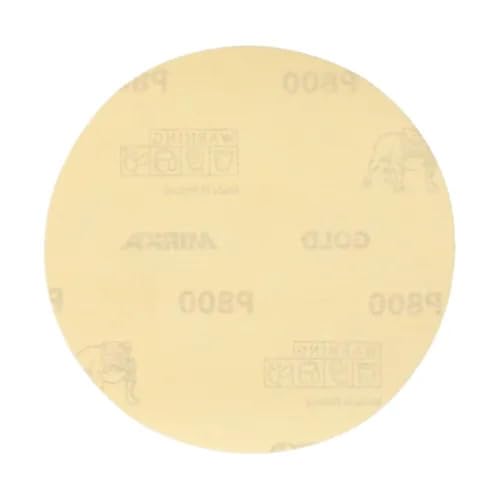
Mirka Gold discs are the shop standard for machine sanding with a sticky-back pad. The pressure-sensitive adhesive backing holds the disc flat on the pad with no hook and loop wear, and the aluminum oxide grain is coated to resist clogging on wood, metal, paint, primer, and body filler. The 80-grit discs below are the coarse option in the line, made for fast stock removal and leveling before finer discs take over.
A 5-inch disc fits the common random orbital sander size, and the no-hole pattern suits pads without dust extraction. The 100-disc pack is sized for a busy shop or a long refinishing project, and the discs stay consistent from the first to the last in the box.
- Abrasive: Aluminum oxide
- Grit: Listed 80 grit
- Disc size: Listed 5 inches
- Discs: Listed 100 discs
- Backing: Pressure-sensitive adhesive, no hole
- Use: Wood, metal, paint, primer, body filler
3. Norton 3X Handy Sandpaper Sheets
Norton 3X sheets sit between budget paper and premium ceramic lines. The aluminum oxide grain is bonded to a heavy paper backing that resists tearing when folded, and the 3X coating is designed to cut faster and clog less than plain paper. The 220-grit pack below is the finishing end of the line, made for smoothing bare wood before stain, easing sharp edges, and preparing a surface for a first coat.
Three sheets at 9 x 11 inches make this the small-pack option in this guide, which suits a single project or a first try of the line before committing to a job pack. The fine grit leaves a scratch pattern that disappears under stain and clear finish when the sequence before it was followed.
- Abrasive: Aluminum oxide
- Grit: Listed 220 grit
- Sheet size: Listed 9 x 11 inches
- Sheets: Listed 3 sheets
- Backing: Heavy paper
- Use: Wood finishing and surface preparation
4. 3M Wetordry Sandpaper

Wetordry is the paper for finishing work that dry paper cannot do well. The silicon carbide grain self-fractures as it cuts, exposing fresh edges and keeping the cut consistent through long wet-sanding passes. The waterproof paper backing holds together in water, which lets the paper float swarf away instead of loading up. The 320-grit sheets below are extra fine, made for sanding between coats of varnish, lacquer, and paint, and for smoothing a surface before the final coat.
Five sheets at 9 x 11 inches cover a full finishing job on furniture or trim, and the sheets cut down easily for hand work around curves and edges. Used dry, the same paper works for fine sanding on wood and paint, but its real strength shows with water on a painted or clear-coated surface.
- Abrasive: Silicon carbide
- Grit: Listed 320 grit
- Sheet size: Listed 9 x 11 inches
- Sheets: Listed 5 sheets
- Backing: Waterproof paper
- Use: Wet or dry sanding between finish coats
5. Fandeli Multi-Purpose and Waterproof Sandpaper Pack

The Fandeli pack is the value play in this guide, and it earns its place by covering the whole sequence in one box. Twenty-five multi-purpose sheets in 80, 120, and 220 grit handle dry sanding on wood and metal, while twenty-five waterproof sheets in 220, 320, and 400 grit cover wet sanding and fine finishing. The aluminum oxide grain on the dry sheets cuts steadily, and the mixed pack means a project can move from rough shaping to final smoothing without a second order.
Each sheet measures 23 x 28 cm, close to the standard full-sheet size, and cuts down for a sanding block or a quarter-sheet sander. The pack suits a home workshop that sands a little of everything: furniture repair, painted trim, and metal parts.
- Abrasive: Aluminum oxide, waterproof sheets included
- Grit range: Listed 80 to 400 grit assorted
- Sheet size: Listed 23 x 28 cm
- Sheets: Listed 50 sheets
- Backing: Paper, waterproof on fine sheets
- Use: Wood and metal, dry and wet sanding
Comparison
| Paper | Form | Abrasive | Listed grit | Best for |
|---|---|---|---|---|
| 3M Pro Grade Precision | Sheets | Aluminum oxide | 80 | General hand sanding |
| Mirka Gold PSA | 5-inch discs | Aluminum oxide | 80 | Orbital sander stock removal |
| Norton 3X Handy | Sheets | Aluminum oxide | 220 | Finish prep on wood |
| 3M Wetordry | Sheets | Silicon carbide | 320 | Wet sanding between coats |
| Fandeli assorted pack | Sheets | Aluminum oxide | 80 to 400 | Full sequence in one box |
FAQ
What grit sandpaper should I start with on bare wood?
Start coarse enough to remove mill marks and level the surface, usually 80 or 100 grit for rough wood, then step up through 120, 150 or 180, and finish at 220 before staining. Each step should remove the scratches of the one before it.
Can I use sandpaper wet?
Only paper with a waterproof backing, such as the 3M Wetordry sheets above, should be used wet. Standard dry paper breaks down in water and loses its grain. Wet sanding suits paint, filler, and clear coats, where water carries swarf away and leaves a finer scratch pattern.
How do I keep sandpaper from clogging?
Step through grits instead of pressing harder, clear the surface often, and use dust extraction on machine sanding. On paint and filler, a clog-resistant coating or wet sanding keeps the paper cutting longer. When the paper stops cutting and starts polishing, it is time for a fresh sheet.
Are discs or sheets better for a random orbital sander?
Discs are the right format for an orbital sander: hook and loop discs swap fastest, while pressure-sensitive discs like the Mirka Gold above hold flat and cost less per disc. Sheets belong to hand sanding, sanding blocks, and quarter-sheet sanders.
How much sandpaper does a furniture project need?
A small refinishing job usually needs a handful of sheets across three or four grits. A full sequence for a table or a set of chairs can use a whole pack of coarse sheets and several fine ones, which is where an assorted pack or a 100-disc box earns its keep.
Conclusion
The best sandpaper is the one matched to the job in front of it: coarse aluminum oxide for removal, fine grits for finish prep, silicon carbide for wet work, and discs for machine sanding. Start with the 3M Pro Grade Precision sheets for general hand sanding, add Mirka Gold discs if an orbital sander does the heavy work, keep Norton 3X 220 grit for the last pass before stain, reach for 3M Wetordry between finish coats, and stock the Fandeli assorted pack when one box must cover the whole sequence.
Related guides
More from Amazon
Programs that pair well with the guide above. Offers and eligibility are set by Amazon and may change.
Free shipping on eligible items, Prime Video and more. Eligible new members can start with a free trial.
Start a Prime free trialAd-free music streaming. Eligible new subscribers can start with a free trial.
Try Music Unlimited freeA Prime membership for ages 18-24 with a trial period. Eligibility is set by Amazon.
See Prime for Young AdultsAudiobooks and podcasts to listen to on the go. Eligible new members can start with a free trial.
Try Audible freeAs an Amazon Associate we earn from qualifying purchases.