Disclosure: As an Amazon Associate, I earn from qualifying purchases. If you buy through links in this article, I may earn a commission at no extra cost to you.
Our top pick: Buck 110 Folding Hunter with Finger Grooves. Runner-up: Spyderco Tenacious Lightweight.
A pocket knife is the tool you actually have with you when a box needs opening, a rope needs cutting, or a campsite chore needs a sharp edge. A folding pocket knife closes into its handle and rides clipped to a pocket, so it is easy to carry every day and quick to open with one hand. This guide covers dedicated folding pocket knives only: knives with a folding blade, a locking mechanism, and a pocket clip or sheath for carry. It does not cover utility knives that take replaceable trapezoid blades, machetes, or kitchen carving knives, which are different tools with different edges. The five knives below are five distinct designs, from a classic lockback hunter to a slim frame-lock folder.
Top 3 picks at a glance


How to Choose a Pocket Knife
Blade length and shape. Most pocket knives in this guide have a listed blade length between 2.88 and 3.75 inches. A shorter blade near 3 inches is discreet in a pocket and nimble for boxes, cord, and food prep at camp. A longer blade near 3.75 inches gives more edge for wood work and field chores but takes up more pocket space. Clip-point blades pierce well and suit general outdoor work, while drop-point blades have a stronger tip and suit everyday cutting and camp tasks.
Blade steel. The steel decides how long the edge lasts and how easy it is to sharpen. Stainless steels such as 420HC and 8Cr13MoV resist corrosion and sharpen easily with a basic stone, which suits a knife that lives in a pocket through rain and sweat. AUS-8 holds an edge a little longer while staying easy to maintain, and none of these steels needs special sharpening gear.
Lock type. A pocket knife should lock open while you cut. A lockback, such as the one on the Buck 110, locks the blade with a spine bar and releases with a press at the back of the handle, which is simple and very secure. A liner lock uses a spring bar inside the handle and releases with a thumb push, which is fast and common on everyday carry folders. A frame lock uses one side of the handle frame itself as the lock bar, which keeps the knife slim and light. Pick the lock you can open and close confidently with one hand.
Handle and carry. The handle decides comfort and grip in wet hands. Textured synthetics such as FRN, G10, and nylon grip well and tolerate hard use, while wood and brass give a classic feel and more weight. A pocket clip keeps the knife in place and ready to draw; a belt sheath suits a larger knife that is too heavy for a pocket clip. A knife over 7 ounces feels substantial on a belt, while one under 3 ounces disappears in a pocket.
1. Buck 110 Folding Hunter with Finger Grooves
The Buck 110 Folding Hunter is the classic American pocket knife, in production since the 1960s, and the finger-grooved version is the one to buy if you want the traditional design with a more secure grip. Its listed blade length of 3-3/4 inches pairs with a 420HC stainless steel clip-point blade, a shape that pierces well and handles field dressing, whittling, and camp chores. The lockback design locks the blade firmly open and releases with a press on the spine, and the ebony handle with brass bolsters gives it the look of a knife meant to be handed down. Finger grooves in the handle keep your grip steady during longer cuts. A leather sheath is included, so the knife rides on a belt rather than loose in a pocket. At a listed weight of 7.2 ounces it is the heaviest knife in this guide, and it is made in the United States.
Specs
- Listed blade length: 3-3/4 inches
- Blade steel: 420HC stainless steel, clip point
- Lock: lockback
- Handle: ebony with brass bolsters, finger grooves
- Model: 0110BRSFG
- Listed weight: 7.2 ounces
- Carry: leather sheath included
- Origin: made in the USA
2. Spyderco Tenacious Lightweight
The Spyderco Tenacious Lightweight is the everyday carry pick of this guide, built around a slim, light handle that disappears in a pocket. Its listed blade length of 3.3 inches pairs with an 8Cr13MoV steel blade in a plain edge, a full-flat grind that slices cleanly through cardboard, cord, and food. The FRN handle is textured for grip and much lighter than the G-10 handle on the standard Tenacious, which is the point of this version: the same blade and lock in a lighter package. The listed overall length is 7.77 inches open, and the knife carries a pocket clip for tip-up or tip-down carry. The round opening hole in the blade is a Spyderco signature and lets you open the knife one-handed with a thumb.
Specs
- Listed blade length: 3.3 inches
- Blade steel: 8Cr13MoV steel, plain edge, full-flat grind
- Lock: liner lock
- Handle: FRN
- Model: C122PBBK
- Listed overall length: 7.77 inches
- Carry: pocket clip
3. Ontario RAT Model II Folder
The Ontario RAT Model II, model 8860, is the working knife of this guide: a mid-size folder that trades flash for a comfortable handle and a tough, easy-to-sharpen blade. Its satin AUS-8 stainless steel drop-point blade holds an edge well and resists corrosion, and the drop-point shape gives a strong tip for camp chores and everyday cutting. The black nylon handle is shaped for a full grip and carries a reversible pocket clip, so the knife sits either way in a pocket. The liner lock holds the blade open securely and releases with a thumb push. The listed overall open length is 7-1/8 inches, which makes it large enough for real work but compact enough for daily pocket carry.
Specs
- Blade steel: AUS-8 stainless steel, satin drop point
- Lock: liner lock
- Handle: black nylon
- Model: 8860
- Listed overall length: 7-1/8 inches open
- Carry: reversible pocket clip
4. CRKT Drifter
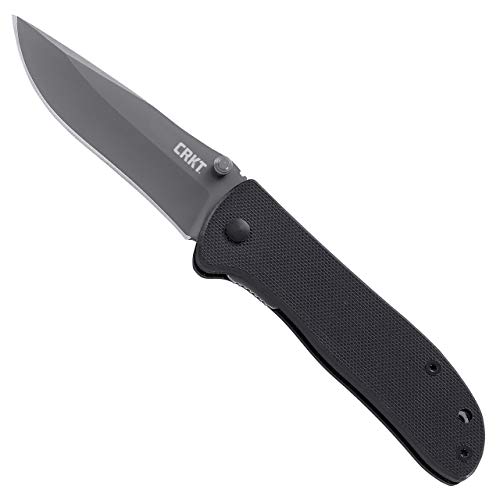
The CRKT Drifter, model 6450K, is the compact pick of this guide, a small folder that covers the everyday jobs without filling a pocket. Its listed blade length of 2.88 inches pairs with an 8Cr14MoV steel drop-point blade with corrosion resistance, a short edge that is quick on boxes, blister packs, cord, and food. The black G10 handle is textured for grip and carries a pocket clip, and the liner lock keeps the blade open while you cut. A thumb stud opens the blade one-handed, which is genuinely useful when your other hand is holding the material. The short blade is the trade-off: it will not cover a long cut in one stroke the way a 3.75-inch blade does, but it is the most discreet knife here.
Specs
- Listed blade length: 2.88 inches
- Blade steel: 8Cr14MoV steel, drop point
- Lock: liner lock
- Handle: black G10
- Model: 6450K
- Carry: pocket clip
- Opening: one-hand thumb stud
5. Gerber Paraframe I
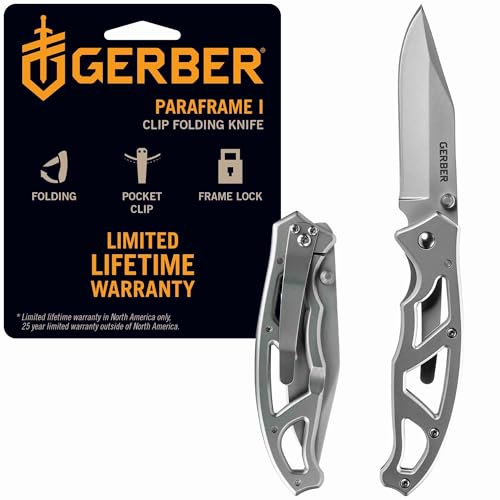
The Gerber Paraframe I, model 22-48446, is the minimalist pick: a slim stainless steel folder with an open-frame design that keeps weight and bulk to a minimum. Its listed blade length of 3 inches pairs with a fine-edge stainless steel blade, a clean slicing edge for boxes, cord, and camp food prep. The frame lock uses one side of the handle frame as the lock bar, which keeps the knife slim while locking the blade securely open. The grey stainless steel handle is the frame itself, with no separate scales, so the knife is easy to clean and hard to wear out. A pocket clip keeps it ready in a pocket. The smooth metal handle is the trade-off: it grips less firmly than textured G10 or FRN when your hands are wet.
Specs
- Listed blade length: 3 inches
- Blade steel: stainless steel, fine edge
- Lock: frame lock
- Handle: grey stainless steel, open frame
- Model: 22-48446
- Carry: pocket clip
Comparison Table
| Pocket Knife | Listed Blade Length | Blade Steel | Lock | Handle |
|---|---|---|---|---|
| Buck 110 Folding Hunter, 0110BRSFG | 3-3/4 inches | 420HC stainless | Lockback | Ebony, brass bolsters |
| Spyderco Tenacious Lightweight, C122PBBK | 3.3 inches | 8Cr13MoV | Liner lock | FRN |
| Ontario RAT Model II, 8860 | Drop point, AUS-8 | AUS-8 stainless | Liner lock | Black nylon |
| CRKT Drifter, 6450K | 2.88 inches | 8Cr14MoV | Liner lock | Black G10 |
| Gerber Paraframe I, 22-48446 | 3 inches | Stainless steel | Frame lock | Grey stainless steel |
Frequently Asked Questions
What is the difference between a pocket knife and a utility knife?
A pocket knife has a fixed folding blade made for cutting, slicing, and piercing, with a lock that holds it open. A utility knife takes replaceable trapezoid blades and is built for scoring drywall, cutting roofing felt, and slicing heavy cardboard. A pocket knife is the better everyday carry tool; a utility knife is the better job-site scoring tool.
Which lock is safest on a pocket knife?
Any of the three locks in this guide holds the blade open securely when it is engaged: the lockback on the Buck 110, the liner locks on the Spyderco, Ontario, and CRKT knives, and the frame lock on the Gerber Paraframe I. Safety comes from keeping the lock clean, confirming it is fully engaged before you cut, and closing the blade before you put the knife back in a pocket.
Can I carry a pocket knife every day?
In most places, yes, but knife carry laws vary by state, county, and city, and some places limit blade length or lock type. Check the rules where you live and where you travel before you carry, and keep the blade closed and clipped in a pocket when you are not using it.
How do I sharpen a pocket knife?
Use a basic sharpening stone or a guided sharpener and hold a steady angle along the edge, working from the base of the blade to the tip. The steels in this guide, 420HC, 8Cr13MoV, AUS-8, 8Cr14MoV, and the stainless steel of the Paraframe I, all sharpen easily with standard gear and do not need special stones.
Conclusion
The best pocket knife is the one you carry every day and can open with confidence. For a classic field knife, the Buck 110 Folding Hunter pairs a 3-3/4-inch 420HC clip-point blade with a lockback and a belt sheath. The Spyderco Tenacious Lightweight and the Ontario RAT Model II are the two best everyday carry choices, one light and fast, the other a steady working folder. The CRKT Drifter covers the everyday jobs in the smallest package, and the Gerber Paraframe I keeps things slim in all-steel form. Pick the blade length, lock, and handle your carry needs.
Related guides
More from Amazon
Programs that pair well with the guide above. Offers and eligibility are set by Amazon and may change.
Free shipping on eligible items, Prime Video and more. Eligible new members can start with a free trial.
Start a Prime free trialAd-free music streaming. Eligible new subscribers can start with a free trial.
Try Music Unlimited freeA Prime membership for ages 18-24 with a trial period. Eligibility is set by Amazon.
See Prime for Young AdultsAudiobooks and podcasts to listen to on the go. Eligible new members can start with a free trial.
Try Audible freeAs an Amazon Associate we earn from qualifying purchases.