A high-visibility safety vest makes a worker conspicuous on a busy site, in daylight and under headlights at night. The five vests below are fluorescent hi-vis designs with retroreflective strips, built for construction, road work, and survey work: a nine-pocket all-rounder, a plain breathable mesh vest, a sixteen-pocket tool carrier, a heavy-duty engineer vest, and a reinforced surveyor vest. This guide covers hi-vis vests only, not fall protection harnesses worn with a lanyard and anchor, and not hard hats or weighted training vests.
Disclosure: As an Amazon Associate, I earn from qualifying purchases. If you buy through links in this article, I may earn a commission at no extra cost to you.
Before choosing, check the listed ANSI/ISEA class, closure, pockets, and size range against the rules of the site where it will be worn.
Top 3 picks at a glance


How to Choose a Safety Vest
Match the listed ANSI/ISEA class to the site. Class 2 is the common requirement for work near traffic moving at 25 to 50 mph, including road construction, utilities, and survey work. Class 1 suits off-road settings separated from traffic, while Class 3 adds sleeve coverage for high-speed highway work and night flagging. If no class is listed, confirm the requirement with the site supervisor before buying. A compliant vest also carries a label stating the standard, the class, and the garment type.
Choose mesh or solid fabric for the conditions. Open polyester mesh lets air through on hot days, while solid or mixed fabric resists snags and holds its shape better around tools. A mesh back with a solid front splits the difference, giving airflow behind and durability where pockets hang. Machine-washable fabric matters, since a vest worn daily needs regular cleaning to stay bright.
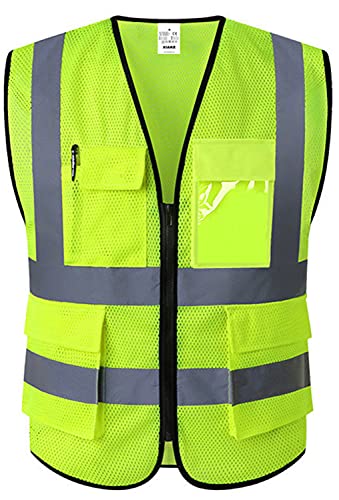
Count the pockets against what you carry. A phone, an ID badge, pens, a radio, and small tools each need a home. Nine to sixteen pockets suit workers who carry drawings and hand tools, while a plain vest suits a supervisor or visitor who carries almost nothing. An ID window pocket keeps a credential visible without unzipping the vest, and a mic tab holds a radio clip in reach.
Check the closure and the fit. A zipper front opens and closes fast and stays shut in wind, while a hook-and-loop front lays flat over a jacket. Either way, the vest should close without pulling across the chest and should leave the reflective strips flat and visible. Check the size chart against chest measurements and order a size up if the vest will be worn over bulky winter layers. United States construction PPE rules require properly fitting equipment for each worker.
Look at the reflective tape and the weight. Two-inch-wide retroreflective strips over the shoulders, chest, waist, and back give 360-degree coverage, which is what makes the wearer visible from every angle under headlights. A vest listed at 0.3 lb feels very different from one listed at 1.2 lb after eight hours with loaded pockets, and a padded collar helps when a heavy vest sits on the neck all day.
1. JKSafety JK150 9-Pocket Hi-Vis Safety Vest
The JKSafety JK150, model 51112L, is the all-rounder in this lineup, pairing a listed ANSI/ISEA Class 2 Type R claim with nine pockets and 100% polyester mesh. Two-inch reflective strips run over the shoulders, chest, waist, and back for 360-degree coverage, and the zipper front closes the vest quickly between tasks. The pocket layout is the reason to pick it: a PVC-transparent ID window pocket, a phone pouch, two large snap-button utility pockets, and pen holders cover the daily carry of a construction worker, utility worker, or security officer. At a listed 0.30 lb the mesh body stays light, the listing states it is machine washable, and sizes run from small through 5XL in yellow-green and safety orange.
Specs
- Brand: JKSafety
- Model: JK150, 51112L
- Listed ANSI/ISEA class: Class 2, Type R
- Pockets: 9, including ID window pocket
- Fabric: 100% polyester mesh
- Reflective strips: 2 in, 360-degree coverage
- Closure: Zipper front
- Listed weight: 0.30 lb
- Sizes: Small through 5XL
2. XIAKE 5MSV Mesh Hi-Vis Safety Vest
The XIAKE 5MSV is the plain option in this roundup, a simple polyester mesh vest with a listed ANSI/ISEA Class 2 Type R claim and no complicated pocket system. Two-inch reflective strips cover the shoulders, chest, waist, and back, and the mesh fabric lets air through during long shifts in warm conditions. At a listed 0.40 lb it adds little load, and the listing states it is machine washable. The listing mentions front pockets with zipper and Velcro closures for a phone, flashlight, and business cards, but it publishes no pocket count, so buyers who need a stated number should look elsewhere. Only Large is listed, and the maker advises checking the size chart and ordering one to two sizes up.
Specs
- Brand: XIAKE
- Model: 5MSV
- Listed ANSI/ISEA class: Class 2, Type R
- Pockets: Front pockets, count not published
- Fabric: Polyester mesh
- Reflective strips: 2 in
- Listed weight: 0.40 lb
- Sizes: Large listed
- Care: Machine washable
3. HYCOPROT 162 Heavy Duty Construction Safety Vest
The HYCOPROT 162 is the pocket-first vest in this group, listing 16 pockets, the highest count here. The layout includes a right chest window pocket, a left chest pencil pocket, two elastic pockets, two large flap pockets, and a hidden back pocket, giving room for tools, drawings, and a phone. The front is a knitted material and the back is breathable mesh, so air keeps flowing behind the wearer while the front stands up to daily use. A padded collar supports the loaded vest, and an ID window pocket keeps a badge visible. It is listed to ANSI/ISEA 107 Class 2, with two-inch reflective strips on the shoulders, waist, and back plus reflective edge binding. No performance type is listed, so confirm the site accepts it near roads; the listing states it is not an anti-static or flame-resistant vest.
Specs
- Brand: HYCOPROT
- Model: 162
- Listed ANSI/ISEA class: Class 2
- Pockets: 16, including ID window pocket
- Fabric: Mixed mesh and solid, knitted front with mesh back
- Reflective strips: 2 in, plus reflective edge binding
- Padded collar: Yes
- ID window pocket: Yes
- Flame-resistant: No, per listing
4. Radians SV55 Class 2 Engineer Vest

The Radians SV55 is the heavy-duty engineer vest here, built for field engineers and superintendents who carry gear all day. The front is heavyweight polyester and the back is polyester birdseye mesh, a combination that trades some weight for durability while keeping airflow behind the wearer. The reflective tape is 3M glass bead material, two inches wide, applied with heat transfer so stitching cannot come loose. A heavy-duty zipper, reinforced edge binding, and a padded neck suit a vest that gets loaded and worn hard, and cargo pockets in rugged Oxford material hold larger items. It is listed to ANSI/ISEA 107-2020 Class 2, in orange in Large. At a listed 1.00 lb it is the second-heaviest vest here, so it suits workers who accept extra weight for a sturdier build. No performance type or pocket count is published, so confirm the site rules for roadway work before buying.
Specs
- Brand: Radians
- Model: SV55
- Listed ANSI/ISEA class: Class 2
- Pockets: Cargo pockets, count not published
- Fabric: Heavyweight polyester front, birdseye mesh back
- Reflective tape: 3M glass bead, 2 in, heat transfer
- Closure: Heavy-duty zipper
- Padded neck: Yes
- Listed weight: 1.00 lb
5. Kishigo S5002 Surveyor Safety Vest

The Kishigo S5002 is the reinforced surveyor vest in this group, with a listed ANSI/ISEA Class 2 Type R claim and ten pockets in a mixed mesh and solid build. A zipper with a reinforced front closes the vest, and the layout suits surveyors and inspectors carrying a radio, phone, pens, and field notes. A padded neck helps when the vest is worn loaded all shift. The two-tone lime and black colorway looks more professional than an all-fluorescent vest, though the black panels reduce the fluorescent area, so it stays a Class 2 garment. Two-inch reflective strips are listed, and the vest is listed in 3X-Large with a listed weight of 1.20 lb, the heaviest in this roundup.
Specs
- Brand: Kishigo
- Model: S5002
- Listed ANSI/ISEA class: Class 2, Type R
- Pockets: 10
- Fabric: Mixed mesh and solid
- Reflective strips: 2 in
- Closure: Zipper with reinforced front
- Padded neck: Yes
- Listed weight: 1.20 lb
Comparison Table
| Vest | Listed ANSI/ISEA class | Pockets | Fabric | Closure | Listed weight |
|---|---|---|---|---|---|
| JKSafety JK150 | Class 2, Type R | 9 | 100% polyester mesh | Zipper | 0.30 lb |
| XIAKE 5MSV | Class 2, Type R | Count not published | Polyester mesh | Not published | 0.40 lb |
| HYCOPROT 162 | Class 2 | 16 | Mixed mesh and solid | Not published | Not published |
| Radians SV55 | Class 2 | Count not published | Heavyweight polyester, mesh back | Heavy-duty zipper | 1.00 lb |
| Kishigo S5002 | Class 2, Type R | 10 | Mixed mesh and solid | Zipper, reinforced front | 1.20 lb |
Frequently Asked Questions
What is the difference between a safety vest and a safety harness?
A safety vest is a hi-vis garment that makes the wearer conspicuous to drivers and equipment operators. A safety harness is fall protection equipment worn on the body with a lanyard and anchor to arrest a fall from height. They serve different purposes and do not replace each other.
Which ANSI class do I need for road work?
Class 2 is the usual minimum for work near traffic moving at 25 to 50 mph, including road construction, utilities, and survey work. Class 3 adds sleeve coverage for traffic above 50 mph and night flagging. Confirm the required class with the site supervisor or safety officer, and check the permanently attached label on the vest itself.
Do I need a vest with many pockets?
It depends on what you carry. Workers who carry a phone, ID, pens, radio, and small tools benefit from nine or more pockets, while supervisors and visitors who carry almost nothing do fine with a plain vest. An ID window pocket helps if a credential must stay visible all shift.
How should a safety vest fit?
The vest should close without pulling across the chest, with strips lying flat and visible from every angle. Check the size chart against chest measurements, and order a size up if the vest will be worn over bulky layers. Too tight restricts movement, and too loose can snag on equipment.
How do I care for a hi-vis vest?
Follow the care label, and machine wash models listed as washable so dirt does not dull the fabric. Inspect the strips regularly for cracking or peeling, and replace the vest when they no longer reflect well or the fabric has faded.
Conclusion
The right safety vest depends on the site, the traffic nearby, and what the wearer carries. The JKSafety JK150 covers the basics with nine pockets and a listed Class 2 Type R claim, the XIAKE 5MSV keeps it simple with plain breathable mesh, and the HYCOPROT 162 leads on storage with sixteen pockets and a padded collar. The Radians SV55 brings heavy-duty fabric, 3M tape, and a rugged zipper for engineer work, while the Kishigo S5002 offers a reinforced surveyor layout with ten pockets and a two-tone look. Match the listed ANSI class to the job, confirm the size, and check the label before the first shift.
Related guides
More from Amazon
Programs that pair well with the guide above. Offers and eligibility are set by Amazon and may change.
Free shipping on eligible items, Prime Video and more. Eligible new members can start with a free trial.
Start a Prime free trialAd-free music streaming. Eligible new subscribers can start with a free trial.
Try Music Unlimited freeA Prime membership for ages 18-24 with a trial period. Eligibility is set by Amazon.
See Prime for Young AdultsAudiobooks and podcasts to listen to on the go. Eligible new members can start with a free trial.
Try Audible freeAs an Amazon Associate we earn from qualifying purchases.