Disclosure: As an Amazon Associate, I earn from qualifying purchases. If you buy through links in this article, I may earn a commission at no extra cost to you.
Our top pick: Taytools 464763 Solid Brass Wheel Marking Gauge. Runner-up: iGaging 34-707 Wheel Marking Gauge.
A marking gauge scribes one line parallel to a reference edge, at a set distance, again and again. That simple job is the foundation of accurate joinery: shoulder lines for tenons, baselines for dovetails, and the paired lines that define a mortise all start with a gauge. A pencil line has width and wanders with the grain; a gauge line is a physical groove that a chisel or saw can register in.
This guide covers the three families that matter. Wheel gauges use a small rotating cutter that slices fibres cleanly, including across the grain. Pin gauges use one or two steel pins that scratch a line, the traditional format for wooden mortise gauges. Cutting and combination designs add a second point or wheel so both sides of a mortise can be marked in a single pass. The five picks below cover a micro-adjust brass wheel gauge, two graduated wheel gauges at different levels, a three-in-one wheel and mortise gauge, and a traditional beechwood pin mortise gauge. Two picks come from iGaging, but they are different models doing different jobs — a plain wheel gauge and a mortise combination — and that relationship is stated openly rather than hidden.
Top 3 picks at a glance

How to Choose a Marking Gauge
Wheel, pin or blade. A wheel cutter rolls as it cuts, so it tends to follow the set line instead of the grain, and it works with or across the grain. A pin drags, which is fine along the grain but can wander across it and tear fibres in stringy woods. A blade-style cutting gauge slices like a wheel but with a fixed knife edge. For dovetail baselines and cross-grain shoulders, a wheel is the safer default; for traditional mortise work along the grain, pins remain practical.
Fence and lock. The fence, or head, registers against the edge of the board. A wide, flat fence face stays square with less effort than a narrow one, and a flat spot or roll stop keeps a round fence from rolling off the bench. The lock must hold the setting under the pressure of a firm stroke; knurled brass thumbscrews and lock nuts are the common formats here.
Micro-adjustment. Sliding a fence by hand and locking it usually moves the setting slightly. A micro-adjust head lets the fence stay locked while a knob creeps the cutter to the line, which matters when a gauge is set from a chisel width or an existing mortise. If most of your work is set from a ruler, a plain graduated beam is enough.
Graduations. A beam etched in millimetres and fractions of an inch lets the gauge be set directly, without a separate rule. Treat the scale as a starting point: for joinery, setting the gauge from the actual mating part — the tenon, the chisel, the hinge leaf — is more reliable than any printed number.
Mortise function. A mortise gauge carries two points, one fixed and one sliding, so both walls of a mortise are scribed in one pass. Combination gauges add a single-point mode for ordinary marking. If you cut mortise-and-tenon joints regularly, the second point saves a full second setup on every joint.
Spares. Wheel cutters dull and chip. A gauge that ships with spare cutters, or whose cutter is a standard replaceable part, stays in service longer than one with a proprietary wheel that cannot be sourced later.
1. Taytools 464763 Solid Brass Wheel Marking Gauge — Micro-Adjust Pick
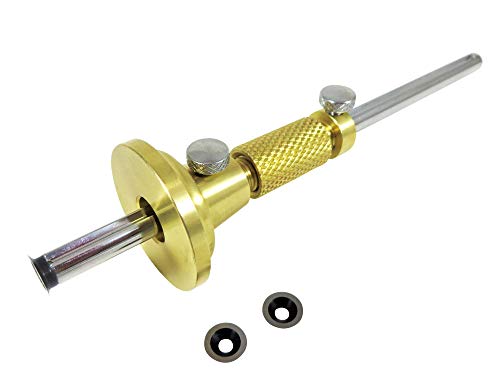
The Taytools 464763 is built around a solid brass head, 1.625 inches in diameter, with a micro-adjust mechanism and independent locking, so the fence can be fixed to the beam and the cutter position then crept in with the knurled knob. That is the feature that separates it from basic wheel gauges: settings taken directly from a chisel or a sample tenon can be matched without the usual tap, lock, re-measure cycle.
The beam is hardened steel, 7 inches long and 5/16 inch in diameter, with a groove that keeps the head from rotating during adjustment. The cutter is a hardened steel wheel, listed at 0.375 inch, and it retracts into a countersink in the head when the gauge is stored, which protects both the edge and whatever it rests against. Two extra cutters are included in the box. At a listed 8.8 ounces, most of that weight sits in the brass head, which helps the fence register firmly against an edge. The trade-off is that the beam carries no graduations, so settings are taken from a rule or from the work itself.
Specs
- Type: Wheel marking and cutting gauge
- Head: Solid brass, 1.625 in diameter, micro-adjust, lockable
- Beam: Hardened steel, 7 in long, 5/16 in diameter, grooved
- Cutter: Hardened steel wheel, 0.375 in, retracts into head
- Included: 2 extra cutters
- Model: MGB (Taytools 464763)
- Listed weight: 8.8 oz
- ASIN: B017Z03G4Y
2. iGaging 34-707 Wheel Marking Gauge — Graduated Everyday Pick
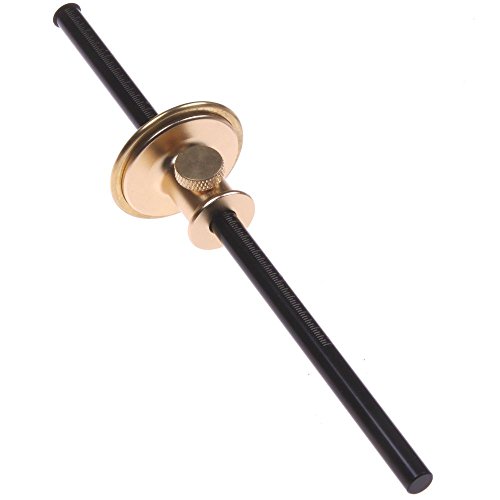
The iGaging 34-707 is the straightforward version of the same idea: a precision-machined solid brass head and knurled lock nut on a steel shaft graduated in both 1 mm and 1/32 inch increments. Because the scale is on the shaft, the gauge can be set straight from a dimension without fetching a rule, which suits hinge gains, drawer-side lines and other repeated layout in mixed metric and imperial workshops.
The free-turning wheel cuts rather than tears, so the same gauge handles long-grain and cross-grain lines. With the head slid to the end, the shaft also works as a depth gauge for checking mortise depth or transferring a measurement, which is why this pattern is often sold as a two-purpose tool. There is no micro-adjustment, so fine settings are made by sliding the head and locking it, with the small shift that method involves. For ruler-set work, that is a fair exchange for the simpler mechanism.
Specs
- Type: Wheel marking gauge, also listed for use as a depth gauge
- Head: Solid brass, precision machined, knurled lock nut
- Shaft: Steel, graduated 1 mm and 1/32 in
- Cutter: Free-spinning wheel cutter
- Model: 34-707
- Manufacturer: iGaging
- ASIN: B00B3ZS2J2
3. Clarke Brothers Wheel Marking Gauge Kit — Spare-Cutter Kit Pick
The Clarke Brothers gauge is sold as a kit rather than a bare tool: the wheel gauge itself, built on a solid metal bar with a graduated scale in inches and millimetres, plus two replacement cutters. That kit format addresses the main wear item directly. When the fitted wheel dulls or chips, a spare from the same box restores the edge without hunting for a compatible part.
The graduated bar lets the fence be set from a measurement, and the wheel format keeps the line clean across the grain for dovetail and shoulder work. The listing is aimed at general carpentry layout rather than fine micro-adjust work — there is no fine-adjust head — so it fits buyers who want a complete, ready-to-use wheel gauge with its consumables included, instead of a premium fence mechanism.
Specs
- Type: Wheel marking gauge kit
- Bar: Solid metal, graduated in inches and millimetres
- Cutter: Wheel cutter, replaceable
- Included: 2 replacement cutters
- Model: WMG8
- Manufacturer: Clarke Brothers
- ASIN: B07FWS5T1L
4. iGaging 34-708 Wheel 3-in-1 Marking and Mortise Gauge — Combination Pick

The iGaging 34-708 extends the 34-707 pattern into mortise work. It is listed as a three-in-one gauge: a standard wheel marking gauge for single lines, a mortise gauge mode that marks both sides of a mortise in one pass, and the same depth-gauge use the plain wheel model offers. For a small bench, one tool covering all three jobs removes the need for a separate wooden mortise gauge.
The shaft carries the same dual graduation, 1 mm and 1/32 inch, so mortise spacing and single-line settings can both be read off the tool. The brass head and lock follow the same machined format as the maker’s plain wheel gauge. This is the second iGaging pick in this guide, included because the mortise function is a genuinely different capability from the 34-707 above, not a size or finish variant of it. Buyers who never cut mortises gain nothing from the extra mechanism and should take the simpler model.
Specs
- Type: Wheel marking gauge with mortise gauge mode, 3-in-1
- Head: Solid brass, knurled lock
- Shaft: Steel, graduated 1 mm and 1/32 in
- Functions: Single-line marking, paired mortise lines, depth gauge
- Model: 34-708
- Manufacturer: iGaging
- ASIN: B00CNYE430
5. Robert Larson 605-1250 Beechwood Mortise and Marking Gauge — Traditional Pin Pick

The Robert Larson 605-1250 is the traditional format in this guide: a beechwood mortise and marking gauge with steel pins instead of a wheel. In mortise mode, two pins — one fixed, one adjustable — scribe both walls of the joint in a single pass along the grain. Used with one pin, it works as an ordinary marking gauge for single layout lines.
Wooden gauges behave differently from brass wheel gauges. The beechwood stock is light, warm in the hand and slides smoothly along an edge, and the pins can be sharpened or replaced with basic tools. The limits are the classic pin limits: a pin drags rather than slices, so cross-grain lines can tear and wander, and there is no etched scale or micro-adjustment — settings are taken from the work or a rule and held by the thumbscrew. For hand-cut mortise-and-tenon work done along the grain, that simplicity is the point.
Specs
- Type: Pin mortise and marking gauge
- Body: Beechwood
- Points: Steel pins, one fixed and one adjustable for mortise width
- Adjustment: Sliding stock with thumbscrew lock, as listed
- Model: 605-1250
- Manufacturer: Robert Larson Co
- ASIN: B000CFH7ZO
Quick Comparison
| Gauge | Type | Adjustment | Scale | Spare cutters | ASIN |
|---|---|---|---|---|---|
| Taytools 464763 | Wheel | Micro-adjust head | None on beam | 2 included | B017Z03G4Y |
| iGaging 34-707 | Wheel | Sliding head, lock nut | 1 mm and 1/32 in | Not stated in sources checked | B00B3ZS2J2 |
| Clarke Brothers WMG8 | Wheel kit | Sliding fence | Inches and millimetres | 2 included | B07FWS5T1L |
| iGaging 34-708 | Wheel and mortise, 3-in-1 | Sliding head, lock | 1 mm and 1/32 in | Not stated in sources checked | B00CNYE430 |
| Robert Larson 605-1250 | Pin mortise and marking | Sliding stock, thumbscrew | None | Pins, not cutters | B000CFH7ZO |
FAQ
Which is better for dovetails, a wheel or a pin gauge?
A wheel gauge. Dovetail baselines run across the grain, where a pin tends to tear fibres and follow the grain off line. A wheel slices a clean groove that a chisel can sit in.
Do I need micro-adjustment?
Only if you regularly set the gauge from a mating part, such as a chisel width or an existing tenon, where a fraction of a millimetre matters. For settings taken from a ruler, a graduated beam and a firm lock are enough.
What does a mortise gauge do that a marking gauge cannot?
It scribes two parallel lines at once, spaced to the width of the mortise, in a single pass. A single-point gauge needs two separate settings and two passes to produce the same pair of lines.
Should the gauge be set from a ruler or from the work?
From the work, whenever a mating part exists. Setting from the actual tenon, chisel or hinge removes accumulated measurement error. Ruler settings are fine for first layout and for dimensions that exist only on a drawing.
How are wheel cutters maintained?
The wheel is a small hardened disc; when the line starts to tear instead of slice, the cutter is dull or chipped. Kits such as the Taytools and Clarke Brothers picks include spares. A fitted spare restores the gauge faster than trying to hone a tiny wheel.
Conclusion
For most benches, the iGaging 34-707 covers everyday layout with a graduated shaft and a brass head at the simple end of the range, while the Taytools 464763 is the step up when micro-adjustment earns its place. The Clarke Brothers kit suits buyers who want spare cutters in the box from day one. If mortises are part of the work, choose between the iGaging 34-708, which adds a mortise mode to a wheel gauge, and the Robert Larson 605-1250, which does the same job the traditional way, with pins and beechwood. Match the cutter type to the grain direction you mark most, and the rest is practice.
Related guides
More from Amazon
Programs that pair well with the guide above. Offers and eligibility are set by Amazon and may change.
Free shipping on eligible items, Prime Video and more. Eligible new members can start with a free trial.
Start a Prime free trialAd-free music streaming. Eligible new subscribers can start with a free trial.
Try Music Unlimited freeA Prime membership for ages 18-24 with a trial period. Eligibility is set by Amazon.
See Prime for Young AdultsAudiobooks and podcasts to listen to on the go. Eligible new members can start with a free trial.
Try Audible freeAs an Amazon Associate we earn from qualifying purchases.