Disclosure: As an Amazon Associate, I earn from qualifying purchases. If you buy through links in this article, I may earn a commission at no extra cost to you.
Our top pick: Swanson S0101 7-Inch Speed Square. Runner-up: Empire e2994 7-Inch True Blue Rafter Square.
A speed square is the triangular layout tool that lives in a framing pouch: it checks a 90-degree corner, lays out a 45-degree miter, works as a saw guide against its thick fence edge, scribes lines at set distances, and reads roof pitches and rafter angles off its degree and common-rafter scales. The design has barely changed in decades, but the details separate the good ones: how the graduations are applied, how thick and true the fence sits against a board edge, and whether the body is cast aluminum that shrugs off drops or molded polymer that keeps the weight down.
The five picks below cover the main classes. Two brands appear twice, in genuinely different classes each time, and that is stated openly rather than dressed up: Swanson supplies the classic 7-inch S0101 and the 12-inch Big 12, which is a different size class with a layout bar for stair work; Johnson supplies the aluminum Johnny Square and the molded-polymer Structo-Cast square, which share a name family but not a material or a construction. Between them sit Empire’s laser-etched True Blue square. Combination squares are a different tool and are deliberately not used as picks here.
Top 3 picks at a glance

How to Choose a Speed Square
Size first: 7 inch or 12 inch. The 7-inch square is the framing standard. It fits a tool pouch, its fence registers against 2x lumber, and its hypotenuse covers the cuts and angles most layout work needs. The 12-inch version reaches across wider stock, guides a saw through longer cuts, and adds room for stair layout; it is heavier and clumsier in a pouch, so most carpenters own the 7-inch first and add the big one for stairs, decks and timber work.
Material. Cast or extruded aluminum is the durable default: it keeps its edges, survives drops onto concrete, and its weight helps it sit still as a saw guide. Molded high-impact polymer is much lighter and will not mar finished surfaces or conduct cold in winter work, but its graduations are molded rather than etched and its edges wear faster against a saw plate. For a primary square, aluminum is the safer long-term buy; polymer makes sense as a light spare or a first square.
Graduations. Stamped or engraved markings sit in recesses and stay readable as the face wears. Laser-etched markings give the finest contrast when new, especially white etching on a colored anodized face, and the better makers state that the etching is permanent. Molded graduations on polymer squares are raised or recessed plastic: they cannot rub off, but they are coarser. Whatever the method, check that the degree scale, the common and hip/valley rafter scales, and the scribe notches are all present and legible in ordinary light.
The fence and the saw-guide edge. The thick lip that hooks over the board edge is what makes the square a saw guide and a repeatable layout fence. A wider, machined fence sits flatter and wanders less under a circular saw. Thin or rounded fences rock on rough lumber. If you plan to run a saw against the square often, fence thickness and a true 90-degree body matter more than extra scales.
Extras that earn their place. A printed rafter table or an included layout book turns the scales from decoration into answers on site. Scribe notches at common distances speed up repetitive marking. A diamond cutout, where fitted, is used for marking around pipes and for one of the square’s less obvious layout tricks. Magnetic versions exist in this class, but none of the five picks below depends on a magnet to do its job.
1. Swanson S0101 7-Inch Speed Square — the original pattern

The S0101 is the square the category is named after: a one-piece 7-inch aluminum layout tool in Swanson’s blue finish, sold with the company’s pocket-sized Blue Book of rafter and stair layout tables. It works as a try square, miter square, saw guide, line scriber and protractor in one body, with stamped graduations, a degree scale, common and hip/valley rafter scales, scribe notches along the inner edge, and the diamond cutout in the web. The heavy-gauge aluminum body is the reason these survive decades in a pouch: there is nothing to loosen, bend back or replace. If you want one square that defines the class and explains itself through its own book, this is it.
Specs
- Size: 7 inch
- Material: Aluminum alloy, one-piece body
- Finish: Blue
- Graduations: Stamped scales — degrees, common and hip/valley rafter
- Features: Diamond cutout, scribe notches, saw-guide fence
- Included: Swanson Blue Book layout guide
- Model: S0101
- ASIN: B00002255O
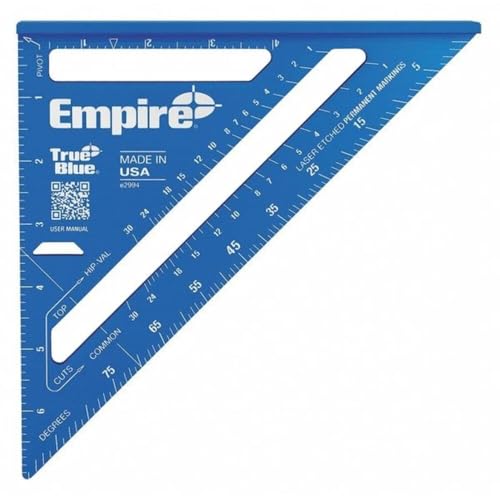
2. Empire e2994 7-Inch True Blue Rafter Square — laser-etched readability
Empire’s answer to the classic pattern keeps the 7-inch aluminum format and changes the markings: the e2994’s graduations are laser etched rather than stamped, which Empire states will not fade or change over time, and the etched scales sit on a matte anodized face that is easy to read in bright site light. The body is thick 6063 aluminum with a wider heel than the traditional pattern, which helps when the square is used to guide cuts across deck boards, and the back carries conversion tables for common applications plus a code that links to the rafter square manual. It is made in the USA. Choose it over the Swanson if your eyes, not your hands, are the limiting factor on layout work.
Specs
- Size: 7 inch
- Material: 6063 aluminum, anodized finish
- Graduations: Laser etched, 1/8 inch increments
- Features: Increased heel width, conversion tables on the body, manual link code
- Origin: Made in USA
- Model: e2994
- UPC: 015812029941
- ASIN: B0090DGNKE
3. Johnson 1904-0700 Johnny Square — machined aluminum, black finish
Johnson’s Johnny Square is the professional aluminum entry from the other big name in levels and squares. The 7-inch body is solid aluminum with CNC-machined edges, which is what keeps the two working faces at a true right angle after years of pouch wear, and its Easy-Read graduations are sized and spaced to be read at arm’s length on a stud wall. The black finish cuts glare compared with a bare silver square. It is sold without the rafter manual, so it suits buyers who already know the scales or prefer to keep a separate reference. Of the three 7-inch aluminum picks here, this is the one to pick for machined edges and low-glare readability.
Specs
- Size: 7 inch
- Material: Solid aluminum, CNC-machined edges
- Finish: Black
- Graduations: Easy-Read etched scales — degrees and rafter
- Included: Square only, manual not included
- Model: 1904-0700
- UPC: 049448190409
- ASIN: B00CTGNETW
4. Swanson Big 12 S0107 12-Inch Speed Square — the stair and timber size

The Big 12 is Swanson’s 12-inch version of the Speed Square pattern, and it earns its separate place here on size class, not on a second helping of the same tool: the longer body bridges wide stock, guides a saw through longer cuts, and adds the reach that stair stringer layout needs. It is die-cast from heavy-gauge aluminum alloy with a matte finish, and it ships with two things the 7-inch does not: the Layout Bar, which fits the square for finding out-of-square corners and setting stair treads and risers, and the Blue Book. As a package it works as a framing square, try square, miter square, protractor, saw guide and stair gauge. Buy it as a companion to a 7-inch square rather than a replacement, unless your work is mostly stairs, decks and wide boards.
Specs
- Size: 12 inch
- Material: Heavy-gauge aluminum alloy, die-cast
- Finish: Matte blue
- Graduations: Stamped scales — degrees, common and hip/valley rafter
- Included: Layout Bar with hardware, Swanson Blue Book
- Model: S0107
- ASIN: B000056C0D
5. Johnson RAS-70B-ORAN Structo-Cast Rafter Square — the polymer lightweight
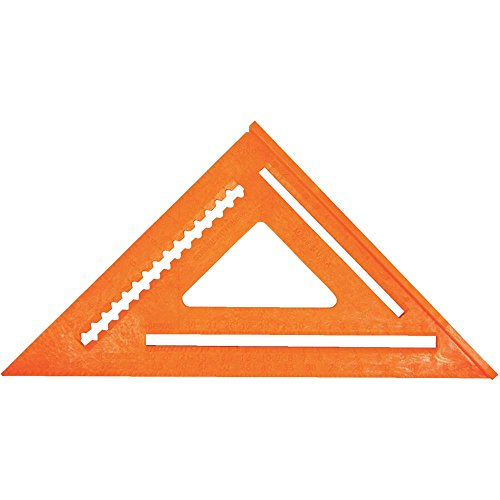
The second Johnson pick is a different material class entirely: the RAS-70B is molded from Structo-Cast, Johnson’s high-impact polymer, in a high-visibility orange. The 7-inch frame is far lighter than any aluminum square here, it will not spark, chill your hand or leave metal marks on finished work, and its graduations are permanent molded markings, so there is no print or etching to wear away. The thick edge still works as a saw guide for occasional cuts. The trade-offs are the honest ones for polymer: molded scales are coarser than etched ones, and the body will not take the same years of saw-guide abuse as cast aluminum. It is sold without a manual. As a first square, a site spare or a lightweight for finish work, it makes a sensible case.
Specs
- Size: 7 inch
- Material: Structo-Cast high-impact molded polymer
- Color: Orange (GloOrange)
- Graduations: Permanent molded markings
- Features: Thick saw-guide edge, lightweight frame
- Included: Square only, manual not included
- Model: RAS-70B-ORAN
- ASIN: B000BQO98M
Quick Comparison
| Pick | Size | Material | Graduation style | Standout feature |
|---|---|---|---|---|
| Swanson S0101 | 7 in | Aluminum alloy | Stamped | Blue Book included, diamond cutout |
| Empire e2994 | 7 in | 6063 aluminum | Laser etched | Widest heel, conversion tables |
| Johnson 1904-0700 | 7 in | Aluminum | Easy-Read etched | CNC-machined edges, black finish |
| Swanson Big 12 S0107 | 12 in | Aluminum alloy | Stamped | Layout Bar for stairs, Blue Book |
| Johnson RAS-70B-ORAN | 7 in | Molded polymer | Molded | Lightest pick, high-visibility orange |
FAQ
Is a 7-inch or 12-inch speed square better?
For most framing and general layout, the 7-inch is better: it fits a pouch, registers on 2x lumber and covers everyday cuts. The 12-inch earns its keep on wide stock, long saw-guided cuts and stair stringers. Many carpenters own both and reach for the big one only when the work needs the reach.
Can a speed square replace a combination square?
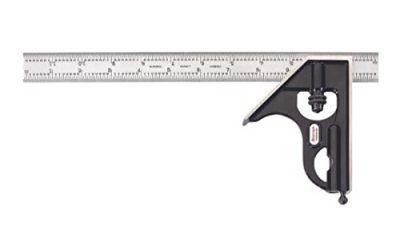
No. A speed square is a fixed triangle for 90- and 45-degree work, angle layout and saw guiding. A combination square has a sliding rule and an adjustable head for depth checks, scribing along an edge and machine setup. They overlap on basic right angles and complement each other everywhere else, which is why combination squares are covered separately.
Do laser-etched markings last as long as stamped ones?
Both are long-lived when done well. Stamped markings are recessed into the metal, so face wear does not remove them. Empire states its laser etching is permanent and will not fade; the practical difference most users notice is readability, since etched white-on-color scales read faster in bright light than plain stamped ones.
Is a polymer speed square accurate enough?
For framing layout, yes — a molded square from a major maker is molded to the same right-angle geometry, and its graduations are molded in rather than printed on. Where polymer gives ground is fine work and longevity: the scales are coarser than etched aluminum, and the saw-guide edge wears faster. Use it for layout and light guiding, and keep an aluminum square for heavy saw work.
What does the Blue Book that comes with the Swanson squares do?
It is a pocket reference of rafter and stair layout tables — common and hip/valley rafter lengths per unit of run across pitches — plus instructions for the square’s scales and, with the Big 12, the Layout Bar. It turns the numbers stamped on the square into finished cut lengths on site.
Conclusion
Start with a 7-inch aluminum square and the choice is about markings and edges: the Swanson S0101 for the original pattern and its Blue Book, the Empire e2994 for laser-etched readability and a wider heel, or the Johnson 1904-0700 for machined edges and a glare-cutting black finish. Add the Swanson Big 12 when stairs, decks or wide stock enter the picture, and keep the Johnson Structo-Cast as the light polymer spare that can live in a finish kit. Any of the five will lay out a true right angle; the right one is the one whose scales you can read at a glance on your own jobs.
Related guides
More from Amazon
Programs that pair well with the guide above. Offers and eligibility are set by Amazon and may change.
Free shipping on eligible items, Prime Video and more. Eligible new members can start with a free trial.
Start a Prime free trialAd-free music streaming. Eligible new subscribers can start with a free trial.
Try Music Unlimited freeA Prime membership for ages 18-24 with a trial period. Eligibility is set by Amazon.
See Prime for Young AdultsAudiobooks and podcasts to listen to on the go. Eligible new members can start with a free trial.
Try Audible freeAs an Amazon Associate we earn from qualifying purchases.