A handheld anemometer answers one question where you are standing: how fast is the air moving right now? Technicians use that number to check a vent, pilots use it to decide whether a drone should launch, sailors use it to read a gust before leaving the dock, and shooters use it to judge drift. The five picks below are all self-contained handheld meters you hold into the airflow. None of them is a fixed weather station, and none of them is a loose replacement sensor for a station. A weather station stays mounted, logs conditions over time, and often combines indoor and outdoor units. A handheld anemometer is the opposite: portable, instant, and aimed at a single spot check or a short series of checks in the field or around a workshop.
Disclosure: As an Amazon Associate, I earn from qualifying purchases. If you buy through links in this article, I may earn a commission at no extra cost to you.
The lineup deliberately covers five different designs rather than five versions of the same meter. There is a basic integrated vane meter for simple wind checks, a Bluetooth version that logs to a phone app, a multi-parameter vane meter that adds humidity, dew point, pressure, and altitude, an integrated meter that shows airflow volume on its own screen, and a detachable probe model on a cable for ducts with USB export. Accuracy figures below are quoted as listed accuracy from the maker, because makers measure and publish them in different ways.
Top 3 picks at a glance

How to Choose a Handheld Anemometer
Start with the job, not the display. For outdoor wind checks before flying, sailing, or shooting, wind speed plus temperature and wind chill is usually enough, and a compact integrated vane is easiest to carry. For HVAC work, the useful number is often airflow volume, not velocity alone. A meter that calculates CFM or CMM after you enter the duct or vent area saves a separate calculation, and a probe on a cable reaches into ducts and ceiling vents far better than a fixed vane held at arm’s length.
Next, decide how readings will be kept. A basic meter shows current, maximum, minimum, and average values on its screen and nothing more. A Bluetooth model sends readings to a phone app, which suits repeated checks at several sites. A USB model stores readings in the meter and exports them to PC software, which suits written HVAC reports. Neither approach is better in the abstract; match the record to how the work is documented.
Check the listed wind speed range and listed accuracy together. Most handheld vane meters here cover roughly 0.3 to 30 m/s, while the probe model extends higher. A listed accuracy such as plus or minus 5 percent or plus or minus 3 percent tells you how the maker positions the meter, but technique matters too: hold the vane squarely into the airflow, keep fingers clear of the blades, and let the reading settle. Very low airflow is the weak point of small vanes, which need moving air to turn.
Finally, look at power and handling. AAA-powered meters are light and easy to feed in the field. Models using a 9V battery tend to be larger HVAC tools. A tripod thread helps for hands-free checks, a backlight helps in plant rooms and at dusk, and auto power off protects a meter left in a tool bag.
1. BTMETER BT-100 — Basic Vane Meter for Everyday Wind Checks

The BT-100 is the straightforward pick: an integrated 8-vane sensor on top of the body, a backlit LCD, and wind speed in five units. It also reads wind temperature and shows wind chill, with current, maximum, minimum, and averaged readings. A metal threaded hole in the base allows tripod mounting for hands-free checks while flying a drone or working at a range. It does not calculate CFM on screen, so HVAC users work out airflow from velocity and duct area themselves. For simple, repeatable spot checks outdoors and at vents, that trade keeps the controls short and the meter pocketable.
Specs
- Brand: BTMETER
- Model: BT-100
- Sensor type: Integrated 8-vane
- Wind speed range: 0.3 to 30 m/s
- Listed accuracy: plus or minus 5% of readings
- Units: m/s, km/h, ft/min, knots, mph
- Extra readings: Wind temperature, wind chill
- Power: 2 AAA batteries, included
2. BTMETER BT-100APP — Bluetooth Vane Meter With App Logging
The BT-100APP keeps the integrated vane layout but adds Bluetooth, so readings move to a phone app for logging and review instead of staying on a small LCD. That suits users who check several launch sites, vents, or outdoor spots in one session and want a saved record rather than a notebook. On the meter itself it covers wind speed, air velocity, temperature, and wind chill in the same five-unit style as the basic model. The body is a distinct design from the BT-100, with different dimensions and a 9V battery arrangement, so treat it as the connected option in this lineup rather than a color or pack variant.
Specs
- Brand: BTMETER
- Model: BT-100APP
- Sensor type: Integrated vane with Bluetooth
- Wind speed range: 0.3 to 30 m/s
- Listed accuracy: plus or minus 5% of readings
- Units: m/s, km/h, ft/min, knots, mph
- Extra readings: Temperature, wind chill, app logging
- Power: 1 9V battery, required
3. BTMETER BT-100WM — Multi-Parameter Vane Meter for Wind Plus Weather Data
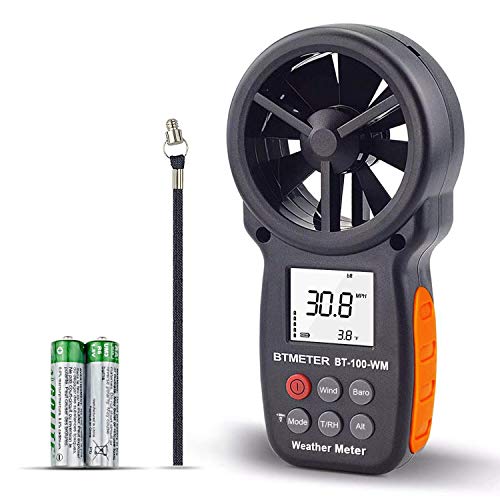
The BT-100WM is for readers who want more than wind speed from one handheld unit. Alongside wind speed, temperature, and wind chill, it measures relative humidity, dew point, barometric pressure, and altitude, and it can store groups of pressure readings. That makes it useful on a boat, on a climb, or at a site where pressure trend matters alongside a gust reading. It remains a handheld anemometer rather than a station: there is no fixed outdoor transmitter and no indoor console. Its listed wind accuracy is looser than the probe model below, so its value is the breadth of parameters in one pocket tool, not airflow reporting.
Specs
- Brand: BTMETER
- Model: BT-100WM
- Sensor type: Integrated 8-leaf vane
- Wind speed range: 0.67 to 67.1 mph
- Listed accuracy: plus or minus 5%
- Units: mph, ft/min, km/h, m/s, knots
- Extra readings: Humidity, dew point, pressure, altitude
- Power: 2 AAA batteries
4. Proster Handheld Digital Anemometer — CFM Shown on the Screen
The Proster takes the integrated vane format and adds the feature HVAC readers ask for most: air volume on the screen. After entering the area of the opening, it displays airflow in CFM, CMM, or CMS alongside wind speed in five units and temperature. Data hold, maximum, minimum, and average modes are included, along with a backlit display and a tripod connector for fixed checks. Its listing does not state a listed accuracy figure, so buyers who need a documented accuracy for formal work should weigh the AOPUTTRIVER below. For routine vent checks where a quick CFM number matters more than a report file, this is the simpler tool.
Specs
- Brand: Proster
- Model: WIND
- Sensor type: Integrated vane
- Wind speed range: 0.40 to 30 m/s
- Listed accuracy: Not stated in the listing
- Units: m/s, ft/min, km/h, mph, knots
- Air volume: CFM, CMM, CMS with area entered
- Power: 1 9V battery, included
5. AOPUTTRIVER AP-856A — Detachable Probe Meter for Ducts and Reports
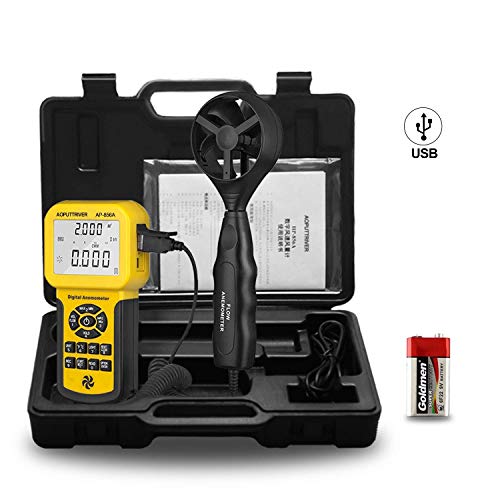
The AP-856A is built differently from everything above: the vane sits on a detachable probe joined to the meter by a coiled cable. That lets a technician place the vane inside a duct or at a ceiling vent while reading the display at a comfortable angle. It calculates CFM and CMM after the duct area is entered, stores up to 600 readings, and exports them over USB to Windows PC software. Its listed accuracy is the tightest in this group, and its wind range extends to 45 m/s. The trade is size and setup: it is a workshop and site tool in a hard case, not a pocket meter for a quick gust check.
Specs
- Brand: AOPUTTRIVER
- Model: AP-856A
- Sensor type: Detachable vane probe on cable
- Wind speed range: 0.001 to 45 m/s
- Listed accuracy: plus or minus 3% plus 0.1 in m/s mode
- Units: m/s, km/h, ft/min, knots, mph
- Air volume: CFM, CMM with area entered, 600 stored readings
- Power: 1 9V battery, included
Comparison Table
| Model | Design | CFM on screen | Logging | Listed accuracy | Best for |
|---|---|---|---|---|---|
| BTMETER BT-100 | Integrated vane | No | On-screen max, min, average | Plus or minus 5% | Everyday wind checks |
| BTMETER BT-100APP | Integrated vane, Bluetooth | No | Phone app | Plus or minus 5% | Saved field readings |
| BTMETER BT-100WM | Integrated vane, multi-parameter | No | 16 pressure groups | Plus or minus 5% | Wind plus weather data |
| Proster WIND | Integrated vane | Yes | On-screen hold, max, min | Not stated | Quick vent CFM checks |
| AOPUTTRIVER AP-856A | Probe on cable | Yes | 600 readings, USB export | Plus or minus 3% plus 0.1 | Duct work and reports |
FAQ
What is the difference between a handheld anemometer and a weather station?
A handheld anemometer is a portable meter you hold into the airflow for an immediate reading at one spot. A weather station is a fixed setup, usually with a mounted outdoor sensor and an indoor display, that tracks conditions continuously at one location. Choose the handheld meter for vents, launch sites, boats, and ranges; choose a station for ongoing conditions at a home or workshop.
Do handheld anemometers measure CFM?
Some do. The Proster and the AOPUTTRIVER AP-856A in this guide calculate CFM after you enter the area of the duct or vent opening. Basic vane meters such as the BT-100 show air velocity only, so airflow is worked out separately from velocity and area.
Which anemometer suits drone flying and sailing?
A compact integrated vane meter suits both, because the task is a fast wind and gust check before committing. The BT-100 covers that with maximum and average readings, while the BT-100WM adds pressure and humidity for longer days on the water. The probe model is better saved for duct work.
How should a vane anemometer be held for a steady reading?
Face the vane directly into the airflow, keep hands and clothing clear of the blades, and hold the meter steady until the value settles. Use the average mode for gusty conditions instead of chasing a single instant value, and repeat the check at the height where the work actually happens.
Conclusion
Match the design to the record you need. The BTMETER BT-100 is the simple everyday wind meter, the BT-100APP adds phone logging, and the BT-100WM adds a full set of weather parameters in one handheld body. For HVAC work, the Proster puts CFM on its own screen with the least fuss, while the AOPUTTRIVER AP-856A, with its cable probe, stored readings, and USB export, is the pick for ducts and documented airflow jobs. Any of the five keeps the measurement handheld and immediate, which is exactly where an anemometer earns its place over a fixed station.
Related guides
More from Amazon
Programs that pair well with the guide above. Offers and eligibility are set by Amazon and may change.
Free shipping on eligible items, Prime Video and more. Eligible new members can start with a free trial.
Start a Prime free trialAd-free music streaming. Eligible new subscribers can start with a free trial.
Try Music Unlimited freeA Prime membership for ages 18-24 with a trial period. Eligibility is set by Amazon.
See Prime for Young AdultsAudiobooks and podcasts to listen to on the go. Eligible new members can start with a free trial.
Try Audible freeAs an Amazon Associate we earn from qualifying purchases.