A bar clamp squeezes work along a rail: one fixed jaw, one sliding jaw, and a screw or trigger that draws them together. That straight-line pressure is what closes panel glue-ups, pulls cabinet carcasses square, and holds a fence to a bench while a cut is made. The five clamps below cover the three designs that do this job best — parallel-jaw clamps, F-style screw clamps, and one-handed trigger clamps — in sizes from 6 inches to 50 inches.
Disclosure: As an Amazon Associate, I earn from qualifying purchases. If you buy through links in this article, I may earn a commission at no extra cost to you.
Before buying, it helps to know where bar clamps end and their cousins begin. A toggle clamp bolts to a jig and locks with a lever for repeatable hold-downs; it stays on the fixture. A band clamp wraps a strap around a frame and pulls every corner at once, which suits picture frames but not flat panels. A corner clamp holds two boards at a fixed angle for assembly. A bar clamp is the moving clamp of the group: it travels from piece to piece, closes along a straight rail, and comes off when the glue sets.
Top 3 picks at a glance


How to choose a bar clamp
Start with the design. Parallel-jaw clamps keep both jaw faces square to the rail as pressure rises, so a panel closes flat instead of racking out of square. They are the right choice for cabinet boxes, doors, and edge-glued panels. F-style screw clamps have smaller jaws and a clutch that slides along a serrated rail; they are the general-purpose clamp for jigs, fences, stop blocks, and bench work. One-handed trigger clamps close with a squeeze of the handle while the other hand holds the parts, which makes them the fastest option for dry fits, templates, and light glue-ups.
Match jaw capacity to the work. Measure the widest assembly the clamp must span, then add a few inches so the sliding jaw sits on the rail rather than at its very end. Four clamps at 24 inches cover drawers, small cabinets, and panels up to about 20 inches wide. Longer panels and tabletops need 40 or 50 inch clamps.
Read the listed clamping force as a ceiling, not a target. Glue joints need even pressure along the whole joint, not maximum pressure at one point. A parallel-jaw clamp listed at 1,500 to 1,700 lb of nominal force closes a cabinet without working near its limit, while an F-style clamp listed at 600 lb handles most bench and jig work. Trigger clamps list far less force, which is fine for positioning and light glue-ups but not for closing a gappy joint.
Check throat depth and jaw pads. Throat depth is how far the jaw reaches in from the edge of the board; a deeper throat grips the middle of a panel instead of only its edge. Wide, flat pads spread pressure and protect the wood, while small bare jaws can dent soft stock. On panels, alternate clamps above and below the joint so the assembly does not cup.
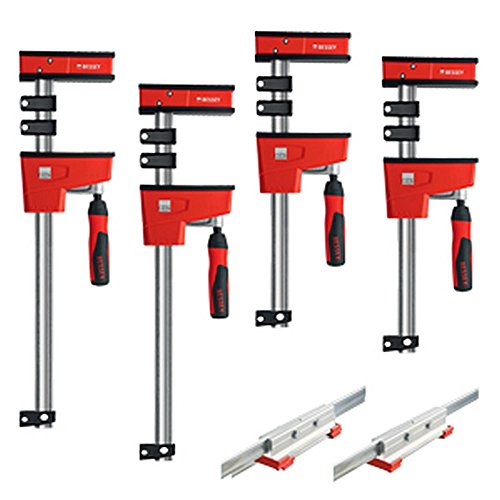
1. BESSEY KREX2450 K Body REVO Parallel Clamp Kit — Best parallel-jaw kit
The K Body REVO is the parallel clamp most furniture makers standardize on, and this kit is the fastest way to own a useful set of them. It includes two 24 inch and two 50 inch clamps plus two KBX20 jaw extenders, so one purchase covers drawer boxes, cabinet carcasses, and wide panels. The large jaw faces stay parallel to each other and square to the bar under a listed 1,700 lb of nominal clamping force, which is why panels glued in these clamps come out flat instead of racking. The clamps also convert to a spreader without tools, and supports on the rail keep the stock from touching the bar.
Buy this kit when cabinet and panel glue-ups are a regular part of the work. Four clamps in two lengths mean a panel can be clamped from both sides at once, alternating above and below the joint. The trade-off is size and weight: the 50 inch clamps need a wall rack or a long shelf, and the kit is the most expensive way into bar clamps on this list.
- Type: Parallel-jaw bar clamp kit
- Sizes: 24 in. (2), 50 in. (2)
- Listed clamping force: 1,700 lb nominal
- Extenders: 2 KBX20 jaw extenders included
- Throat depth: 3-3/4 in. listed for the clamps in the kit
- Spreader: head converts to a spreader without tools
2. Jorgensen Cabinet Master 24-Inch Parallel Bar Clamps, 2-Pack — Best parallel-jaw value
The Cabinet Master is the lower-cost route into parallel clamps. Two 24 inch clamps with a listed clamping force of up to 1,500 lb handle boxes, shelves, and small cabinets, and the reversible head converts each clamp into a spreader. A clamp stand helps position the clamp on the bench, so a panel can be set up and squared before the glue starts to set.
Buy this pair when the work is mostly small cabinets and boxes and the budget does not stretch to a full kit. Two clamps are enough for one joint at a time, and more pairs can be added later as projects grow. The limit is capacity: at 24 inches, these clamps do not cover tabletops or full-height cases.
- Type: Parallel-jaw bar clamp, 2-pack
- Sizes: 24 in. (2)
- Listed clamping force: up to 1,500 lb
- Spreader: reversible head converts to a spreader
- Stand: clamp stand included for bench positioning
3. BESSEY GSCC2.524 Clutch Style Bar Clamp, 24 In. — Best F-style workhorse
An F-style clamp with cast-iron jaws and a serrated rail is the most useful clamp in a shop because it does everything adequately: it holds a fence to the drill press, a stop block to the miter saw, a board to the bench, and two boards to each other. The GSCC2.524 is the classic version of that design, with a clutch that bites the rail, non-marring pads that keep the jaws from marking the wood, and a listed clamping force of 600 lb. The screw handle gives fine control over pressure, so a joint can be closed slowly and checked for square as it tightens.
Buy this clamp in quantity. Four to six at 12 inches and two to four at 24 inches cover most bench and jig work. The jaws are small and not parallel, so heavy pressure can dent soft wood and rack a joint; use cauls on panels and keep the big glue-ups for the parallel-jaw picks above.
- Type: Clutch-style F-clamp
- Size: 24 in.
- Listed clamping force: 600 lb
- Jaws: cast iron with non-marring pads
- Rail: serrated steel rail with sliding clutch head
4. Jorgensen 4-Pack Steel Bar Clamps, 6 In. and 12 In. — Best F-clamp starter set

This set gives a new shop the two short sizes that end up doing the most work: two 6 inch clamps and two 12 inch clamps in one purchase. The listing states a 600 lb clamping force, a multi-disc clutch, and soft protective pads, with a fast sliding head that moves along the rail and locks when the screw is turned. A rust-resistant finish suits a shop where clamps live on a rack near the bench.
Buy this set to start a clamp collection, then add 24 inch Bessey F-clamps as needed. The set covers small boxes, drawer parts, jigs, and holding work for sanding and routing, which is where most clamping hours go. It is medium-duty by the listing’s own description, so for the hardest glue-ups the cast-iron Bessey above is the better choice.
- Type: F-style steel bar clamp set, 4-pack
- Sizes: 6 in. (2), 12 in. (2)
- Listed clamping force: 600 lb
- Clutch: multi-disc clutch with fast sliding head
- Pads: soft protective pads
5. IRWIN Quick-Grip 1964748 One-Handed Mini Bar Clamp, 4-Pack — Best one-handed clamp

Speed is the reason to own Quick-Grips. A trigger clamp goes on with one hand while the other holds the parts in place, which makes it the right tool for dry fits, for holding a template to a board before routing, and for light glue-ups such as edge banding. This 4-pack includes two 6 inch and two 12 inch clamps, model 1964748. The head reverses to turn the clamp into a spreader, and a quick-release button opens the jaws fast when the fit needs adjusting.
Buy this pack for positioning work rather than for closing joints. Trigger clamps list far less force than screw clamps, so they hold parts in place and apply light pressure; they are not the clamp to close a gappy joint. That is what the screw clamps above are for.
- Type: One-handed trigger bar clamp, 4-pack
- Sizes: 6 in. (2), 12 in. (2)
- Model: 1964748
- Mechanism: trigger close with quick-release button
- Spreader: head reverses to spread, listed for the Quick-Grip line
Bar clamps compared
| Clamp | Design | Sizes | Listed clamping force | Best for |
|---|---|---|---|---|
| BESSEY KREX2450 kit | Parallel-jaw kit | 24 in. (2), 50 in. (2) | 1,700 lb nominal | Cabinets, wide panels |
| Jorgensen Cabinet Master 2-pack | Parallel-jaw | 24 in. (2) | Up to 1,500 lb | Small cabinets, boxes |
| BESSEY GSCC2.524 | Clutch F-style | 24 in. | 600 lb | Jigs, bench work, glue-ups |
| Jorgensen 4-pack | F-style set | 6 in. (2), 12 in. (2) | 600 lb | Starting a clamp collection |
| IRWIN Quick-Grip 1964748 4-pack | One-handed trigger | 6 in. (2), 12 in. (2) | Light-duty trigger pressure | Dry fits, templates, holding work |
FAQ
How many bar clamps do I need to start?
Four parallel clamps at 24 inches cover cabinets, drawers, and case work. Add four to six F-style clamps at 12 inches and two to four at 24 inches for jigs and bench work, plus a 4-pack of one-handed trigger clamps for dry fits and holding work. Buy more clamps as projects demand them, not all at once.
Can a bar clamp replace a band clamp on a picture frame?
No. A band clamp pulls from every side at once, which closes four miters together. A bar clamp squeezes along one straight line, so it can close one joint of a frame but not all four at once. Use a band clamp for frames and a bar clamp for flat panels and cabinets.
Why do my panel glue-ups come out out of square?
The usual cause is jaws that flex and rack under pressure, which is what parallel-jaw clamps are built to prevent. Check that the jaws stay square to the rail as pressure rises, alternate clamps above and below the panel, and measure both diagonals of the assembly before the glue sets.
What is the difference between a parallel-jaw clamp and an F-style clamp?
A parallel-jaw clamp keeps both jaw faces square to the rail and spreads pressure across a wide face, which suits panels and cabinets. An F-style clamp has smaller jaws on a serrated rail with a clutch, which suits jigs, fences, and general bench work. The F-style clamp is cheaper and more versatile; the parallel-jaw clamp is more accurate on wide glue-ups.
Conclusion
The best bar clamp depends on the joint, not on the brand. Parallel-jaw clamps are the pick for panels and cabinets, because their jaws stay square and their pressure spreads across the joint. F-style screw clamps are the pick for jigs, fences, and bench work, because they are cheap enough to own by the half dozen and strong enough for most glue-ups. One-handed trigger clamps are the pick for dry fits and holding work, because they go on with one hand while the other holds the parts.
Related guides
More from Amazon
Programs that pair well with the guide above. Offers and eligibility are set by Amazon and may change.
Free shipping on eligible items, Prime Video and more. Eligible new members can start with a free trial.
Start a Prime free trialAd-free music streaming. Eligible new subscribers can start with a free trial.
Try Music Unlimited freeA Prime membership for ages 18-24 with a trial period. Eligibility is set by Amazon.
See Prime for Young AdultsAudiobooks and podcasts to listen to on the go. Eligible new members can start with a free trial.
Try Audible freeAs an Amazon Associate we earn from qualifying purchases.