Disclosure: As an Amazon Associate, I earn from qualifying purchases. If you buy through links in this article, I may earn a commission at no extra cost to you.
Our top pick: Victorinox Fibrox Pro 12-Inch Granton Slicing Knife. Runner-up: Dexter-Russell Sani-Safe 12-Inch Scalloped Slicer.
A roast deserves a clean cut. A short, wide blade drags through the crust, tears the outer slices and leaves the middle ragged, while a long, thin carving knife glides through a whole bird or a rib roast in one smooth stroke. This guide covers single carving knives only: long, narrow blades built to slice cooked meat at the table or on the board. That scope matters. A chef knife is a general-purpose tool with a wider blade meant for chopping and mincing, and a draw knife is a two-handed woodworking tool for shaping timber, not food. Knife sets, which bundle many blades together, are a different purchase altogether. The five knives below are individual carving and slicing knives, each with a distinct design.
Top 3 picks at a glance


How to Choose a Carving Knife
Blade length. Match the blade to the widest roast you slice. A listed blade length of 8 inches handles chickens and small roasts, a listed blade length of 10 inches suits most turkeys and rib roasts, and a listed blade length of 12 inches covers large birds, briskets and whole hams in a single stroke.
Edge style. A plain straight edge gives the cleanest cut on a rested roast with a firm crust. A Granton edge, with shallow hollows ground along the blade, keeps thin slices from clinging to the steel. A scalloped edge has a series of points that bite through hard skin and crust before the curved sections slice the softer meat inside. Choose the plain or Granton edge for everyday roasting and the scalloped edge when you often carve birds with crisp skin or crusted brisket.
Blade construction. Forged blades are shaped from a single piece of steel with a bolster where the blade meets the handle, which adds weight and balance. Stamped blades are cut from a sheet of steel, so they run lighter and more flexible. A forged knife feels solid and steady, while a stamped slicer is easier to guide through a long cut.
Handle. You will often carve with damp hands, so grip matters more than looks. A textured synthetic handle stays secure when wet, and a contoured handle reduces fatigue during a long carving session. A smooth hardwood handle looks classic but needs more care and can get slick.
1. Victorinox Fibrox Pro 12-Inch Granton Slicing Knife
The Victorinox Fibrox Pro is the long, light slicer that carving stations reach for first. Its listed blade length of 12 inches crosses a whole turkey breast or a brisket in one pass, and the Granton hollows along the blade stop thin slices from sticking. The stamped blade is thin and slightly flexible, so it follows the shape of the roast instead of fighting it. The Fibrox handle is textured and slip-resistant, staying secure with wet hands through a holiday carving session. This is the pick for large roasts, whole birds and anyone who carves for a crowd.
Specs
- Listed blade length: 12 inches
- Edge: Granton
- Construction: stamped high-carbon stainless steel
- Handle: textured Fibrox, slip-resistant
- Model: 5.4723.30
2. Dexter-Russell Sani-Safe 12-Inch Scalloped Slicer
The Dexter-Russell Sani-Safe S140-12SC-PCP is the workhorse of the group, built for commercial kitchens and equally at home on a holiday table. Its listed blade length of 12 inches pairs with a scalloped edge: the points pierce crisp skin and hard crust, then the curved scallops slice the tender meat underneath without tearing it. The blade is stain-free, high-carbon steel, individually ground and honed. The white polypropylene handle is textured for grip, sealed to the blade for hygiene and certified by NSF for professional kitchen use. At a listed weight of 6.74 ounces it is light for its length, and it is made in the United States. Choose this one for crusted brisket, crackling-topped pork or birds with crisp skin.
Specs
- Listed blade length: 12 inches
- Edge: scalloped
- Construction: stain-free high-carbon steel, individually ground
- Handle: textured white polypropylene, NSF certified
- Model: S140-12SC-PCP, item 13463
- Listed weight: 6.74 ounces
3. Wusthof Classic 8-Inch Hollow Edge Carving Knife
The Wusthof Classic is the forged option for cooks who want a shorter, heavier carving knife with real heft. Its listed blade length of 8 inches makes it the most maneuverable knife in this guide, easy to steer around bones and ideal for smaller roasts, chickens and hams. The hollow edge, Wusthof’s version of a Granton edge, keeps slices from clinging to the blade. The blade is forged from a single piece of high-carbon stainless steel in Solingen, Germany, with a listed hardness of 58 HRC and a full bolster for balance. The handle is 4.4 inches long with a classic three-rivet design.
Specs
- Listed blade length: 8 inches
- Edge: hollow edge
- Construction: forged high-carbon stainless steel, full bolster
- Listed hardness: 58 HRC
- Handle: black synthetic, three rivets, 4.4 inches long
- Model: 1040100820
4. Mercer Culinary Genesis 10-Inch Forged Carving Knife
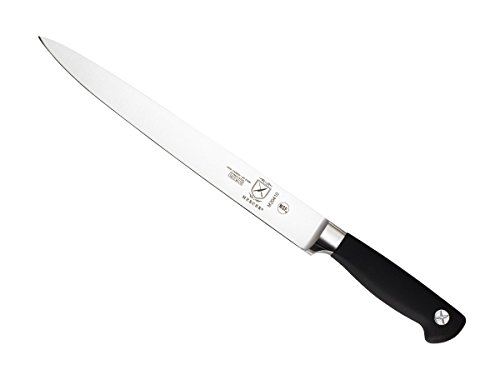
The Mercer Culinary Genesis M20410 sits in the middle of this guide on length and on build: a listed blade length of 10 inches, forged from high-carbon German steel with a full tang. That middle length is the sweet spot for most home cooks, long enough for a turkey and short enough to control on a chicken. The taper-ground edge is designed for stability and easy honing, and the Santoprene handle gives a soft, non-slip grip that stays comfortable through a long carve. It is a straightforward, professional-style knife without decoration. If you carve one or two roasts a week and want a single knife that covers almost everything, this is the balanced choice.
Specs
- Listed blade length: 10 inches
- Edge: straight, taper-ground
- Construction: forged high-carbon German steel, full tang
- Handle: Santoprene, non-slip
- Model: M20410
5. Dalstrong Gladiator Series 10-Inch Slicing and Carving Knife

The Dalstrong Gladiator Series 10-inch slicer pairs a forged high-carbon German steel blade with a black G10 handle and a Granton-style RockHollow edge. Its listed blade length of 10 inches covers turkeys and rib roasts, and the hollowed sections along the blade reduce drag so slices release cleanly. The G10 handle resists moisture and stays grippy, and the knife is NSF certified. A fitted sheath is included, which is handy if the knife travels to a holiday dinner or lives in a crowded drawer.
Specs
- Listed blade length: 10 inches
- Edge: Granton-style RockHollow
- Construction: forged high-carbon German steel, full tang
- Handle: black G10
- Certification: NSF certified
- Sheath: included
Comparison Table
| Knife | Listed Blade Length | Edge | Construction | Handle |
|---|---|---|---|---|
| Victorinox Fibrox Pro | 12 inches | Granton | Stamped | Textured Fibrox |
| Dexter-Russell Sani-Safe S140-12SC-PCP | 12 inches | Scalloped | Stamped, high-carbon steel | Textured polypropylene |
| Wusthof Classic | 8 inches | Hollow edge | Forged | Black synthetic, three rivets |
| Mercer Culinary Genesis M20410 | 10 inches | Straight, taper-ground | Forged, full tang | Santoprene |
| Dalstrong Gladiator Series | 10 inches | Granton-style RockHollow | Forged, full tang | Black G10 |
Frequently Asked Questions
What length carving knife should I buy first?
A listed blade length of 10 inches is the best starting point for most kitchens. It handles a turkey, a rib roast and a ham, and it is easier to control than a 12-inch blade. Move up to 12 inches if you regularly carve large birds or whole briskets, or down to 8 inches if you mostly carve chickens and small roasts.
Is a Granton edge better than a straight edge for carving?
A Granton edge helps thin slices release from the blade, which is useful for turkey breast and ham. A straight edge cuts just as cleanly on a rested roast and is simpler to sharpen.
Can a carving knife replace a chef knife?
No. A carving knife is a specialist: long, thin and built for slicing cooked meat in long strokes. A chef knife is wider and heavier, built for chopping, mincing and general prep. Keep both, and use the carving knife only for the roast.
How do I care for a carving knife?
Wash it by hand and dry it right away, even if the handle is synthetic. Store it in a sheath, a blade guard or a knife block slot so the long edge does not bang against other tools. Hone the edge with a steel before carving and sharpen it on a whetstone when honing stops bringing the edge back.
Conclusion
The best carving knife matches the roasts you actually cook. For large birds and briskets, the long Victorinox Fibrox Pro Granton slicer or the scalloped Dexter-Russell Sani-Safe cover the most ground in a single stroke. For a balanced, forged all-rounder, the Mercer Culinary Genesis 10-inch and the Dalstrong Gladiator 10-inch both handle a turkey with control to spare. For smaller roasts, the forged Wusthof Classic 8-inch is the most maneuverable pick. Start with a listed blade length of 10 inches if you are unsure, and choose a Granton or scalloped edge for skin-on birds.
Related guides
More from Amazon
Programs that pair well with the guide above. Offers and eligibility are set by Amazon and may change.
Free shipping on eligible items, Prime Video and more. Eligible new members can start with a free trial.
Start a Prime free trialAd-free music streaming. Eligible new subscribers can start with a free trial.
Try Music Unlimited freeA Prime membership for ages 18-24 with a trial period. Eligibility is set by Amazon.
See Prime for Young AdultsAudiobooks and podcasts to listen to on the go. Eligible new members can start with a free trial.
Try Audible freeAs an Amazon Associate we earn from qualifying purchases.