Disclosure: As an Amazon Associate, I earn from qualifying purchases. If you buy through links in this article, I may earn a commission at no extra cost to you.
Our top pick: Oregon Professional Compact Bench Grinder (410-120). Runner-up: Oregon 12V Sure Sharp Electric Sharpener (30846).
A dull saw chain makes a saw work harder, cut slower, and wander in the cut, and it wears the bar and sprocket faster than a sharp chain does. Sharpening is routine maintenance, not a repair: a few strokes with the right file, or a few seconds on a grinder, restores the cutter edges before the chain starts throwing dust instead of chips. The tool you want depends on where you sharpen — at a workbench with several chains in rotation, or in the field with the chain still on the bar.
The five picks below cover the main sharpening methods: a bench grinder, a 12-volt electric sharpener for field use, a 2-in-1 hand file guide, a complete manual file kit, and a precision bar-mounted filing jig. Three of the five come from Oregon, which reflects how concentrated this category is; they are three different tool types, not variations of one product. Every pitch, gauge, and file-size figure is given as listed by the maker, and compatibility should always be checked against the numbers stamped on your own chain before ordering.
Top 3 picks at a glance


How to Choose a Chainsaw Sharpener
Match the file or wheel to your chain pitch. Pitch is the distance between drive links, and it decides the file diameter or grinding wheel thickness you need. Common pairings as listed by most makers: a 5/32-inch file for 3/8-inch low-profile chain, a 3/16-inch file for .325-inch pitch, and a 7/32-inch file for 3/8-inch and .404-inch pitch. Using the wrong diameter changes the cutter profile, so confirm the pitch and gauge printed on your chain’s packaging or drive links first.
Bench grinder, electric hand tool, or hand file. A bench grinder is the fastest route when you sharpen several chains at a bench, and it repeats the same angle on every cutter. A 12-volt sharpener trades some precision for portability — it runs off a vehicle battery and sharpens the chain on the bar. Hand files and guides are the slowest option but remove the least metal per session, which can extend chain life, and they work anywhere with no power at all.
Guides matter more than power. Consistent cutter angle and length matter more than raw speed. Fixed-angle guides, 2-in-1 tools that file the cutter and the depth gauge in the same pass, and bar-mounted jigs with calibrated settings all exist to remove guesswork. Freehand filing with a bare round file is the cheapest route, but it is also the easiest to get uneven.
Do not forget the depth gauges. Cutters are only half the job. As cutters are filed back and shortened, the depth gauges (rakers) ahead of them also need occasional lowering with a flat file and a gauge tool, or the chain will skim instead of bite. Two picks below handle depth gauges as part of the tool; the rest need a flat file, which the Oregon kit includes.
1. Oregon Professional Compact Bench Grinder (410-120)
The 410-120 is the workshop anchor of this roundup. It mounts to a bench or a wall, clamps the chain in a self-centering vise, and grinds each cutter with a wheel instead of a file, so every tooth gets the same angle and length with far less effort than hand filing a full chain. Oregon lists it as a universal sharpener for chains up to .404-inch pitch, covering 1/4-inch, 3/8-inch low profile, .325-inch, and 3/8-inch chains from Oregon and other makers as listed. The box includes two grinding wheels (3.2 mm and 4.7 mm) for the different pitch ranges, a 6.0 mm flat profile disc for depth gauge maintenance, a dressing brick, and a quick-check grinding template. At 17 pounds as listed, it is a fixed-station tool rather than a field tool, and it needs a 120-volt outlet — but for anyone rotating through several chains, it is the most repeatable option here.
Specs
- Type: bench or wall mount chain grinder
- Power: 120V corded electric
- Chain pitch: 1/4″, 3/8″ low profile, .325″, 3/8″, up to .404″ as listed
- Included wheels: 3.2 mm and 4.7 mm grinding wheels, 6.0 mm flat profile disc
- Included extras: dressing brick, quick-check grinding template
- Weight: 17 lb as listed
- Model: 410-120
2. Oregon 12V Sure Sharp Electric Sharpener (30846)
The Sure Sharp takes the opposite approach: instead of bringing the chain to the tool, it brings a small grinding stone to the chain, right on the bar. It runs on 12-volt power through a vehicle adapter plug or alligator clips straight onto a battery, which makes it a genuine field tool for trucks, tractors, and tailgates. Three sharpening stones are included — 5/32-inch, 3/16-inch, and 7/32-inch — so the one tool covers round-ground chains in 1/4-inch, 3/8-inch low profile, .325-inch, 3/8-inch, and .404-inch pitches as listed. An adjustable guide sits over the cutter to hold the stone at a repeatable angle. It will not match a bench grinder for resetting a badly rocked chain, and depth gauges still need separate attention, but for quick touch-ups between cuts it is the most convenient pick in this group.
Specs
- Type: handheld electric sharpener, chain stays on the bar
- Power: 12V, vehicle adapter plug and battery alligator clips
- Sharpening stones included: 5/32″, 3/16″, 7/32″
- Chain pitch: 1/4″, 3/8″ low profile, .325″, 3/8″, .404″ as listed
- Guide: adjustable sharpening angle guide
- Model: 30846
3. PFERD Chain Sharp CS-X 2-in-1 File Guide (17300)
The CS-X is the hand-filing pick for people who want a guide to do the thinking. The tool holds two round files at a fixed 30-degree sharpening angle as listed and positions a flat depth gauge file at the same time, so each pass touches up the cutter and checks the depth gauge together — the same 2-in-1 layout popularized by the well-known orange version of this tool. This listing is the 17300 model with 5/32-inch files for 3/8-inch low-profile chain as listed, with a depth gauge distance of 0.025 inches as listed; PFERD sells sibling sizes for other pitches, so match the model number to your chain before ordering rather than assuming one tool fits all. The files are replaceable when they wear, and the whole tool is light enough to live in a saw case. It is slower than any powered option, but it removes very little metal per pass, which is gentle on chains you sharpen often.
Specs
- Type: manual 2-in-1 file guide (cutter file plus depth gauge file)
- File diameter: 5/32″
- Chain pitch: 3/8″ low profile as listed
- Sharpening angle: 30 degrees as listed
- Depth gauge distance: 0.025″ as listed
- Included: sharpener body, 2 round files, 1 depth gauge file
- Model: 17300
4. Oregon Universal Chainsaw Field Sharpening Kit (617067)
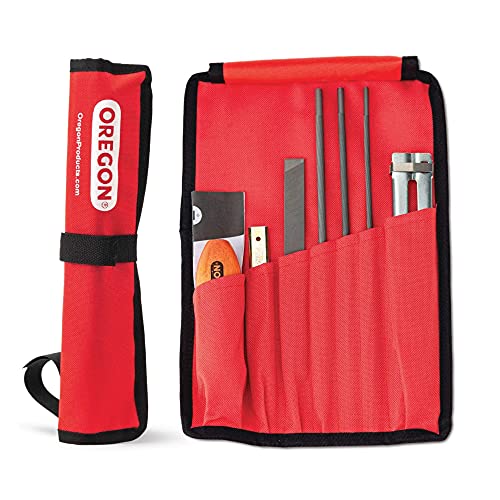
If you would rather own the individual tools than a guided system, this 7-piece kit is the straightforward option. It bundles the three round file sizes that cover most homeowner and mid-range chains — 5/32-inch, 3/16-inch, and 7/32-inch — with a 6-inch flat file for depth gauges, a file guide, a universal handle, and a travel pouch that keeps it together in a toolbox or saw bag. Because the files are standard separate pieces, you choose the file that matches your chain’s pitch as listed on the packaging, work freehand or with the included guide, and replace individual files as they dull instead of replacing a whole tool. It asks more of your technique than the CS-X or the Granberg jig — even results depend on keeping your stroke angle consistent — but it is the most flexible and portable kit here, and it covers the depth gauge side of the job with the flat file.
Specs
- Type: manual file kit, 7 pieces
- Round files included: 5/32″, 3/16″, 7/32″
- Flat file: 6″ for depth gauges
- Also included: file guide, universal file handle, travel pouch
- Chain pitch: covers pitches matched to the three file sizes as listed
- Model: 617067
5. Granberg File-N-Joint Bar-Mount Filing Guide (G-106B)

The File-N-Joint is the precision pick for hand filing. It clamps directly onto the saw’s bar and turns a plain round file into a jig-guided tool: calibrated swivel markings set and hold the filing angle, and separate adjustments control file height and cutter length, so every tooth can be filed to the same dimensions — the thing freehand filing struggles with most. The body is cast aluminum with zinc-plated steel hardware, and it accepts any standard round file size, so one jig serves every pitch you own as long as you have the matching file. It also handles depth gauge jointing. The catch is in the name of the listing itself: files are not included, so budget for the correct file diameter for your chain. Setup takes longer than grabbing a 2-in-1 guide, which makes it a better fit for deliberate workshop sharpening sessions than quick field touch-ups.
Specs
- Type: bar-mounted filing jig, manual
- Construction: cast aluminum, zinc-plated steel
- File compatibility: accepts standard round file sizes; files not included
- Adjustments: calibrated swivel angle markings, file height, cutter length, depth gauge jointing
- Weight: 1.2 lb as listed
- Model: G-106B
Quick Comparison
| Pick | Type | Power | Pitch coverage as listed | Depth gauge handling |
|---|---|---|---|---|
| Oregon 410-120 | Bench grinder | 120V corded | 1/4″ to .404″ | 6.0 mm flat profile disc included |
| Oregon 30846 Sure Sharp | Handheld electric | 12V battery | 1/4″ to .404″ | Separate tool needed |
| PFERD CS-X 17300 | 2-in-1 hand file guide | Manual | 3/8″ low profile | Built into the same pass |
| Oregon 617067 kit | File kit | Manual | Set by file size chosen | 6″ flat file included |
| Granberg G-106B | Bar-mount jig | Manual | Set by file size chosen | Jointing adjustment built in |
FAQ
How do I know which file size my chain needs?
Check the chain’s packaging or the manual for your saw: pitch and gauge are printed there, and makers list the matching file diameter for each pitch. As listed by most makers, 3/8-inch low-profile chain pairs with a 5/32-inch file, .325-inch pitch with 3/16-inch, and 3/8-inch and .404-inch pitch with 7/32-inch. When in doubt, match the sharpener’s stated pitch to your chain rather than going by bar length.
Is a bench grinder better than hand filing?
It is faster and more consistent, especially across a whole chain or several chains, and it can restore cutters that have hit dirt or stone. Hand filing removes less metal per session, so a chain that is filed little and often can last through more sharpenings. Many owners use both: a file or 2-in-1 guide for touch-ups in the field and a grinder for periodic resets.
Can I sharpen a chain without taking it off the bar?
Yes. The 12V Sure Sharp, the PFERD CS-X, and the Granberg jig all work with the chain mounted on the bar. Only the bench grinder requires the chain to come off the saw and sit in its vise.
How often should depth gauges be lowered?
Check them every few sharpenings with a depth gauge tool. As cutters get filed shorter over the chain’s life, the depth gauges effectively grow taller relative to the cutting edge and need filing down to the maker’s listed setting to keep the chain biting properly.
Will any of these sharpen carbide or skip-tooth chain?
These picks are listed for standard round-ground steel chains. Carbide-tipped chain needs diamond abrasives, and unusual cutter profiles may not match the guides here, so check the maker’s compatibility notes for specialty chain before ordering.
Conclusion
For a workshop with several chains in rotation, the Oregon 410-120 bench grinder is the most repeatable way to keep angles and cutter lengths uniform. For sharpening where the saw actually works, the Oregon 30846 Sure Sharp runs off any 12-volt battery and touches up a chain on the bar in minutes. If you prefer hand filing, the PFERD CS-X folds the depth gauge check into every pass, the Oregon 617067 kit covers the basics in one pouch, and the Granberg G-106B offers jig-level precision for owners willing to spend a little setup time. Whichever route you choose, match the file or wheel size to your chain’s pitch and gauge as listed, and the saw will tell you the difference in the first cut.
Related guides
More from Amazon
Programs that pair well with the guide above. Offers and eligibility are set by Amazon and may change.
Free shipping on eligible items, Prime Video and more. Eligible new members can start with a free trial.
Start a Prime free trialAd-free music streaming. Eligible new subscribers can start with a free trial.
Try Music Unlimited freeA Prime membership for ages 18-24 with a trial period. Eligibility is set by Amazon.
See Prime for Young AdultsAudiobooks and podcasts to listen to on the go. Eligible new members can start with a free trial.
Try Audible freeAs an Amazon Associate we earn from qualifying purchases.