
The best insulation resistance testers for electrical systems are 250V/500V/1000V handheld testers like the Fluke 1507 and Hioki IR4057 for residential and commercial work, and 2500V to 5000V testers like the Megger MIT525 and Fluke 1550C for industrial motors, switchgear, and high-voltage cabling where higher test voltages and gigaohm ranges are required.
As an Amazon Associate we earn from qualifying purchases at no extra cost to you.


Our Top Picks
 Klein Tools ET600 Megohmmeter Insulation Tester Multimeter90 cubic inches10 x 2 x 4.5 inches1.4 poundsCheck on Amazon
 Fluke 1507 Digital Megohmmeter Resistance Tester for Advanced29.7 x 15.2 x 7.7 cm11.77 x 15.2 x 3.07 Inches1.1 PoundsCheck on Amazon

Top 3 picks at a glance
How to Choose the Right Test Voltage
Test voltage is not about power, it is about stress. You apply a DC voltage slightly above the system’s operating voltage to reveal weak insulation before it fails under load. Using too low a voltage will miss defects, using too high a voltage can damage sensitive residential electronics and low-voltage wiring.
Match the tester output to the equipment rating, not just to what the tester can do:
- 250V: For low-voltage electronics, telecommunication circuits, and sensitive control wiring under 50V. Essential if you work on PLCs, fire alarm loops, or 24V HVAC controls.
- 500V: The standard for residential and light commercial systems. Use for 120V to 240V branch circuits, outlets, lighting circuits, and appliances rated up to 300V. This is required by most residential troubleshooting standards.
- 1000V: For commercial and industrial systems rated 440V to 600V, including three-phase motors, 480V panels, and 600V-rated THHN/THWN building wire.
- 2500V to 5000V: For industrial rotating machinery, generators, transformers, and medium-voltage cables rated 1000V to 5000V. Required for predictive maintenance and commissioning tests.
- 5000V to 10kV+: For utility-grade equipment, high-voltage motors above 4kV, and long-run HV cables. These are bench or large portable units like the Megger MIT1025.
A common mistake is buying a 2500V tester for residential work. You will never use the 2500V setting on a 120V home circuit, and you pay more for a larger, heavier unit with lower accuracy at low resistance ranges.
Measurement Range and Accuracy That Actually Matters
All insulation testers measure resistance in megaohms (MΩ) or gigaohms (GΩ), but the useful range depends on your system. Residential insulation failures typically show up between 1 MΩ and 200 MΩ. Industrial systems need to measure into the tens or hundreds of GΩ to track slow degradation over time.
Check these two specs before buying:
- Low-end resolution: For residential, you need 0.01 MΩ resolution up to 100 MΩ to distinguish a marginal 2 MΩ circuit from a good 50 MΩ circuit.
- High-end range: For industrial, you need at least 100 GΩ at 2500V or 500 GΩ at 5000V. Without it, a healthy 50 GΩ motor and a degrading 5 GΩ motor will both just read as “overload.”
Accuracy is typically stated as ±3% to ±5% of reading. More important are the built-in diagnostic functions for industrial use: Polarization Index (PI) and Dielectric Absorption Ratio (DAR). A basic 500V tester will not calculate these. A 1000V+ tester with timer and PI/DAR is necessary if you maintain motors and transformers.
Worked Calculation: What Is a Passing Result?
A spec sheet will not tell you if 100 MΩ is good or bad. Use the industry formulas to set your pass/fail threshold.
For rotating machinery, the IEEE 43 standard uses: kV + 1 = Minimum MΩ where kV is the machine’s rated voltage in kilovolts.
Example 1 – Residential 240V circuit: There is no IEEE formula, but the NEC and NETA guideline is a minimum of 1 MΩ for circuits under 1000V, with 2 MΩ+ preferred for new wiring. A 0.8 MΩ reading on a 120V branch circuit is a fail, even though the tester shows continuity.
Example 2 – Industrial 480V (0.48 kV) motor: Minimum = 0.48 + 1 = 1.48 MΩ. However, this is the absolute failure limit. A well-maintained 480V motor should read 100 MΩ to 500 MΩ at 500V or 1000V test. If last year’s reading was 250 MΩ and this year’s is 35 MΩ at the same temperature, the 85% drop indicates moisture or thermal degradation even though it still passes the 1.48 MΩ minimum.
Example 3 – 4160V (4.16 kV) motor: Minimum = 4.16 + 1 = 5.16 MΩ at 2500V test. New motors of this class often test at 500 MΩ to 5 GΩ. Always correct for temperature: insulation resistance roughly halves for every 10°C increase in winding temperature.
Safety Ratings: CAT III vs CAT IV
Safety category is not optional. A tester without the correct CAT rating can arc or explode if a transient surge occurs during our research.
- CAT III 600V / CAT III 1000V: For distribution-level testing inside a building. This includes breaker panels, busbars, feeders, and fixed industrial equipment. Most 1000V insulation testers like the Fluke 1587 FC carry CAT III 1000V / CAT IV 600V.
- CAT IV 600V: For testing at the origin of the installation, where surge energy is highest. This includes the service entrance, main disconnect, utility meter, and outdoor conductors. Required if you test incoming service cables or work for a utility.
- CAT II: Only for outlet-level appliance testing. Insufficient for panel or motor testing. Avoid testers rated only CAT II for electrical system work.
Also verify IEC 61010 compliance and that test leads are rated to the same CAT and voltage as the tester. A CAT IV tester with CAT II leads is a CAT II system.
Decision Matrix: Match the Tester to Your System
| Your Situation | Required Test Voltages | Required Range | Key Features | Spec Class to Buy |
|---|---|---|---|---|
| Homeowner, residential electrician, 120V/240V branch circuits | 250V, 500V | 0.1 MΩ to 200 MΩ | Live circuit warning, auto-discharge, CAT III 600V | Compact handheld 1000V class |
| Commercial electrician, 208V/480V panels, HVAC, elevators | 500V, 1000V | 0.1 MΩ to 2 GΩ | PI/DAR, timer, CAT III 1000V / CAT IV 600V | Multifunction tester with DMM |
| Industrial maintenance, 480V motors up to 100 HP | 500V, 1000V, 2500V | 0.1 MΩ to 100 GΩ | PI/DAR, ramp test, guarded terminal, data logging | 2500V industrial portable |
| Plant / utility, motors >250 HP, 4160V gear, long cables | 1000V, 2500V, 5000V | 1 MΩ to 500 GΩ | PI/DAR, step voltage, dielectric discharge, software | 5000V diagnostic tester |
Real Models by Spec Class in 2026
Use this as a shortlist, not an endorsement. All models below are established product lines available in 2026.
Handheld 1000V Class – Residential to Commercial
Fluke 1507 and Fluke 1587 FC: Both offer 50V, 100V, 250V, 500V, 1000V outputs, 0.01 MΩ to 2 GΩ range, and CAT III 1000V / CAT IV 600V. The 1587 FC adds a true-RMS DMM, low-pass filter, and Fluke Connect logging. Usually $500–$900 depending on kit. Best if you want one tool for insulation plus troubleshooting volts, ohms, and capacitance.
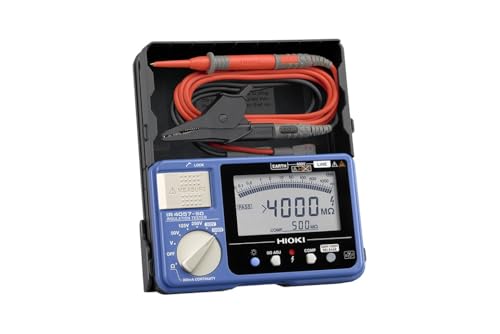
Hioki IR4056 and IR4057: 50V to 1000V (IR4057) or 250V to 1000V (IR4056), 0.1 MΩ to 4000 MΩ, CAT III 600V. Known for fast 0.8-second response and comparator pass/fail function for repetitive residential checks. Usually $400–$650. Lighter and faster than the Fluke 1500 series for basic pass/fail.
2500V to 5000V Class – Industrial Maintenance
Megger MIT410/2 and MIT415/2: 50V to 1000V, up to 200 GΩ, with PI/DAR, CAT IV 600V, and onboard storage. The MIT415 adds 25V increments and higher accuracy. Usually $900–$1500. Ideal for commercial 480V systems and smaller industrial motors without stepping up to 5kV.
Megger MIT525: 50V to 5000V, up to 500 GΩ, PI/DAR, step voltage, dielectric discharge, and guard terminal to eliminate surface leakage on dirty motors. Usually $2,000–$3,200. The standard for 2300V+ motors and preventive maintenance programs that need trending.
Fluke 1550C: 250V to 5000V, up to 1 TΩ, with PI/DAR, ramp mode, and CAT III 1000V / CAT IV 600V. Usually $2,500–$3,800. Comparable to the MIT525 but with Fluke’s test voltage lockout and larger display for field trending.
For all industrial units, confirm the included leads support the full voltage and that the tester has automatic discharge to at least 5000V. Manual discharge on high-capacitance cables is a shock hazard.
Settings and Test Procedure With Reasoning
Follow this sequence to get repeatable, safe results:
- 1. Isolate and discharge: De-energize, lock out, and discharge the circuit for 5 minutes before testing. Capacitive charge on long cables can destroy a tester and give false high readings.
- 2. Select voltage at 500V for 120-240V, 1000V for 440-600V: Testing a 480V motor at 250V will show high resistance even if the insulation is cracked, because the lower voltage cannot bridge micro-cracks.
- 3. Use the guard terminal on industrial motors and cables: Connect guard to exposed insulation surface or cable shield. This shunts surface leakage so you measure volume insulation only. Without it, humidity can make a good motor read as failed.
- 4. Run 60-second test for DAR and 10-minute test for PI: DAR = 60s reading / 30s reading. PI = 10min reading / 1min reading. For industrial acceptance, DAR should be >1.4 and PI should be >2.0 for Class F insulation. A PI below 1.5 indicates moisture or contamination.
- 5. Document temperature and humidity: Record winding temperature with an IR thermometer. Correct readings to 40°C base using the IEEE 43 correction table. A 70 MΩ reading at 50°C is actually about 140 MΩ at 40°C.
What to Avoid When Buying
Do not choose based on maximum voltage alone. A 5000V tester used at 500V often has worse accuracy (±10-15%) than a dedicated 1000V handheld at the same voltage. If 90% of your work is under 600V, a high-voltage unit will be less accurate where you need it most.
Avoid testers without automatic discharge, live-voltage detection, or a CAT rating printed on the tester itself with an IEC 61010 mark. Units that list “designed to meet CAT III” without certification have not been independently researched.
FAQ
Can I use a standard multimeter for insulation resistance?
No. A multimeter applies less than 3V on resistance mode and cannot stress insulation. A circuit that reads “OL” on a multimeter can still read 0.2 MΩ – a clear failure – when stressed at 500V. You need a dedicated insulation tester.
Do I need to disconnect electronics before a 500V test?
Yes. Disconnect or isolate VFDs, PLCs, LED drivers, and electronic controls before testing wiring that connects to them. The 500V DC test will damage solid-state inputs. Test wiring with the electronic devices disconnected and test the devices separately at 250V if their manual allows it.
Why does my reading keep climbing during the test?
That is normal dielectric absorption. Good insulation shows a steadily rising reading as capacitive charging settles. The PI and DAR functions measure this rise. If the reading is flat or falling, it indicates leakage current and likely insulation failure.


