A broken exhaust manifold stud or a seized head stud can stop a repair cold. The stub sits flush with the surface or just proud of it, there is nothing left to put a wrench on, and drilling it out risks the threads underneath. A stud extractor clamps onto the outside of the exposed stud body and turns it out with a ratchet or a wrench, without drilling into the fastener first.
This guide covers outside-grip stud extractors only: cam-action removers, collet sockets, and internal-grip socket sets that close on the stud from the outside. That is a different tool from a screw extractor set, which drills into the broken fastener first, and from a wheel stud installer, which pulls a new stud into a hub. If the stud is broken off below the surface with nothing to grip, an outside-grip extractor cannot help.
Disclosure: As an Amazon Associate, I earn from qualifying purchases. If you buy through links in this article, I may earn a commission at no extra cost to you.
Top 3 picks at a glance

How to choose a stud extractor
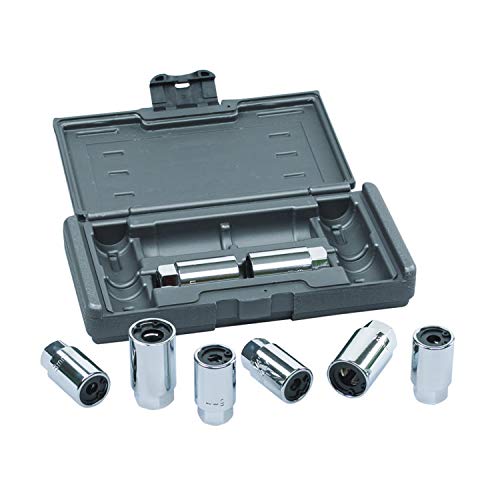
Grip design decides what it can hold. A cam-action remover uses a roller or cam that wedges tighter as you turn, which suits a single stud size range and works well on rounded or rusted studs. A collet socket set uses a split collet inside each socket that closes evenly around the stud, which spreads the load and suits repeated shop use. An internal-grip socket set bites into the outside of the stud with a shaped bore, a good middle ground when you need several sizes in one case.
Size range matters more than piece count. Exhaust and intake manifold studs are usually in the 6 to 12 mm range, while larger suspension and engine studs run up to 1/2 inch. A set covering both SAE and metric sizes saves a second purchase.
Drive size and clearance. Most stud extractors take a 3/8-inch square drive, which matches a standard ratchet and keeps the tool compact. Check the outside diameter of the socket against the space around the stud: a cam-action remover is slim and reaches into tight manifold corners, while a socket set needs room for the socket body plus the ratchet head.
Remover, installer, or both. Some collet sets are listed for installing studs as well as removing them, which is handy when you are replacing a full set of manifold studs. A remover-only tool is simpler and usually cheaper.
1. Lisle 71200 Stud Remover

The Lisle 71200 is the classic single cam-action stud remover, and it is the pick when you want one compact tool for broken manifold and engine studs. The cam design tightens its grip as you turn the ratchet, so a rusted or partly rounded stud that would slip in a plain socket still comes out. It is slim enough to reach studs in tight corners where a socket set cannot fit.
The tool works with a standard ratchet: slip it over the exposed stud, turn, and the cam does the holding. It is a remover-only design, so it does one job with fewer moving parts than a set. For a home shop that sees a broken stud a few times a year, that simplicity is the point.
Specs
- Brand: Lisle
- Model: 71200
- Design: Cam-action stud remover
- Listed stud range: 1/4 inch to 1/2 inch
- Listed drive: 3/8-inch square drive
- Use: Removes broken or seized studs
2. GEARWRENCH 41760D 8-Piece Stud Removal Set
The GEARWRENCH 41760D is the set to buy when you face studs in both SAE and metric sizes and want one case to cover them. Eight collet-style sockets span the common range, and each socket closes evenly around the stud body, which spreads the turning force and lowers the chance of chewing up the stud further.
The set is listed for both removal and installation, so it earns its keep when you are fitting fresh manifold studs too. It is the most complete option here for a shop that works on a mix of domestic and import engines.
Specs
- Brand: GEARWRENCH
- Model: 41760D
- Pieces: 8
- Design: Collet-style stud removal sockets
- Listed sizes: 1/4 inch to 1/2 inch SAE and 6 mm to 12 mm metric
- Listed drive: 3/8-inch square drive
- Use: Removes and installs studs
3. Assenmacher 201 Metric Stud Remover and Installer Set
The Assenmacher 201 is a four-piece metric collet set, and it is the pick for an import-focused shop that does not need SAE sizes. Four sockets cover the metric range most often found on exhaust manifolds and cylinder heads, and the collet design grips the stud evenly around its full circumference.
Like the GEARWRENCH set, this one is listed for installing studs as well as removing them, which makes it a good companion when you are replacing a whole row of manifold studs. The four-piece case is smaller and lighter than an eight-piece set, so it is easier to carry to the car. If your work is mostly metric, the narrower range is a feature, not a gap.
Specs
- Brand: Assenmacher Specialty Tools
- Model: 201
- Pieces: 4
- Design: Collet-style stud remover and installer sockets
- Listed sizes: 6 mm, 8 mm, 10 mm and 12 mm metric
- Listed drive: 3/8-inch square drive
- Use: Removes and installs metric studs
4. ABN Stud Extractor Set, 8-Piece SAE and Metric

The ABN 8-piece set is the budget-friendly way to cover both SAE and metric studs in one case. Its internal-grip sockets bite onto the outside of the stud and hold it as you turn, which works on broken, seized, and partly rounded studs without any drilling. Eight sockets span the common sizes, so one case handles most of what a mixed fleet of vehicles throws at you.
This set is the practical choice when you want full size coverage without paying for a professional collet set.
Specs
- Brand: ABN
- Model: 8-Piece Stud Extractor Set
- Pieces: 8
- Design: Internal-grip stud puller sockets
- Listed sizes: 1/4 inch to 1/2 inch SAE and 6 mm to 12 mm metric
- Listed drive: 3/8-inch square drive
- Use: Removes broken, seized and rounded studs
5. OEMTOOLS 25438 Universal Stud Extractor

The OEMTOOLS 25438 is a single universal extractor, and it is the pick when you want one tool that adjusts across a range of stud sizes instead of a set of fixed sockets. It clamps onto studs, bolts, and screws in the listed 6 mm to 12 mm range, which covers most manifold and small-engine studs, and it is listed for manifold stud work in particular.
The clamp design grips the stud body from the outside, so it works on studs that are too damaged for a fixed socket to hold. It fits tight engine bays, and it pairs with a standard ratchet or wrench.
Specs
- Brand: OEMTOOLS
- Model: 25438
- Design: Universal clamp-style stud extractor
- Listed clamping range: 6 mm to 12 mm
- Use: Removes damaged bolts, screws and manifold studs
Comparison table
| Product | Design | Pieces | Listed size range | Also installs studs |
|---|---|---|---|---|
| Lisle 71200 | Cam-action remover | 1 | 1/4 to 1/2 inch | No |
| GEARWRENCH 41760D | Collet socket set | 8 | 1/4 to 1/2 inch, 6 to 12 mm | Yes |
| Assenmacher 201 | Collet socket set | 4 | 6, 8, 10, 12 mm | Yes |
| ABN 8-Piece Set | Internal-grip sockets | 8 | 1/4 to 1/2 inch, 6 to 12 mm | No |
| OEMTOOLS 25438 | Universal clamp extractor | 1 | 6 to 12 mm | No |
Frequently asked questions
What is the difference between a stud extractor and a screw extractor set?
A stud extractor grips the outside of the exposed stud body with a cam, a collet, or an internal-grip socket, and turns the stud out directly. A screw extractor set drills into the broken fastener first and then turns it out in reverse. Use an outside-grip extractor when enough stud sticks out to grab, and a drill-in set when the fastener is broken off flush.
Can a stud extractor remove a stud that is broken off flush?
No, not on its own. An outside-grip extractor needs exposed stud body to clamp onto. If the break is flush with the surface, you need to build up the stub, drill into it, or take the part to a machine shop.
Can these extractors install a new stud too?
Some can. The GEARWRENCH 41760D and the Assenmacher 201 are both listed as remover and installer sets, so they can thread a new stud in as well as pull a broken one out. The single cam-action and clamp tools in this guide are listed for removal only.
Conclusion
A stud extractor earns its place the first time a manifold stud snaps. The Lisle 71200 is the slim cam-action pick for a broken stud in a tight spot. The GEARWRENCH 41760D covers both SAE and metric sizes in one collet set and installs studs too, while the Assenmacher 201 does the same job in a compact metric-only case. The ABN 8-piece set gives full size coverage at a friendly outlay, and the OEMTOOLS 25438 is the single adjustable tool for a drawer that needs a grab-and-go remover.
Related guides
More from Amazon
Programs that pair well with the guide above. Offers and eligibility are set by Amazon and may change.
Free shipping on eligible items, Prime Video and more. Eligible new members can start with a free trial.
Start a Prime free trialAd-free music streaming. Eligible new subscribers can start with a free trial.
Try Music Unlimited freeA Prime membership for ages 18-24 with a trial period. Eligibility is set by Amazon.
See Prime for Young AdultsAudiobooks and podcasts to listen to on the go. Eligible new members can start with a free trial.
Try Audible freeAs an Amazon Associate we earn from qualifying purchases.