Disclosure: As an Amazon Associate, I earn from qualifying purchases. If you buy through links in this article, I may earn a commission at no extra cost to you.
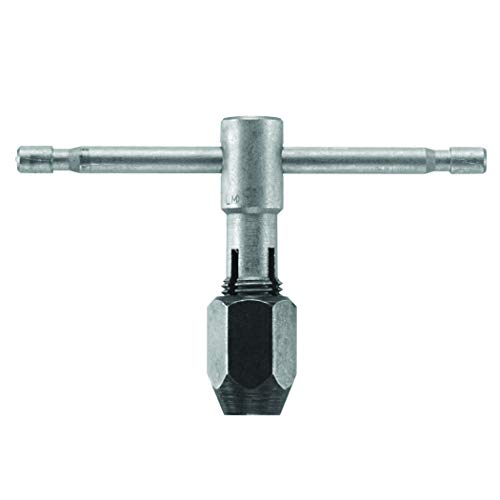
Our top pick: Starrett 93A T-Handle Tap Wrench. Runner-up: Bosch BTH014 T-Handle Tap Wrench.
A tap wrench is the handle that holds a hand tap by its square shank and turns it, and it matters more than its simple shape suggests. A tap started crooked cuts a crooked thread, and a tap gripped loosely can slip, round off its drive square, or snap in the hole. The right wrench keeps the tap centered over the work, lets both hands share the turning effort evenly, and gives enough feel to back the tap out a quarter turn at a time to break the chip.
This guide covers tap wrenches only: T-handle models for small and medium taps, a ratcheting T-handle for spots where handle swing is limited, and a long bar-type wrench for larger taps on open work. It does not cover full tap and die sets, and none of the picks below is a set. The five picks span tap capacities from No. 0 up to 1/2 inch, so most readers will find one wrench for fine work and, if needed, a second for the larger end of the range.
Top 3 picks at a glance

How to Choose a Tap Wrench
Match the tap capacity first. Every tap wrench lists a tap size range, and the tap has to sit inside it. A wrench used above its range grips near the limit of its jaws and can slip under load; one used far below its range gives clumsy, heavy handling for a delicate tap. Small taps in the No. 0 to 1/4 inch range pair with short T-handles, while taps from 1/4 to 1/2 inch want a longer handle and more leverage.
Check the square shank size, not just the thread size. The wrench grips the square at the top of the tap shank, and that square is what the listed square shank capacity describes. Two taps with the same thread diameter can have different shank and square sizes across brands, so confirm the square dimension of the taps you already own against the wrench specification before ordering.
Pick the handle type for the space. A T-handle is compact and balanced, and its centered grip helps start a tap straight, which is why it suits bench work and smaller taps. A bar-type wrench is longer, with the tap held in the middle and a handle at each end; turning both ends together keeps force on the tap axis and gives the leverage larger taps need, as long as there is room to swing it. A ratcheting T-handle sits between the two: it keeps the compact T shape but lets you reset the handle without lifting the wrench off the tap, which helps next to an obstruction.
Look at the jaw and sleeve design. Better wrenches use hardened or tempered gripping surfaces that bite the square without chewing it, and a knurled sleeve or cap that can be tightened firmly by hand. Sliding handles are a useful detail: the bar can be shifted to one side when a wall, vise jaw, or machine part blocks a full swing, then centered again for balanced turning.
Keep the range honest. No single wrench covers No. 0 through 1/2 inch well. If you tap both fine instrument threads and larger bracket holes, plan on two wrenches sized for each end rather than one oversized tool forced onto small taps.
1. Starrett 93A T-Handle Tap Wrench

The Starrett 93A is the small end of the maker’s 93 series of T-handle wrenches, sized for taps from 1/16 to 3/16 inch with square shanks from 1/16 to 5/32 inch. The body is only 2 inches long, which keeps the tool light over fine taps where excess weight works against a straight start. Starrett describes the 93 series as heat treated for ordinary shop use, with a sliding handle that is frictionally held, so the bar can be removed or repositioned when clearance is tight on one side.
This is the pick for small machine-screw taps, model and instrument work, and any job where the tap is small enough that feel matters more than leverage. The short body also makes it easy to keep the wrench, and therefore the tap, aligned with the hole while the first threads engage.
Specs
- Type: T-handle tap wrench, sliding handle
- Tap capacity: 1/16 to 3/16 inch
- Square shank capacity: 1/16 to 5/32 inch
- Body length: 2 inches
- Model: 93A
- ASIN: B0006J4DNK
2. Bosch BTH014 T-Handle Tap Wrench
The Bosch BTH014 covers the common No. 0 to 1/4 inch tap range with adjustable jaws that Bosch describes as self-equalizing: the jaws close evenly on the tap shank, which helps the tap sit centered in the wrench instead of cocked to one side. The jaws are hardened steel, and the T-handle is held in place by spring tension, so the handle position stays set while you work rather than sliding on its own.
For a general bench wrench for small taps, this is a straightforward design: a compact T shape, jaws that adjust to the shank, and a stated capacity that matches the taps most often used for brackets, enclosures, and repair work in electronics and light fabrication. It is a single wrench only, with no taps included.
Specs
- Type: T-handle tap wrench, adjustable jaws
- Tap capacity: No. 0 to 1/4 inch
- Jaw design: Self-equalizing, hardened steel
- Handle: T-handle held by spring tension
- Model: BTH014
- ASIN: B07GRJMSDQ
3. General Tools 164 Plain Tap Wrench
The General Tools 164 is a plain sliding T-handle wrench for taps from No. 0 to 1/4 inch. Plain here means no ratchet and no spring mechanism: the tap is clamped in the chuck, the crossbar slides to wherever the work allows, and you turn it by hand. General Tools lists the body at 2.75 inches long in powder-coated alloy steel, and the wrench is also specified for holding reamers, drill bits, and screw extractors with suitable shanks.
That simplicity is the appeal. There is little to adjust and little to go wrong, and the short body gives direct feedback from the tap, which is what you want when cutting small threads in softer metals or plastics where the tap should be turned gently and backed off often.
Specs
- Type: Plain T-handle tap wrench, sliding handle
- Tap capacity: No. 0 to 1/4 inch
- Overall length: 2.75 inches
- Material: Powder-coated alloy steel
- Also holds: Reamers, drill bits, screw extractors
- Model: 164
- ASIN: B017087336
4. IRWIN 21202 Ratcheting Tap Wrench

The IRWIN 21202 is a ratcheting tap wrench for taps from 1/4 to 1/2 inch, the larger half of the common hand tap range. The ratchet mechanism lets you turn the tap, then swing the handle back without releasing the grip on the square shank, which is useful when a full rotation is blocked by a vise, a frame rail, or nearby parts. It also means the wrench can keep working in a confined bay where a long bar wrench would have to be lifted off and reseated every half turn.
Choose this one when the work is on assembled equipment rather than a bare plate on the bench: chasing or cutting threads in place, where access is limited and the larger tap sizes still need steady, two-handed control. It is sold as the wrench alone.
Specs
- Type: Ratcheting T-handle tap wrench
- Tap capacity: 1/4 to 1/2 inch
- Mechanism: Ratchet, resets handle without releasing the tap
- Model: 21202
- ASIN: B002YKFRTS
5. Starrett 91B Tap Wrench

The Starrett 91B is the bar-type pick: a straight, 9-inch body with the tap held at the center and handles at both ends. It covers taps from 3/16 to 1/2 inch with square shanks from 5/32 to 9/32 inch. Starrett’s 91 series uses tempered gripping surfaces that hold square or round shanks, and the wrench is plunger operated by a knurled sleeve: the spring inside the sleeve backs the plunger off when pressure is released, which makes loading and unloading taps quicker.
A bar wrench earns its place on larger taps and open work, where there is room to swing both handles and the extra length turns into controlled leverage rather than strain. Pushing and pulling the two ends together keeps the turning force on the tap axis, which is exactly what a 1/2 inch tap needs to start square and stay square.
Specs
- Type: Bar-type (straight handle) tap wrench
- Tap capacity: 3/16 to 1/2 inch
- Square shank capacity: 5/32 to 9/32 inch
- Body length: 9 inches
- Grip: Tempered gripping surfaces, plunger operated by knurled sleeve
- Model: 91B
- ASIN: B0006J4DN0
Quick Comparison
| Pick | Type | Tap capacity | Square shank | Body length |
|---|---|---|---|---|
| Starrett 93A | T-handle, sliding | 1/16–3/16 in | 1/16–5/32 in | 2 in |
| Bosch BTH014 | T-handle, adjustable jaws | No. 0–1/4 in | Adjusts to shank | Compact T body |
| General Tools 164 | Plain T-handle, sliding | No. 0–1/4 in | Chuck grip | 2.75 in |
| IRWIN 21202 | Ratcheting T-handle | 1/4–1/2 in | Chuck grip | T body |
| Starrett 91B | Bar-type, straight | 3/16–1/2 in | 5/32–9/32 in | 9 in |
FAQ
What size tap wrench do I need for a 1/4-20 tap?
A 1/4 inch tap sits at the top of the small T-handle range, so a wrench listed for No. 0 to 1/4 inch, such as the Bosch BTH014 or the General Tools 164, covers it. Check the square shank size of your specific tap as well, because shank dimensions vary by brand.
Can one tap wrench cover all my taps?
Realistically, no. The picks here split the range: small T-handles for taps up to 1/4 inch, and the IRWIN 21202 or Starrett 91B for 1/4 to 1/2 inch. Using one oversized wrench on fine taps makes a straight start harder and raises the chance of snapping the tap.
When is a ratcheting tap wrench worth choosing?
When the handle cannot swing a full circle: threads cut in place on assembled equipment, or holes close to a wall or frame member. The ratchet lets you reset the handle without lifting the wrench off the tap and losing alignment.
Do these wrenches hold round shanks too?
Some do within limits. Starrett states its 91 series grips square or round shanks, with care needed on round shanks because excessive tightening can damage the jaw. The primary design case for all five picks is the square drive end of a standard hand tap.
Are taps included with any of these wrenches?
No. All five picks are the wrench or handle only, which is deliberate: this guide compares holders, not tap and die sets, so you pair the wrench with taps you already own.
Conclusion
For small taps, the Starrett 93A, Bosch BTH014, and General Tools 164 each cover the fine end of the range with a compact T-handle, differing mainly in jaw design and size: the 93A is the smallest and most specialized, the BTH014 adds self-equalizing jaws, and the 164 is the plainest sliding-handle option. For larger taps, the IRWIN 21202 brings a ratchet for restricted swing, and the Starrett 91B brings a 9-inch bar for open work and maximum control. Match the listed capacity and square shank size to the taps on your bench, and the wrench will do the rest.
Related guides
More from Amazon
Programs that pair well with the guide above. Offers and eligibility are set by Amazon and may change.
Free shipping on eligible items, Prime Video and more. Eligible new members can start with a free trial.
Start a Prime free trialAd-free music streaming. Eligible new subscribers can start with a free trial.
Try Music Unlimited freeA Prime membership for ages 18-24 with a trial period. Eligibility is set by Amazon.
See Prime for Young AdultsAudiobooks and podcasts to listen to on the go. Eligible new members can start with a free trial.
Try Audible freeAs an Amazon Associate we earn from qualifying purchases.