
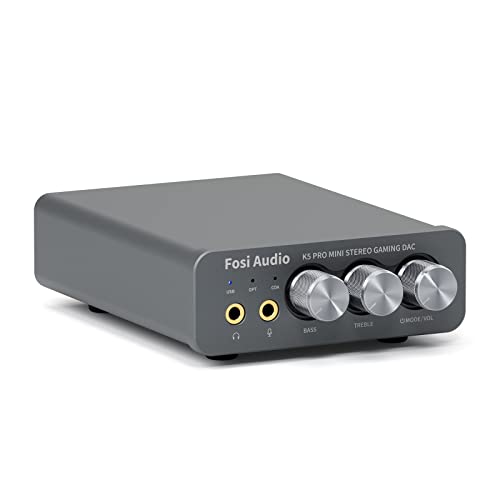
The Fosi Audio K5 Pro is the best USB DAC for gaming headsets in this group: it takes a USB-C connection from a PC or console, drives a headset with a 3.5mm plug from a dedicated amplifier, and, unlike most desktop DACs, adds a microphone input so a headset boom mic stays usable. A DAC, short for digital-to-analog converter, replaces the weak audio chip on a motherboard or console controller with a cleaner converter and a stronger headphone amplifier. If you want more power for demanding headphones, the FiiO K11 and Fosi ZH3 sit further up the range, while the BZINK dongle is the pocketable option.
Our Top Picks



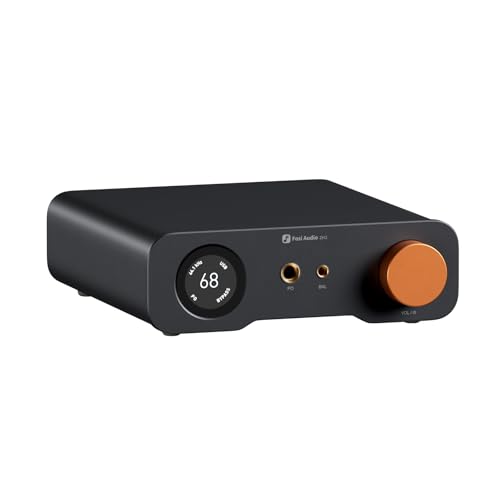
Top 3 picks at a glance
Quick List
- Fosi Audio Q4 – best for a simple, low-cost-style desktop upgrade with USB, optical and coaxial inputs
- Fosi Audio K5 Pro – best overall for gaming headsets with a microphone and tone controls
- FiiO K11 – best for high-power balanced output with a 4.4 mm jack
- Aveek Gaming DAC – best for a feature-packed unit with Bluetooth, RCA and a 3-band EQ
- BZINK USB-C DAC adapter – best for a pocket-sized upgrade for a laptop, phone or handheld
- Fosi Audio ZH3 – best for a fully balanced desktop DAC and preamp
Which One Is Right for You?
| If you… | Choose |
|---|---|
| Use a 3.5mm gaming headset with a boom mic and want a simple desktop box | Fosi Audio K5 Pro |
| Own high-impedance or planar headphones and want a balanced 4.4 mm output | FiiO K11 |
| Want a premium DAC that also feeds speakers or an amplifier | Fosi Audio ZH3 |
| Need Bluetooth, RCA and an EQ in one unit for console and PC play | Aveek Gaming DAC |
| Travel or play on a laptop or handheld and need something that fits in a pocket | BZINK USB-C DAC adapter |
| Want a basic DAC with optical and coaxial inputs for a console or TV | Fosi Audio Q4 |
The first filter is the headset itself. Many gaming headsets connect over USB or wireless with a built-in sound card, and they gain little from an external DAC. A DAC makes sense for headsets and headphones with a 3.5mm analog cable, especially with a detachable boom mic, where the DAC replaces the weaker onboard audio.
All 6 Picks in Detail
1. Fosi Audio Q4 – Best for a Simple Desktop Upgrade with Multiple Inputs
As an Amazon Associate we earn from qualifying purchases at no extra cost to you.

The Fosi Audio Q4 is a compact desktop DAC and headphone amplifier with USB, optical and coaxial inputs, a 3.5mm headphone output and RCA line outputs. It suits listeners who want to improve the sound from a PC, TV or console and do not need a microphone connection.
- Inputs: USB, optical and coaxial
- Outputs: 3.5mm headphone jack and RCA
- USB input up to 24-bit/96 kHz; optical and coaxial up to 24-bit/192 kHz per the manufacturer
- Roughly 100 mW into 32 ohms per Fosi’s specification table; some retailers quote more, so confirm
- Recommended headphone impedance of roughly 16 to 200 ohms
- Bass and treble adjustment; powered over a 5V Micro-USB connection
Build notes: the Q4 is the older and simpler of the Fosi desktop models. It has no mic input, so a headset with a detachable boom mic would need a separate path for voice chat. It is a good match for wired gaming headphones where voice chat comes from a different device, or for people who mostly want better music and game sound.
Who should skip it: players who rely on a headset boom mic and want one box to handle both directions, or anyone with high-impedance headphones. For those cases the K5 Pro or one of the higher-power models is a better match. The Q4 remains a reasonable pick for a TV or console setup where the goal is cleaner stereo sound.
Pros:
- Multiple digital inputs in a small body
- RCA outputs for powered speakers
Cons:
- No microphone input
- Modest output power for demanding headphones
The K5 Pro adds a mic jack and more power for a modest step up in features.
2. Fosi Audio K5 Pro – Best Overall for Gaming Headsets with a Microphone
The K5 Pro is the gaming-focused follow-up to the Q4. It adds a 3.5mm microphone input, a 1000 mW output rating into 16 ohms, and bass and treble controls. It suits console and PC players who want their headset’s audio and mic routed through a single compact box.
- Inputs: USB-C, optical, coaxial and a 3.5mm microphone jack
- Outputs: 3.5mm headphone jack and RCA line out
- Output power of about 1000 mW at 16 ohms, 500 mW at 32 ohms and 80 mW at 300 ohms
- USB up to 24-bit/96 kHz; optical and coaxial up to 24-bit/192 kHz
- Texas Instruments NE5532 op-amp per the manufacturer
- Knobs for volume, bass and treble plus an input selector; small desktop body
Build notes: the USB-C port both powers the unit and carries audio, which makes it easy to use with a phone, laptop or console. The mic jack lets a headset with a 3.5mm cable use the DAC for sound while keeping the boom mic active, which is the main reason it is the top choice in a gaming-headset list.
Who should skip it: owners of demanding planar or high-impedance headphones, who will want the balanced power of the K11 or ZH3, and players whose headsets already have a USB sound card. Everyone else with a 3.5mm headset will find the controls and mic handling convenient during long sessions.
Pros:
- Microphone input for gaming headsets
- Good power for common 32 to 80 ohm headsets
Cons:
- Output is single-ended 3.5mm only
- USB resolution capped at 24-bit/96 kHz
It costs a little more in features than the Q4 but is the better match for a headset with a boom mic.
3. FiiO K11 – Best for High-Power Balanced Output

The FiiO K11 is a desktop DAC and headphone amplifier built around a Cirrus Logic CS43198 DAC chip, with a 4.4 mm balanced output and a 6.35 mm single-ended output. The listing cites 1400 mW of balanced output and support for 384 kHz and DSD256. It suits owners of higher-impedance headphones who also game and want a flexible, premium-feeling box.
- Inputs: USB Type-C, optical and coaxial; RCA line output
- Outputs: 4.4 mm balanced and 6.35 mm single-ended headphone jacks
- Up to 1400 mW balanced into 32 ohms per FiiO
- Supports 384 kHz PCM and DSD256 per the listing
- Powered by an external 12V adapter; about 147 x 133 x 32 mm
- Front-facing controls with a volume knob and gain selection
Build notes: the K11 has no microphone input, so it is best for headphones with a separate microphone, such as a desktop microphone or a clip-on boom, or for headphones used for single-player games and music. Balanced output needs a headphone with a 4.4 mm cable or an adapter, which is worth checking before buying.
Who should skip it: anyone who needs a mic input in the same box, and people with only a 3.5mm headset who will not use the balanced jack. The 12V adapter also means the unit stays on the desk, so it is not the choice for travel.
Pros:
- Strong balanced output power
- Versatile inputs and two headphone jacks
Cons:
- No microphone input
- Requires an external power adapter
It offers more power than the K5 Pro but gives up the mic jack.
4. Aveek Gaming DAC – Best for Bluetooth, RCA and EQ in One Unit
The Aveek Gaming DAC is a combined DAC, headphone amplifier and compact preamp aimed at PS5 and PC players. The listing highlights Bluetooth, RCA connections and a 3-band equalizer, and it describes a front microphone input and headphone monitoring. It suits players who want simple tone control for game audio and flexible connections.
- Combined DAC, headphone amp and compact preamp
- Bluetooth connectivity plus RCA connections
- 3-band EQ for bass, mid and treble
- Designed for headphones from roughly 16 to 100 ohms per the listing
- Up to 24-bit/96 kHz processing, with 113 dB SNR and under 0.003% THD claimed
- Front mic input; confirm exact output power on the listing
Build notes: this is a newer, less-established brand, so rely on the listing for exact specifications and check what the box includes. The listed 16 to 100 ohm range covers most gaming headsets and many consumer headphones but not high-impedance studio models. Bluetooth is convenient for phone audio, though a wired USB connection is better for latency-sensitive gaming.
Who should skip it: buyers who want independent measurements before spending, because few exist for this model, and those who need high power for demanding headphones. The listing is the main source of information, so read the connection diagram and the included cables closely.
Pros:
- Feature-rich with EQ, Bluetooth and mic input
- Good fit for console players
Cons:
- Less proven brand and fewer independent measurements
- Output power not clearly stated in the sources we found
Next to the K5 Pro, it adds Bluetooth and a mid-band EQ but has a shorter track record.
5. BZINK USB-C DAC Adapter – Best Pocket-Sized Upgrade

The BZINK adapter is a small USB-C to 3.5mm dongle built around a CX31993 DAC chip and a MAX97220 headphone amplifier. It is meant to replace a laptop, phone or handheld’s weak headphone output. It suits mobile gamers and anyone who wants a clean headphone output without carrying a desktop box.
- USB-C input with a 3.5mm headphone output
- CX31993 DAC chip and MAX97220 amplifier
- 32-bit/384 kHz playback support per the listing
- Output power claimed at about 63 mW into 32 ohms; other sellers of similar chips quote lower, so confirm
- Silver-plated copper cable and aluminum body
- Plug-and-play with no driver on common devices
Build notes: a dongle draws power from the host device, so it works best with a laptop, handheld or phone that can supply it. Output is modest compared with a desktop DAC, so it suits headsets with low to moderate impedance. Some dongles use a TRRS layout for a mic, but the listing does not clearly state that, so confirm mic support before relying on it.
Who should skip it: desktop users with high-impedance headphones or anyone who wants tone controls and multiple inputs. A dongle is best when portability is the main goal, such as a travel laptop, a handheld PC or a phone used for gaming.
Pros:
- Very portable
- No external power needed
Cons:
- Limited output power
- Specifications vary between sellers
It trades power and controls for portability compared with the K5 Pro.
6. Fosi Audio ZH3 – Best for a Fully Balanced Desktop DAC and Preamp
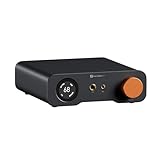
The Fosi Audio ZH3 is a fully balanced desktop DAC, headphone amplifier and preamp built around an AK4493SEQ DAC and an XMOS XU316 USB interface. Fosi lists 4.4 mm balanced output of up to 2570 mW per channel into 32 ohms and 6.35 mm single-ended output of 640 mW. It suits enthusiasts with higher-end headphones who game on the same desk.
- AK4493SEQ DAC and XMOS XU316 chipset
- USB PCM up to 768 kHz and DSD512; optical and coaxial up to 24-bit/192 kHz per Fosi
- Inputs: USB, optical, coaxial and RCA; outputs include 4.4 mm, 6.35 mm, RCA and XLR
- Rated for roughly 16 to 300 ohm headphones
- Three gain levels and a remote control
- Replaceable op-amps per the manufacturer
Build notes: the ZH3 is overbuilt for a typical gaming headset, and it has no microphone input. Its strengths show with high-quality wired headphones and active speakers. If voice chat matters, plan a separate microphone. The balanced design also needs a headphone or adapter that supports 4.4 mm or XLR to use the strongest output.
Who should skip it: players who only use a basic headset with a boom mic, since the extra power and balanced outputs will go unused and there is no mic input. It is aimed at listeners who treat the desk as a hi-fi setup first and a gaming station second.
Pros:
- High output power and balanced design
- Flexible inputs and speaker-ready outputs
Cons:
- No microphone input
- More box than most headset users need
It is the premium end of this list and a clear step above the K5 Pro in power and outputs.
Specs Compared
| Model | Inputs | Headphone outputs | Output power (listed) | Max resolution | Mic input |
|---|---|---|---|---|---|
| Fosi Audio Q4 | USB, optical, coaxial | 3.5 mm | About 100 mW at 32 ohms (confirm) | 24-bit/96 kHz USB; 24-bit/192 kHz digital | No |
| Fosi Audio K5 Pro | USB-C, optical, coaxial, mic | 3.5 mm | 1000 mW at 16 ohms; 500 mW at 32 ohms | 24-bit/96 kHz USB; 24-bit/192 kHz digital | Yes (3.5 mm) |
| FiiO K11 | USB-C, optical, coaxial | 4.4 mm balanced, 6.35 mm | Up to 1400 mW balanced at 32 ohms | 384 kHz PCM, DSD256 | No |
| Aveek Gaming DAC | Confirm on listing; Bluetooth, RCA | Confirm on listing | Confirm on listing | 24-bit/96 kHz | Yes (front) |
| BZINK USB-C adapter | USB-C | 3.5 mm | About 63 mW at 32 ohms (seller claim) | 32-bit/384 kHz | Confirm on listing |
| Fosi Audio ZH3 | USB, optical, coaxial, RCA | 4.4 mm, 6.35 mm; XLR and RCA line outputs | Up to 2570 mW balanced at 32 ohms | 768 kHz PCM, DSD512 USB | No |
How We Chose These
This guide is built from manufacturer specifications and listing details, not from personal use of the devices. We began with the six DACs in the current catalog set and compared them on features that affect gaming-headset use: input types, headphone output type and power, microphone support, supported audio resolution and connection to console or PC. Where sellers or sources disagree, such as output power on the Q4 and the dongle, we say so and recommend checking the listing. We do not publish measurements, and we mark any value the listing does not state as “confirm on listing.”
What to Look For
Do You Need a DAC at All?
Most USB and wireless gaming headsets include their own audio chip, so a separate DAC mostly benefits analog headsets and headphones. If your headset connects with a 3.5mm cable, a DAC can lower noise, increase volume headroom and give you more control. If the headset plugs in by USB, the benefit is small. The most common gaming scenario is a pair of wired headphones or a headset with a detachable cable, used on a PC or console with a USB or optical connection.
Output Power and Impedance Matching
Headphone impedance is measured in ohms, and higher impedance usually needs more voltage. A rule of thumb is to choose an amplifier with an output impedance below one-eighth of the headphone’s impedance. Power in milliwatts tells you how much the amplifier can deliver at a given load. Worked example: a 32-ohm headset that needs about 100 mW for loud volume needs roughly 1.8 volts RMS, because voltage equals the square root of power times resistance. Any of these DACs can supply that. A 250-ohm headphone needs more voltage for the same loudness, which favors the FiiO K11 or Fosi ZH3.
Microphone Handling
Many DACs ignore the microphone entirely. If you use a headset with a boom mic, you need either a DAC with a mic input, such as the K5 Pro or the Aveek unit, a separate microphone, or a splitter. Mic quality varies, so check whether the DAC passes the mic through as a USB audio device or simply connects it to a sound card.
Connections: USB, Optical, Coaxial and Bluetooth
USB-C is the simplest connection for PC and many consoles. Optical and coaxial inputs suit consoles and televisions that output digital audio, but they only carry stereo or compressed multichannel audio. Bluetooth adds convenience but also latency, which is why wired USB is preferred for competitive gaming. Look for the sample rates listed: 24-bit/96 kHz is already beyond what most game audio uses.
Choosing by Budget Tier and Use
Think in three tiers. A pocket dongle covers casual and mobile play. A desktop unit in the Q4 or K5 Pro class suits most wired headsets and is where the microphone input matters. A premium balanced unit such as the K11 or ZH3 makes sense once you own headphones that can use the extra power. Buying one tier above your current headphones is rarely wasted, because the DAC outlasts several headset upgrades.
Latency, Drivers and Platform Support
Most USB DACs use standard USB audio class drivers, so they work on Windows, macOS and many consoles without extra software. Wired USB connections add very little delay, which matters for competitive games, while Bluetooth links add noticeably more. Optical connections carry a digital signal and avoid ground noise from the computer, which is helpful if you hear hum or interference with a USB connection. If you hear electrical noise, try a different USB port, a shorter cable or an optical connection.
Controls and Extras
Tone controls, gain switches and a physical volume knob are valuable during play, since you can adjust without opening software. Surround-sound features are usually software on the PC or console rather than in the DAC, so do not expect a DAC alone to create a 7.1 effect.
Questions
Will a DAC improve a USB gaming headset?
Usually not much, since a USB headset already contains its own converter and amplifier. A DAC helps analog headsets and headphones more.
Do I need a headphone amplifier?
Low-impedance gaming headsets can often run from a laptop or console, but a dedicated amplifier gives more volume headroom and cleaner sound. High-impedance headphones almost always benefit.
Can I use these DACs with a PS5?
Many work over USB or optical. Console support varies, so check the listing for your console, especially for units with Bluetooth or a mic input.
What does a balanced output do?
A balanced output uses separate connections for each side of the signal, which can deliver more power and lower crosstalk. It needs a headphone cable or adapter with a 4.4 mm plug.
Is the BZINK dongle enough for a gaming headset?
For low- to moderate-impedance headsets, yes, especially for portable play. Confirm mic support before use.
Why do the listed output powers vary between sellers?
Different revisions and sellers quote different measurement conditions. Treat power numbers as guidance and rely on the manufacturer’s specification when available.
Update History
- October 21, 2026 – Initial publication; product set drawn from current catalog listings.
- Check the product page for current specifications and availability before buying.
Sources
- Manufacturer product and specification pages for Fosi Audio and FiiO
- Retailer listing titles and specification fields for each DAC
- Published product pages and reviews for the CX31993 and MAX97220 chip combination
Related guides
- Best Moondrop IEMs for Gaming: USB-C, 3.5 mm and 2-Pin Picks: 4 Compared (2026)
- Best Budget HP Laptops: Ten Listings Decoded by Processor, RAM and Reseller Tags: 10 Compared (2026)
- 10 Best Gaming Laptops for Singapore: Twelve Widely Sold Options and an Import Checklist (2026)
- Ryzen Threadripper 1900X for Gaming: Specs and Is It Worth It?


