The Short Answer
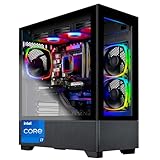
For an overclocked gaming rig, size your power supply so that your estimated maximum system draw uses no more than 80% of the PSU’s rated wattage. In practical terms, a modern overclocked build with a flagship-class GPU and a mid-to-high-tier CPU typically needs an 850W to 1000W PSU, while extreme dual-GPU or heavily overclocked systems may justify 1200W to 1500W. A prebuilt like the Skytech Gaming PC with an Intel Core i7 12700F and RTX 4070 Ti ships with a 750W Gold unit, which is adequate at stock speeds but leaves little room once you add meaningful overclocking headroom, new components, or power-hungry peripherals.
Headroom matters for two reasons. First, transient power spikes on modern GPUs can briefly draw 1.5 to 2 times their rated board power — a card rated at 285W can spike past 450W for milliseconds. Second, PSUs run most efficiently and run cooler (and quieter) at 40–60% load. A unit running at 95% of capacity will thermally throttle its fan, shorten capacitor life, and may trip over-current protection during spikes.
As an Amazon Associate we earn from qualifying purchases at no extra cost to you.
Standard Sizes
PSU wattage is only half the sizing equation — the physical dimensions matter too, because a 1500W unit may not fit your case. Most gaming PSUs use the ATX form factor, but compact cases require SFX or SFX-L units. Here are the standard PSU form factors and their dimensions:
| Form Factor | Width | Length | Height | Typical Wattage Range |
|---|---|---|---|---|
| ATX | 5.9 in (15 cm) | 5.5–7.9 in (14–20 cm) | 3.4 in (8.6 cm) | 450–1600W |
| SFX | 4.9 in (12.5 cm) | 3.9 in (10 cm) | 2.5 in (6.4 cm) | 450–800W |
| SFX-L | 5.0 in (12.7 cm) | 5.0 in (12.7 cm) | 2.5 in (6.4 cm) | 500–800W |
| CFX (Compact) | 5.7 in (14.5 cm) | 4.5 in (11.5 cm) | 2.6 in (6.5 cm) | 450–600W |
| TFX (Thin) | 3.4 in (8.5 cm) | 6.7 in (17 cm) | 1.6 in (4.1 cm) | 300–500W |
Weight is another practical check: quality ATX units in the 850–1200W range typically weigh 3 to 5.5 pounds (1.4–2.5 kg) because of larger heatsinks and capacitors. An unusually light “1200W” budget PSU is a red flag. Note that ATX units longer than 7.1 inches (18 cm) — common in 1200W+ models — may collide with drive cages or front radiators in mid-tower cases.
How to Measure Your Space
- Measure your case’s PSU bay length. Open the case and measure from the rear PSU mounting bracket to the nearest obstruction (drive cage, shroud, or fan mount). Most mid-towers accommodate 6.3 to 7.9 inches (16–20 cm).
- Check clearance with cables connected. Modular cables need roughly 1 inch (2.5 cm) behind the mounting bracket for connectors to seat fully.
- Confirm fan clearance. Bottom-mounted PSUs with intake fans need 0.4–0.8 inches (1–2 cm) of floor clearance or a side-vented shroud.
- Measure your wall outlet and UPS capacity. A 1000W-drawing rig on a 1500VA/900W UPS will overload it — match UPS wattage to your system’s peak draw plus 20%.
- Check your circuit capacity. A single 15A/120V circuit (standard in US homes) provides about 1800W total. An overclocked rig peaking at 800W plus a 200W monitor and peripherals is fine; two such rigs on one circuit is not.
- Verify GPU power connector requirements. Newer high-end cards increasingly use 12V-2×6 (16-pin) connectors rated for up to 600W — confirm your PSU has a native cable or a certified adapter.
By Room or Use Case
Desk Setup in a Bedroom or Small Office
Bedroom circuits are often shared with air conditioners or space heaters, so leave more margin on the wall side. A 650–850W PSU-sized system is typical here. Physically, compact mid-towers (16–18 inches / 41–46 cm tall) fit under desks with limited clearance; measure the gap under your desk and leave 2 inches (5 cm) above the case for hot air exhaust.
Dedicated Gaming Room or Battlestation
With a dedicated circuit, you can run high-draw systems comfortably. An overclocked flagship GPU plus a 250W+ CPU targets a 1000W PSU (roughly $130–$250 for a good Gold unit, $180–$350 for Platinum). Full-tower cases (20–24 inches / 51–61 cm tall, 25–40 lbs / 11–18 kg empty) accommodate 1600W-class PSUs and 360mm AIOs like the 360mm unit in the Skytech build above.
Small Form Factor (SFF) Builds
SFF cases using SFX PSUs top out around 800W from major brands, which limits extreme overclocking. If you’re building an SFF rig with a 300W+ GPU, budget $150–$220 for a quality SFX unit and verify the case supports SFX-L length before buying. Expect the case itself to measure roughly 4–7 gallons in volume (12–25 liters).
Streaming or Dual-PC Setups
A gaming PC plus a dedicated streaming PC on one desk draws from one circuit. Keep the gaming rig’s PSU at 850–1000W for the overclocked system and the streaming box at 450–550W. Combined peak draw of 1000–1200W still fits a standard 15A circuit, but avoid plugging both into the same power strip.
Common Sizing Mistakes
- Sizing to TDP instead of transient spikes. A GPU with a 285W TDP can momentarily exceed 450W. A PSU rated exactly at your calculated draw will trip its protection or shut down under spikes.
- Buying cheap high-wattage units. A no-name 1000W PSU may deliver far less safely than a certified 750W. Stick to 80 Plus Gold or better from established brands, and check the warranted continuous wattage at 50°C ambient.
- Ignoring PSU length in the case. 1200W+ ATX units at 7.9 inches (20 cm) long routinely fail to fit mid-towers with front drive cages.
- Underestimating upgrade headroom. If you plan to upgrade the GPU in two or three years, buy the wattage your target card will need now, not your current card.
- Forgetting overclocking adds draw. A meaningful CPU overclock can add 30–80W; GPU overclocking with raised power limits adds 50–100W. Budget for both when calculating your 80% target.
- Reusing old PSUs for new builds. Units older than roughly eight years may lack modern connectors and have degraded capacitors, even if the wattage looks sufficient.
FAQ
Is 750W enough for an overclocked RTX 4070 Ti and i7 build?
Yes, for moderate overclocking. Stock system draw for this configuration peaks around 500–550W, and even with a GPU power limit raised, you’ll typically stay under 700W. However, you’re near the 80% efficiency sweet spot’s ceiling, so an 850W unit gives more comfortable headroom for GPU upgrades later.
How do I calculate my system’s actual power draw?
Add your CPU’s maximum realistic package power, your GPU’s board power, then add 50–75W for the motherboard, RAM, storage, fans, and RGB. Add 25–50% for transient spikes, and divide the total by 0.8 to find your target PSU wattage. Example: 250W CPU + 285W GPU + 75W other = 610W; with spikes, plan for 850W.
Does a bigger PSU use more electricity at idle?
Negligibly. Modern units draw only a few watts at idle regardless of rating, and higher-rated quality units often have better low-load efficiency. You will not see a meaningful difference on your electric bill between an 850W and 1200W unit in the same rig.
What wattage should I buy to future-proof my build?
Buy 1000W Gold or Platinum if you’re building any high-end system today. It covers current flagship GPUs, one next-generation GPU upgrade, and aggressive overclocking without replacing the PSU. Going to 1200W or beyond only makes sense for dual-GPU or extreme-OC enthusiasts — the extra cost of $50–$100 buys little real-world benefit otherwise.