The best Shun Premier Japanese knife block sets are the 7-piece Essential set for most cooks, the 8-piece set for frequent vegetable preparation, and a larger 10-piece collection only if you will regularly use both a chef’s knife and a santoku.
Shun Premier knives combine a VG-MAX stainless-steel core with a Damascus-style layered finish, a hammered surface, and a walnut-colored pakkawood handle. They are premium Japanese-style knives: thin, sharp, and excellent for controlled slicing, but they need gentler maintenance than a typical thick Western knife.
As an Amazon Associate we earn from qualifying purchases at no extra cost to you.



Our Top Picks
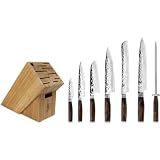
 Shun Premier 8 Piece Professional Block Set8 Piece Set17 x 9.13 x 7.99 Inches11 PoundsCheck on Amazon


Top 3 picks at a glance
Shun Premier sets compared
The exact SKU and contents can vary between countries and production years, so confirm the retailer’s component list before buying. The following comparison reflects the commonly sold Premier block-set configurations and their practical differences.
| Collection | Typical knife contents | Other tools | Approximate block footprint | Best for |
|---|---|---|---|---|
| Premier 7-piece Essential Block Set | 8-inch chef’s knife, 6.5-inch utility knife, 3.5-inch paring knife, plus one additional everyday knife such as a santoku | Kitchen shears and honing steel | About 9–10 inches wide by 5–6 inches deep; roughly 12–13 inches high | Small kitchens and cooks who want the core tools |
| Premier 8-piece Block Set | Usually adds a 7-inch santoku or another preparation knife to the Essential selection | Kitchen shears, honing steel, and block | About 10–11 inches wide by 6 inches deep; roughly 12–14 inches high | Cooks who alternate between slicing and rocking cuts |
| Premier 10-piece Block Set | Typically includes an 8-inch chef’s knife, 7-inch santoku, utility knife, paring knife, and additional small or specialty knives | Kitchen shears, honing steel, and block | About 11–13 inches wide by 6–7 inches deep; roughly 13–15 inches high | Households that use several knife shapes every week |
These footprint figures are planning estimates rather than manufacturer dimensions. Leave at least 2 inches of clearance above and beside the block so knives can be removed without hitting a cabinet, backsplash, or nearby appliance.
Head-to-head: which Premier set fits your cooking?
Choose the 7-piece Essential set for an efficient starter collection
The 7-piece set is the strongest choice when you want a chef’s knife for large tasks, a utility knife for medium items, a paring knife for detail work, and basic sharpening and trimming tools without filling a drawer or countertop.
Its 8-inch chef’s knife is long enough for onions, herbs, meat, and most vegetables while remaining easier to control than a 10-inch blade. The 6.5-inch utility knife handles sandwiches, small roasts, citrus, and vegetables that are awkward with a chef’s knife. The 3.5-inch paring knife is useful for peeling and trimming.
Choose this set if you:
- Cook for one to four people.
- Have limited counter space.
- Prefer one main knife rather than switching between several profiles.
- Already own a bread knife or do not need one in the block.
Choose the 8-piece set if you prepare vegetables in different styles
A 7-inch santoku changes the feel of the collection more than its piece count suggests. Its flatter edge and broad blade suit push cuts, thin vegetable slices, herbs, and boneless proteins. It is a useful complement to an 8-inch chef’s knife, not merely a duplicate.
The chef’s knife is generally the better all-purpose tool for rocking cuts and larger ingredients. The santoku is often more comfortable for cooks who keep the blade closer to the board and use a straight up-and-down motion. If you cook vegetables daily but rarely carve large foods, the santoku may become your primary knife.
Choose the 10-piece set only when the extra blades solve real tasks
The largest block offers convenience, but additional knives can become expensive storage. It makes sense for a busy household that cooks most days and wants several ready-to-use profiles. It is less sensible if two or three knives will do nearly everything.
Before buying, identify the extra knives by length and purpose. A second small knife is valuable if you frequently peel, segment, or trim. A second medium knife is valuable if more than one person prepares food at once. Specialty knives that remain unused add cost, cleaning, and space without improving your routine.
Blade-length decision guide
| Blade length or type | Best tasks | Potential drawback |
|---|---|---|
| 8-inch chef’s knife | General prep, herbs, onions, meat, medium vegetables | Less nimble than a utility knife for small ingredients |
| 7-inch santoku | Push cuts, vegetables, boneless proteins, compact prep | Less suited to rocking cuts and very large ingredients |
| 6.5-inch utility knife | Sandwiches, small fruit, citrus, trimming, medium foods | Too short for large produce and less precise than a paring knife for tiny work |
| 3.5-inch paring knife | Peeling, coring, garnishing, detail trimming | Slow and uncomfortable for board-scale chopping |
A useful way to choose is to count cutting motions rather than meals. If most of your work happens on a board, prioritize an 8-inch chef’s knife or 7-inch santoku. If much of your preparation happens in the hand, prioritize the utility and paring knives. If you regularly cut crusty bread, add a separate serrated knife instead of expecting a Premier chef’s knife to replace one.
Maintenance requirements buyers should expect
Premier blades are sharp and relatively thin. That improves precision but makes them a poor match for hard twisting, frozen food, bones, coconuts, and chopping through joints. Use a wooden, soft composite, or suitable plastic cutting board rather than glass, stone, or ceramic.
- Wash by hand: Use warm water, mild dish soap, and a soft sponge immediately after use.
- Dry promptly: Dry the blade and handle before returning the knife to the block.
- Use the steel correctly: The supplied honing steel is for realigning a slightly displaced edge, not for removing substantial metal. Use light pressure and a controlled angle rather than repeated forceful strokes.
- Sharpen periodically: When honing no longer restores performance, use a qualified professional or a compatible whetstone service. Avoid aggressive pull-through sharpeners unless Shun specifically approves the device for the knife.
- Protect the edge: Keep blades in their slots and do not let them rub against other tools in a drawer.
A practical maintenance schedule
For a household cooking five nights per week, wash and dry after every use, inspect the edge weekly, and hone lightly when the knife begins to feel less confident on tomato skin or onion layers. Professional sharpening may be needed roughly once or twice a year, depending on board material, food volume, and technique. Heavy daily use can shorten that interval; occasional use can lengthen it.
Price and value considerations
Shun Premier block sets usually occupy a premium price range: smaller collections commonly sell for about $400–$600, while larger sets often fall around $600–$900 or more. A larger block is not automatically better value. Compare the price of the included knives with the cost of the two or three knives you will actually use, then treat the shears, steel, and block as convenience extras.
The block itself also has an opportunity cost. A 7-piece collection may occupy roughly half the countertop width of a 10-piece block, and it is easier to place away from a sink where water exposure is lower. If your counters are crowded, a smaller set plus a wall-mounted or drawer-safe storage solution may be more practical than a large upright block.
Frequently asked questions
Can a Shun Premier chef’s knife replace a bread knife?
No; the article recommends adding a separate serrated knife if you regularly cut crusty bread. The Premier chef’s knife is described as a general-purpose tool for tasks such as herbs, onions, meat, and medium vegetables, not as a bread-knife substitute.
Is the honing steel enough to sharpen a dull Premier knife?
No; the supplied honing steel is for realigning a slightly displaced edge, not removing substantial metal. When honing no longer restores performance, the article recommends a qualified professional or a compatible whetstone service, and advises avoiding aggressive pull-through sharpeners unless Shun specifically approves them.
What cutting board should I use with these knives?
Use a wooden, soft composite, or suitable plastic cutting board. The article advises against glass, stone, or ceramic boards, and notes that board material affects how often the knives may need sharpening.
How much space should I leave around the knife block?
Leave at least 2 inches of clearance above and beside the block. This helps you remove knives without hitting a cabinet, backsplash, or nearby appliance. The article gives approximate block footprints for planning, but says to confirm the retailer’s component list because set configurations can vary.
Are Premier knives suitable for cutting frozen food or bones?
No; the article says their relatively thin blades are a poor match for frozen food, bones, coconuts, hard twisting, and chopping through joints. For everyday use, it recommends a suitable cutting board and careful handling to protect the edge.
Final buying recommendation
For most buyers, the Shun Premier 7-piece Essential Block Set is the best balance of blade coverage, footprint, and maintenance burden. Select the 8-piece version when a santoku’s push-cut profile matches your vegetable-heavy cooking. Move to the 10-piece set only after confirming that every additional blade has a weekly job and that your counter can accommodate the wider, taller block.
Whichever collection you choose, prioritize the correct blade length, a forgiving cutting board, hand washing, and an appropriate sharpening plan. Those choices will affect daily performance more than the number printed on the box.