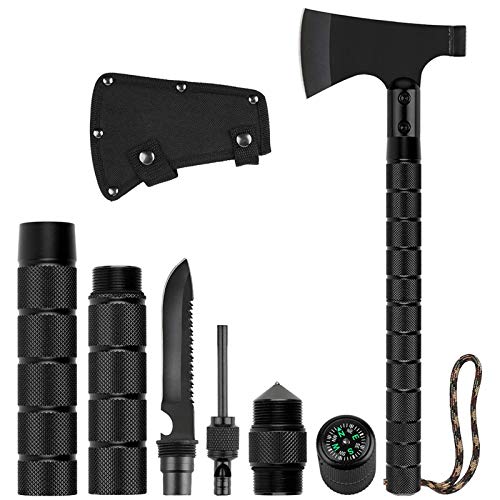
The best survival axes are the Gränsfors Bruk Scandinavian Forest Axe for serious wood processing, the Gränsfors Bruk Wildlife Hatchet for compact carry, and the Husqvarna 26-inch Forest Axe for a more affordable all-purpose option.
A survival axe has to do more than split logs: it should remain controllable when tired, carry safely, hold a useful edge, and process the sizes of wood you are realistically likely to encounter. The right choice depends less on maximum head weight than on matching head geometry, handle length, sheath quality, and portability to your trip.
As an Amazon Associate we earn from qualifying purchases at no extra cost to you.


Our Top Picks


Top 3 picks at a glance
Quick comparison of the best survival axes
| Model | Approx. head weight | Approx. overall length | Handle material | Best use | Typical market range |
|---|---|---|---|---|---|
| Gränsfors Bruk Wildlife Hatchet | About 1 lb | About 13.5 in | Hickory | Packable camp chores, kindling, limbing | Usually $150–$200 |
| Gränsfors Bruk Scandinavian Forest Axe | About 1.5 lb | About 25 in | Hickory | Balanced trail and firewood work | Usually $180–$250 |
| Husqvarna 26-inch Forest Axe | About 1.7 lb | About 26 in | Hickory | General outdoor use and value | Usually $70–$120 |
| Council Tool Wood-Craft Pack Axe | About 2 lb | About 19 in | Hickory | Compact chopping with more authority | Usually $80–$130 |
| Fiskars X7 Hatchet | About 1.4 lb | About 14 in | Fiber-reinforced composite | Low-maintenance camping and yard work | Usually $35–$60 |
| Fiskars X27 Splitting Axe | About 3.5 lb | About 36 in | Fiber-reinforced composite | Efficient splitting at a base camp | Usually $60–$100 |
Weights and dimensions are approximate because product variants and regional specifications can differ. The table is intended for comparing size classes, not replacing the manufacturer’s specification sheet.
Head weight: power versus control
Head weight determines how much momentum the axe can deliver, but it does not determine performance by itself. A heavier head can split larger rounds with fewer swings, while a lighter head is easier to place accurately and less tiring during repeated limbing or carving.
- Under 1.5 lb: Best for kindling, small branches, food preparation, light limbing, and emergency carry. The Wildlife Hatchet and Fiskars X7 fit this class.
- About 1.5–2.25 lb: The most versatile range for a vehicle kit, cabin, or longer backcountry trip. It offers useful chopping power without becoming cumbersome.
- Over 3 lb: Better suited to splitting rounds at a fixed camp than carrying on foot. The Fiskars X27 is effective for this job but is too large for most personal survival kits.
A useful way to estimate the trade-off is to compare swing energy. If a 1.5 lb head moves at roughly 45 feet per second, its idealized kinetic energy is about 47 foot-pounds. A 2 lb head moving at 40 feet per second produces about 45 foot-pounds. The lighter axe can therefore deliver similar energy while being easier to accelerate and control. Real cutting performance also depends on edge geometry, handle technique, impact losses, and wood species.
Head-to-head: the leading choices
Best overall: Gränsfors Bruk Scandinavian Forest Axe
The Scandinavian Forest Axe is a strong all-rounder for users who want one traditional axe rather than a hatchet and a splitting tool. Its roughly 25-inch hickory handle gives better leverage than a short hatchet, while its moderate head weight remains manageable for limbing, shelter work, and splitting medium firewood.
Its polished carbon-steel head is typically supplied with a protective leather sheath. The edge can be sharpened to a keen working profile, but carbon steel requires drying and occasional oiling after wet use. The long handle improves reach and reduces the need to crouch, though it is less convenient to strap outside a small daypack.
Best packable traditional axe: Gränsfors Bruk Wildlife Hatchet
The Wildlife Hatchet is a better fit when portability matters more than large-log performance. Its short hickory handle allows accurate one-handed work, but that same compact format limits leverage and makes it a poor choice for sustained splitting.
It is particularly useful for making kindling, removing small limbs, cutting notches, and processing deadfall up to modest diameters. The supplied leather sheath is generally more protective and secure than the thin slip covers found on inexpensive hatchets. For backpacking, place it inside or firmly secure it to the pack so the head cannot snag vegetation or equipment.
Best value full-size option: Husqvarna 26-inch Forest Axe
The Husqvarna 26-inch Forest Axe offers a practical middle ground. Its hickory handle and medium-weight head provide enough reach for general wood processing without the bulk of a dedicated splitting axe. It is a sensible choice for a truck kit, cabin, or regular camping where the axe will see real use but does not need premium finishing.
Edge sharpness and sheath design can vary by regional package, so inspect the head-to-handle fit and the included cover before relying on it. If the sheath is basic, replacing it with a rigid, retention-focused cover is a worthwhile safety upgrade.
Best compact heavy hitter: Council Tool Wood-Craft Pack Axe
A pack axe around 19 inches with a roughly 2 lb head is a useful compromise for users who find a hatchet underpowered but do not want a 26-inch handle. The Council Tool Wood-Craft Pack Axe is designed around that role: more authority for chopping and splitting, while remaining shorter and easier to transport than a forest axe.
The extra head mass increases fatigue during fine work. Use it for processing medium firewood and reserve delicate carving or precise notching for a lighter tool.
Best low-maintenance option: Fiskars X7 Hatchet
The Fiskars X7 uses a composite handle rather than hickory, which makes it resistant to ordinary moisture and eliminates the need to maintain a wooden handle. Its molded grip and included sheath make it convenient for casual camping and emergency vehicle storage.
The trade-off is different serviceability. A damaged composite handle is not replaced in the same way as a traditional wooden haft, and some users prefer the impact feel and repairability of hickory. Its coated blade is designed for practical durability, but sharpening should follow the manufacturer’s recommended angle rather than aggressively thinning the edge.
Decision matrix: which axe fits your situation?
| Your situation | Recommended class | Why | Avoid |
|---|---|---|---|
| Backpacking with limited pack space | 12–14 inch hatchet, about 1–1.5 lb | Lowest carry burden and good control for small fuel | 36-inch splitting axes |
| Vehicle emergency kit | 14–20 inch axe, about 1.5–2.25 lb | More chopping power without excessive storage space | Very small hatchets if large limbs are possible |
| Cabin or established base camp | 24–28 inch forest axe | Better leverage and less fatigue for repeated work | Short handles for sustained splitting |
| Mainly splitting seasoned rounds | 30–36 inch splitting axe | Long handle and wedge-shaped head separate fibers efficiently | Thin forest-axe heads used as mauls |
| Wet climate or infrequent maintenance | Composite-handle model | Less concern about handle swelling, drying, and finish care | Leaving carbon-steel heads wet in a sheath |
Handle materials and ergonomics
Hickory remains the traditional choice because it combines shock absorption, strength, and the ability to replace the handle if it eventually breaks. Look for straight grain running along the handle, no deep knots near the eye, and a head that does not move when the axe is shaken.
Composite handles are convenient and weather-tolerant. They are often a good match for a vehicle or emergency kit that may sit unused for months. Their molded shapes can provide consistent grip, but replacement options are more limited than with a standard wooden haft.
Handle length also changes technique. A short hatchet is easier to control close to the body, but it demands careful foot placement and should not be swung between the legs. A longer axe generates more leverage and reach; it should be used with a clear swing path and both hands when chopping.
Edge retention and sharpening
Edge retention depends on steel hardness, edge angle, wood contamination, and impact conditions. No axe edge stays sharp after striking dirt, embedded metal, or frozen knots. A durable field edge is usually slightly thicker behind the apex than a carving edge, reducing chips while still biting into softwood.
- Use a file for repairing small rolls or nicks and for controlled reshaping.
- Use a sharpening puck or stone for final refinement and burr removal.
- Sharpen from both sides and preserve the manufacturer’s general convex profile.
- Stop when the edge cuts cleanly; excessive polishing removes metal without improving useful chopping.
- Dry carbon-steel heads immediately and apply a thin protective oil before storage.
Sheath quality and safe portability
A sheath is part of the survival system, not an accessory. It should cover the entire edge, resist being pulled off when the axe is handled, and keep the head from contacting pack fabric. Leather is durable and repairable but needs drying and conditioning. Molded polymer or composite covers tolerate wet conditions better, provided their retention is positive and their fasteners are not fragile.
Before carrying an axe, perform three checks: tug the sheath from several directions, verify that no edge is exposed, and secure the handle so it cannot swing into your legs or another person. Do not attach a heavy axe loosely to the outside of a pack merely because the sheath fits.
Wood-processing ability: what these axes can and cannot do
A forest axe with a relatively thin, moderately curved bit is intended to cut across grain and remove chips. It can split smaller pieces, but it is not optimized for forcing apart large rounds. A splitting axe has a wider, more convex wedge that turns the fibers apart; it is faster for firewood but less suitable for precise cuts and limbing.
For survival use, choose wood that is within the tool’s practical size range rather than trying to make one axe perform every task. A hatchet is efficient on branches roughly wrist-sized and smaller. A 24–26 inch forest axe is more comfortable for medium deadfall and firewood. Larger rounds are safer and more efficient with a full-size splitting axe, wedges, and a stable chopping block.
Frequently asked questions
How should I store a carbon-steel axe after using it in wet conditions?
Dry the head thoroughly and apply occasional oil after wet use. Carbon-steel heads should not be left wet inside a sheath, because moisture can promote deterioration. Store the axe with its protective cover fitted only after the head is dry, and inspect the sheath periodically. A composite-handle model requires less handle maintenance, but its blade still needs appropriate care.
Can a short hatchet replace a full-size forest axe?
A short hatchet cannot fully replace a full-size forest axe for sustained processing of larger wood. It is easier to control and useful for kindling, small branches, light limbing, notches, and modest deadfall. A longer forest axe provides more leverage, reach, and chopping power, making it better for repeated work and medium firewood, though it is less convenient to carry.
What should I inspect before relying on an axe outdoors?
Inspect the head-to-handle fit, handle grain, sheath, and edge before relying on an axe outdoors. Hickory handles should have straight grain and no deep knots near the eye, and the head should not move when the axe is shaken. Check that the sheath protects and retains the head securely, especially if the axe will be carried on a pack.
Is the Fiskars X7 suitable for processing large firewood?
The Fiskars X7 is better suited to light camping and yard work than to processing large firewood. Its approximately 1.4 lb head and 14-inch length favor portability, control, kindling, small branches, and light limbing. Larger or repeated firewood work benefits from a longer axe with a heavier head, while dedicated splitting is better handled by a 30–36 inch splitting axe.
How should I choose between a wooden and composite handle?
Choose hickory when shock absorption, traditional feel, and handle replaceability matter most. Choose a composite handle when moisture resistance and low maintenance are priorities, such as for a vehicle or emergency kit stored for months. Hickory requires attention to drying and finish care, while a damaged composite handle is not replaced in the same way as a wooden haft.
Final recommendation
Choose the Gränsfors Bruk Wildlife Hatchet when minimum size and precise camp work matter most. Choose the Gränsfors Bruk Scandinavian Forest Axe when you want the best balance of portability, edge quality, handle leverage, and general wood processing. Choose the Husqvarna 26-inch Forest Axe for strong all-purpose performance at a lower market price, or the Fiskars X7 when weather resistance and low maintenance outweigh traditional handle replaceability.
Whichever model you select, prioritize a secure sheath, a sound handle-to-head fit, and a sharpening method you will actually carry. Those details usually matter more in the field than a small difference in head weight or decorative finish.