The best workstation kitchen sinks for most remodels are the Kraus KWT310-30 Kore for a 30-inch cabinet, the Ruvati RVH8300 for a spacious 33-inch installation, and the Kohler Prolific K-5540 when flexible accessories and a premium workstation layout matter more than price.
A workstation sink combines a deep basin with built-in ledges that support accessories such as cutting boards, colanders, drying racks, and grids. The right choice depends less on the longest accessory list than on cabinet clearance, basin geometry, installation method, sound control, and how often you prepare food directly at the sink.
As an Amazon Associate we earn from qualifying purchases at no extra cost to you.



Our Top Picks
 Lordear 33 Inch Undermount Kitchen Sink Workstation 33"x19"x10"33x19x10 Inch19 x 33 x 10 inches37.1 poundsCheck on Amazon
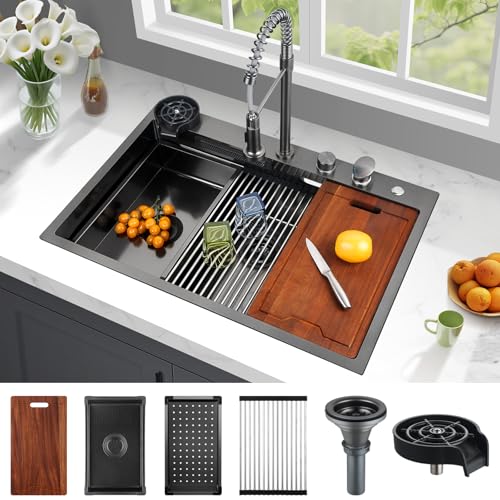 Kunoqi 33x22 Inch Kitchen Sink with Waterfall Faucet33"Lx22"Wx10"H22 x 33 x 10 InchesCheck on Amazon


Top 3 picks at a glance
Best workstation kitchen sinks compared
| Model or class | Approximate outside size | Basin depth | Material | Installation | Typical market range |
|---|---|---|---|---|---|
| Kraus KWT310-30 Kore | 30 in. wide × 22 in. front-to-back | About 10 in. | 16-gauge stainless steel | Undermount, with some configurations supporting flush or top-mount use | Usually $400–$600 |
| Ruvati RVH8300 | About 33 in. wide × 22 in. front-to-back | About 10 in. | 16-gauge stainless steel | Undermount | Usually $400–$650 |
| Kohler Prolific K-5540 | About 33 in. wide × 20 in. front-to-back | Approximately 9 in. | Stainless steel | Undermount | Usually $800–$1,200 |
| 30-inch workstation class | Approximately 30 × 18–22 in. | 9–10 in. | 16- or 18-gauge stainless steel | Undermount, top-mount, or dual-mount | Usually $250–$700 |
| 33–36-inch workstation class | Approximately 33–36 × 20–24 in. | 9–10 in. | Stainless steel, fireclay, or composite granite | Mostly undermount; some farmhouse options | Usually $500–$1,500 |
Dimensions and included accessories can vary by revision and configuration, so confirm the manufacturer’s current cutout drawing before ordering. The outside width is not the same as the countertop cutout or minimum cabinet width.
Head-to-head: which sink fits your kitchen?
Kraus KWT310-30 Kore: best all-around 30-inch option
The KWT310-30 Kore is a strong choice when the sink cabinet is limited to 30 inches. Its single bowl is large enough for sheet pans and stockpots, while the integrated ledges create a usable prep surface without requiring a separate cutting board over the sink.
Its main advantage is balance: a roughly 30-inch footprint, a deep single basin, stainless-steel construction, and a practical accessory system. A 10-inch basin can accommodate tall cookware, but it may require more bending than a shallower sink. The included or compatible accessories typically make the most sense when you regularly rinse vegetables, drain pasta, or move prepared ingredients directly from the sink to the counter.
Allow room behind the sink for the faucet, soap dispenser, backsplash, and any countertop seam. In a narrow cabinet run, the front-to-back dimension can be more restrictive than the sink’s width.
Ruvati RVH8300: best for maximum prep room
The RVH8300 is aimed at kitchens with a 33-inch sink cabinet and enough counter space to benefit from a wider basin. Its approximately 33-by-22-inch footprint gives large cookware more clearance and leaves the workstation ledges less crowded when a colander and cutting board are used together.
This size is especially useful for batch cooking, washing large vegetables, or cleaning baking trays. The trade-off is cabinet commitment: replacing a smaller sink with a 33-inch model may require cabinet modification, and a wide bowl filled with water becomes heavy. Check that the cabinet base, plumbing, and garbage-disposal position can support the installation.
The RVH8300 and similar stainless models commonly use sound-dampening pads and an undercoating. These reduce metallic ringing, but they do not make the sink silent. Running water, dishes striking the basin, and the disposal will still be audible.
Kohler Prolific K-5540: best premium accessory flexibility
The Kohler Prolific K-5540 takes a different approach from a simple sink with one cutting board. Its tiered design allows accessories to sit at different heights, so a rack, pan, colander, or basin can occupy the sink without necessarily blocking the entire bowl.
This is valuable when the sink functions as a prep station and cleanup area at the same time. For example, a colander can drain above the bottom of the basin while the lower area catches water and scraps. The approximately 33-inch width provides generous workspace, but the premium price and larger cabinet requirement make it a poor fit for a compact kitchen.
Compare accessory storage before buying. A sophisticated tier system is useful only if the cutting board and racks have a place to dry and do not need to be stacked on the counter after every use.
Decision matrix: choose by situation
| Your situation | Best fit | Why | Watch out for |
|---|---|---|---|
| 30-inch sink cabinet | 30-inch workstation sink such as the Kraus KWT310-30 | Large single basin without requiring a wider cabinet | Confirm the exact minimum cabinet width and cutout |
| Frequent baking or large cookware | 33–36-inch single bowl | More room for sheet pans and stockpots | Greater weight, cost, and cabinet commitment |
| Small or short user | 8–9-inch basin with rounded corners | Less reaching and easier access to the bottom | Very large pots may not sit fully below the waterline |
| Renter or countertop replacement | Top-mount or dual-mount workstation sink | More forgiving installation and countertop support | Raised rim interrupts wiping debris into the bowl |
| Minimalist stone countertop | Undermount stainless or composite sink | Clean edge and easy counter-to-basin sweeping | Requires a properly finished countertop cutout |
| Need accessories at several heights | Kohler Prolific-style tiered workstation | Rack, board, and colander can be used together | Higher cost and more parts to clean |
Dimensions and cabinet fit matter more than the product name
Start with the cabinet, not the countertop opening. Measure the inside width of the sink base cabinet at its narrowest point, including face-frame obstructions. A sink marketed as “30-inch” may require a 33-inch cabinet, while a sink with a 30-inch outside width may fit a cabinet only if the plumbing and mounting rails leave enough side clearance.
Use this simple clearance calculation:
Available sink width = inside cabinet width − left clearance − right clearance.
For example, if the cabinet interior is 31 inches wide and the installation requires 1 inch of clearance on each side, the practical maximum is about 29 inches. A 30-inch sink may therefore be unsuitable even though its label sounds compatible.
Also measure front-to-back space from the cabinet face to the wall or backsplash. A 22-inch-deep sink can leave little room for a faucet, rear ledge, windowsill, or countertop support. Check the drain location too: a centered drain can interfere with a disposal, while an offset drain may leave more usable cabinet storage.
Workstation accessories: useful versus decorative
- Sliding cutting board: Choose one that spans the ledges securely and can be lifted out for cleaning. Wood needs drying space; composite boards are easier to maintain.
- Roll-up rack: Useful for rinsing produce and air-drying dishes, but verify its width and weight rating. It should not bow into the drain.
- Colander: A fitted colander is more stable than a generic one perched on the rim. Look for drainage that does not empty onto the countertop.
- Basin rack: A bottom grid protects the finish from cookware and improves drainage, but it also reduces effective basin height.
- Drain cover or basket: Check whether it is compatible with a garbage disposal and whether food debris can be removed without touching the waste.
Do not count accessories as equal value. A sink with two excellent, washable accessories can be more useful than one with six pieces that are difficult to store or clean.
Material, gauge, and noise control
Stainless steel is the safest general-purpose material for a workstation sink because it tolerates hot pans, resists chipping, and is relatively light. Sixteen-gauge steel is thicker than 18-gauge steel and generally feels more substantial, although geometry, bracing, and undercoating also affect rigidity and noise.
Composite granite sinks offer muted sound and strong color options, but they are heavier and can be more vulnerable to damage from severe impact or thermal shock. Fireclay can provide a distinctive farmhouse appearance, yet it is heavy and usually demands more careful cabinet and countertop preparation. Its integrated ledges and accessory compatibility may also be less universal than those of stainless workstation models.
Look for full coverage of sound-deadening pads rather than a single small patch. A sprayed or bonded undercoating can reduce vibration. Even so, cabinet insulation, correct mounting, and a properly supported disposal often have more effect on perceived noise than gauge alone.
Installation types and practical trade-offs
Undermount
Undermount installation places the sink below the countertop edge. It gives the cleanest appearance and lets you sweep crumbs directly into the basin. It requires a compatible solid-surface countertop, accurate fabrication, and a secure support system. A deep workstation sink should not hang from adhesive alone; follow the sink and fabricator’s support instructions.
Top-mount
Top-mount sinks rest on the countertop and are generally easier to install or replace. The rim provides support and hides less-perfect cut edges, but it creates a raised boundary around the sink. This can interfere with sliding workstation accessories and makes wiping debris into the basin less seamless.
Farmhouse or apron-front
Apron-front workstation sinks can be visually striking, but the cabinet must be modified for the exposed front. Confirm apron height, cabinet rail removal, countertop overhang, and support framing before ordering. Their weight makes professional installation particularly sensible.
Frequently asked questions
Can a 30-inch workstation sink fit in any 30-inch sink cabinet?
No, the label alone does not confirm compatibility. Measure the cabinet’s narrowest inside width, including face-frame obstructions, then subtract the required left and right clearances. A sink with a 30-inch outside width may still need more cabinet space for plumbing or mounting rails. Confirm the manufacturer’s current cutout drawing and minimum cabinet width before ordering.
How deep should a workstation sink be for a shorter user?
An 8–9-inch basin may be easier for a shorter user because it requires less reaching to access the bottom. A deeper basin can accommodate tall cookware, but it may require more bending. Very large pots may not sit fully below the waterline in a shallower sink. Basin depth should therefore balance cookware needs with comfortable daily access.
Which workstation accessories are most useful for everyday prep?
A secure sliding cutting board, roll-up rack, fitted colander, and basin rack are among the most practical accessories described. Their value depends on stability, drainage, weight capacity, and ease of cleaning. A roll-up rack can help rinse produce or air-dry dishes, while a basin rack protects the finish but reduces effective basin height. Storage space also matters.
What should I check if I want to use a garbage disposal?
Check the drain location and the drain basket or cover’s disposal compatibility before buying. A centered drain can interfere with a garbage disposal, while an offset drain may preserve more usable cabinet storage. Also consider whether food debris can be removed without touching the waste. The cabinet base, plumbing, and disposal position must support the installation.
Is stainless steel better than composite granite or fireclay for this type of sink?
Stainless steel is the safest general-purpose choice because it tolerates hot pans, resists chipping, and is relatively light. Composite granite offers muted sound and strong color options but is heavier and may be more vulnerable to severe impact or thermal shock. Fireclay provides a farmhouse appearance but is heavy and usually requires more careful cabinet and countertop preparation.
Bottom line
Choose the Kraus KWT310-30 Kore when you want a capable workstation sink for a 30-inch cabinet, the Ruvati RVH8300 when large-scale food preparation justifies a 33-inch basin, and the Kohler Prolific K-5540 when tiered accessories and premium flexibility are worth the added cost. Before comparing finishes or accessory counts, verify cabinet width, cutout dimensions, basin depth, faucet clearance, drain position, and the support requirements for your countertop.