The best powered subwoofers for deep, clean bass in 2026 are the SVS SB-1000 Pro for compact rooms, the RSL Speedwoofer 10S MKII for high value, and the SVS PB-1000 Pro when maximum low-end output matters more than cabinet size.
A powered subwoofer has its own amplifier, so the useful comparison is not simply “how many watts?” Look at clean output at listening distance, extension below 30 Hz, cabinet volume, crossover and phase controls, and whether the enclosure suits your room. A subwoofer that reaches 17 Hz on paper can still sound weak if it is placed badly or pushed beyond its comfortable output.
As an Amazon Associate we earn from qualifying purchases at no extra cost to you.


Our Top Picks

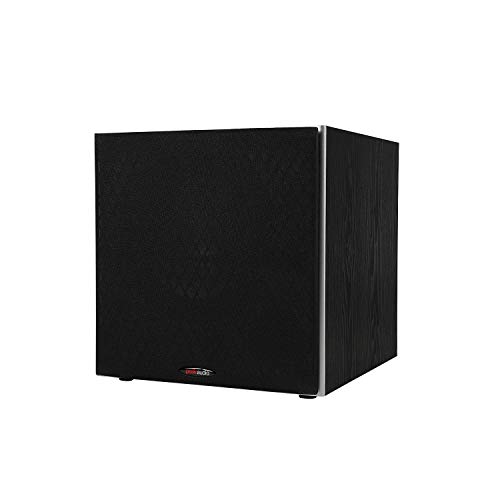

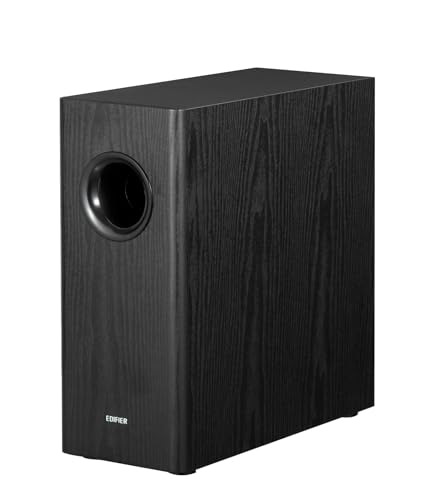
Top 3 picks at a glance
Best powered subwoofers compared
| Model | Design and driver | Amplifier rating | Useful extension | Approx. cabinet size | Best suited to |
|---|---|---|---|---|---|
| SVS SB-1000 Pro | Sealed, 12-inch | 325 W RMS, 820 W peak | About 20 Hz at moderate levels | 13.5 × 13 × 15.6 in | Small to medium rooms, music and games |
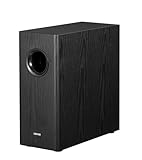
| RSL Speedwoofer 10S MKII | Ported, 10-inch | 350 W RMS | About 24 Hz, with strong mid-bass output | Approximately 15 × 15 × 19 in | Desktop or living-room gaming on a budget |
| SVS PB-1000 Pro | Ported, 12-inch | 325 W RMS, 820 W peak | About 17 Hz | Approximately 15 × 18.9 × 23.3 in | Medium to large rooms and cinematic effects |
| REL HT/1003 MKII | Sealed, 10-inch | 300 W RMS | Roughly 24–30 Hz depending on level | Approximately 12.8 × 11.8 × 13.5 in | Compact systems needing simple integration |
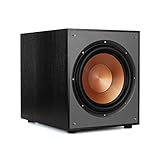
| Klipsch Reference R-121SW | Ported, 12-inch | 400 W RMS, 800 W peak | About 28 Hz in typical use | Approximately 16.3 × 14.5 × 19.2 in | High-impact gaming and home theater |
Extension figures are useful comparisons rather than guarantees of identical loudness. Manufacturer frequency ranges are commonly measured under different conditions, and room gain can make a compact subwoofer appear to reach lower than it does in an open-field measurement.
Head-to-head: which model fits your room?
SVS SB-1000 Pro: the safest compact-room choice
The SB-1000 Pro is the strongest all-round recommendation when you want deep bass without a large ported cabinet. Its sealed enclosure is easier to position near a desk, sofa, or front wall, and its app provides unusually useful control over volume, low-pass filtering, phase, and parametric equalization.
Its 12-inch driver gives it more authority than many small 8- and 10-inch subs, while the sealed design avoids port noise and has a controlled response. It will not move as much air as the PB-1000 Pro below 25 Hz, but it is often the better choice for a small room where excessive low-frequency energy creates booming rather than useful impact. It usually sits in the $500–$700 range.
RSL Speedwoofer 10S MKII: the value and placement-flexibility pick
The Speedwoofer 10S MKII combines a compact 10-inch driver with a ported cabinet and a wireless input option. That makes it practical for a gaming setup where running a long RCA cable is difficult. It is particularly effective for explosions, engine noise, and kick drums because its output through the upper bass region is strong.
The trade-off is less extreme sub-20-Hz authority than a larger ported 12-inch model. For a bedroom, office, or modest living room, that is rarely a serious limitation. Its high-level input also helps with systems that do not provide a dedicated subwoofer output. Expect a general market price around $450–$600, depending on availability and configuration.
SVS PB-1000 Pro: the deep-bass specialist
Choose the PB-1000 Pro if your priority is the physical rumble of large game environments, science-fiction effects, and movie soundtracks. Its ported 12-inch enclosure is substantially larger than the SB-1000 Pro, but the ports allow it to produce more output in the lowest octave with less amplifier strain.
This is the better option for a medium or large room, especially when the listening position is several metres from the subwoofer. It is also more likely to expose room modes, so placement and equalization matter. The cabinet is too large for many desks and can dominate a small room visually. It commonly falls around $600–$900.
REL HT/1003 MKII: compact, simple, and controlled
The HT/1003 MKII is a sensible choice when you want a small sealed subwoofer with a straightforward control layout. Its 10-inch driver and 300-watt amplifier are well matched to compact gaming and stereo systems. The sealed cabinet is easy to place beside furniture, and its relatively restrained low-frequency character can be preferable in an apartment.
It does not offer the same deep-bass headroom as the PB-1000 Pro, and its connectivity and app-based adjustment are less comprehensive than SVS’s. Choose it for size, simplicity, and integration rather than maximum output. Typical pricing is around $500–$700.
Klipsch R-121SW: high-impact output for larger spaces
The R-121SW uses a front-firing 12-inch driver in a ported cabinet and is aimed at people who want obvious physical impact. It can make gaming soundtracks feel energetic at moderate-to-loud levels, particularly in rooms where a smaller sealed model runs out of headroom.
Its published low-frequency extension is not as ambitious as the PB-1000 Pro’s, so it is better described as a high-output, punchy option than an ultra-deep specialist. It also provides fewer sophisticated room-correction tools. Market pricing commonly ranges from $450–$700.
Decision matrix: match the subwoofer to your setup
| Your situation | Recommended choice | Why | Starting crossover |
|---|---|---|---|
| Desk or room under 150 sq. ft. | REL HT/1003 MKII or SVS SB-1000 Pro | Compact cabinets and controlled bass reduce boom | 70–90 Hz |
| 150–300 sq. ft. multipurpose room | RSL Speedwoofer 10S MKII or SB-1000 Pro | Good balance of output, extension, and placement flexibility | 70–80 Hz |
| Over 300 sq. ft. or open-plan room | SVS PB-1000 Pro or Klipsch R-121SW | More air movement and headroom at the listening position | 60–80 Hz |
| Apartment or shared wall | SVS SB-1000 Pro or REL HT/1003 MKII | Sealed designs can be easier to moderate and less physically intrusive | 60–80 Hz |
| No convenient RCA cable route | RSL Speedwoofer 10S MKII | Wireless connectivity simplifies placement | 70–80 Hz |
How much bass extension do you actually need?
Game audio below 30 Hz is felt as much as heard. A subwoofer rated to 20 Hz is useful for cinematic effects, but only if it can produce that frequency at your normal listening level. If you listen at moderate volume in a small room, room gain may fill in the lowest octave. If you sit far away or play loudly, a larger ported cabinet provides more useful headroom.
As a practical calculation, suppose your room is 12 by 16 feet with an 8-foot ceiling: 1,536 cubic feet. A compact sealed 10-inch model can work well below roughly 2,000 cubic feet at moderate levels, but a ported 12-inch model gives more margin if you want reference-like movie volume. In an open-plan room, calculate the entire connected space rather than only the area around the desk; the subwoofer must pressurize the air volume that is acoustically connected.
Set up a powered subwoofer for clean bass
-
Start with placement. Put the subwoofer near the front wall, then try a corner and the midpoint of a wall. A corner increases output but can exaggerate room modes; a wall midpoint may sound smoother.
-
Set the crossover correctly. With an AV receiver or PC audio interface that applies bass management, begin at 80 Hz and disable the subwoofer’s own low-pass filter if possible. If the main speakers are tiny satellite units, try 90–110 Hz. Large bookshelf speakers may integrate better at 60–80 Hz.
-
Match phase. Play a bass line or repeating game effect, switch between 0 and 180 degrees, and keep the setting that produces fuller bass at the listening position. Variable phase controls let you refine the result between those positions.
-
Reduce the gain before increasing it. Set the subwoofer volume around the middle of its range, calibrate the system, then raise it only a few decibels if desired. Excess gain often creates one-note bass and masks dialogue.
-
Use equalization after placement. Equalization can cut a room peak, but it cannot make a small subwoofer deliver unlimited output at 18 Hz. If bass disappears at one seat and booms at another, move the subwoofer or listening position before applying more EQ.
Final buying advice
For the broadest combination of deep extension, compact size, control, and placement flexibility, choose the SVS SB-1000 Pro. The RSL Speedwoofer 10S MKII is the value-oriented alternative, especially when wireless placement helps. Select the SVS PB-1000 Pro when low-frequency output across a larger room is the priority, and choose the REL HT/1003 MKII when a compact sealed design matters more than maximum volume. The Klipsch R-121SW remains a good high-impact option when you want strong output without paying primarily for app-based tuning.