Geofencing sounds simple: the thermostat watches where your phone is and eases the heating or cooling back once everyone has left the house. The decision behind a search for thermostats with geofencing is narrower than a general smart-thermostat shopping trip, though. You are deciding whether location-based control is worth paying for over a plain schedule, and whether the model you pick actually advertises that feature or merely sits in a Wi-Fi family that might offer it through an app.
This guide is for households with irregular routines: shift workers, parents who drive between school and appointments, anyone whose weekly schedule never repeats. A fixed seven-day program wastes energy when plans change, and phone-based presence detection fills that gap. A thermostat that notices your phone leaving the neighborhood can drop a setpoint on a Tuesday afternoon that no calendar would have predicted, and it can start recovering the house as you drive back. Heading into 2026, the shortlist below separates the listings that name geofencing in their title from the Wi-Fi models where you will need to confirm the feature yourself. Read the entries as a compatibility-first checklist: wiring and system type decide what can be installed, and the geofencing claim decides whether the feature you came for is really there.
Our Top Picks
 Honeywell Home T5 Smart Wi-Fi Thermostat3.5 x 3.5 inches (1-Pack)4.1 x 1.1 x 4.1 inches0.2 poundsCheck on Amazon


Top 3 picks at a glance
Quick Picks
As an Amazon Associate we earn from qualifying purchases at no extra cost to you.



| Product | Best for | Key spec from the title |
|---|---|---|
| Honeywell Home T5 | Geofencing plus a touchscreen | Geofencing technology, 7-day programmable, C-wire required |
| Honeywell Home T5 Plus | Flexible scheduling with location control | Geofencing technology, 7-day flexible programming |
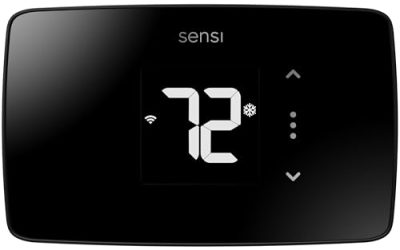
| Sensi Smart Thermostat ST55 | DIY installers on a mid-range budget | Wi-Fi, DIY, Energy Star certified |
| Sensi Lite ST25 | Entry-level Wi-Fi control | Wi-Fi, Alexa, DIY, Energy Star certified |
| Honeywell Lyric T6 Pro | Heat pump or two-stage systems | Up to 2 heat/1 cool heat pump, or 2 heat/2 cool conventional |
How to Choose
Confirm the geofencing claim, not just the Wi-Fi badge
Only two listings here put geofencing in the product title. For any other Wi-Fi thermostat, open the manufacturer feature list or the companion app description and look for the words “geofence,” “location,” or “away mode based on phone.” If it is not spelled out, assume you are buying a scheduler with remote control rather than true presence detection. Retailer titles are often written for search engines, and a missing keyword is a prompt to verify, not proof that the feature is absent.
Check wiring and system type first
A thermostat that cannot talk to your furnace is useless. Count the wires behind the current unit, look for a C-wire (common wire) for constant power, and note whether you run single-stage, two-stage, or heat pump equipment. The T5 title states a C-wire is required, and the Lyric T6 Pro title lists stage support for 2 heat/1 cool heat pump or 2 heat/2 cool conventional systems. Match those numbers to your equipment before ordering. Photograph the existing wiring and the labels on the terminals before you remove anything; that single image answers most compatibility questions and makes a return or a support call far easier.
Understand how geofencing actually behaves
Geofencing relies on the phone’s location services and a battery-friendly radius around the house. Look for multi-user support if two adults share the home, since a thermostat that follows only one phone will set the house to away while the other person is still inside. Also check how wide the radius can be: a tight fence triggers on short errands, a wide one saves energy only on longer trips. A radius of roughly a mile or two suits most suburban commutes, while city dwellers with short trips often prefer a smaller fence plus a conservative away temperature.
Ignore the extras you will not use
Voice assistant support, color touchscreens, and Energy Star badges are pleasant but do not change how well location control works. Budget models usually cut the display quality and the number of programmable periods, so decide whether you will interact with the unit at the wall or almost entirely through the app. If guests, children, or roommates need to adjust the temperature, a wall display with clear buttons beats an app-only experience every time.
The 5 Best Options
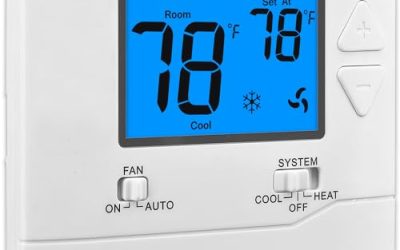
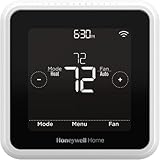
Honeywell Home T5
The T5 is the most direct answer to the keyword, because its title names geofencing technology alongside a 7-day programmable touchscreen and Alexa readiness. It suits homeowners who want a wall display they can adjust by hand plus phone-based away control. The Energy Star mention supports its efficiency positioning, and the Alexa-ready label means voice control can be added without extra hardware beyond a compatible speaker. Households that already run a voice assistant will find it slots into the routine easily.
- Strength: geofencing is stated outright, so there is no guesswork about the headline feature.
- Strength: a seven-day touchscreen schedule gives a sensible fallback when location data is unreliable.
- Trade-off: the title says a C-wire is required, which rules out some older homes without a rewiring step.
Skip it if your wall has only four wires and you do not want to run an adapter or add a wire.
Honeywell Home T5 Plus
The T5 Plus carries the same geofencing language and adds “7 day flexible programming” to a Wi-Fi touchscreen design, finished in black. It fits buyers whose weekdays differ from each other, such as people with rotating shifts, because flexible scheduling pairs well with location awareness. Together they cover both predictable and unpredictable days. The Wi-Fi touchscreen format also keeps manual control on the wall for family members who never open an app.
- Strength: geofencing and flexible programming appear in the same listing.
- Strength: the black touchscreen finish suits darker wall plates and modern interiors.
- Trade-off: the title gives no stage or heat pump details, so system compatibility needs a manual check.
Skip it if you want the cheapest possible entry point or a thermostat without a touchscreen.
Sensi Smart Thermostat ST55
The ST55 is a Wi-Fi, DIY-installable, Energy Star certified model with Alexa support. It is aimed at buyers who want to install the unit themselves in an afternoon and control it from a phone. It is also a reasonable choice for second homes or vacation properties, where remote adjustment matters more than wall-level features. The title does not mention geofencing, so treat location control as something to verify in the app before you commit.
- Strength: the DIY label signals a straightforward install for confident homeowners.
- Strength: Energy Star certification helps if your utility offers efficiency incentives.
- Trade-off: no geofencing statement in the listing, so you may be buying remote scheduling only.
Skip it if location-based away mode is the whole reason for the purchase and you want it confirmed on the box.
Sensi Lite ST25
The Sensi Lite sits at the entry end of the same family: WiFi, Alexa, DIY, and Energy Star certified. It works for rental-friendly upgrades and for spare bedrooms or secondary zones where a premium unit would be overkill. Landlords and owners of small apartments who want remote visibility without a large outlay will find the positioning sensible. As with the ST55, the listing does not claim geofencing.
- Strength: a simple, budget-tier path to app control without a touchscreen premium.
- Strength: DIY installation keeps labor costs at zero for handy owners.
- Trade-off: the title offers no location-based feature, and the model is positioned as the lite version.
Skip it if you want a built-in touchscreen or a verified geofencing feature.
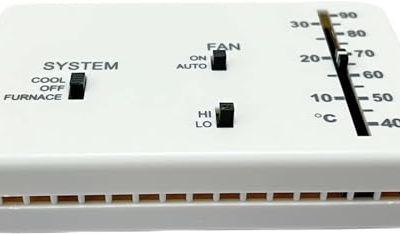
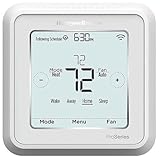
Honeywell Lyric T6 Pro
The Lyric T6 Pro, listed as TH6220WF2006/U, is a Wi-Fi programmable thermostat built for systems with up to 2 heat and 1 cool on a heat pump, or 2 heat and 2 cool on conventional equipment. It is the pick for homes with staged equipment that simpler thermostats cannot handle. Owners of dual-fuel or upgraded equipment often discover that a basic model leaves a stage unused, and that is the problem this listing addresses. Geofencing is not named in the title.
- Strength: explicit multi-stage and heat pump support covers more complicated HVAC setups.
- Strength: Wi-Fi programmability allows remote adjustments from anywhere.
- Trade-off: no geofencing mention, so the headline keyword feature must be confirmed separately.
Skip it if your system is a basic single-stage furnace and you would rather pay for a touchscreen.
Which One Fits Your Situation
You work rotating shifts
The Honeywell Home T5 Plus pairs geofencing with flexible programming, which handles weeks where the schedule changes daily. The location trigger covers the gaps the schedule cannot predict, and the flexible programming means you are not forced into the same pattern every weekday. Confirm your equipment type before ordering.
You want a wall touchscreen and a plainly stated geofencing feature
The Honeywell Home T5 is the straightforward choice, provided your wall has a C-wire. Both its display and its location feature are confirmed in the title. It also suits families where several people want to adjust the temperature at the wall without opening an app.
You have a heat pump or two-stage system
The Honeywell Lyric T6 Pro lists its stage support directly, which makes compatibility far less of a gamble than with a thermostat that lists only a brand name. If you later add a location-based routine through another system, the Wi-Fi connection leaves that door open.
You are on a tight budget and install things yourself
The Sensi Lite ST25 or the Sensi ST55 keep costs down. Choose the ST55 if you want the slightly more capable unit, and verify the geofencing feature in the app first. Both are DIY-friendly, so a weekend swap is realistic for most homeowners.
Common Mistakes
- Assuming every Wi-Fi thermostat includes geofencing. Many only provide remote control and schedules.
- Skipping the wire check and discovering at installation that a C-wire is required.
- Setting a geofence radius so small that a trip to the mailbox flips the house into away mode.
- Forgetting to add every household member’s phone, which leaves the house in away mode while someone is home.
- Buying a single-stage thermostat for a heat pump or two-stage system, then wondering why auxiliary heat misbehaves.
Related guides
- Windows Macos Linux Gaming Performance Comparison Strengths Weaknesses
- Desktop Operating Systems Gaming Performance Strengths Weaknesses
- 5G Home Internet Wifi Modem Settings Low Latency Gaming
Frequently Asked Questions
Does geofencing work without a smartphone?
No. Geofencing depends on the location data from a phone running the thermostat’s app. Without a phone, the thermostat falls back to its programmed schedule.
Will geofencing drain my phone battery?
Most apps use low-power location checks, so the effect is usually small. Battery impact varies by phone settings, so review the app’s location permission options after setup.
Do I need a C-wire for a Wi-Fi thermostat?
Many Wi-Fi models need constant power, and the T5 listing says a C-wire is required. If your wall lacks one, look for a power adapter kit or a model that explicitly supports a no-C-wire install.
Is a programmable schedule still useful with geofencing?
Yes. The schedule handles predictable patterns like sleep and wake times, while geofencing handles the exceptions. Using both gives the most reliable savings.