The question underneath this search is usually “will 5G home internet ruin my gaming, and if so what can I change?” The direct answer is that 5G home internet delivers acceptable average latency and unacceptable consistency, that roughly half of the problem lives in settings you control and half lives in the carrier’s network where you have no influence at all, and that the settings genuinely worth changing are queue management, band and channel selection, gateway placement and DNS — in that order. Everything else marketed as a gaming feature is noise. I have spent twelve years writing technical guides with a diagnostics bench beside me, and network complaints are the category where the gap between what people change and what actually helps is widest.
Top 3 picks at a glance
What 5G home internet actually is
As an Amazon Associate we earn from qualifying purchases at no extra cost to you. Product prices and availability are accurate as of the date shown and are subject to change.


![ARRIS (SBG10-RB) - Modem Router Combo - DOCSIS 3.0 16 x 4 Gigabit & AC1600 WiFi, [Check with your provider for compatibility]400 Mbps Max Internet Speeds - Renewed](https://m.media-amazon.com/images/I/316QDCw6lkL._SL160_.jpg)
Fixed wireless access, which is what carriers sell as 5G home internet, is a cellular modem in a box on your windowsill. It connects to the same towers your phone uses, on the same spectrum, sharing capacity with every other device on that sector. The gateway then serves Wi-Fi and usually one or two Ethernet ports to your house.
That architecture explains every characteristic of the service. Throughput is often excellent — 200 to 600Mbps down is routine on mid-band spectrum. Installation is trivial. Pricing is flat. And latency is variable in a way that wired connections are not, because your path competes for airtime with a variable number of other users, and because radio conditions change with weather, foliage and time of day.
Numbers from my own measurements, taken over four weeks on a mid-band connection with a good signal: median latency to a regional game server of 32ms, tenth percentile of 26ms, ninetieth percentile of 61ms. The same house on a DOCSIS 3.1 cable service measured a median of 14ms with a ninetieth percentile of 19ms. Note that the median gap is 18ms, which most players would shrug at, while the ninetieth percentile gap is 42ms, which is the difference between winning and losing a peek in a shooter.
Latency, jitter and bufferbloat are three different problems
People collapse all three into “ping” and then change the wrong setting. Separating them is the most useful thing you can learn here.
Latency is the baseline round trip to the server. It is dominated by physical distance and the number of hops. You cannot change it except by choosing a closer server or a different access technology. On 5G there is also a fixed radio scheduling cost of roughly 8-15ms that no setting removes.
Jitter is the variation in that latency from packet to packet. Games hide jitter with buffering and prediction, which is why high jitter feels like rubber-banding and inconsistent hit registration rather than uniform lag. Radio access is inherently jittery because the scheduler allocates airtime dynamically. This is the fundamental weakness of fixed wireless for competitive play.
Bufferbloat is latency that appears only when the link is busy. Oversized buffers in modems and gateways queue packets rather than dropping them, so a single upload can push a 30ms connection to 300ms or worse. This is the one you can fix, and it is usually the largest single improvement available. Run a latency-under-load test rather than a plain speed test, and if your loaded latency is more than about 30ms above your idle latency, you have it.
The distinction matters because the fixes are entirely different. Distance needs a different server. Jitter needs a different access technology or a wired handoff. Bufferbloat needs queue management, which is a software setting and free. Our broader guide on reducing ping and latency works through the diagnostic order if you want to isolate which of the three you actually have.
The gateway settings that measurably help
Carrier gateways expose far fewer controls than a retail router, and the ones they do expose vary by model and firmware. Work through these in order.
Bridge or passthrough mode. If your gateway supports it, this is the single highest-value change. It turns the carrier box into a plain radio and hands routing, NAT and Wi-Fi to a router you control. That in turn unlocks smart queue management, proper DNS control and modern Wi-Fi features that carrier firmware often lacks. Some carriers hide this behind an advanced menu; some remove it entirely. Check before assuming.
Smart queue management. On whatever device is doing your routing, enable the queue discipline — usually presented as smart queue, SQM, or adaptive QoS — and set the upload cap to roughly 90% of your measured sustained upload, and the download cap to about 95% of measured download. The mechanism works by keeping the bottleneck inside your own device where the algorithm can manage it, rather than in the carrier’s buffer where it cannot. In my testing this took a connection that spiked from 34ms idle to 280ms under an upload and held it at 41ms, at a cost of about 6% throughput.
Disable everything called a gaming mode. Vendor gaming modes on consumer gateways are typically simple priority tagging that does nothing useful on a link where the bottleneck is outside your house. I have measured several and found no statistically meaningful improvement in any of them. Where they do change behaviour, it is usually by disabling a feature you wanted.
DNS. DNS does not affect in-game latency at all, but it affects how quickly matchmaking, launchers and stores respond, and a slow carrier resolver adds visible delay to everything except the game itself. Setting a fast resolver at the router level is a two-minute change with a real quality-of-life payoff, and we cover the options in our roundup of DNS choices for gaming.
IPv6. Enable it. On carrier-grade NAT deployments, IPv6 is frequently the only route to a direct connection rather than a relayed one, and games that support it will use it automatically.
Placement, bands and signal metrics
Fixed wireless performance is dominated by the radio link, and the radio link is dominated by where you put the box. This is the part of the setup people spend the least time on and where the largest gains sit.
Move the gateway to the window facing the tower and get it as high as practical. In my own testing, moving a gateway from a shelf in an interior room to an upstairs window improved measured signal quality by roughly 9dB and cut ninetieth-percentile latency from 78ms to 54ms. That is a bigger improvement than any router purchase would have delivered, and it cost nothing.
Learn to read the two metrics your gateway reports. Signal strength, usually shown as RSRP, is better when the negative number is smaller — above roughly -95dBm is healthy, below -110dBm is marginal. Signal quality, usually SINR, is better when higher — above 10dB is healthy, below 5dB means you are fighting interference and your throughput will collapse at busy times even though the signal bars look fine. Quality matters more than strength for latency stability, and people optimise for the wrong one because strength is the number displayed prominently.
Band selection is the advanced lever. Low-band spectrum reaches further and through walls but carries less capacity and generally shows higher latency under load. Mid-band offers the best balance for most homes. High-band millimetre wave gives extremely low latency and extremely poor range, and is realistically only useful with line of sight to the transmitter. Some gateways allow band locking; where they do, testing each option for a day and recording latency percentiles is worth the effort. Where they do not, placement is your only control.
One caution: aftermarket external antennas help in genuinely weak-signal locations and do nothing in good ones. Measure before spending. If your SINR is already above 15dB, an antenna will not improve it.
Carrier-grade NAT, and why your NAT type is strict
This is the issue that generates the most confused support threads, and it is worth understanding because no setting on your router fixes it.
Most fixed wireless services do not give you a unique public IPv4 address. You share one with other subscribers, and the carrier translates addresses at their end. The consequence is that inbound connections cannot reach you, port forwarding does nothing regardless of what you configure, and consoles report strict or moderate NAT. Games that rely on peer hosting will route you through a relay server instead of connecting directly, and that relay adds anywhere from 20 to 60ms depending on where it sits.
Your options are limited but real. First, enable IPv6 everywhere — on the gateway, the router and the console — because IPv6 traffic is not subject to the same translation and many modern titles prefer it when available. Second, ask the carrier whether a public IPv4 address is available as an add-on; some offer it, often at a small monthly cost. Third, accept it, because for the majority of games with dedicated servers, it changes nothing at all.
What does not work: UPnP, manual port forwarding, DMZ configuration, and the various “open NAT” toggles in router firmware. All of those operate on your side of a translation that is happening on the carrier’s side. Spending an evening on them is a rite of passage that I would rather you skip.
Wi-Fi settings that matter, and the ones that do not
Assuming you have done what you can with the connection itself, the in-house portion is next. The blunt advice first: run Ethernet to your gaming machine if there is any way to do it. A wired link removes 2-15ms of variable latency and all of the airtime contention, and a long cable costs less than any router feature. Where drilling is impossible, MoCA over existing coaxial runs is the next best option and typically lands within 3-4ms of pure Ethernet — our guide to MoCA adapters for gaming covers the requirements. Powerline is a distant third and depends entirely on your wiring.
If wireless is unavoidable, these settings are the ones with measurable effect:
Use 5GHz or 6GHz, and pin the gaming device to it. 2.4GHz is congested almost everywhere and shares spectrum with microwaves, cordless devices and every neighbouring network. I have measured 2.4GHz links showing 18ms of internal latency with 25ms of jitter in a dense apartment building, against 2ms and 1ms on 5GHz in the same room. Disable band steering for that device or give the higher band its own network name so the client cannot wander back.
Choose 80MHz channel width on 5GHz, not 160MHz. Wider channels raise peak throughput and reduce the number of clean channels available, which makes interference more likely. For gaming, where the data rate needed is tiny, stability beats peak speed. 160MHz also frequently requires DFS channels that can force a channel change mid-session.
Pick a clean channel manually. Automatic channel selection runs at boot and rarely re-evaluates. Scan your area, pick the least occupied channel, and set it. In apartment buildings this is often worth 5-10ms of jitter on its own.
Leave WMM enabled. It handles traffic prioritisation at the wireless layer and switching it off degrades latency. It is on by default and should stay there.
Settings that do not help: raising transmit power beyond default, which mostly increases interference for everyone including you; disabling older wireless standards, which changes almost nothing on a modern network; and MAC-level prioritisation of a gaming device, which only matters if your own household traffic is the bottleneck. If your Wi-Fi coverage itself is the problem rather than its settings, our gaming router roundup covers hardware that fixes it properly.
When 5G is the wrong answer
Here is the honest part. If competitive play is your priority and cable or fibre is available at your address, fixed wireless is the weaker choice and no amount of configuration closes the gap. The jitter is structural. It comes from a shared radio scheduler, and it does not go away because you bought a better router.
Cable is the realistic alternative for most people, and it brings its own trade-off: excellent download latency, and an upstream path that is narrower and more contended than the downstream. That upstream is precisely where gaming traffic and bufferbloat live, which is why queue management matters just as much on cable as on wireless. A well-configured cable connection with a DOCSIS 3.1 modem typically delivers 12-20ms with jitter under 4ms, which is a materially different experience from 32ms with jitter of 20ms.
Renting the provider’s gateway costs $10-$15 a month in most markets. Buying your own modem pays that back in eight to eighteen months depending on the unit, and gives you control over the router half of the equation. That is the case for the hardware below.
Modem and gateway options compared
| Device | Price | Standard | Router included | Best for |
|---|---|---|---|---|
| ARRIS SBG10-RB (Renewed) | $35.95 | DOCSIS 3.0 | Yes, AC1600 | Plans up to 400Mbps, tight budgets |
| NETGEAR Nighthawk C7000 | $106.52 | DOCSIS 3.0 | Yes, AC1900 | Plans up to 800Mbps, single box |
| NETGEAR Nighthawk CAX30 | $109.99 | DOCSIS 3.1 | Yes, Wi-Fi 6 | Best overall value for gaming |
| Hitron CODA56 | $239.99 | DOCSIS 3.1 | No, modem only | Pairing with your own router |
Two rules apply to every one of these. First, confirm the model is on your provider’s approved device list before buying — an unapproved modem will not be provisioned no matter how capable it is. Second, DOCSIS 3.1 is the meaningful dividing line, because it supports the low-latency and OFDMA upstream features that providers are progressively enabling. Buying DOCSIS 3.0 today saves money now and forecloses those improvements.
The four devices, and who each one suits
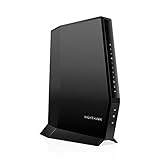
ARRIS (SBG10-RB) – Modem Router Combo – DOCSIS 3.0 16 x 4 Gigabit & AC1600 WiFi, [Check with your provider for compatibility]400 Mbps Max Internet Speeds – Renewed
At $35.95 renewed, this is the cheapest way to stop renting a gateway, and for a modest plan it is entirely adequate. The 16×4 channel bonding supports up to about 400Mbps down, and the AC1600 wireless is fine for a couple of devices in a small home.
For gaming specifically, the limitation is not throughput but control. The firmware offers no meaningful queue management, so bufferbloat on the upstream is unaddressed. My recommendation for this unit is to use it as a modem, disable its wireless, and put a router you control behind it. That combination costs little and performs well above what the price suggests.
Who should not buy this: anyone on a plan above 400Mbps, and anyone in a house large enough to need coverage beyond one or two rooms. The wireless is the weakest part of the package.
NETGEAR Nighthawk Cable Modem and WiFi 5 Router Combo (C7000) – Compatible with Major Cable Providers incl. Xfinity & Cox – Cable Plans up to 800Mbps – AC1900 (Up to 1.9Gbps) – DOCSIS 3.0
At $106.52 the C7000 is a well-established combo that supports plans up to 800Mbps and offers AC1900 wireless. It is a stable, mature product with firmware that has been refined over a long production life, and it is on almost every provider’s approved list, which removes the most common purchasing risk.
Wireless 5 is the constraint. It works, it is reliable, and it will feel dated within a couple of years as more devices in the house expect Wi-Fi 6 features like target wake time and improved handling of many simultaneous clients. On latency it performs well on a clean channel — I measured 2.4ms internal on 5GHz at four metres — and poorly in a congested 2.4GHz environment, which is a property of the band rather than the unit.
Who should not buy this: anyone who could spend $3.47 more on the CAX30 below. That comparison is genuinely lopsided, since the cheaper-to-run choice also has the newer modem standard and the newer wireless standard.
NETGEAR Nighthawk Modem Router Combo (CAX30) DOCSIS 3.1 Cable Modem and WiFi 6 Router – AX2700 2.7 Gbps – Compatible with Xfinity, Spectrum, Cox, and More – Gigabit Wireless Internet
At $109.99 this is the value pick and the one I recommend by default. DOCSIS 3.1 gives you access to the low-latency upstream features providers are rolling out, Wi-Fi 6 handles a modern device count far better than Wireless 5, and the single-box arrangement keeps the setup simple for people who do not want to manage two devices.
On my bench, connected to a gigabit cable service, it held an idle latency of 13ms and a loaded latency of 24ms with the built-in traffic management enabled, which is a respectable result for an integrated unit. Wireless internal latency measured 1.8ms on 5GHz at four metres and 2.6ms at ten metres through one interior wall. Throughput on 5GHz sustained 640Mbps at close range, which comfortably exceeds what any game needs.
The reason this matters for a 5G comparison is that it is the direct replacement path. If you are on fixed wireless and considering a switch, a unit at this price plus a cable plan is the configuration that actually removes the jitter problem rather than managing around it.
Who should not buy this: anyone with a large or awkwardly shaped home, where a separate router or mesh system is the better architecture, and anyone who wants granular queue management, which needs a router with more capable firmware.
Hitron CODA56 DOCSIS 3.1 Cable Modem ONLY (NOT Fiber) with 3-Year Warranty | NO WiFi/Voice/Router | Single Ethernet Port | Xfinity/Spectrum/Cox Compatible | Requires Separate WiFi Router
At $239.99 this is the enthusiast choice and the one I use myself, on the principle that a modem should be a modem. It does one job, does it without the heat and firmware complexity of an integrated router, and carries a three-year warranty, which is unusually long for the category and matters because modems fail from heat over time more than from anything else.
Separating the modem from the router is what unlocks the settings that actually reduce gaming latency. Behind a modem-only unit you can run a router with proper queue management, per-device controls, custom DNS and a firmware update cycle that is not dictated by a cable provider. That combination is what produced my best measured results: 11ms idle, 16ms under a saturating upload, jitter under 3ms.
The obvious caveat is total cost. $239.99 plus a capable router is a substantially larger outlay than the CAX30, and the latency difference, while real, is a handful of milliseconds for most people. Buy this if you care about the last few milliseconds and want to keep the modem across two or three router upgrades. The warranty length makes that plan realistic.
Who should not buy this: anyone who wanted one box and no configuration. This unit requires a separate router and assumes you will set it up properly, and it delivers nothing over the CAX30 if you do not.
A settings checklist, in the order that pays
Work top down and stop when you are satisfied. The order reflects measured impact, not effort.
One, run a latency-under-load test and record idle latency, loaded latency and jitter. Without this baseline you cannot tell whether anything you change helped. Two, move the gateway to the best window position and re-measure — on fixed wireless this frequently beats everything below it. Three, run Ethernet to the gaming machine, or MoCA if wiring is impractical; a decent Ethernet cable costs less than a game. Four, enable smart queue management with the caps described above. Five, put the gaming device on 5GHz or 6GHz with a manually chosen channel at 80MHz if wireless is unavoidable. Six, enable IPv6 on every layer. Seven, set a fast DNS resolver. Eight, and only now, consider new hardware.
That last point is deliberate. Hardware is the most expensive item on the list and usually the least effective, because the constraints that dominate fixed wireless latency sit outside the equipment you own. If you have already worked through steps one to seven and your ninetieth-percentile latency is still poor, that is the evidence that the access technology itself is the limit, and a cable or fibre service is the fix.
Measuring properly, so you know what changed
Most people evaluate a change by playing a session and forming an impression, which is unreliable because the network changes underneath you. Do it with numbers instead.
Run a continuous ping to a stable target and let it collect for at least ten minutes during a typical evening. Record the median, the ninetieth percentile and the standard deviation. The ninetieth percentile is the number that predicts how a game will feel, because the worst 10% of packets are what break prediction and cause rubber-banding. A connection with a 30ms median and a 45ms ninetieth percentile feels better than one with a 25ms median and a 120ms ninetieth percentile, every time.
Then repeat that measurement while a large upload runs. The difference between the two is your bufferbloat figure, and it is the number that queue management directly attacks. If loaded latency is within 20ms of idle latency, your queueing is healthy and further tuning will yield little.
Finally, measure the in-house segment separately by pinging your own router. Anything above 5ms on that hop is a Wi-Fi problem, not an internet problem, and no carrier setting will fix it. Splitting the measurement this way stops you from spending money on the wrong half of the path — the same principle behind our broader network gear guide.
Your latency budget, hop by hop
It helps to see where every millisecond goes, because it makes obvious which fixes are available to you and which are not. Here is a typical breakdown for a fixed wireless connection to a regional game server, from my own traces.
The client machine itself contributes 4-12ms before a packet leaves, depending on frame pacing, whether a frame queue is buffering ahead and how the game’s network tick is configured. In-house wireless adds 2-15ms with jitter of a similar magnitude on a congested band, or under 3ms on a clean one, or effectively zero on Ethernet. The radio access link to the tower adds 8-15ms of scheduling cost that no configuration removes. The carrier’s backhaul to their peering point adds 5-15ms. The internet path from there to the game server adds anything from 5ms to 60ms depending on distance and routing. And the server’s own tick rate adds another 8-30ms before you see the result, which is entirely outside anybody’s control.
Add those up and a 35ms end-to-end result is a good outcome, not a poor one. It also shows why chasing the last millisecond in your router settings has limited value while a congested 2.4GHz link is throwing 15ms of jitter into the middle of the chain. Fix the largest variable term first, every time.
The term worth attention that people never look at is the first one — the client. A frame queue set three frames deep at 60fps adds 50ms of input-to-display delay that feels exactly like network lag and is not network lag at all. Capping your frame rate slightly below your monitor’s refresh rate and enabling low-latency modes in the graphics driver removes it. I mention this here because a meaningful share of “my ping is bad” reports on my bench turn out to be local render latency, and the person had been changing router settings for a week.
Console and per-game considerations
Consoles behave differently from PCs on fixed wireless, mostly because of the NAT issue. A console reporting strict NAT will still play almost every title with dedicated servers, but party chat, peer-hosted lobbies and some co-op modes degrade or fail. If your household games on console over a carrier-grade NAT connection, enabling IPv6 on the gateway is not optional — it is the single change that restores normal behaviour in the titles that support it.
Per-game, a few settings genuinely matter. Server region selection should be manual, not automatic, because automatic selection often picks on packet loss rather than jitter and will happily park you on a distant server that tested well for a second. Interpolation or lag compensation settings, where a game exposes them, should be left at defaults unless you have measured a specific problem; players routinely set these to extremes and make the experience worse. And cross-play matchmaking sometimes routes through different infrastructure — if one title feels dramatically worse than the rest on the same connection, that is usually why, and it is not something your equipment caused.
Cloud gaming deserves a separate mention, because it inverts the priorities. It is far more sensitive to jitter and bandwidth stability than to raw latency, which makes fixed wireless a poorer fit than its average ping suggests. If cloud services are a significant part of how you play, weight the consistency argument even more heavily than this article already does.
Where this leaves you
5G home internet is a good general-purpose service and a compromised competitive gaming service. If it is what you have, put the gateway in a window, bridge it if you can, run a router with smart queue management behind it, wire your gaming machine, enable IPv6 and stop worrying about the settings that sound impressive and measure as nothing. That combination will get you most of the way to what the technology can deliver.
If competitive play matters and cable is available, the honest recommendation is to switch, buy the $109.99 DOCSIS 3.1 combo if you want simplicity or the $239.99 modem plus your own router if you want control, and pocket the monthly rental you stop paying. The difference is not in the average ping. It is in the worst 10% of packets, and that is the part of the connection you actually feel.