Disclosure: As an Amazon Associate, I earn from qualifying purchases. If you buy through links in this article, I may earn a commission at no extra cost to you.
Our top pick: Lisle 52500 Mechanic's Stethoscope. Runner-up: Lisle 52750 Dual Purpose Stethoscope Kit.
A ticking lifter, a growling water pump bearing and a chirping idler pulley can all sound like the same vague complaint from the driver’s seat. A mechanic’s stethoscope turns that guesswork into a comparison: you touch a probe to one component at a time, listen, and move on. The part where the noise is loudest and sharpest is the part you inspect first. Despite the name, this is a workshop tool for machines only — it has nothing to do with medical use, and it is built for engines, gearboxes, axles and chassis parts.
This guide covers five listening tools in two families. Three are classic acoustic stethoscopes with a diaphragm chamber and a metal probe: two from Lisle and one from GEARWRENCH. Two are electronic listeners from Steelman: a single-point electronic stethoscope and a six-channel chassis ears kit for noises that only appear on the road. That brand concentration is stated openly because Lisle and Steelman dominate this niche; the five picks still differ in design, reach and job, so read the sections by use case rather than by logo.
Top 3 picks at a glance

How to Choose a Mechanic’s Stethoscope
Start with where the noise happens. If the sound is present with the vehicle parked and idling — a tick at the valve cover, a whir at the alternator, a rumble at the water pump — an acoustic probe stethoscope is the right tool. If the noise only shows up at speed or over bumps, no probe tool can follow it; you need clamp-on microphones and a road test, which is what chassis ears are for.
Probe style decides what you can reach. A rigid screw-in metal rod transmits structure-borne sound from bearings, injector bodies, pulley bolts and housings. A hollow tube or funnel attachment hears air-borne sound instead, which is how you find vacuum leaks and exhaust ticks. A dual-purpose kit that includes both covers more jobs than a probe-only model. For electronic models, a flexible gooseneck with a non-conductive probe tip is safer around wiring and sensitive electronics.
Diaphragm and chamber quality drive clarity. On acoustic models, the sound chamber and diaphragm do the amplifying. A thin, responsive diaphragm over a sealed chamber makes faint bearing noise easier to separate from normal engine sounds. Remember that every injector ticks and every healthy alternator whirs — compare the suspect part against a known-good cylinder or the matching component before calling anything faulty.
Comfort and control matter more than they sound. You will hold the probe with one hand and keep the other clear of belts and fans, so earpieces that seal well and tubing that stays put are practical features, not luxuries. On electronic kits, look at the number of sound level settings, whether the headphones are full-coverage, lead length on chassis ears, and the battery type. Finally, keep probe, tubing and hands away from the serpentine belt, fan and pulleys while the engine runs, and never rely on a jack alone if you lift a wheel for a spin check.
The 5 Best Mechanic’s Stethoscopes
1. Lisle 52500 Mechanic’s Stethoscope

The 52500 is the classic single-purpose pick: a stainless steel probe and diaphragm chamber built for one job, which is finding mechanical noise at idle. Lisle pairs a unique sound chamber with a super-thin diaphragm, a combination the maker lists as greatly amplifying sound so that ticks and growls stand out from general engine noise. In practice that makes it a natural first tool for valve train tick, injector noise, and bearing rumble at the alternator, water pump, tensioner and idler pulleys, plus sounds carried through transmissions, differentials and bearing housings.
The tool is light at under two ounces and needs no batteries, no setup and no warm-up — it lives in a toolbox drawer and is ready the moment a noise shows up. The listed limited lifetime warranty is a plus for a tool that will be knocked around a workshop. The trade-off is scope: there is no air-leak attachment in the box, so vacuum leak hunting belongs to the dual-purpose kit below. For parked-vehicle engine and accessory diagnosis, though, this is the straightforward benchmark in the category.
Specs
- Brand: Lisle
- Model: 52500
- Type: Acoustic mechanic’s stethoscope
- Construction: Stainless steel
- Sound pickup: Sound chamber with super-thin diaphragm
- Dimensions: 14 x 5 in (as listed)
- Weight: 1.76 oz (as listed)
- Warranty: Limited lifetime, as listed by the maker
2. Lisle 52750 Dual Purpose Stethoscope Kit
The 52750 kit exists for the noises a probe alone cannot sort out. Its black diaphragm chamber and screw-in metal probe handle mechanical sounds the same way the 52500 does — bearings, gears, valves and pulleys — while the included vinyl hose, hollow tube and funnel attachments listen for air-induced sounds instead. That second mode is what separates a vacuum leak hiss from a lifter tick, or an exhaust manifold tick from a valve train problem, without buying a second tool.
At 4.8 ounces with a metal exterior, the kit is still a simple acoustic tool with nothing to charge or pair. The honest limitation is that swapping attachments takes a moment, and a funnel hears everything in a noisy bay, so air-leak checks work best in a quiet space with the engine at idle. If your diagnostic work regularly mixes mechanical knocks with leak hunting, this is the most versatile acoustic option in this guide and the one kit that covers both sound families in a single purchase.
Specs
- Brand: Lisle
- Model: 52750
- Type: Acoustic dual-purpose stethoscope kit
- Attachments: Screw-in metal probe, vinyl hose, hollow tube and funnel (as listed)
- Exterior: Metal
- Dimensions: 14 x 5.25 x 2 in (as listed)
- Weight: 4.8 oz (as listed)
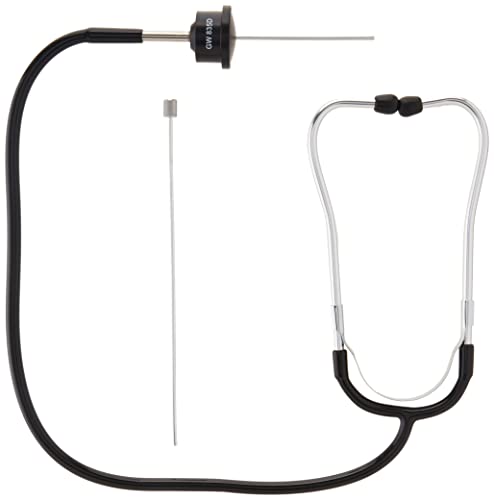
3. GEARWRENCH Mechanic’s Stethoscope – 835D
The GEARWRENCH 835D is the alternative-brand acoustic option, sold under the GEARWRENCH name with KD Tools listed as the manufacturer on its Amazon record. It follows the same proven layout — a diaphragm chamber, a contact probe for structure-borne noise and earpieces — and the maker describes a shock-resistant handle design that can be taken apart for compact storage, which suits a crowded service cart or a mobile tool bag.
Choose this one if you already run GEARWRENCH hand tools and prefer to keep the diagnostic drawer in one brand family, or if the Lisle models are hard to source when you need one. Functionally it sits in the same class as the 52500: parked-vehicle work on engines, transmissions, rear axles and valve trains. It does not add air-leak attachments or electronics, so its appeal is build and brand support rather than extra capability. Keep the same discipline as with any probe tool: compare suspect components against known-good ones, because a stethoscope makes normal noises louder too.
Specs
- Brand: GEARWRENCH
- Model: 835D
- Type: Acoustic mechanic’s stethoscope
- Manufacturer: KD Tools (as listed)
- Design: Shock-resistant handle, disassembles for storage (as listed by the maker)
- UPC: 082171008351 (as listed)
4. Steelman EngineEAR II Electronic Stethoscope (06800)

The EngineEAR II replaces the diaphragm with a microphone and an amplifier, which changes what you can hear. Its control unit offers a decibel meter with seven sound level settings spanning 60 to 120 decibels as listed, so you can turn sensitivity up for a faint bearing whine or down before a loud knock distorts. The included over-ear mono headphones shut out surrounding shop noise, and the flexible gooseneck shaft reaches into tight spots in the bay. The solid aluminum probe wears a non-conductive rubber boot, a thoughtful detail around wiring and electronic modules.
Steelman lists it for worn bearings, noisy valves, broken gear teeth, faulty fuel injectors and air leaks, and the foam-padded case keeps the kit together between jobs. Power comes from AA batteries, which the listing says are included. The costs of going electronic are real: batteries to manage, a two-pound kit instead of a two-ounce probe, and more money tied up in a tool that still only listens to one point at a time. For a noisy workshop where an acoustic diaphragm struggles, that amplification is exactly the point.
Specs
- Brand: Steelman
- Model: 06800 (EngineEAR II)
- Type: Electronic stethoscope, single point
- Sound control: Decibel meter with 7 level settings, 60-120 dB (as listed)
- Probe: Aluminum with non-conductive rubber boot, flexible gooseneck
- Headphones: Over-ear mono, included
- Power: AA batteries, included (as listed)
- Case: Foam-padded storage case included
- Weight: 2 lb (as listed)
5. Steelman ChassisEAR Electronic Squeak & Rattle Finder (06600)

The ChassisEAR answers the question the other four cannot: where is that clunk coming from when it only happens on the road? Six color-coded microphone clamps attach to springs, shocks, body mounts, brakes, sway bars, struts, axle hubs, transmissions and similar points, each on a 16-foot wire lead. You listen through the included full-coverage headphones during a road test, switch between locations, and the loudest channel names the corner or component to inspect. That workflow fits wheel bearing hum that changes with speed or steering load, CV joint clicking, differential whine and suspension clunks over bumps.
The kit runs on a single 9V battery, included as listed, and the whole set weighs about 2.12 kg in its packaging. Setup is the trade-off: routing six leads and clamping sensors takes time, and wind or road noise can swamp a poorly placed microphone, so placement discipline matters. It also complements rather than replaces a probe stethoscope — engine-bay noises at idle are still faster with the acoustic picks above. For moving-vehicle noise that no scan tool will ever flag, this is the purpose-built option.
Specs
- Brand: Steelman
- Model: 06600 (ChassisEAR)
- Type: Electronic chassis noise finder, 6 channels
- Sensors: 6 color-coded microphone clamps (as listed)
- Lead length: 16 ft per sensor (as listed)
- Headphones: Full-coverage, included
- Power: 1 x 9V battery, included (as listed)
- Weight: 2.12 kg (as listed)
Quick Comparison
| Product | Type | Listening points | Attachments / sensors | Power | Best for |
|---|---|---|---|---|---|
| Lisle 52500 | Acoustic | 1 | Metal probe | None | Engine and bearing noise at idle |
| Lisle 52750 Kit | Acoustic | 1 | Probe, hose, tube, funnel | None | Mechanical noise plus vacuum and air leaks |
| GEARWRENCH 835D | Acoustic | 1 | Metal probe | None | Brand-loyal buyers, compact storage |
| Steelman EngineEAR II 06800 | Electronic | 1 | Gooseneck probe with non-conductive boot | AA batteries | Faint noises in a loud workshop |
| Steelman ChassisEAR 06600 | Electronic | 6 | 6 clamp microphones, 16 ft leads | 9V battery | Road-test squeaks, rattles and bearing hum |
FAQ
Can a mechanic’s stethoscope find a vacuum leak?
Yes, with the right attachment. A contact probe hears structure-borne mechanical sound, but a hollow tube or funnel hears moving air, which is why the dual-purpose Lisle 52750 kit is the pick here for vacuum leaks and exhaust ticks. Probe-only models are not the right tool for leak hunting.
What is the difference between a stethoscope and chassis ears?
A stethoscope listens to one point at a time with the vehicle stationary, which suits engine, accessory and bearing checks at idle. Chassis ears clamp several microphones to suspension and driveline points so you can compare them during a road test — the only way to chase noises that appear exclusively while driving.
Can these tools tell a lifter tick from an exhaust leak?
They help you narrow it down. Probe the valve cover and then the exhaust manifold studs and compare where the tick is loudest; a manifold tick that fades as the engine warms points to a leak, while one loudest at the valve cover points to the valve train. The listener narrows the suspect list; a physical inspection confirms the repair.
Is an electronic stethoscope worth it over an acoustic one?
For a quiet home garage, an acoustic model covers most jobs for less money and never needs batteries. The electronic EngineEAR II earns its place in a loud shop, where adjustable sound levels and sealed headphones keep faint noises audible, and its non-conductive probe tip is safer around electronics.
Are mechanic’s stethoscopes medical devices?
No. Despite the shared name, these are automotive and machinery diagnostic tools with metal probes or clamp microphones. They are designed to be touched to engine and chassis components, not used on people.
Conclusion
For most parked-vehicle diagnosis, start with an acoustic probe: the Lisle 52500 for pure mechanical noise, the Lisle 52750 kit if vacuum and air leaks are part of your work, and the GEARWRENCH 835D if you prefer that brand’s support and storage-friendly design. Step up to the Steelman EngineEAR II when shop noise or faint sounds defeat a diaphragm, and keep the Steelman ChassisEAR in mind for the squeaks, clunks and bearing hums that only exist at road speed. Match the tool to where the noise lives, compare against a known-good component before condemning any part, and the listening tool will pay for itself in avoided guesswork.
Related guides
More from Amazon
Programs that pair well with the guide above. Offers and eligibility are set by Amazon and may change.
Free shipping on eligible items, Prime Video and more. Eligible new members can start with a free trial.
Start a Prime free trialAd-free music streaming. Eligible new subscribers can start with a free trial.
Try Music Unlimited freeA Prime membership for ages 18-24 with a trial period. Eligibility is set by Amazon.
See Prime for Young AdultsAudiobooks and podcasts to listen to on the go. Eligible new members can start with a free trial.
Try Audible freeAs an Amazon Associate we earn from qualifying purchases.