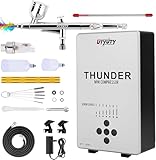
The best airbrush compressors for painting and crafts are quiet, moisture-controlled models that deliver roughly 15–30 PSI for detail work, 30–45 PSI for broader coverage, and enough airflow to avoid pulsing when you paint continuously.
As an Amazon Associate we earn from qualifying purchases at no extra cost to you.

Our Top Picks
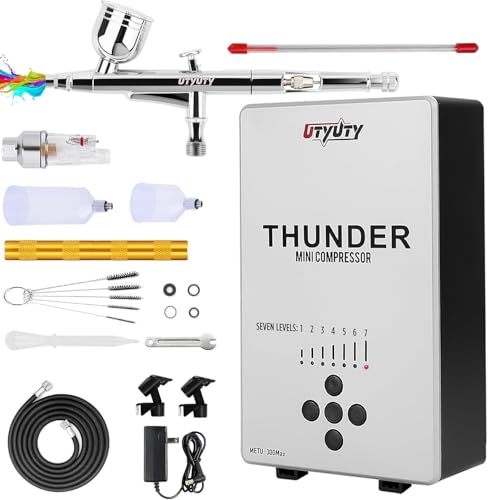

Quick recommendations by project
| Craft situation | Best compressor type | Useful target specifications | Why it fits |
|---|---|---|---|
| Miniatures, models, and fine illustration | Oil-less diaphragm or piston compressor with regulator | 0.5–1.5 gallon tank, 20–30 PSI working range, under 55 dB | Precise control, modest airflow, and low interruption during detail work |
| T-shirts, canvas, and larger craft surfaces | Tank compressor with higher airflow | 1–3 gallons, 0.8–2.0 CFM at 40 PSI, 30–50 PSI capability | Maintains pressure during long passes and reduces pulsing |
| Resin printing cleanup and occasional airbrushing | Compact tank compressor | 0.3–1 gallon tank, moisture trap, automatic shutoff | Portable enough for a hobby bench while still controlling pressure smoothly |
| Shared room, bedroom, or studio apartment | Low-noise piston compressor | 45–55 dB, vibration feet, duty cycle of at least 50% | Less disruptive than a shop compressor and safer for extended sessions |
What matters more than the advertised PSI
Airflow and pressure stability
Maximum PSI tells you the highest pressure the motor can build; it does not tell you how well the compressor sprays. Airflow, normally listed as CFM or L/min, determines whether pressure falls while you hold the trigger open. A gravity-feed 0.2 mm airbrush may use only about 0.3–0.5 CFM, while a 0.5 mm brush or broad spray head can approach 0.8–1.2 CFM depending on pressure and paint.
For miniatures and illustration, a compressor delivering about 0.5 CFM at 20–30 PSI is generally sufficient. For shirts, terrain, and large panels, choose at least 0.8 CFM at the pressure you actually intend to use. A model claiming 1.5 CFM at zero PSI may produce far less at 40 PSI, so compare “air delivered at pressure” figures when available.
Tank capacity
A tank acts as a buffer between the motor and the airbrush. It smooths motor pulses, lets the motor switch off during short passes, and gives you a few seconds of spray if the pump starts again. It does not multiply the compressor’s long-term airflow.
A tank under 0.5 gallon is adequate for short miniature sessions but may cause frequent restarts. Around 0.5–1 gallon is the useful middle ground for most hobby painters. A 1–3 gallon tank is better for clothing, canvas, and multiple airbrushes, although it adds weight and takes longer to refill.
For example, suppose a 1-gallon tank is filled to 45 PSI and your airbrush consumes 0.5 CFM. The tank contains approximately 1 gallon × 45/14.7, or 3.06 cubic feet of air measured at atmospheric pressure. Usable air between 45 PSI and a 25 PSI restart pressure is approximately 1 × (45−25)/14.7 = 1.36 cubic feet. At 0.5 CFM, that provides roughly 2.7 minutes of theoretical spraying before the motor must restore pressure. Real-world time is lower because pressure and airflow are not perfectly constant, but the calculation explains why a tank reduces pulsing rather than replacing adequate CFM.
Recommended compressor classes and notable models
Compact hobby compressors: best for detail painting
Small oil-less compressors with a regulator, pressure gauge, and moisture trap are the simplest choice for miniatures, scale models, nails, and small illustrations. Look for automatic shutoff, rubber feet, and a standard 1/8-inch airbrush connection. They are commonly sold in the roughly $70–$180 range, depending on noise level and tank size.
The Iwata-Medea Studio Series Smart Jet Pro is a well-established example of this class. Its compact design and regulated output suit detail airbrushing, though a small tankless design is less resistant to pressure variation during long, broad sprays. It is better matched with a fine or medium gravity-feed airbrush than with a large siphon-feed brush.
Quiet tank compressors: the best all-purpose choice
A quiet piston compressor with a tank is usually the strongest choice for a shared craft room. It provides steadier output, lower motor cycling during short strokes, and better flexibility as you add airbrushes with different nozzle sizes. Models such as the Iwata-Medea Studio Series Power Jet Pro target this category, with more capacity and control than a basic portable unit.
Expect roughly $250–$500 for a reputable hobby-grade quiet tank compressor. Check the specified noise level carefully: “quiet” models can still sound obvious in a silent room, while vibration isolation often matters as much as the decibel number.
Small shop compressors: best for multiple tools
The California Air Tools 8010 is a useful example of a compact, low-noise shop compressor with an 8-gallon tank. It is far larger than necessary for one fine-detail airbrush, but its reservoir and airflow make it suitable for several airbrushes, blow-off tools, or intermittent pneumatic equipment. It is usually in the roughly $180–$300 market range.
For airbrushing, a shop compressor should be paired with a fine secondary regulator, a quality moisture separator, and a short flexible hose. Its factory pressure range may be too broad for direct airbrush control, and the large tank does not automatically remove water from humid air.
Moisture control: the feature that prevents ruined paint
Compressed air warms inside the pump and cools as it travels through the hose. That temperature change causes condensation, especially in humid rooms. Water droplets can create sudden pale spots, bubbling, fisheyes, or a sputtering spray pattern.
- Choose a compressor with a drainable moisture trap near the outlet.
- Add a second inline mini-filter close to the airbrush for humid climates or long hoses.
- Drain a tank after each session; leaving water inside encourages corrosion.
- Use a flexible braided or nylon hose rather than a very short rigid connection that transfers vibration.
- Keep the compressor off the floor when possible, but leave ventilation space around its motor.
A trap is not a substitute for draining. If water appears at the airbrush despite a filter, check whether the bowl is full, whether the filter is installed in the correct airflow direction, and whether the hose is holding condensed water.
Noise, duty cycle, and portability
Noise affects how long you can comfortably paint. A compressor rated around 45–55 dB is appropriate for most indoor hobby spaces; a louder shop compressor may be acceptable in a garage but distracting in a bedroom or shared office. Put the unit on a dense rubber mat, not a hollow wooden shelf, because vibration can make a quiet pump sound much louder.
Duty cycle describes how long the motor can run within a given period. A 50% duty cycle means approximately 30 minutes of operation in an hour under the manufacturer’s conditions, not unlimited operation at every pressure. For intermittent detail painting, 50% is normally adequate. For shirts or continuous coverage, choose a higher-rated unit or pause whenever the pump becomes hot.
Portability involves more than weight. A 4-pound tankless compressor is easy to carry but may run constantly. A 25-pound tank compressor is harder to move but can remain off during many short strokes. If you paint at workshops, prioritize a compact case, a protected regulator, and a voltage rating that matches your travel location.
Nozzle compatibility and pressure settings
| Airbrush nozzle | Typical use | Starting pressure | Compressor requirement |
|---|---|---|---|
| 0.15–0.2 mm | Fine lines, highlights, miniature details | 12–20 PSI | Low airflow with very stable regulation |
| 0.3–0.35 mm | General model painting and illustration | 18–28 PSI | About 0.4–0.7 CFM at working pressure |
| 0.5 mm | Primers, base coats, shirts, and larger areas | 25–35 PSI | Prefer a tank and at least about 0.8 CFM delivered airflow |
| 0.7 mm or larger | Broad coverage and heavier media | 30–45 PSI | Tank compressor with strong airflow; compact detail units may struggle |
These are starting points, not fixed rules. Thicker paint, a longer hose, and a larger nozzle require more air. Thin paint sprayed at excessive pressure can create overspray and a rough, dry finish, so increase pressure gradually rather than buying the highest-PSI compressor.
A practical buying decision
Choose a compact tankless model if you paint small areas for less than 20 minutes at a time and value minimum size. Choose a 0.5–1 gallon quiet tank compressor if you want one machine for miniatures, models, and occasional canvas. Choose a 1–3 gallon or larger shop-style compressor if you regularly use a 0.5 mm or larger nozzle, paint clothing, or supply more than one airbrush.
Before purchasing, verify four connections: the airbrush hose thread, the compressor outlet thread, the regulator’s adjustment range, and the availability of replacement moisture-filter elements. A compressor can have ample airflow yet be inconvenient if it needs uncommon adapters or lacks a drain valve.
Common setup problems and fixes
- Pulsing spray: add or use the compressor’s tank, lower the trigger opening, and inspect the hose for kinks. Pulsing usually indicates insufficient buffering or unstable airflow.
- Water in the paint: drain the tank, empty the moisture trap, install an inline filter near the brush, and allow the compressor to cool between long sessions.
- Pressure falls while spraying: reduce nozzle size or spray width, clean a clogged airbrush, and compare the compressor’s delivered CFM at your working PSI.
- Excessive noise: place the compressor on rubber isolation, tighten loose fittings, and avoid enclosing it in a cabinet where heat can build up.
- Motor runs continuously: check for leaks with soapy water, confirm the regulator is not set unnecessarily high, and stop if the motor becomes unusually hot.
For most home painters, the best balance is a quiet, oil-less piston compressor with a 0.5–1 gallon tank, adjustable regulator, automatic shutoff, and two-stage moisture control. That combination handles common 0.2–0.5 mm airbrushes without making portability, noise, or moisture problems more difficult than the painting itself.
Frequently asked questions
How often should I drain the compressor tank?
Drain the tank after each session. Compressed air can produce condensation as it cools while traveling through the hose, and water left inside the tank can encourage corrosion. A moisture trap helps reduce water reaching the airbrush, but it is not a substitute for draining. If water still appears at the brush, check the trap bowl, airflow direction, and hose.
Can one compressor handle both a fine airbrush and a larger nozzle?
A quiet tank compressor is usually the more flexible choice for different nozzle sizes. Fine brushes may need only modest airflow, while a 0.5 mm nozzle can require about 0.8 CFM at working pressure. A 0.7 mm or larger nozzle generally benefits from a tank compressor with strong airflow, because compact detail units may struggle with broad coverage.
Why does my airbrush sputter even when the compressor reaches its maximum PSI?
Maximum PSI only describes the highest pressure the motor can build, not how steadily it sprays. Sputtering can result from pressure falling during use, moisture in the air line, or a full or incorrectly installed moisture trap. Compare airflow at your working pressure, inspect the filter and hose, and use a tank or regulator that provides steadier output.
Is a tankless compressor suitable for short painting sessions?
A compact tankless compressor can suit small areas painted for less than 20 minutes at a time, especially when minimum size matters. It may run constantly and is less resistant to pressure variation during long, broad sprays. For miniatures, models, nails, and small illustrations, choose one with a regulator, pressure gauge, moisture trap, and automatic shutoff.
What hose and connection should I use with an airbrush compressor?
Use a flexible braided or nylon hose rather than a very short rigid connection, which can transfer vibration. A standard 1/8-inch airbrush connection is a useful feature for compact hobby compressors. With a shop compressor, add a fine secondary regulator, a quality moisture separator, and a short flexible hose so the airbrush receives controlled, cleaner airflow.