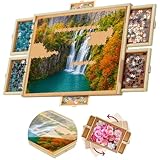
The best jigsaw puzzle boards with drawers for adults are large enough for your usual puzzle size, have drawers that close securely, and combine a smooth wood work surface with a lightly grippy felt or fabric layer for sorting and portability.
As an Amazon Associate we earn from qualifying purchases at no extra cost to you.



Our Top Picks
 1500 Piece Rotating Wooden Puzzle Board1500 Piece Puzzle Board Rotating19 x 1 x 0.1 InchesCheck on Amazon
 ALL4JIG 1500 Piece Rotating Puzzle Board with 4Medium-1500pcs26 x 26 x 0 inches0.4 PoundsCheck on Amazon


Top 3 picks at a glance
Quick comparison: which puzzle board fits your setup?
| Board type | Typical outside size | Practical puzzle capacity | Drawer storage | Best for |
|---|---|---|---|---|
| Compact portable board | 26 × 20 inches | 500–750 pieces | 2–4 shallow drawers | Small tables, occasional puzzling, easy storage |
| Medium four-drawer board | 34 × 26 inches | 1,000 pieces | 4–6 drawers | Most adult puzzlers and standard 1,000-piece puzzles |
| Large sorting board | 40–44 × 30–32 inches | 1,500 pieces | 6–8 drawers | Large dining tables and detailed sorting systems |
| Extra-large puzzle table | 48–52 × 34–36 inches | 2,000–3,000 pieces | 6–8 drawers or compartments | Dedicated puzzle rooms and long-term projects |
These capacities refer to the puzzle itself, not the entire board. A 1,000-piece puzzle may measure about 27 × 20 inches when complete, but you also need room around it for loose pieces and edge assembly. A board advertised as 1,000-piece compatible can feel cramped if its usable work area is only 28 × 21 inches.
What makes the best jigsaw puzzle boards with drawers?
1. A usable work surface, not just a large outer frame
Check the interior assembly area separately from the overall dimensions. Frames, drawer housings and raised borders can consume several inches on every side. For a 1,000-piece puzzle, look for at least 32 × 24 inches of clear work area. For a 1,500-piece puzzle, 40 × 28 inches is a more comfortable target.
Leave extra space for sorting. If a completed puzzle is 27 × 20 inches and you reserve a 3-inch sorting margin on all four sides, the required area becomes:
(27 + 6) × (20 + 6) = 33 × 26 inches.
That is why a board with a nominal 1,000-piece rating may still be awkward for someone who sorts by color, edge and pattern before assembling.
2. Drawers deep enough to be useful
Most puzzle-board drawers are shallow, which is helpful for keeping pieces visible but limits how much each drawer can hold. A drawer around 10–12 inches wide, 8–10 inches deep and 1–1.5 inches high is suitable for one category of pieces spread in a single layer. Deeper drawers hold more pieces but encourage stacking, making small shapes harder to identify.
Four drawers are a practical minimum for a 1,000-piece puzzle. Six or eight drawers are better if you sort by several colors or want separate areas for corners, edges, sky, text and miscellaneous pieces. A drawer divider is more useful than extra depth because it prevents categories from mixing during transport.
Look for drawers with positive stops or small retaining lips. Smooth drawers that can slide completely out are convenient on a stationary table, but they are risky when the board is lifted. Removable trays should have handles or finger cutouts and should not flex when filled with pieces.
Wood versus felt: which surface should you choose?
| Surface | Advantages | Limitations | Best use |
|---|---|---|---|
| Finished wood or laminate | Firm, easy to clean, good for pressing pieces together, slides well for repositioning | Pieces can move when the board is tilted; noisy against hard pieces | Precision assembly and fixed tabletop use |
| Felt or fabric | Reduces sliding, softens noise, protects finished puzzles during short moves | Can collect dust, snag on rough piece backs, and make pieces harder to slide into alignment | Portable boards and interrupted projects |
| Wood base with felt panels | Combines rigidity with grip and cushioning | Usually heavier and more expensive; felt may wear at the drawer edges | Most adult users who assemble and store puzzles in the same place |
A smooth surface is usually best when you frequently nudge groups of pieces into position. Felt is preferable if pets, children, vibration or an uneven table could disturb the layout. The strongest all-round design is a rigid wood or composite base with removable felt-covered sorting trays rather than thick felt permanently glued over the entire assembly area.
Portability: calculate the real carrying load
Board weight matters more than advertised foldability. A medium wooden board may weigh roughly 8–15 pounds empty. A 1,000-piece puzzle adds about 1–2 pounds, and six sorting drawers filled with loose pieces can add another 3–5 pounds. A realistic carrying calculation is therefore:
10-pound board + 1.5-pound puzzle + 4-pound drawers = 15.5 pounds.
That is manageable for moving between rooms, but it is not ideal for carrying one-handed up stairs. If you regularly relocate a project, choose a board under 10 pounds, use removable trays with retaining edges, and confirm that the board can be lifted without the drawers sliding out.
Foldable designs save closet space, but hinges create a potential height difference across the center. Check that the folded seam does not cross the main assembly area or create a ridge that catches puzzle pieces. A rigid board with a cover is often more reliable than a hinged board for puzzles that remain unfinished for weeks.
Decision matrix for common adult puzzling setups
| Your situation | Recommended specification | Why |
|---|---|---|
| You complete mostly 500-piece puzzles in a small apartment | 26–30 inch board, 2–4 drawers, under 8 pounds | Fits small tables and can be stored vertically |
| You usually build standard 1,000-piece puzzles | At least 32 × 24 inch clear area, 4–6 drawers | Leaves room for the picture and useful sorting zones |
| You sort everything before assembly | Six or more shallow drawers, removable trays, 3-inch side margins | Prevents categories from piling up on the main surface |
| You pause projects and move them often | Felt or fabric grip, retaining cover, drawer stops, under 12 pounds | Reduces sliding and protects the unfinished layout |
| You build 1,500–2,000-piece puzzles | 40 inches or more wide, 28 inches or more deep, 6–8 drawers | Provides working clearance beyond the completed puzzle footprint |
| You have a permanent puzzle table | Heavy wood construction, smooth surface, full-depth drawers | Weight and portability matter less than rigidity and capacity |
Features worth paying for
- Raised outer edges: A lip around 0.25–0.5 inch high helps stop pieces from falling when the board is moved, but it should not obstruct the completed puzzle.
- Drawer stops: These are essential for portability. Magnetic catches are useful, but a mechanical stop is less likely to release accidentally.
- Rigid base: A board that bends can separate connected sections. Choose a reinforced wood panel or stiff composite base.
- Low-friction drawer runners: Drawers should open smoothly without shaking their contents. Rough wooden runners can scatter pieces.
- Cover or portfolio panel: A cover protects against dust and makes temporary storage possible. It should sit above the puzzle rather than press directly onto it.
- Rounded handles: Carrying handles should be placed near the center of balance, not only at one end.
How to choose without being misled by the piece rating
First, measure your largest completed puzzle, then add at least 3 inches to both dimensions for sorting clearance. Next, subtract the frame and drawer area from the board’s external dimensions to find the actual work area. Finally, check the loaded weight and the drawer design.
If the board is marketed for 1,000 pieces but offers only a 28 × 21 inch work surface, treat it as a compact assembly platform rather than a comfortable sorting station. If it offers a 34 × 26 inch surface but has no cover or drawer stops, it is better for a permanent table than for portability.
Frequently asked questions
Can a puzzle board with drawers be stored vertically?
Yes, a compact board can be stored vertically, especially for 500-piece puzzles in a small apartment. A 26–30 inch board with 2–4 drawers and a weight under 8 pounds is suited to limited storage. Before storing any board upright, make sure the drawers have retaining lips, positive stops or other features that prevent pieces from sliding out.
How much extra space should I leave around a completed puzzle?
Leave at least a 3-inch margin on all four sides for sorting and edge assembly. For example, a completed puzzle measuring 27 × 20 inches needs about 33 × 26 inches of total working area. This extra space helps keep loose pieces organized instead of forcing them onto the completed puzzle or into crowded drawers.
What should I look for in a cover for an unfinished puzzle?
Choose a cover that sits above the puzzle without pressing directly on it. A cover or portfolio panel protects the layout from dust and makes temporary storage possible. It is particularly useful when you pause projects or move them often, but the board should also have retaining edges or drawer stops so pieces and trays remain secure during relocation.
How should I organize pieces in the drawers?
Use each shallow drawer for one category of pieces spread in a single layer. Useful categories can include corners, edges, sky, text and miscellaneous pieces. Six or eight drawers provide more flexibility than four when you sort extensively. A divider is valuable because it prevents categories from mixing during transport without requiring a deeper drawer that encourages stacking.
Can a wooden puzzle board be carried safely between rooms?
Yes, if its loaded weight and storage features are suitable. A realistic example is a 10-pound board, a 1.5-pound puzzle and 4 pounds of filled drawers, totaling 15.5 pounds. For frequent relocation, choose a board under 10 pounds with removable trays, retaining edges, drawer stops and handles near the center of balance.
Bottom line
For most adults, the best jigsaw puzzle boards with drawers are medium boards with a clear work area of at least 32 × 24 inches, four to six shallow drawers, a rigid wood base and removable felt-lined trays. Choose a compact model for 500-piece puzzles and limited storage, a large six- or eight-drawer board for 1,500-piece projects, and a heavy smooth-surface model when portability is unimportant. Prioritize usable dimensions and secure storage over the headline piece count.