The best serving bowl set with lids for most kitchens is a borosilicate- or soda-lime-glass set with three to five nesting bowls, vented or snap-on lids, at least one 4–6-quart bowl, and dishwasher-safe construction; Pyrex Sculpted-style glass mixing-bowl sets are a strong all-round choice, while lightweight polypropylene sets suit frequent transport.
As an Amazon Associate we earn from qualifying purchases at no extra cost to you.


Our Top Picks
 Heavy-Duty 5QT Large Mixing Bowls with Lids Set5, 4, 3.5, 2, 1.5QT2 x 2 x 2 Inches0.8 PoundsCheck on Amazon
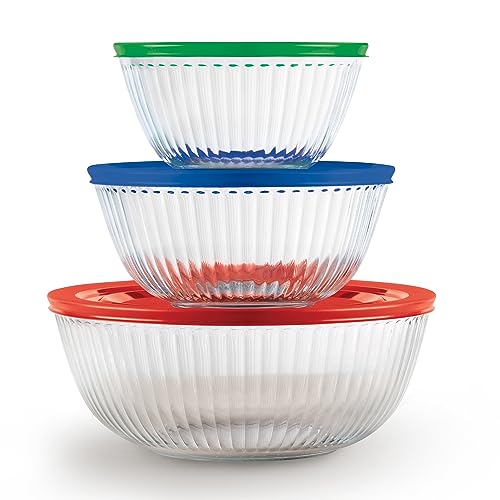

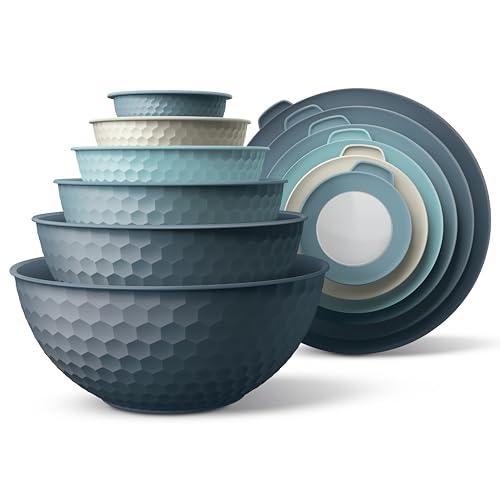
Top 3 picks at a glance
Best Serving Bowl Set With Lids: Top Picks for 2026
A bowl set with lids has to do more than hold a salad. The useful set should cover small prep jobs, family-size serving, refrigerator storage, and transport without forcing you to wash several unrelated containers. The most important differences are capacity, lid security, nesting efficiency, material, and whether “microwave-safe” applies to the lid as well as the bowl.
| Best for | Recommended spec or product line | Typical useful capacities | Main advantage | Watch for |
|---|---|---|---|---|
| General serving and storage | Pyrex Sculpted-style glass mixing bowls with lids | About 1.5–4 qt | Glass resists stains and handles reheating | Lids usually require separate microwave handling |
| Meal transport and leak resistance | Snapware plastic or glass storage-bowl sets | About 1–7 cups per container | Clip-style lids can seal more securely | Not every lid is suitable for hot food or microwaving |
| Lightweight everyday serving | Food-grade polypropylene bowl sets with snap lids | About 2–6 qt | Lower weight and better impact resistance | Plastic may retain oily smells or scratch over time |
| Mixing, baking, and large gatherings | Stainless-steel mixing-bowl set plus compatible covers | About 1.5–8 qt | Very durable and spacious | Metal cannot go in a microwave |
1. Best All-Rounder: Glass Mixing Bowls With Fitted Lids
A Pyrex Sculpted-style set is the most balanced choice when the bowls need to move between preparation, serving, refrigeration, and reheating. Glass does not absorb tomato, curry, garlic, or salad-dressing odors, and its transparent walls make leftovers easy to identify. A large bowl can serve pasta or salad, while the smaller bowls cover sauces, chopped ingredients, and leftovers.
Look for a set containing at least 1.5-quart, 2.5-quart, and 4-quart bowls. That combination is more useful than a set of four nearly identical bowls. A 4-quart bowl holds roughly 12 cups, enough for a family salad or a side dish for a larger gathering, while a 1.5-quart bowl holds about 6 cups for fruit, grains, or leftovers.
Why the lids matter
Many glass sets include flexible plastic lids that are good for refrigerator storage but not truly leakproof when carried sideways. A lid with a continuous silicone gasket and four locking tabs is a better choice for soup, dressing, or wet leftovers. A simple press-on lid is usually adequate for covering salad in the refrigerator and keeping dust away during serving.
Check the lid instructions before microwaving. In most sets, the glass bowl is microwave-safe but the lid must be removed or left partially open. Heating a fully sealed container can create pressure, warp the lid, or cause a sudden release of hot steam.
2. Best for Leak-Resistant Transport: Clip-Lid Storage Bowls
Snapware-style sets are preferable when the bowl will travel to work, school, a picnic, or another kitchen. Their locking tabs provide a clearer mechanical seal than a loose stretch-fit cover. Choose a model with a silicone gasket rather than relying only on plastic-on-plastic contact.
These sets are often better at storing a portion of chili, fruit, or pasta than at serving a large crowd. Their capacities commonly range from about 1 to 7 cups, so check the largest container before buying. A set whose largest bowl is only 4 cups may be marketed as a multi-piece set but will not replace a genuine serving bowl.
For transport, leave at least 1 inch of headspace in liquid foods. The space reduces pressure buildup and makes it less likely that food will contact the gasket. Cool hot food before sealing unless the manufacturer specifically permits hot filling.
3. Best Lightweight Choice: Polypropylene Bowls With Snap Lids
Polypropylene is the practical option for households that want large capacities without the weight and breakage risk of glass. A 6-quart plastic bowl weighs substantially less than a comparably sized glass bowl, making it more comfortable to carry to a potluck or use outdoors.
Choose bowls labeled BPA-free and made from food-contact polypropylene. The best designs have a broad, stable base, a thick rim, and lids that can be removed without flexing the bowl. A textured exterior can improve grip when the bowl is full.
The trade-off is longevity. Plastic can develop fine scratches from abrasive cleaners, and oily or strongly colored foods may leave odors or staining. Avoid using metal whisks inside plastic bowls if appearance matters. “Dishwasher-safe” also does not mean every cycle is equally gentle: place lids on the upper rack and use a moderate drying setting to reduce warping.
4. Best for Maximum Durability: Stainless-Steel Bowls With Covers
Stainless steel is the best material for heavy mixing, outdoor use, and kitchens where dropped bowls are common. It will not shatter, rarely retains odors, and generally tolerates repeated dishwasher cycles better than plastic. A non-slip silicone base is useful when whisking or tossing food.
The limitation is compatibility. Stainless steel cannot be used in a microwave, and its opaque walls make it harder to see what is stored inside. Some covers are intended only to protect the contents in the refrigerator rather than create a watertight seal. If you need to transport soup, verify that the lid has a gasket and locking mechanism.
Capacity: Choose by the food you actually serve
Capacity labels can be misleading because a bowl is rarely filled to its rim. For comfortable mixing or tossing, use about 70% of the stated volume. That gives room for a spoon, salad tongs, or expansion from ingredients.
| Stated bowl size | Approximate cups | Comfortable working capacity | Good uses |
|---|---|---|---|
| 1.5 qt | 6 cups | About 4 cups | Sauces, fruit, chopped vegetables |
| 2.5 qt | 10 cups | About 7 cups | Small salads, grains, side dishes |
| 4 qt | 16 cups | About 11 cups | Family salads, pasta, marinated foods |
| 6 qt | 24 cups | About 17 cups | Large gatherings, dough, bulk preparation |
For example, a 4-quart bowl may technically hold 16 cups, but filling it with 15 cups of salad leaves almost no room to toss. Planning around 11 cups gives a more usable result and reduces spills.
Nesting and cabinet storage
Measure the tallest bowl and the lid stack, not just the bowls. Some lids nest neatly inside the bowls; others create a separate pile that consumes more shelf height than expected. A good set stores in one vertical stack with the largest bowl at the bottom and progressively smaller bowls inside it.
Look for rims that do not interfere with nesting and lids with a flat top. Domed lids may provide extra food clearance but can prevent the set from sliding beneath a shelf. If cabinet space is limited, a three-bowl set with efficient nesting may be more useful than a seven-piece set that spreads across two shelves.
Microwave and dishwasher safety checklist
- Confirm that the bowl material, not merely the set packaging, is microwave-safe.
- Remove or vent plastic lids before heating.
- Do not move a cold glass bowl directly into a very hot oven unless the manufacturer specifically approves that use.
- Place plastic lids on the dishwasher’s upper rack.
- Use non-abrasive detergent and avoid harsh scouring pads on plastic.
- Inspect silicone gaskets for food residue and remove them if the design allows.
- Replace a lid that has lost its shape, cracked, or no longer stays attached around the entire rim.
Which set should you choose?
| Your situation | Best choice | Reason |
|---|---|---|
| You reheat leftovers often | Glass bowls with removable plastic lids | Glass handles reheating and resists stains |
| You carry liquid food regularly | Clip-lock bowls with silicone gaskets | Mechanical locks reduce accidental opening |
| You host large meals | A set including a 4–6-quart bowl | Small bowls alone cannot handle tossing volume |
| You have limited cabinet space | Three or four tightly nesting bowls | Storage efficiency matters more than piece count |
| You need outdoor or child-friendly use | Polypropylene bowls | They are lighter and less prone to shattering |
| You do heavy mixing and want maximum lifespan | Stainless steel with fitted covers | It tolerates impacts, utensils, and frequent washing |
Frequently asked questions
Can a serving bowl set replace separate food-storage containers?
It can cover many preparation, serving, and refrigerator-storage needs, but the right set depends on what you store and how you carry it. Glass bowls with fitted lids work well for serving and refrigerator leftovers, while clip-lid bowls are a better choice for transporting food. Check that the set’s largest bowl is large enough for your usual dishes.
Are press-on lids secure enough to carry food?
Press-on lids are generally adequate for refrigerator storage and covering food during serving, but they may not be leakproof if carried sideways. For liquid foods or wet leftovers, look for a lid with a silicone gasket and locking tabs. Leave headspace in liquid foods and cool hot food before sealing unless the manufacturer permits hot filling.
How much room should I leave in a serving bowl?
For comfortable mixing or tossing, fill a bowl to about 70% of its stated volume. This leaves room for utensils and helps reduce spills. For example, a 4-quart bowl holds about 16 cups, but around 11 cups is a more comfortable working capacity for tossing food.
What should I check before buying a set for a small kitchen?
Check how the bowls and lids stack together, and measure the tallest bowl and the lid stack. A well-nesting set stores in one vertical stack, while some lids take up separate shelf space. If cabinet space is limited, three tightly nesting bowls may be more useful than a larger set that spreads across shelves.
Can I use the bowls and lids in the microwave and dishwasher?
It depends on the material and the manufacturer’s instructions. Glass bowls may be microwave-safe while their plastic lids need to be removed or left partially open; stainless steel cannot go in a microwave. For plastic lids, use the dishwasher’s upper rack and a moderate drying setting to reduce warping.
Final buying recommendation
For the broadest range of serving and storage tasks, choose a glass set with 1.5-, 2.5-, and 4-quart bowls, secure refrigerator lids, efficient nesting, and clearly stated dishwasher and microwave instructions. Select clip-lock plastic when leak resistance and low weight matter more than stain resistance. Choose stainless steel when durability and large-batch mixing are the priority.
Do not judge the best serving bowl set with lids by piece count alone. The winning set is the one whose largest bowl is genuinely large enough for your meals, whose lids match the way you transport food, and whose material fits your microwave, dishwasher, and storage habits.