Our Top Picks
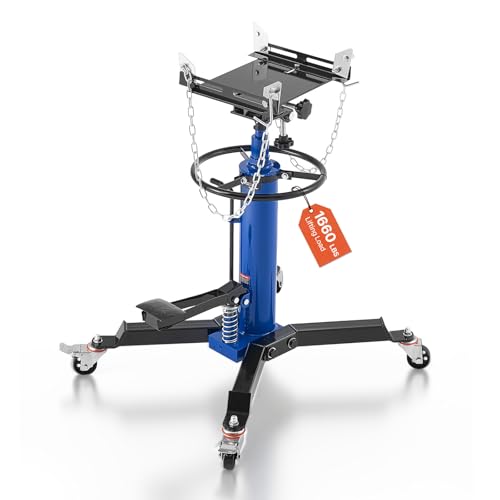 VEVOR Hydraulic Transmission Jack2-Stage 1660 lbs28.94 x 24.61 x 38.19 Inches98.55 PoundsCheck on Amazon


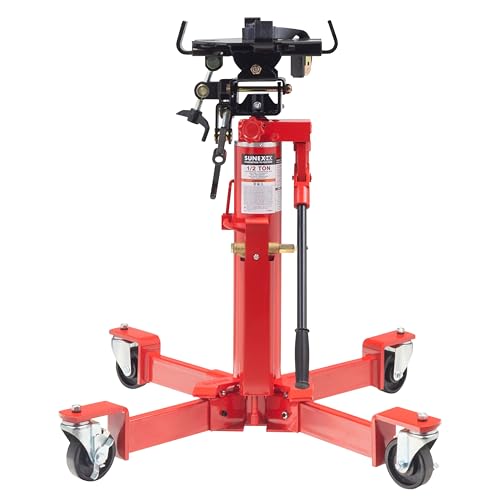
Top 3 picks at a glance
Best Transmission Jacks: Picks for Safe Lifting
The best transmission jack for most home garages is a 1,000-lb telescoping or hydraulic transmission jack with a four-caster base, a height range beginning below 8 inches, and a saddle that tilts and adjusts in both directions.
A good choice depends less on the headline capacity than on whether the jack can reach the transmission, keep it centered, and lower it precisely inside your vehicle’s limited clearance. The picks below cover common shop, DIY, low-clearance, and heavy-duty needs without treating maximum capacity as the only buying criterion.
As an Amazon Associate we earn from qualifying purchases at no extra cost to you.


Quick Picks by Garage and Vehicle Type
| Situation | Best transmission-jack type | Useful target specifications | Why it fits |
|---|---|---|---|
| Occasional RWD car or light truck work | Standard hydraulic transmission jack | 1,000 lb capacity; 7–8 in minimum height; four casters | Affordable and sufficient for most conventional automatic and manual transmissions |
| Low sports car or lowered vehicle | Low-profile transmission jack | 6–7 in minimum height; compact base; fine lowering control | Can roll under the transmission without lifting the vehicle excessively |
| Frequent shop use | Heavy-duty hydraulic or air-assisted jack | 1,000–2,000 lb capacity; rigid base; adjustable saddle; replaceable parts | Better durability and less operator effort during repeated removals |
| Large truck, diesel, or transfer case | Heavy-duty transmission or powertrain jack | 1,500 lb or more; wide saddle; long travel; high stability | Handles heavier assemblies and helps control large, awkward loads |
| Limited storage space | Compact folding or removable-saddle design | Small footprint; locking casters; capacity matched to the vehicle | Easier to store, but usually offers less stability and adjustment |
Best Transmission Jack Picks
Best all-around pick: OTC 1795A
The OTC 1795A is a strong general-purpose choice for a professional or serious home garage. Its 1,000-lb class is appropriate for many passenger-car transmissions, transfer cases, and light-truck applications. It is most useful when you need controlled positioning rather than simply raising a load.
Look for its adjustable saddle and tilt control when aligning a transmission with the engine or bellhousing. The important advantage is not just capacity; it is the ability to alter the assembly’s angle while it remains supported. That reduces the temptation to push or pull the transmission by hand.
This type of jack usually occupies more floor space than a compact shop model. Check the width of the base and the height of the vehicle’s lifting points before buying.
Best durable shop-style choice: Hein-Werner HW93718
The Hein-Werner HW93718 is aimed at users who value a substantial, serviceable shop jack over the smallest possible footprint. A rigid base and broad stance are valuable when the transmission is high in the air or when the vehicle has limited room between the crossmember, exhaust, and suspension.
It is a particularly sensible choice for repeated work on conventional rear-wheel-drive vehicles. The trade-off is weight and storage space. A robust jack is easier to control under load, but harder to move around a crowded garage.
Best compact professional option: Sunex 7793B
The Sunex 7793B is a practical choice when you need a conventional hydraulic transmission jack without stepping up to a large powertrain stand. Its 1,000-lb class suits many cars and light trucks, while the adjustable saddle helps with alignment during removal and installation.
Before choosing a compact jack, compare the minimum height with the clearance under your vehicle. A jack that is stable and well-built is still unusable if its saddle cannot slide under the transmission. Also measure the distance between the caster legs and the vehicle’s tires or lift arms.
Best budget-oriented class: 1,000-lb telescoping hydraulic jack
A generic 1,000-lb telescoping transmission jack can be adequate for occasional work, provided it has a four-caster base, a mechanical safety chain or retaining strap, and a saddle with genuine tilt adjustment. These models commonly fall in the roughly $150–$300 range, while better-built professional models often cost about $400–$800 or more.
Do not select solely by the lowest price. Some inexpensive jacks have narrow bases, small casters, coarse height control, or saddles that only move vertically. Those limitations matter when the transmission must be rotated a few degrees to clear a dowel, tunnel, or crossmember.
Specifications That Matter More Than the Advertising Headline
Lift capacity: calculate the real load
Transmission weight varies widely. A small manual transmission may be well below 200 lb, while a large automatic transmission, transfer case, fluid, torque converter, adapter, and attached brackets can approach or exceed several hundred pounds.
Use this simple calculation before choosing a jack:
Required capacity = estimated supported weight × safety margin
For example, suppose the transmission and attached components weigh an estimated 420 lb. Applying a 1.5 margin gives:
420 lb × 1.5 = 630 lb minimum rated capacity
A 1,000-lb jack would therefore provide a reasonable capacity margin. This calculation does not make an overloaded or badly balanced load safe: the jack must also be rated for the load’s height and must keep the assembly centered on the saddle.
Minimum and maximum height
Minimum height determines whether the jack can reach the transmission while the vehicle is supported. Measure from the workshop floor to the lowest point of the transmission, then allow room for the jack saddle and any adapter.
Maximum height determines whether the jack can raise the transmission high enough to meet the engine and bellhousing. A jack with a high maximum height may still fail if its minimum height is too tall. For lowered cars, target a minimum height around 6–7 inches. For ordinary cars and trucks, roughly 7–9 inches is often workable, but verify the actual clearance.
Saddle adjustment and tilt
A flat saddle is suitable only when the transmission can be lifted almost perfectly level. In real installations, the assembly often needs a nose-up, nose-down, or side-to-side angle.
Prefer a saddle that offers:
- Front-to-back tilt for matching the engine’s installation angle.
- Side-to-side adjustment for correcting an off-center load.
- Adjustable support arms or pads for different transmission housings.
- A chain or strap that holds the transmission against the saddle.
- Enough pad area to avoid concentrating force on a thin aluminum housing.
Adjustment is especially important during installation. The last inch of alignment is where a fixed saddle encourages dangerous pushing, pulling, or working underneath an unstable load.
Stability and caster design
A wide four-caster base is generally more stable than a narrow three-wheel layout, particularly when the saddle is raised. Casters should roll smoothly under load and have enough diameter to cross small floor joints without abruptly stopping.
Swiveling casters improve maneuverability, but they can also allow the jack to move unexpectedly while the transmission is being aligned. Use the vehicle’s parking brake and wheel chocks, keep the jack centered, and avoid sideways force. If the jack has caster locks, engage them when the instructions permit it; do not rely on caster locks to compensate for an uneven floor.
Vehicle Compatibility: Match the Jack to the Job
- Front-wheel-drive transaxles: Check saddle width and maximum height. These assemblies can be broad and awkward even when their weight is moderate.
- Rear-wheel-drive automatics: A 1,000-lb jack is often suitable, but the long transmission shape makes tilt adjustment and a retaining chain important.
- Manual transmissions: Weight may be lower, but installation alignment can be demanding. A fine hydraulic release valve and adjustable saddle are valuable.
- Transfer cases: Confirm the jack’s minimum height and saddle footprint. The load may be compact but unusually offset.
- Diesel and heavy-duty truck transmissions: Consider a 1,500–2,000-lb class jack or a dedicated powertrain jack. Do not assume a 1,000-lb rating is sufficient because the transmission appears to fit physically.
- Lifted vehicles: Maximum height becomes the limiting specification. Measure the required lifting distance rather than choosing based on vehicle type alone.
How to Choose Without Guessing
- Identify the complete supported assembly. Include the torque converter, transfer case, adapter, brackets, fluid, and any parts that will remain attached.
- Measure the vehicle clearance. Record the floor-to-transmission distance at the jack’s entry point and the height required for removal.
- Choose capacity with margin. Use at least a 1.5 multiplier for a known, centered load; choose a heavier class if the weight is uncertain or offset.
- Check saddle movement. Confirm that the saddle tilts and that its pads can support the actual housing without contacting fragile covers, sensors, or plugs.
- Inspect the base and casters. Match the base width to the available space and the caster size to the condition of the shop floor.
- Plan retention and support. Use the jack’s chain or strap, never balance the transmission loosely, and support the vehicle with properly rated stands or a certified lift.
Safe Use and Common Mistakes
A transmission jack supports a load; it is not a substitute for vehicle support. Raise the vehicle with equipment rated for its weight, place it on approved support points, chock the wheels, and keep people clear of the load’s path.
Before loosening the final transmission mount, verify that the jack saddle is centered and secured. Lower slowly using the release control rather than opening the valve abruptly. If the transmission begins to roll, stop lowering and reposition the saddle; do not try to catch or steady it by hand.
Finally, inspect hydraulic leaks, damaged welds, bent saddle arms, caster looseness, and worn retaining hardware before each use. A jack with adequate capacity but damaged structural or retention parts should be removed from service.
Frequently asked questions
Do I need a transmission jack with a safety chain or strap?
Yes, a mechanical safety chain or retaining strap is an important feature, especially when the transmission must be tilted or moved during installation. It helps hold the assembly against the saddle, while adjustable support arms or pads help distribute the load. The jack must still keep the transmission centered and remain within its rated capacity.
How much clearance should I measure before buying a transmission jack?
Measure from the workshop floor to the lowest point of the transmission, then allow room for the saddle and any adapter. Also compare the distance between the caster legs and the vehicle’s tires or lift arms. For lowered cars, a minimum height around 6–7 inches may be appropriate; ordinary cars and trucks often need roughly 7–9 inches.
Can a 1,000-lb jack handle a transmission weighing 420 lb?
Yes, a 1,000-lb jack provides a reasonable capacity margin for an estimated 420-lb load when applying the article’s 1.5 safety margin, which produces a 630-lb minimum rated capacity. The load must still be centered on the saddle, and the jack must be rated for the required height and the complete supported assembly.
Are caster locks enough to keep a transmission jack from moving?
No, caster locks should not compensate for an uneven floor or replace safe positioning. Keep the jack centered, use the vehicle’s parking brake and wheel chocks, and avoid applying sideways force while aligning the transmission. If the jack has caster locks, engage them when the instructions permit it, while maintaining a stable setup.
Why is tilt adjustment useful during transmission installation?
Tilt adjustment helps match the transmission’s angle to the engine and bellhousing, reducing the need to push or pull the assembly by hand. Front-to-back tilt can provide a nose-up or nose-down angle, while side-to-side adjustment can correct an off-center load. Adjustable supports and adequate pad area also help fit different housings.
Bottom Line
For most owners, a quality 1,000-lb transmission jack such as the OTC 1795A, Hein-Werner HW93718, or Sunex 7793B provides the right balance of capacity, adjustment, and stability. Choose a low-profile model for lowered vehicles, a wider heavy-duty jack for large trucks, and prioritize saddle tilt, minimum height, and caster stability over an impressive maximum-capacity number.