
The best violin for most adult beginners is a solid-carved, shop-set-up 4/4 in the $400–$700 range — the Eastman VL100, Yamaha V5 or Stentor Conservatoire II class of instrument — because at that price you get a carved spruce top, ebony fittings and, above all, a bridge and soundpost fitted by a person rather than a factory jig. Below roughly $200 you are usually buying a plywood top with an unfitted bridge, and no amount of practice fixes a nut that sits too high. Advancing players should aim at a step-up workshop violin in the $1,200–$2,500 band and put $250–$600 of the same budget into a carbon-fibre bow instead of chasing a more expensive beginner outfit.
As an Amazon Associate we earn from qualifying purchases at no extra cost to you.


Our Top Picks
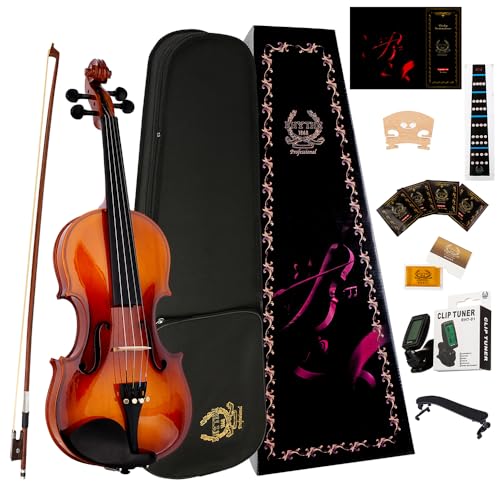

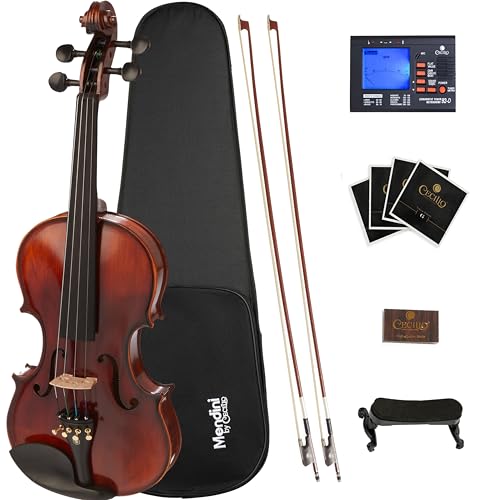

Top 3 picks at a glance
The picks at a glance
| Pick | Best for | What to confirm on the spec sheet | Typical outfit price |
|---|---|---|---|
| Eastman VL100 / Yamaha V5 class | Most adult beginners and teenagers | Solid carved spruce top, maple back and ribs, ebony fingerboard, pegs and chinrest, four fine tuners, seller-performed setup | usually $400–$700 |
| Stentor Student II / Eastman VL80 class | Tight budgets and second instruments | Solid spruce top, maple back and sides, real ebony fingerboard (not ebonized hardwood), bow at least 55 g | usually $200–$350 |
| Workshop fractional, 1/2 or 3/4 | Players under about 12, or short arms | Correct body length for the size, lighter bow (45–55 g), case that fits the smaller body | usually $180–$400 |
| Eastman VL305 / Scott Cao STV-750 class | Advancing players, youth orchestra, grade 5–8 | Hand-graduated top, luthier-cut bridge and fitted soundpost, usually sold as instrument only | usually $1,200–$2,500 |
| Yamaha YEV-104 electric | Apartment practice, recording, silent drills | Solid body, piezo pickup, 1/4-inch line out and headphone practice, no acoustic body resonance | usually $550–$800 |
Best overall: Eastman VL100 / Yamaha V5 class
This is the tier where a violin stops being a toy. Per the makers’ published spec sheets, instruments in this class carry a solid carved spruce top, solid maple back and ribs, and ebony for the fingerboard, pegs and chinrest. That combination matters for three reasons: a carved top is what eventually “opens up” as it is played, ebony does not wear into grooves the way ebonized hardwood does, and ebony pegs hold pitch more predictably in changing humidity.
Who it suits: an adult beginner or returning player practising 20–60 minutes a day, or a teenager in a school orchestra, in 4/4 or 3/4. The trade-off is that you are paying for setup labour and a usable case rather than for pretty wood. Figured, flamed maple is cosmetic and priced accordingly — a plainer instrument in this tier usually sounds better than a highly figured one at the same price. Buy from a specialist string retailer that states it fits the bridge, shapes the nut and sets the soundpost. If a listing cannot tell you whether the bridge is fitted, assume it is not.
Best budget: Stentor Student II / Eastman VL80 class
Around $200–$350 you can still get a solid spruce top and maple back and sides, which is the floor for an instrument worth upgrading. The compromises are plainer fittings, less careful graduation and a bridge that usually needs recutting. Who it suits: a cautious first purchase, a school loaner replacement, or a fiddle for folk and campfire playing.
Main trade-off, in numbers: budget $60–$120 for a luthier to fit a new bridge and check the nut within the first year. If the instrument plus that $100 lands within about $80 of the mid tier, buy the mid tier instead — you will get better wood for the same money. The other thing to check is the bow: the free bow in a boxed outfit is often under 50 g with a warped stick, and it will teach bad habits faster than the violin will.
Best for young and small players: a correctly sized fractional
Size is not a preference, it is a measurement, and the wrong size causes tension, intonation problems and, eventually, quitting. Use arm length rather than age, and check the fit with the scroll test: with the instrument under the chin and the left arm extended, the scroll should sit in the middle of the cupped palm without locking the elbow.
| Size | Body length (approx.) | Nut-to-bridge playing length (approx.) | Arm length | Typical player age |
|---|---|---|---|---|
| 1/4 | 280 mm | 257 mm | 47–50 cm (18.5–20 in) | 5–7 |
| 1/2 | 310 mm | 283 mm | 50–56 cm (20–22 in) | 7–9 |
| 3/4 | 335 mm | 307 mm | 56–60 cm (22–23.5 in) | 9–12 |
| 4/4 | 356 mm | 328 mm | 60 cm+ (23.5 in+) | 12+ and most adults |
The trade-off with fractionals is resale and lifespan: a growing player changes size every 12–24 months, and small instruments hold value poorly. Run the rental maths before buying. A $250 fractional plus $100 of setup is $350; renting at $25 a month for 14 months is also $350, but the rental usually includes size swaps, insurance and maintenance. If the player is under about 10, renting almost always wins; buy when the player reaches 3/4 or 4/4 and has stuck with it for a year.
Best step-up for advancing players: Eastman VL305 / Scott Cao STV-750 class
Between about $1,200 and $2,500 you move from a workshop assembly line to hand graduation, better-seasoned wood and a luthier’s attention to the bridge, soundpost and fingerboard. Who it suits: a player working on shifting, vibrato and double stops, playing five or more hours a week, auditioning for a youth orchestra or preparing grades.
The main trade-off is that step-ups are normally sold as the instrument alone. Budget $250–$600 for a bow and $80–$250 for a case on top. Above roughly $2,500 the returns flatten sharply for an amateur — the next real jump in tone is usually a different bow or a better room, not a more expensive fiddle. If you can only upgrade one thing this year, upgrade the bow first.
Best for silent practice: Yamaha YEV-104 electric
A solid-body electric with a piezo pickup, a 1/4-inch output and headphone practice solves the one problem that stops most adult beginners: other people in the building. Per the manufacturer’s spec page, the YEV-104 pairs a spruce-and-maple-look body with a passive piezo system, so it works straight into an audio interface, a small amp or a gaming headset-friendly mixer without extra gear.
The trade-off is real: with no acoustic body, you get less feedback on bow weight, contact point and tone production, and the instrument can mask a scratchy bow arm. Use it for scales, note learning and late-night drills, and play an acoustic whenever you can. Students who practise exclusively electric tend to develop a thin, pressed tone.
How to choose: the numbers that decide it
Setup is worth more than the badge
Two violins off the same production line can play completely differently depending on setup. These are the commonly cited targets a luthier works to:
- Fingerboard projection at the bridge position: about 27 mm. If it is wrong, the bridge has to be cut abnormally high or low and the instrument will never feel right.
- String height at the end of the fingerboard (top of the fingerboard to the underside of the string): roughly 2.5–3.5 mm for the E and 4.5–5.5 mm for the G, with D and A in between. Too high and beginners press hard and play sharp in first position; too low and the string buzzes.
- Nut clearance: the strings should sit about 0.4–0.5 mm above the fingerboard at the nut. A nut that is too high is the single most common cause of a cramped left hand in first position.
- Bridge: feet in full contact with the top, standing close to 90°, leaning very slightly back toward the tailpiece.
- Soundpost: fitted — not jammed — roughly under the treble foot of the bridge, a few millimetres behind it.
- Tuning hardware: four fine tuners on the tailpiece, or geared pegs. For a beginner, four fine tuners are worth more than any cosmetic upgrade, because you can tune without touching the pegs.
- Bow: a full-size violin bow is normally 58–62 g, fractional bows 45–55 g. The hair should form a flat ribbon with no gap at the frog.
A worked budget split
Take a $900 total budget. A sensible split is $550 instrument, $180 bow, $90 case and $80 held back for a luthier check-up in the first month — roughly 61/20/10/9. The counter-intuitive part is the bow: a $550 violin with a $180 bow will handle and sound better than a $700 violin with the $30 bow from a boxed outfit, because the bow controls contact point, weight and tone colour more than most beginners expect. A well-made carbon-fibre bow in the $150–$300 range is the standard recommendation for players moving past the first year.
Tuning stability: what is normal
- New strings stretch. Expect to retune every 5–10 minutes on the first day and daily for 3–7 days before pitch settles. That is normal, not a fault.
- Steel-core strings (the D’Addario Prelude and Helicore class) settle in a day or two and hold pitch well, which suits beginners. Perlon strings such as Thomastik Dominant sound warmer but drift for longer.
- A full set of violin strings pulls with roughly 22–25 kg (about 50 lb) of tension at A = 440 Hz, which is why a leaning bridge is worth straightening after every tuning session.
- If all four strings drift the same way together, suspect humidity, not the pegs. Keep the case at 40–60% relative humidity with a humidifier, and use peg compound rather than chalk or soap.
- If one string drifts alone, it is the peg or the string, not the instrument.
Tonewood and upgrade potential
A solid carved spruce top with solid maple back and ribs is the minimum for an instrument that improves with playing; laminated or pressed tops do not open up and usually sound dull. Upgrade money spent on a $400 instrument goes a long way: strings $30–$80, a luthier-cut bridge $60–$120, a soundpost adjustment $40–$80, a bow $150–$400, a case $80–$250. On a $150 instrument the same $200–$300 buys almost nothing, because the top is the limiting factor. That is the whole argument for buying the mid tier first.
Frequently Asked Questions
How much should a beginner violin cost?
Plan on $400–$700 for a complete outfit that a shop has set up, or $200–$350 if the budget is genuinely tight and you accept a later $60–$120 bridge fitting. The setup, not the label, is what determines whether the instrument is playable in the first year. Anything under about $150 is usually a plywood top with an unfitted bridge.
Is a cheap $100 violin worth buying?
Usually not, but the maths is worth doing. A $100 violin plus $100 of setup is $200, and it will still play worse than a $300 instrument that was set up properly at the factory and checked by the seller, because the top wood and the fingerboard are the limiting factors and no setup can change them. If $100 is the entire budget, rent instead.
Should a child rent or buy?
Rent until the player reaches 3/4 or 4/4 size or has been playing consistently for more than a year. A $250 fractional plus setup is roughly the same 12–14 month cost as renting at $20–$40 a month, but the rental includes size swaps, maintenance and insurance, and fractional instruments resell poorly. Buy when the size stops changing.
How often should violin strings be replaced?
With 30–60 minutes of daily playing, every 6–12 months is typical. Perlon strings lose their tone and pitch stability sooner than steel-core strings. Replace immediately if a string is fraying at the bridge, if the winding has gone false, or if the E string starts whistling persistently.
Do I need a shoulder rest and rosin?
Yes to both. A shoulder rest is typically $20–$45 and rosin $8–$20, and together they do more for a beginner’s comfort and sound than any accessory in the same price range. Also budget for a spare set of strings and a soft cloth for cleaning rosin off the top after each session.
Can you learn violin on an electric instrument?
Yes for note reading, intonation and left-hand technique, but the acoustic response is what teaches bow control, so a purely electric practice routine tends to produce a pressed, thin tone. The practical compromise is an acoustic instrument for daily work and an electric for late-night or shared-space sessions.


