This review analyzes published product information. We have not performed detailed research of this unit.
As an Amazon Associate, we earn from qualifying purchases.
More fan connections, not more control zones
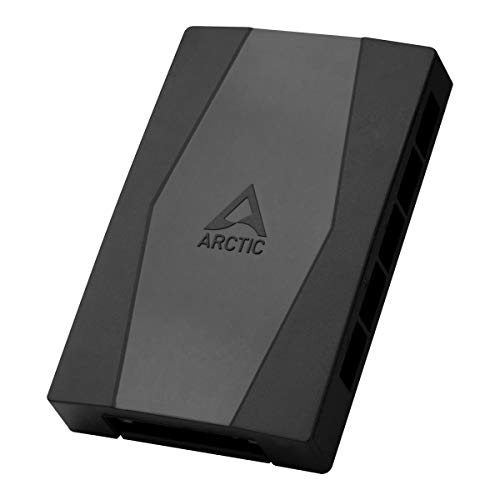
The ARCTIC Case Fan Hub is a ten-port, four-pin PWM distributor powered through a SATA power connection. Its purpose is straightforward: connect multiple case fans where the motherboard does not provide enough headers, while sending them a common control signal. For a build that needs several fans following one cooling policy, that arrangement is a sensible fit. For a build needing separate intake, exhaust and radiator control, the distinction between additional sockets and additional control channels matters.
This review is based on the supplied retailer specifications, not installation or acoustic testing. The exact configuration assessed has ten four-pin PWM outputs, one motherboard fan-header connection and SATA power input. Its strongest buying argument is connection consolidation; its main limitation is that control and monitoring remain shared rather than becoming independent for every fan.
The specifications that affect installation
| Product | ARCTIC Case Fan Hub |
|---|---|
| Fan outputs | 10 × 4-pin PWM sockets |
| Inputs | SATA power and 4-pin fan header |
| Listed output current | Up to 1 A per port |
| Listed input current | Up to 4.5 A |
| Control behavior | One PWM signal distributed synchronously to connected fans |
| Speed feedback | RPM from the first fan slot returned to the system |
| Dimensions | 55.6 × 86.3 × 14.3 mm |
| Weight | 50 g |
These are listing values, not independently verified measurements. The listing describes the hub as adding nine fan slots: it uses one motherboard connection to serve ten fan outputs. That is a useful expansion in connection count, but it does not turn one header into ten separately adjustable headers.
Plan both the power route and the signal route
Installation planning starts with two connections. The hub needs SATA power from the power supply and a connection to a motherboard fan header for its control path. Fans receive power directly from the PSU through the hub, according to the listing. A spare motherboard header alone is therefore not enough; a suitable SATA power connection must also reach the intended mounting location.
The hub measures 55.6 by 86.3 mm and is 14.3 mm thick. Use those dimensions when checking space inside the enclosure, but also allow room for connected plugs and cable bends. The supplied evidence does not identify mounting hardware, cable lengths or clearance with plugs installed. Do not assume a particular adhesive pad, magnetic mount or supplied cable reach when planning placement.
ARCTIC presents the hub as a cable-management aid because only one fan-control connection runs to the motherboard. That can consolidate routing, especially if the hub sits near a group of fans. It does not eliminate the individual fan leads or the SATA power cable. Before choosing a location, check that all intended fan cables can reach it without interfering with panel closure or access to other components.
Shared PWM is useful, but shared RPM reporting has limits
The supplied specifications say that the incoming PWM signal is passed to all connected fans simultaneously. In buying terms, this makes the hub appropriate for fans that should respond together. It is not the right basis for expecting different fan curves from different ports: independent per-port control is not described.
A common PWM command should not be interpreted as a promise of identical rotational speeds. The listing establishes synchronized signal distribution, not matched RPM across different fan designs. If you intend to mix fans, consider whether a shared control policy makes sense for their different roles rather than assuming the hub will equalize them.
Monitoring is narrower still. Only the RPM signal from the first fan slot is returned to the system. Put a fan whose speed you want to track in that position, and remember that its reading does not verify the speed or operation of the other connected fans. This is a meaningful limitation for anyone expecting motherboard software to monitor every fan individually.
The specified outputs are four-pin PWM sockets. The evidence does not establish speed-control behavior for three-pin fans or compatibility with proprietary fan connectors, so those combinations should be verified separately. Lighting connections and RGB control are not described either; this listing supports a fan power-and-control purchase, not a lighting-controller purchase.
Check electrical demand before filling all ten ports
The listing gives an output limit of up to 1 A per port and an input-current figure of up to 4.5 A. Those figures should be considered together. Ten sockets do not establish that ten fans can each draw the full per-port allowance simultaneously.
Check each fan’s documented current requirement against the per-port figure, then assess the intended group against the hub’s power documentation. The supplied listing does not explain startup-current allowance, overload protection or how the input figure translates into a permissible combined fan load. If your proposed configuration approaches these limits, obtain clearer manufacturer guidance rather than treating socket count as an electrical capacity guarantee.
The listing also makes a broad assurance about power delivery and smooth operation. Without testing, that should not become a promise of quieter fans, better cooling or improved reliability. If broader PSU troubleshooting is part of the project, our power supply tester guide provides related reading; it does not establish compatibility for a particular fan load.
Frequently asked questions
Can the hub control intake, exhaust, and radiator fans separately?
No, the hub does not provide separate control zones for those fan groups. It distributes one PWM signal synchronously to its connected fans, so they follow a common control policy. The article identifies connection consolidation as its main benefit, but independent per-port control is not described. A different control arrangement is more suitable when separate fan curves are a priority.
Does the hub report the speed of every connected fan?
No, only the RPM signal from the first fan slot is returned to the system. That reading can be used to track the fan installed in that position, but it does not verify the speed or operation of the other connected fans. Anyone requiring individual RPM monitoring should not assume that the hub provides separate feedback for every output.
Can I connect three-pin fans or proprietary fan connectors?
The article does not establish compatibility with three-pin fans or proprietary fan connectors. The listed outputs are four-pin PWM sockets, so those other combinations should be verified separately before purchase or installation. The published listing information also does not describe lighting connections or RGB control, meaning this listing supports a fan power-and-control purchase rather than a lighting-controller purchase.
What should I check before deciding where to install the hub?
Check that a SATA power connection and a motherboard fan-header connection can both reach the intended location. Also verify that the hub’s dimensions, connected plugs, cable bends, and individual fan leads will not interfere with panel closure or other components. The article says cable lengths, mounting hardware, and clearance with plugs installed are not identified in the supplied evidence.
Will ten connected fans always be within the hub’s electrical limits?
No, having ten sockets does not guarantee that ten fans can each draw the full listed per-port allowance simultaneously. Check every fan’s documented current requirement against the per-port figure, then assess the intended group against the hub’s power documentation. The listing does not explain startup-current allowance, overload protection, or how its input figure translates into a permissible combined load.
Verdict: a practical expansion for one coordinated fan group
The ARCTIC Case Fan Hub suits a header-limited build whose fans can share one PWM command and whose PSU has an accessible SATA power connection. Its ten outputs and single motherboard control connection offer a clear organizational benefit. Choose a different control arrangement if independent curves or individual RPM monitoring are priorities. Before committing, verify fan current requirements, cable reach and mounting provisions—the supplied specifications leave those installation details partly unresolved.
Sources: Supplied ARCTIC Case Fan Hub retailer listing.
Check the exact product and current offer on Amazon